The only SUV built in Australia during its run, a three-row family wagon that won Wheels Car of the Year and ran through five series.
Ford's three-row Territory was made at Broadmeadows from 2004 to 2016 and was the only SUV Australia produced in that span. The 2004 Wheels Car of the Year award went to it, and its five series used Barra petrol and Duratorq diesel engines.
The Ford Territory was a mid-size SUV built by Ford Australia from 2004 to 2016. It was the only SUV made in Australia during that period and Ford's first large three-row crossover, with seating for up to seven. It won Wheels Car of the Year in 2004 and went through five series before production ended in October 2016.
Where did the Ford Territory come from?
The Territory began as the R7, a concept SUV whose team was led by the late Geoff Polites. It was revealed at the 2002 Australian International Motor Show in Melbourne. The response was so strong that Ford fast-tracked it into production just two years later, and the production Territory previewed the new front styling of the BA Falcon range.
Ford reportedly spent A$500 million developing the vehicle over four years. Australian toolmakers were praised for keeping costs low, and while the car was not as cheap as Japanese rivals, it was much less expensive than Detroit-built vehicles.
A large Australian-built family SUV that outlived its donor Falcon wagon and carried Ford's first three-row crossover to five series.
Why did Ford build the Territory alongside the Falcon wagon?
Ford built the Territory on the same Broadmeadows Assembly Plant line as the Falcon wagon, and the two cars sold side by side. Ford Australia's senior executives expected the Falcon wagon to be discontinued soon after the Territory arrived, as fleet buyers moved to the new SUV.
That did not happen. The Falcon wagon kept much of its fleet base, and the Territory appealed mainly to large families. Production of the Falcon station wagon ended in September 2010, but the Territory never became a serious replacement for it, because of its higher fuel consumption and weight.
What made the Territory different from other SUVs of its time?
The Territory was the first SUV to win the Australian Wheels Car of the Year title, in 2004, thanks to its acceptable handling and its ability to carry children. It was also the first locally built vehicle to feature electronic stability control, which the SX brought to the Australian market.
Its styling borrowed cues from the North American Freestyle and Taurus X. Simon Butterworth, who had also restyled the BA Falcon, shaped the Territory's look, and Marcus Hotblack worked on the interior, which was inspired by a knife.
Inside, the Territory had a few unusual touches, including flexing cup holders and a handbag holder beside the seat for female drivers. Its seating could be five (two rows) or seven (three rows), with the rows arranged in a theatre style so that the back row was the highest.
How were the Territory's seats and drivetrain arranged?
The Territory was offered in rear-wheel drive and all-wheel drive for the Australian market. Its all-wheel drive models had an optional Hill Descent Control feature that used the anti-lock braking system to control the car's speed on steep downhill sections.
The middle and back rows folded flat into the floor to open up cargo room. The design made the Territory a strong choice for large families with children, which was the group it appealed to most.
What was the SX Territory?
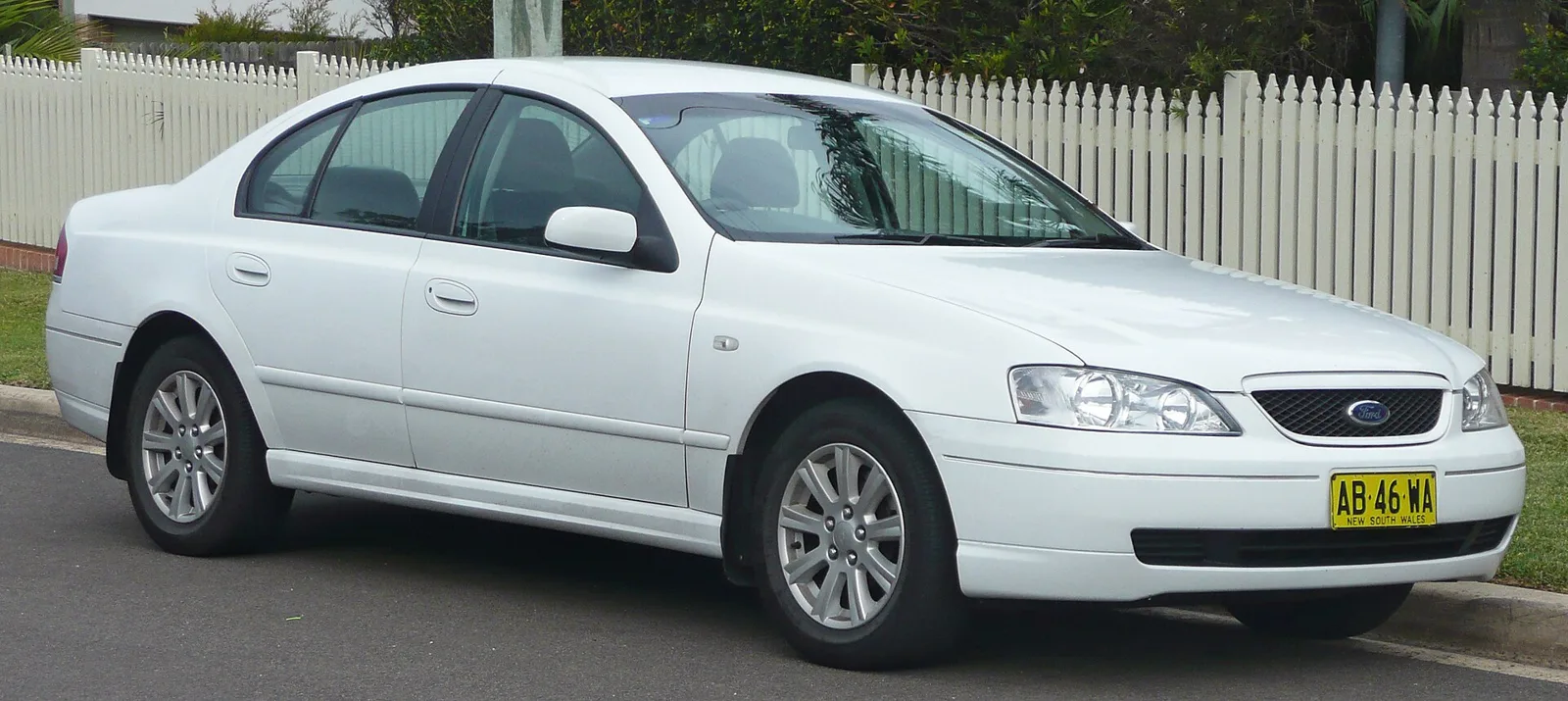
The first series, the SX, was built from April 2004 to September 2005. It came in TX, TS and Ghia trim, and its platform was offered in rear-wheel drive or all-wheel drive. Every SX used a Barra petrol unit, a 4.0-litre DOHC straight six borrowed from the BA Falcon and slightly detuned by software, which produced 182 kW (244 hp) and 380 Nm (280 lb ft).
The SX was paired to a four-speed automatic gearbox. All SX models were known for heavy fuel use, averaging between 14 and 18 L/100 km, and the Territory was the first Australian-built vehicle to offer electronic stability control.
An Alpine DVD entertainment system with a 10.2-inch screen and infrared headphones for rear passengers was offered as standard or optional, depending on the variant. New Zealand models differed slightly, with body-colour bumpers and alloy wheels even on the base model.
What changed with the SY?
The SY arrived in October 2005 as mainly a mechanical upgrade with little visual change. Engine power rose to 190 kW (255 hp), and AWD models gained a new automatic transmission. The SY was also the first Australian-built vehicle with a reverse parking camera, which was optional on the TS and standard on the Ghia.
The revised 4.0-litre straight six produced 190 kW (255 hp) and 383 Nm (282 lb ft). The earlier four-speed automatic was kept for rear-wheel drive models, while AWD cars received the six-speed ZF 6HP 26 transmission, which slightly improved fuel economy.
In mid-2006 Ford added the Territory Turbo. The AWD-only car had a turbocharged version of the straight six making 245 kW (329 hp) and 480 Nm (354 lb ft), available in standard or luxury Ghia trim. Ford chose a turbo petrol engine over a mooted diesel to tackle high fuel use from its six-cylinder engines.
Which limited editions were built?
Ford released several TX-based limited editions. The SR arrived in February 2006 and was re-released in June 2008, and the SR2 followed in October 2008. Each one offered extra equipment to lift sales of the core range.
The TS Limited Edition appeared in December 2009 and October 2010, with Ghia-derived fittings. Later, the TX Limited Edition was marketed in August 2012 with TS-derived equipment.
What was the SY II facelift?
The SY II was a facelift shown at the 2009 Melbourne show and on sale that May. It had a mildly restyled front end, minor exterior changes, improved interior trim and better suspension design. The Falcon's centre console and Interior Command Control were carried over, even though the newer FG Falcon had a redesigned console.
The SY II also fixed a well-documented weakness in the front lower ball joints. The original design kept the joints under constant tension, which caused some catastrophic failures at high speed and wear that required lower control arm replacements after as little as 30,000 kilometres (19,000 mi). The new design put the lower joints under compression, which removed the premature wear.
The Turbo was now available only in the Ghia specification. Ford also added a front passenger seatbelt warning chime to cars built from 11 January 2010, which lifted the entire range to a five-star score in the Australasian crash tests. Earlier models had a four-star rating.
How did the SZ change the Territory?
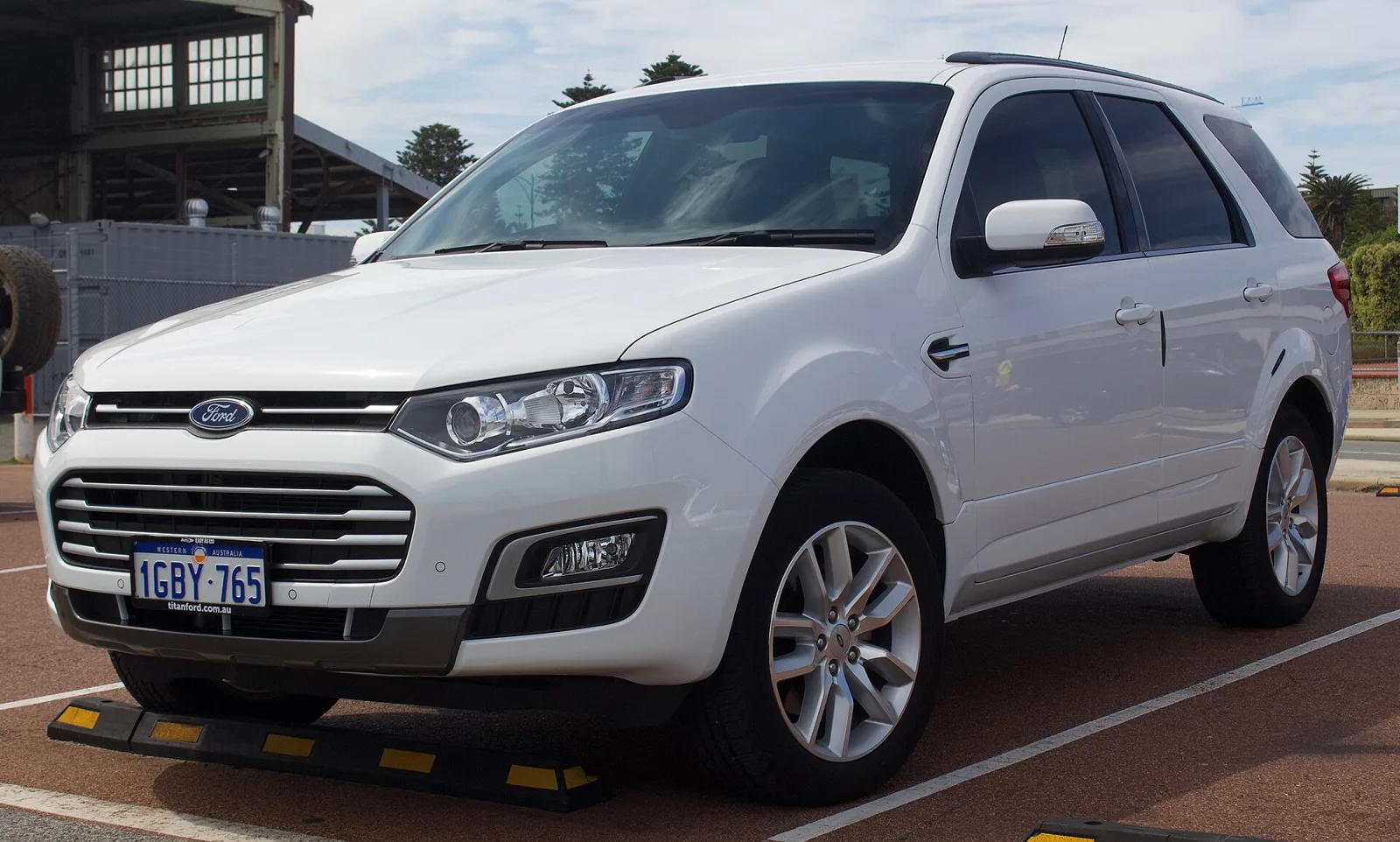
The SZ series was released in April 2011, after Ford Australia released official photos on 8 February 2011. The facelift cost some A$230 million to develop, and it moved to the E8 platform of the FG Falcon, codenamed E265A.
The SZ brought Kinetic Design to the Territory, with a large lower air intake, a thin upper grille and an estimated drag coefficient of Cd=0.38. Titanium models had LED position lights, while the mid-spec TS had fog lights. The tail lights became horizontal, and higher models gained an eight-inch colour touch screen for the SYNC system. A driver's knee airbag was added to the safety features.
Mechanically the SZ was a first for Ford Australia, introducing a diesel to its locally made range. The 2.7-litre turbocharged direct injection V6 diesel, marketed as Duratorq, was offered in rear-wheel drive and AWD. It was a seven-year-old Ford unit that had first appeared in the Jaguar XF and Land Rover Discovery 3. Ford said it emitted up to 25 percent less CO2 than the petrol engine.
The petrol engine was a further-upgraded 4.0-litre straight six for rear-wheel drive only, rated at 195 kW (261 hp) and 391 Nm (288 lb ft) and compliant with Euro 4 standards. Petrol AWD models were no longer offered. The SZ also adopted electric power-assist steering, the same system used on the American Ford Mustang.
| Specification | Detail |
|---|---|
| Production | 2004 to 2016, Broadmeadows, Australia |
| Platform | EA169 (E265) for SX to SY II, E8 (E265A) for SZ and SZ II |
| SX engine | 4.0-litre DOHC straight six, 182 kW (244 hp), 380 Nm (280 lb ft) |
| SY engine | 4.0-litre straight six, 190 kW (255 hp), 383 Nm (282 lb ft) |
| 2006 Territory Turbo | 245 kW (329 hp), 480 Nm (354 lb ft) |
| SZ petrol | 195 kW (261 hp), 391 Nm (288 lb ft), Euro 4 |
| SZ diesel | 2.7-litre turbocharged V6 (Duratorq) |
| FPV F6X | 270 kW (362 hp), 550 Nm (406 lb ft), 5.9 seconds to 100 km/h |
| Fuel use (SX) | 14 to 18 L/100 km |
What is the FPV F6X?
The FPV F6X was a performance SUV based on the SY Territory. Ford Performance Vehicles launched it on 29 February 2008, and it was the first and only non-Falcon vehicle sold by FPV. It was essentially a high-performance Territory Turbo, available only with all-wheel drive and a six-speed automatic.
Its engine produced 270 kW (362 hp), with 550 Nm (406 lb ft) of torque, shared with the Falcon-based FPV F6 sedan. It was the most powerful SUV available at the time, reaching 100 km/h in 5.9 seconds. Standard equipment included 18-inch wheels, upgraded front Brembo brakes and instrumentation styled to match the FPV sedans.
Its high price of A$75,990 and poor fuel consumption, together with little visual difference from the donor Turbo, meant sales were low. Only 251 units were built, and production stopped in February 2009. The F6X also featured datadot paint technology.
Where was the Territory sold overseas?
The Territory was sold in New Zealand, where 12,000 units were sold. Exports to South Africa began in 2005, with sales starting on 22 June 2005, and around 2,300 units were exported. Ford's South African branch had assessed a Territory in 2004 before the launch.
Thailand was the other major export market. Exports were announced for April 2006 with the Ghia 4WD, and the SY appeared at the 2005 Bangkok Motor Show. A Thailand-Australia Free Trade Agreement was in place when those exports began. About 100 units went to Thailand in August 2012, after Ford Australia showed interest in a diesel version at the 2012 Bangkok Motor Show.
Concerns were later raised that the Thai programme could collapse because of high import taxes. The 2013 tax increases made a Territory expensive to buy there.
How successful was the SZ and the final SZ II?
The Titanium proved the most popular SZ variant, and the SZ series helped Ford Australia reach a manufacturing milestone when it built its 150,000th Territory, a white TX TDCi RWD model, in 2012. The AWD 2.7-litre TDCi Titanium was also the only model that went to Thailand when those shipments restarted in late 2012.
After ten years of production, the SZ II represented the Territory before Ford Australia's full production ended in October 2016. Production of the SZ II started on 20 October 2014, at the same time as the FG X Falcon sedan, and sales opened in December 2014. Its range matched the SZ, but it had a new fascia and alloy wheels, and the LED position lights gave way to traditional fog lights.
Inside, the SZ II received an updated SYNC2 touchscreen that gained voice control, Wi-Fi, digital radio and an emergency call feature. The engine range was unchanged apart from transmission tweaks and aerodynamic work that improved fuel consumption by around 0.5 percent.