A heavily re-engineered Falcon with Barra sixes, a 5.4-litre V8 family, FPV performance variants and a Territory-spawning platform.
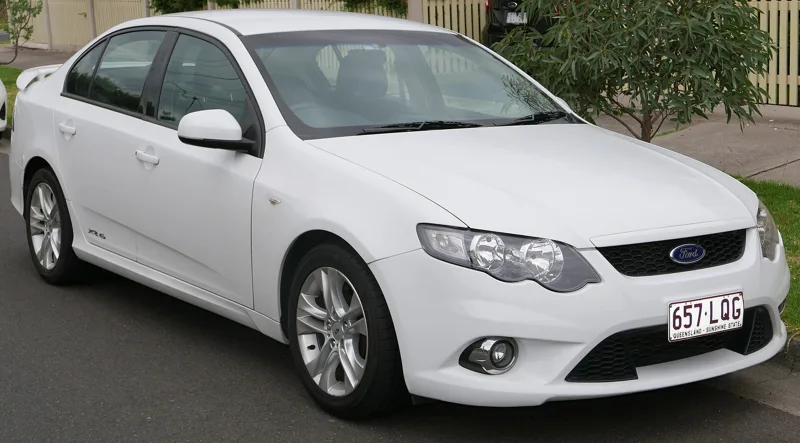
The Ford Falcon BA was a heavily updated Australian sixth-generation Falcon built from 2002 to 2005. It offered Barra six and V8 engines, a new Control-Blade rear suspension and XR, Fairmont and FPV variants, and it spawned the Ford Territory.
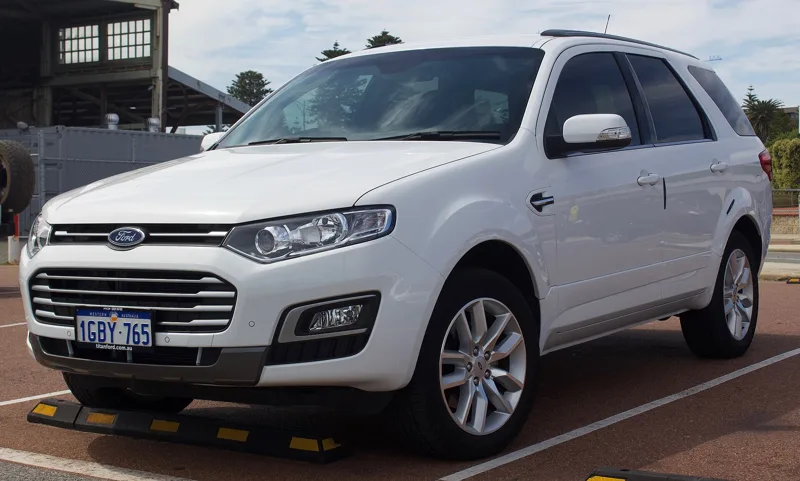
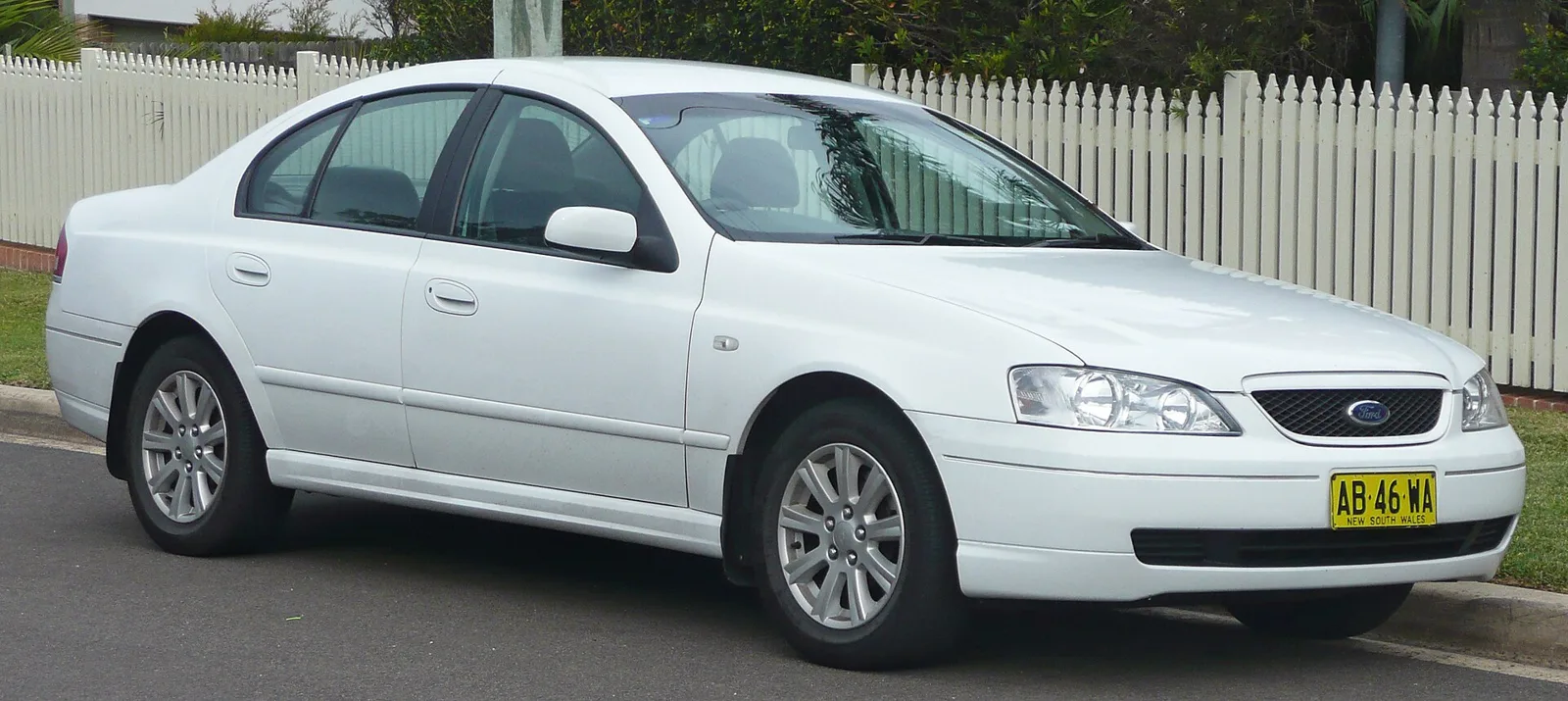
The Ford Falcon BA was a full-size Australian car built by Ford Australia from 2002 to 2005. It was a heavily reworked second iteration of the sixth-generation Falcon, and it gave rise to the Ford Territory crossover that arrived in 2004. Its sporting and luxury variants, from the Fairmont to the XR8, helped it win awards and a share of the market that rivalled Holden.
Where did the Ford Falcon BA come from?
The BA was a response to the disappointing reception of the preceding AU series. Ford Australia updated the car heavily for its launch in September 2002, which was the same month as its main rival, the Holden Commodore VY. Its exterior was more restrained than the AU's.
Ford made changes that went well beyond the bodywork. Interior, suspension and engine areas were all extensively revised. In October 2004 the car received a Mark II update with subtle styling and mechanical changes, and in October 2005 the BA gave way to the BF.
Awards followed. In late 2002 the BA was named Wheels Car of the Year, ending a 36-year drought for the award. It then won four Australia's Best Cars awards in a row over three years. Its market share briefly edged above the Commodore on two occasions, although it never matched the record set by the EL Falcon.
The BA rebuilt a sixth-generation Falcon around a new rear suspension and a stronger range of sixes and V8s, and then won racing titles with it.
What did the Ford Falcon BA cost to develop?
Ford put A$500 million into the BA programme, and the engineering team completed 24,000 hours of engine and durability testing. Some of the suspension work was carried out at the Nurburgring in Germany. The anti-lock brakes and electronic stability control were calibrated in both Sweden and Australia, which reflected the car's international engineering network.
Rather than designing a new body, the team reworked the existing AU shell, which kept the programme manageable while still giving the car a visibly fresh look.
How was the BA styled?
Exterior styling was led by Scott Strong, who was then chief designer at Ford Australia. Strong left the company in 2001, and Simon Butterworth took over the work. Ford wanted a European flavour, so most elements of the AU's New Edge design were reworked. Every panel was new except for the carry-over door skins, which gave the car a fresh outline without a complete body redesign.
One visible change was the integrated aerial in the rear window, which replaced the conventional retractable antenna. The fixed design improved aerodynamics and removed the breakage problems that had affected the retractable units on earlier cars. Engine noise did not disturb the radio reception.
Inside, the AU's New Edge cabin was dropped in favour of a contemporary style with European roots. Marcus Hotblack, the director of interior design, concentrated on how easy the car was to use. The dashboard became an ergonomic command centre, with a satin-finish centre console, and the audio and cruise control switches were moved onto the steering wheel.
A large liquid crystal display showed air conditioning and sound system information. The premium sound package with a full-colour screen came as standard on the Fairmont Ghia. Ventilation outlets were enlarged so the cabin heated and cooled more effectively, and the headlamp switch moved to the end of the turn signal stalk for easier reach.
Colour schemes differed between models but followed a shared approach. The entry-level XT had a black plastic upper dashboard panel and a lower panel in black, charcoal or beige. Sports variants could not be ordered with the two-tone interior, which kept the sportier models distinct.
What engines did the Ford Falcon BA offer?
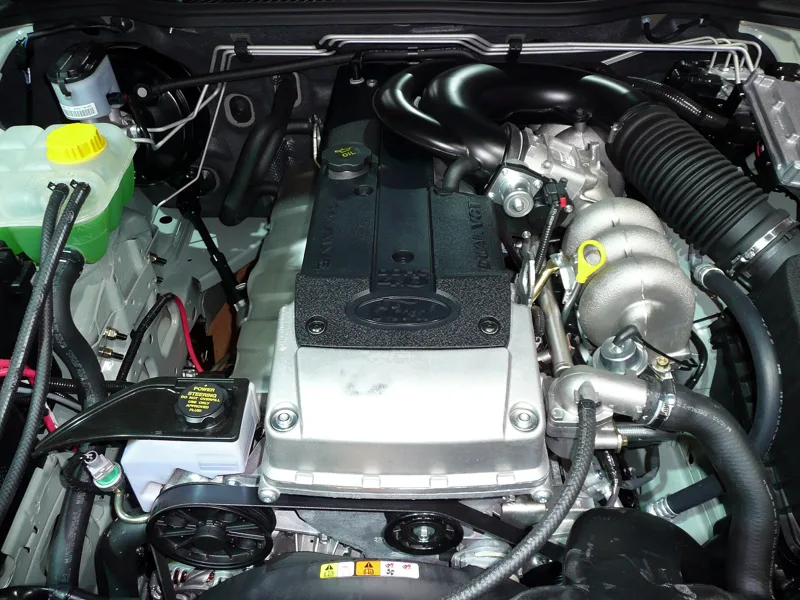
The BA offered straight-six and V8 engines. The entry-level Barra 182 six was a clear step up from the AU's six, and it gained dual infinitely variable cam timing that added 25 kW (34 hp), for a total of 182 kW (244 hp). It could also take advantage of higher octane fuel for a small gain in torque.
An LPG-only version, the Barra E-Gas, produced 156 kW (209 hp) and was offered as an option on lower-specification models. A turbocharged Barra arrived in the new XR6 Turbo, producing 240 kW (320 hp). That made it the most powerful six in the range by a wide margin.
The V8 line changed as well. A 5.4-litre unit replaced the AU's Windsor engine. It was a modified version of Ford's Modular V8, and it came in two forms: the Barra 220, which made 220 kW (300 hp), and the 260 kW (350 hp) Boss 260.
What transmissions and suspension did the BA use?
Buyers could choose a four-speed automatic or a five-speed manual, both with a floor-mounted lever. The automatic introduced Sequential Sports Shift to the Falcon nameplate in Australia for the first time. Utilities could instead be fitted with a column-mounted automatic lever, which did not have Sequential Sports Shift.
All sedans received a new Control-Blade independent rear suspension. The design had first been used on the Ford Focus and the Jaguar X-Type. It was better than the optional double-wishbone arrangement on AU sedans and cheaper to make. It was heavier than the old live axle used on base models, though, and the change added 130 kg (287 lb) to the base XT sedan.
Wagons and utilities kept the leaf-spring live rear axle from the AU, so they did not gain as much weight. Towing capacity improved over the earlier cars, and the BA felt smoother on the road than its predecessor.
How economical was the Ford Falcon BA?
Official figures for the Barra 182 gave 12.5 L/100 km (18.8 mpg-US) in city driving and 8.2 L/100 km (29 mpg-US) on the highway. Those numbers came from indoor dynamometer tests, which do not reflect the road. Real-world testing suggested that about 12% more fuel was consumed than the official figures indicated.
Because the official numbers came from a dynamometer, the gap to everyday driving was a practical point for buyers to weigh when comparing this large car with its rivals.
How safe was the Ford Falcon BA?
Ford's engineers treated passenger protection as a central aim. Anti-lock brakes were standard on every model, and electronic brakeforce distribution came standard on most variants. Traction control was added to the higher trim levels, and dual front airbags were fitted across the range.
Side-impact airbags were reserved for the upper luxury grades such as the Fairmont. In an ANCAP crash assessment the BA scored 27.27 out of a possible 37 points, which earned a rating of four out of five stars.
What were the main Ford Falcon BA models?
The BA range ran from the fleet-focused XT up through the Futura, XR6, XR8 and the Fairmont family. The XT sold in the greatest numbers and came in sedan and station wagon forms. The Futura was the semi-luxury family model, the XR6 and XR6 Turbo were the sports choices, and the XR8 was the flagship sports variant.
The XT was based on the Barra 182 six, with air conditioning, front power windows and a five-speed manual, and buyers could swap to a four-speed automatic. A Barra 220 V8 was available as an option. Australia's Best Cars judges named the XT Best Family Car in 2002 and again in 2004, while the Futura took the award in 2003.
The Futura built on the XT with cruise control, 16-inch alloy wheels and rear power windows, along with body-coloured mirrors and side mouldings. Side-impact airbags and power-adjustable pedals were available only as options.
The XR6 used a specific body kit and the naturally aspirated six. The XR6 Turbo was visually identical but added a turbocharger that lifted output to 240 kW (320 hp), using a Garrett GT35/40 unit. Judges gave it the Best Sports Car under A$57,000 award in 2002, and Ford had nearly dropped the XR6 before production began.
The XR8 had a sports suspension, XR badged seat trim, 17-inch wheels and a 5.4-litre Boss 260 engine. Its engine produced 30 percent more power than the model it replaced.
The Fairmont opened the luxury sector to the BA. It had 16-inch alloy wheels, a grey mesh grille with chrome surround, dual-zone climate control and velour upholstery. Automatic headlights became standard, and the car gained illuminated footwells. The Fairmont Ghia sat at the top of the range with leather upholstery, full power options and a unique suspension assembly. Reverse parking sensors appeared for the first time in the BA.
What did the Ford Falcon BA ute range include?
The utility was introduced in October 2002 in six guises: the XL and XLS in cab-chassis and wellbody forms, plus the XR6 Wellbody and the XR6 Turbo. Two more followed. The XR8 returned early in 2003, and the RTV arrived in September 2003.
The RTV stood for Rugged Terrain Vehicle. It sat higher off the ground, had added protection under the body, and came with a lockable rear differential, its own grille, flared wheel arches and 16-inch alloy wheels. It was first called Hi-Ride, and Ford Australia held a naming contest in early 2003, with RTV chosen as the winner in July.
What changed with the BA Mk II?
The Mk II, sometimes called the BA II, arrived in October 2004 to keep sales strong until the BF replaced it in 2005. It brought cosmetic changes and a new six-speed Tremec T56 manual to replace the five-speed in the XR6 Turbo and XR8.
The Mk II XT gained an MKII badge, wider hubcap spokes, automatic headlights, standard cruise control and a different cup holder. The Futura received power-adjustable pedals and side airbags, and a DVD entertainment system was offered on the top trims. The XR8 sedan also received the premium audio system.
What were the FPV versions of the BA?
Ford Performance Vehicles, Ford Australia's performance partner, built several models on the BA under the FPV name. The 2003 range included the GT, the GT-P and the Pursuit. The GT was the entry model at A$59,810, while the GT-P was the upmarket car at A$69,850. The Pursuit was a ute version of the GT with the same seats and interior package.
All three used the Boss 290, a unique 5.4-litre version of the Modular V8 with DOHC four-valve heads borrowed from the 2000 Cobra R. It produced 290 kW (390 hp). The bodywork carried FPV kits with lights taken from the XR range, and the look borrowed from the BA Falcon V8 Supercar racer.
In the Mk II phase the GT, GT-P and Pursuit gained a new stripe package, bonnet decals and the six-speed Tremec T56. The GT-P also received 19-inch five-spoke wheels, and the Super Pursuit paired the Pursuit ute with GT-P extras. The F6 Typhoon sedan and F6 Tornado ute joined as six-cylinder models. They used the Barra 270T engine, which produced 270 kW (360 hp).
How did the Ford Falcon BA perform in racing?
Racing took the BA into Australia's V8 Supercar series from 2003. Ambrose claimed the title in 2003 and again in 2004 behind the wheel of a BA. Lowndes and Whincup later secured the 2006 Bathurst 1000 with a Falcon BA.
The FPV cars borrowed styling cues from the racing machines, which tied the road models to the track.
What were the Enforcer and Devil R?
After the 2004 championship Ford Australia released two limited-run XR8 models through dealers. The Enforcer came only in Envy Green and was linked to Russell Ingall. The Devil R came only in Shock-Wave blue and was named after Ambrose's nickname, The Devil Racer, a reference to the Tasmanian Devil from his home state.
Both used the 260 kW (350 hp) Boss 260 engine, and Ford Australia said only 125 of each model were made, 56 manual and 69 automatic. Each car came with 18-inch shadow chrome alloy wheels, embroidered carpets, leather seats, a Momo steering wheel and a signed owner's manual and engine bay plate. They were priced below the FPV GT and GT-P, and they helped clear the remaining options before the BF arrived.
What criticism did the Ford Falcon BA attract?
Critics pointed to build quality faults, including uneven gaps between trim sections and joints. Other commentators praised the interior design and the craftsmanship, so opinion was mixed. In the used market non-FPV BA Falcons depreciated quickly, partly because a large number of ex-fleet cars entered the second-hand trade and because of the running costs.
What are the Ford Falcon BA specifications?
| Specification | Detail |
|---|---|
| Production years | 2002 to 2005; Mk II in October 2004 |
| Base engine | Barra 182 six, 182 kW (244 hp), 25 kW (34 hp) gain from cam timing |
| LPG engine | Barra E-Gas, 156 kW (209 hp), LPG only |
| Turbo engine | XR6 Turbo, 240 kW (320 hp), Garrett GT35/40 |
| V8 engines | Barra 220, 220 kW (300 hp); Boss 260, 260 kW (350 hp) |
| FPV V8 | Boss 290, 290 kW (390 hp) |
| Transmissions | Four-speed automatic with Sequential Sports Shift; five-speed manual; six-speed Tremec T56 from Mk II |
| Economy, Barra 182 | 12.5 L/100 km (18.8 mpg-US) city; 8.2 L/100 km (29 mpg-US) highway |
| ANCAP | 27.27 out of 37 points; four out of five stars |
| XT weight gain | 130 kg (287 lb) over the previous base sedan |
| Enforcer and Devil R | 125 each, 56 manual and 69 automatic |