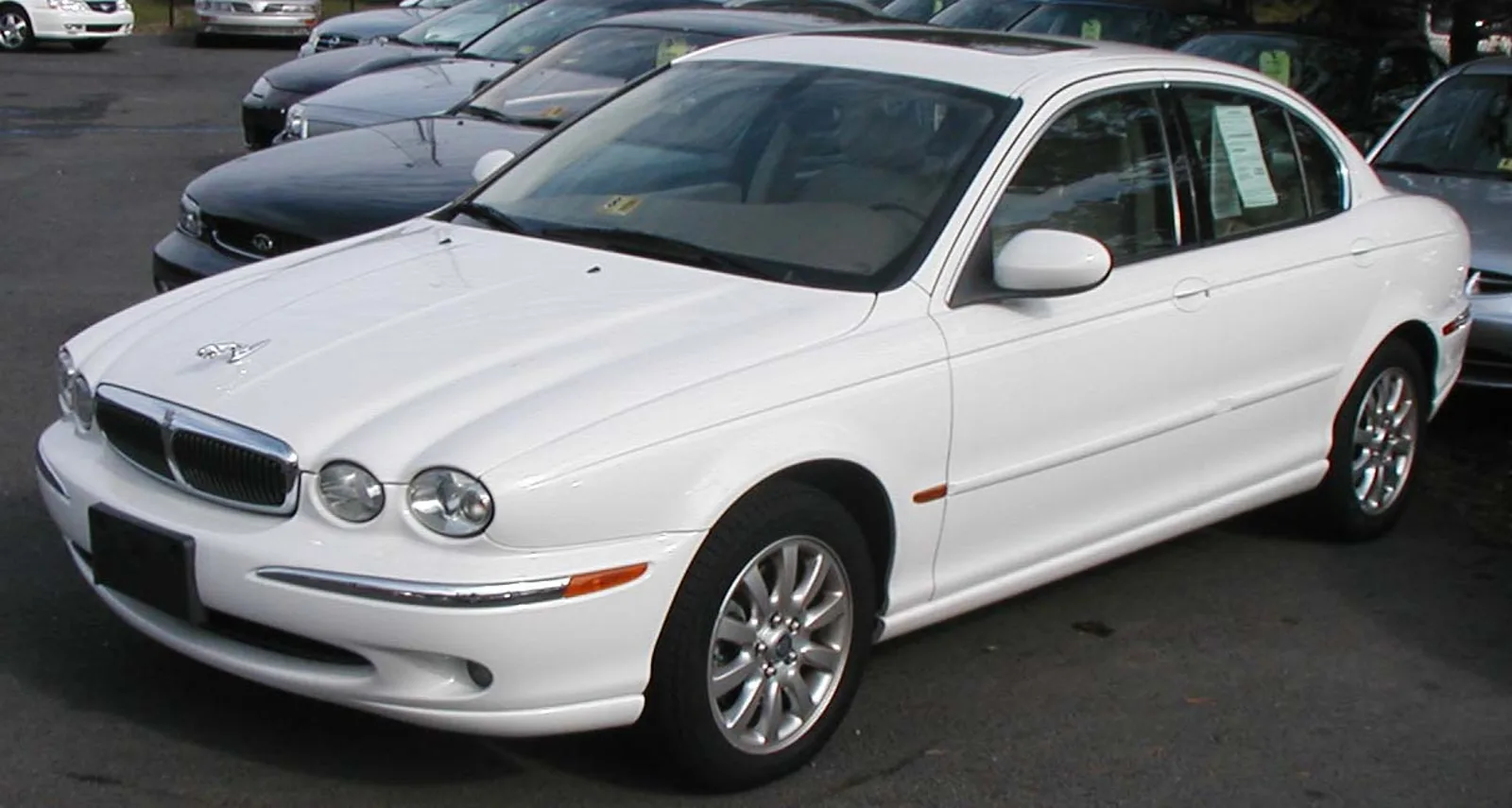
Jaguar's first compact executive car since 1959 shared its underpinnings with the Ford Mondeo, and it was built to double the marque's sales over eight years.
Built by Jaguar between 2001 and 2009, the X-Type was a compact executive model codenamed X400. It rode on an adapted Ford Mondeo platform, offered all-wheel drive at launch, and reached 350,000 units, well short of the 100,000 a year Jaguar had hoped for.
The Jaguar X-Type was a compact executive car that Jaguar built from 2001 to 2009. Codenamed X400, it came as a saloon and, from 2004, as an estate. It was Jaguar's first front-wheel drive car, its first diesel and its first four-cylinder model.
Why did Jaguar build the X-Type?
Jaguar wanted a share of the compact executive segment, which was dominated by the BMW 3 Series and the Mercedes-Benz C-Class. The plan was to double Jaguar's global sales, which meant more engineering staff, factory space and service support. Ford owned the marque at the time.
Jonathan Browning, the managing director, set the objective of 100,000 sales a year in November 2000. Annual projections stood at that level, and the total came to 350,000 cars across eight years.
The X-Type was developed while Jaguar was owned by Ford as part of the Premier Automotive Group, which ran from 1999 to 2010. It was the first Jaguar compact executive since the Mark 2 of 1959.
Jaguar's compact executive gamble, built on a Ford platform and asked to double the company's sales.
How was the X-Type engineered?
The car used an adapted Ford CD132 platform, the same base as the Mondeo. Jaguar added all-wheel drive, marketed as Jaguar Traction 4, and engineered the handling and steering to minimise torque steer from the front wheels. The result was a car with the Mondeo's bones and Jaguar's badge.
Initially the X-Type was offered only with all-wheel drive. It used a centre differential and a compact viscous coupling that split torque 60 per cent to the rear and 40 per cent to the front by default.
The viscous coupling was removed for the 2004 model year, which ended its mechanical limited-slip function. Electronic stability control could still reduce individual wheel spin by braking or by cutting engine torque.
Critics noted that 19% of its origins came from the Mondeo, much of it hidden inside, such as climate units. The platform link became a point of criticism throughout the car's life.
Which engines did the X-Type use?
The first engines were two V6 petrol units, a 2.5 litre and a 3.0 litre, both from the AJ-V6 family, which used variable valve timing. The entry petrol engine was a Ford Duratec V6 that Jaguar had tuned, based on the 2.5 litre used in the Mondeo.
The 3.0 litre V6 was an adaptation of the engine used in the Jaguar S-Type and the Lincoln LS. A 2.1 litre V6 front-wheel-drive model arrived in 2002, and all three petrol engines were offered with either a five-speed automatic or a five-speed manual.
In 2003 front-wheel drive gained Jaguar's first four-cylinder diesel, based on the Ford Duratorq ZSD unit. The later 2.2 litre diesel came with a six-speed automatic and Jaguar Sequential Shift, and the facelift added a particulate filter to that engine.
What did the estate add?
The estate went on sale in January 2004 and was Ian Callum's first Jaguar design. Behind the windscreen, 420 tooled parts and 58 stampings were changed, and it weighed 150 pounds more than the saloon. It also offered a programmable garage-door opener.
Load volume was 16 cubic feet to the side windows and 24 to the headliner, and 50 cubic feet once the rear seats are folded flat. In the United States the estate carried the Sportwagon name.
Equipment on the estate included a 320-watt premium Alpine sound system, a wood-and-leather steering wheel, electrochromic mirrors inside and out, and Reverse Park Control. Its 17-inch alloy wheels set it apart from the saloon's 16-inch wheels.
What changed in the facelift?
The 2007 Canary Wharf Motorexpo was the facelift's debut, with worldwide sales during 2008 and British sales from March. The update changed the front and rear fascias and added door mirrors with built-in indicator repeaters. It was the last major change before production ended in 2009.
The range also gained a 2.2 litre diesel with a particulate filter and a new six-speed automatic. Several European countries stopped selling petrol versions, and British buyers had one petrol model left in the final year.
How did the X-Type sell?
The X-Type was Jaguar's best-selling model during almost all of its run, but sales never met projections. Volume topped out at 50,000 in 2003. Its main market was the United States, where the car went from 21,542 units in 2004 to 10,941 in 2005.
Rivals sold far more. Their 2005 figures were 48,922 Audi A4s, 106,950 BMW 3 Series and 60,658 Mercedes-Benz C-Class cars.
Because sales were poor, Jaguar lost 4,690 euros on every X-Type it built. The early press also found fault with the limited powertrain choice at launch, which offered only six-cylinder petrol engines with all-wheel drive.
How did critics judge the X-Type?
Jeremy Clarkson praised the X-Type on Top Gear, especially the 4x4 and sport versions, and demonstrated its snow ability in two episodes. Several other magazines called the car comfortable, well equipped and a good drive. Its reception was mixed, with praise for comfort and criticism for the styling.
Clarkson dismissed the Mondeo connection as a minor issue. Robert Cumberford, the noted designer, took a harsher line, calling the styling a pastiche of many earlier Jaguars in Car and Driver that year.
Jaguar's own design director Ian Callum later said the car was essentially designed in Detroit and presented to reluctant engineers at Jaguar's Whitley centre. Time magazine called it an English version of the Cadillac Cimarron.
How safe was the X-Type?
Euro NCAP's crash test showed the doors still opened following a frontal impact, and the rear seats offered good protection for children. It judged the pedestrian impact performance dire, pointing out that seventeen of the eighteen impact locations offered no protection.
The X-Type was also tested by Thatcham's New Vehicle Security Ratings programme. Euro NCAP considered the car a large family car, while the United States Environmental Protection Agency classed it as a compact.
What came as standard at launch?
Standard equipment at launch included automatic climate control, leather upholstery, Sapele wood trim, 70/30 folding rear seats and an eight-way driver's seat. The car also came with 16-inch alloy wheels. Wood veneers were made in-house, a costly choice that raised development spend.
What special editions were sold?
The 2004 Spirit edition was built around the 2.5 litre V6 and carried a Sports Collection pack with new spoilers and a rear valance. In 2005 the XS limited edition continued the sporty theme with a wider range of engines.
Subsequent versions brought carbon fibre dashboards and Alcantara upholstery. The interior wood was genuine, veneered at Jaguar's Browns Lane facility for the door trim on the higher models.
What did the X-Type win and when?
AutoWeek's editors gave the X-Type their Editors Choice honour, recognising it as the most significant car shown at the 2001 Geneva show. Autocar had called it the most important Jaguar ever at the time of its launch, and the honour reflected how much the marque was counting on the car to reach new buyers.
How did the X-Type end?
Jaguar announced the end of X-Type production in July 2009, to finish by the close of that year. Both saloon and estate were built at the Halewood Assembly Facility near Liverpool, which had been renovated at a cost of $450 million.
The successor project carried the X760 codename and aimed for a 2015 debut. Jaguar confirmed in March 2014 that the X-Type would be replaced by a car called the XE, sitting below the XF.