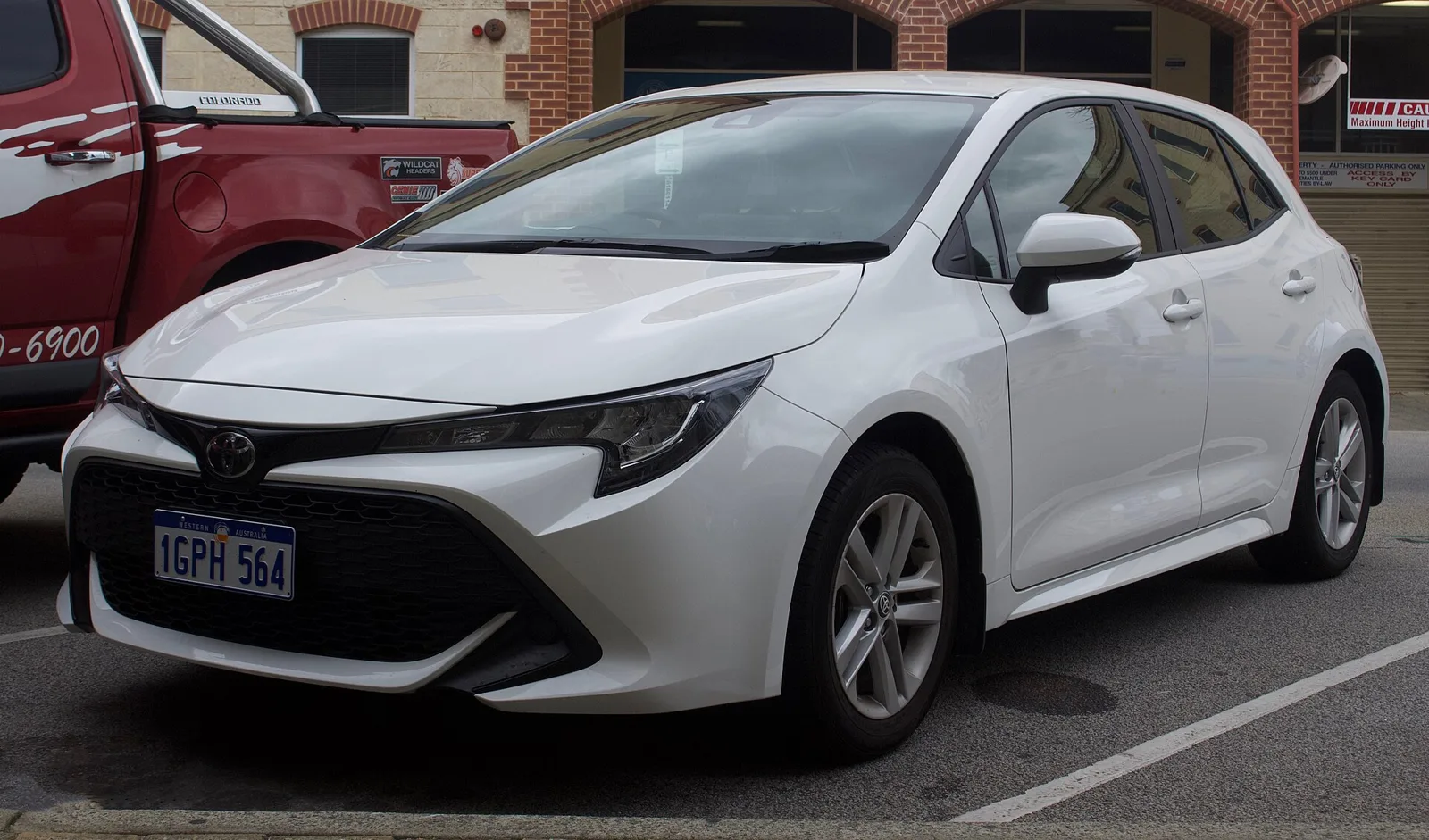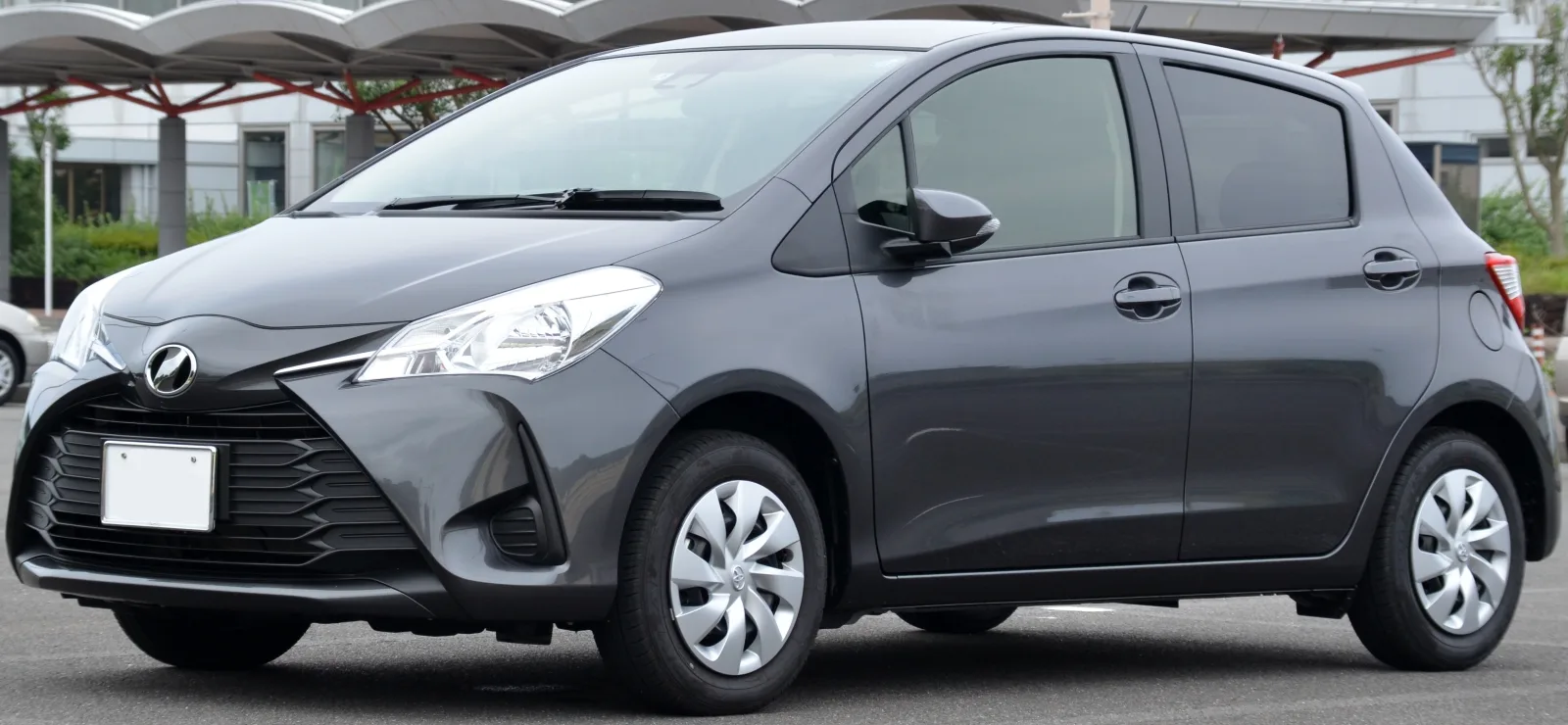
A small Toyota hatchback sold from 1999 to 2019 that travelled abroad as the Yaris and the Echo and became one of the brand's best-known compacts.
The Toyota Vitz was a subcompact hatchback built by Toyota from 1999 to 2019. It was sold as the Yaris in most export markets and the Echo in Australasia and Canada, and the first two generations passed 3.5 million sales.
The Toyota Vitz was a subcompact hatchback that Toyota built from 1999 to 2019 in three- or five-door body styles. Japan kept the Vitz name throughout, whereas buyers in most export markets met it as the Yaris, and the Echo name was used in Australasia and Canada for the first generation. Over the first two generations it passed 3.5 million sales in more than 70 countries.
What was the Toyota Vitz?
The Vitz was a small hatchback that Toyota sold in Japan through its Netz Store dealerships. Production started in Japan and later spread to other Asian countries and to France.
The name was used consistently in Japan for the whole production run. Elsewhere the same car was marketed under other names, so buyers in different countries could know it as a Yaris, an Echo or a Vitz depending on where they lived.
A small Toyota hatchback that became a Yaris abroad and sold more than three million cars across its first two generations.
Where did the first-generation Vitz come from?
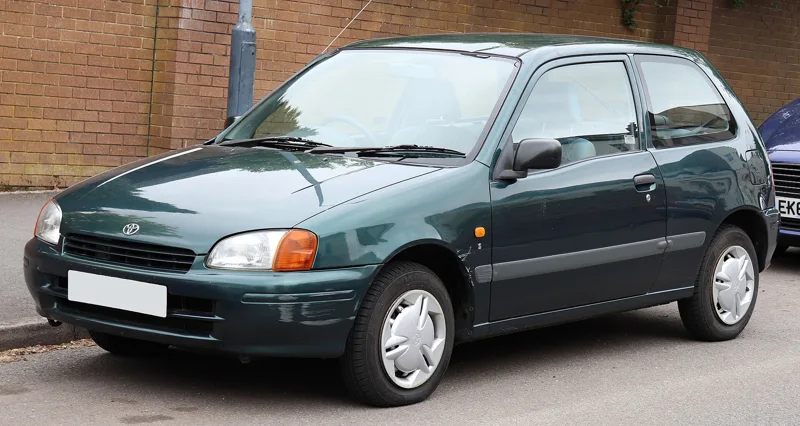
The first-generation XP10 was designed by Sotiris Kovos at Toyota's ED2 studio in Europe and first shown at the 1998 Paris Motor Show. Production began in late 1998, and the Japanese on-sale date was 13 January 1999. European sales started two months later under the Yaris name.
The car had an earlier life as a concept. A show car called Funtime appeared at the 1997 Frankfurt Motor Show, developed under Shuhei Toyoda, and it was followed by Funcoupe and Funcargo versions on the same platform. Those concepts became the New Basic Car programme, in which the three-door Vitz was designated NBC1.
The name Vitz is an anglicised spelling of the German word Witz, which means wit, although in modern German it mostly means joke. Toyota said the Yaris name was intended to give a European impression, while the Echo name was meant to echo nothing at all.
How did the Vitz differ from its Platz sibling?
The Vitz hatchback was sold alongside the Toyota Platz sedan, which was also exported as the Echo or Yaris. The two cars shared a platform, a common mechanical layout and a dashboard module, although they were visually different. Only the front doors were shared between their exterior panels.
Toyota also built a Yaris Verso or Echo Verso MPV for some export markets from late 1999. It was based on the Japanese FunCargo and used the Vitz's running gear, with a roomier interior. At its introduction in 1999 the Vitz won the Car of the Year Japan Award.
What set the first-generation Vitz's dashboard apart?
In Japan the Vitz used digital instruments in a pod in the centre of the dashboard, instead of the conventional analogue dials used in most small cars. The Canadian version was different, because Toyota fitted a standard speedometer in the same central position.
In 2003 the facelifted Phase 2 Vitz arrived with different bumpers and teardrop-shaped front lights. The change kept the car's basic shape but gave it a fresher look for its later years.
How did the first-generation Vitz perform in crash tests?
The first generation was not a strong performer in every test. Euro NCAP tested the dual-airbag XP10 in 2000 and gave it 29 out of 37 for adult occupant protection, which earned four stars. The pedestrian rating was lower, at two stars.
ANCAP tested the XP10 in July 2004 with only a driver's airbag fitted, and it scored 23.64 out of 37, or three stars. Monash University's 2010 Used Car Safety Ratings then rated the XP10 as poor for occupant protection, with two stars out of five.
Which engines did the first-generation Vitz use?
In Europe the Vitz was sold with 1.0-litre and 1.3-litre inline fours, both using Toyota's VVT-i variable valve timing. Toyota said its engine management let the 70 hp (52 kW) 1.0-litre deliver the equivalent of 1.4-litre performance while keeping fuel use low.
The Vitz RS was introduced in Japan in October 2000. It had revised bumpers, a mesh grille, black-tinted headlamps, fog lamps, side skirts and alloy wheels, with sports seats inside. Two engines were offered: a 1.3-litre 2NZ-FE with 84 hp (63 kW) and a 1.5-litre 1NZ-FE with 110 hp (82 kW). The RS also had better brakes and firmer suspension.
A small number of Phase 2 RS cars were built with a turbocharger by Toyota Racing Development. It used a 1.5-litre engine producing 148 hp (110 kW), and it reached 0-100 km/h (0-62 mph) in 7.9 seconds. Most of these cars were sold in the domestic Japanese market.
How did the Vitz sell in Australia?
The XP10 series reached Australia on 8 October 1999 as the Echo, replacing the Starlet. Both three-door and five-door hatchbacks were offered, alongside a four-door Echo sedan based on the Platz. Australian hatchbacks used the 1.3-litre engine with a five-speed manual, and a four-speed automatic was optional.
The Echo Sportivo followed in March 2001 with the 1.5-litre 1NZ-FE and a manual gearbox only. It used a locally developed T-CAM body kit and 14-inch alloy wheels. In March 2003 the price fell and the standard equipment rose, but the safety pack was dropped as an option, and ANCAP cut the car's rating from four stars to three in 2004.
How did the Vitz become the Yaris in Europe?
In Europe the Vitz was sold as the Yaris, and it outsold the Starlet it replaced in most markets. The XP10 was voted European Car of the Year for 2000 and also won the Semperit Irish Car of the Year award in the same year.
From 31 January 2001 the Yaris was built at Toyota Motor Manufacturing France in Onnaing, alongside the Japanese-built cars. The hot-hatch T Sport arrived in 2001 with the 1.5-litre engine, and a 1.4-litre D4-D diesel producing 75 hp (56 kW) joined the range after March 2002. The first-generation Yaris went on to sell more than 1.2 million units in Europe.
Why did the Echo reach North America late?
The Vitz hatchback was not sold in North America until 2003, when it arrived in Canada as the Echo for the 2004 model year. Until then only the Platz-based Echo sedan and coupe were on sale there, and the hatchback was introduced in Canada because those cars had sold better there than in the United States.
Canadian Echo hatchbacks came in LE, CE and RS trim. The LE was the standard version in three- or five-door form, the CE was an economy three-door without power steering, and the RS was a five-door with an aero package and sport seats. All of them used the 1.5-litre 1NZ-FE, rated at 108 hp (81 kW), and a tachometer was added for the 2005 model year.
What was the second-generation Vitz?
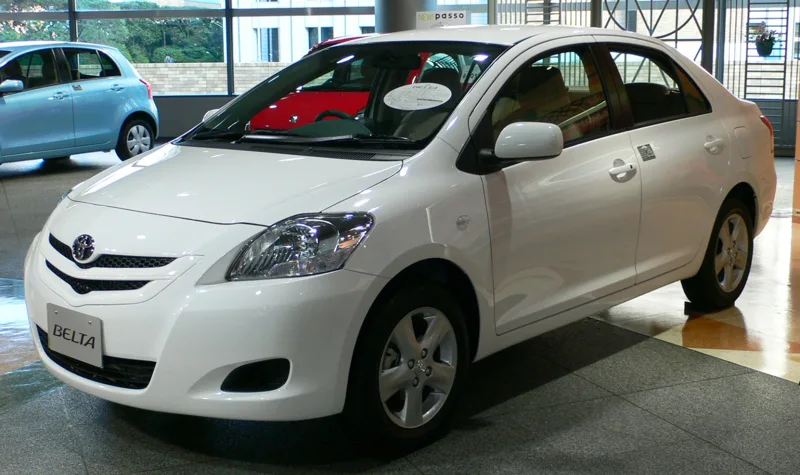
Toyota redesigned the Vitz in early 2005, and it went on sale in Japan that February. The Yaris family, which included the Belta, was developed under chief engineer Kousuke Shibahara. The Vitz and Belta shared underpinnings, the frame and drivetrain components, but their sheet metal and interior were different.
The second generation was larger in every dimension, which gave it more interior space for its class. It had a short overhang and a cab-forward design, and some versions carried up to nine airbags. European, Australian, Canadian and Mexican markets received it at the end of 2005, and it was sold as the Yaris in Australia and North America for the first time.
The 4-cylinder 1.0-litre engine was replaced by a three-cylinder unit also used in the Toyota Aygo. The 1.3-litre was revised for slightly more power, and the 1.4 D-4D diesel gained 15 PS (11 kW; 15 hp), taking it to 90 PS (66 kW; 89 hp). A 1.33-litre engine with Stop and Start technology arrived in Europe in early 2009.
How did the Vitz RS change in the second generation?
The Vitz RS launched in 2005 with a 1.5-litre VVT-i engine rated at 107 bhp (80 kW). It had 16-inch alloy wheels, an RS mesh grille, redesigned bumpers and tail lamps, deep side skirts and a tail spoiler, along with sports-tuned steering and suspension.
The RS sold in North America had the base 1.5-litre engine, while in Europe it was the Yaris TS. Its Japanese version used a 1.8-litre 2ZR-FE rated at 130 hp (97 kW), which could reach 100 km/h in under 10 seconds. The G-BOOK telematics subscription was offered on Japanese models from 2007.
What happened with the second-generation recall?
In January 2009 Toyota recalled 1.28 million vehicles worldwide across the Yaris platform, including the Vitz, Belta and Ractis. Toyota traced the problem to a seat belt fault: in heavy frontal impacts, a foam pad in the cabin could catch fire.
The second generation was built in Japan, France, Thailand, China and Taiwan, and the Chinese plant continued to make it until November 2013.
What was the third-generation Vitz?
The third generation was introduced in December 2010 with a redesigned front, a roomier interior, a single windscreen wiper and an instrument cluster in front of the driver. European cars could be ordered with a six-speed manual for the 1.33-litre engine, or a CVT marketed as a seven-speed MultiDrive or MultiDrive S.
Japanese launch took place on 22 December 2010 in Yokohama. The car's drag coefficient was 0.285, and a new 1.3-litre four-cylinder engine was claimed to be as economical as the 1.0-litre unit. It also had an engine start-stop system, and the facelift added Toyota Safety Sense C with lane departure alert and automatic high beam.
In Japan the Vitz was offered in F, U, Jewela and RS grades, with engines from 1.0 to 1.5 litres. Sales in Japan had once reached 160,000 a year, but they dropped to 87,000, which prompted Toyota to rebrand the car as Yaris to expand its middle-aged customer base.
How did the Vitz become a hybrid?
The Yaris HSD concept appeared at the March 2011 Geneva Motor Show, and the production hybrid was shown there a year later. It went on sale in June 2012 with the same powertrain as the Prius c in North America and the Aqua in Japan.
The hybrid used a 1.5-litre petrol engine with 55 kW (74 hp) and a 45 kW (60 hp) electric motor, for a combined output of 74 kW (99 hp). Its NiMH battery had 0.9 kWh of capacity. The Yaris Hybrid sold 23,692 units during 2012, and cumulative sales reached 35,151 units by March 2013.
What was the GRMN version?
The Vitz and Yaris GRMN was a limited-production performance version tuned by Gazoo Racing, the Meister of the Nurburgring. The first version launched in August 2013 with a turbocharged 1.5-litre engine making 150 hp (152 PS). Only 200 were built, and they were sold solely in Japan.
The second GRMN arrived in September 2017 with a Lotus-tuned supercharged 1.8-litre engine from the Series 3 Elise, producing 209 hp (212 PS). Its claimed 0-100 km/h time was about 6.3 seconds, and it was limited to 230 km/h (143 mph). Some 150 cars were built for Japan and 400 for Europe.
What happened to the Vitz name after 2019?
The Vitz nameplate was dropped in Japan in 2019 after sales faltered and Toyota unified its Japanese sales network. The car was replaced by the XP210 series Yaris. The name returned in 2023 on a rebadged third-generation Suzuki Celerio sold in African markets.
Outside Japan the Yaris name had already been the main name for the model, so the Vitz was widely known to buyers as a Yaris long before its final Japanese year.
Toyota Vitz specifications
| Specification | Detail |
|---|---|
| Body styles | Three-door or five-door hatchback |
| Production years | 1999 to 2019 |
| First generation | XP10 series; Japan 13 January 1999; Europe as Yaris |
| Second generation | XP90 series; Japan February 2005 |
| Third generation | XP130 series; Japan 22 December 2010 |
| First generation RS engine | 1.5-litre 1NZ-FE, 110 hp (82 kW) |
| Turbo RS (Japan, Phase 2) | 1.5-litre turbo, 148 hp (110 kW), 0-100 km/h in 7.9 seconds |
| Second generation RS (Japan) | 1.8-litre 2ZR-FE, 130 hp (97 kW) |
| Hybrid | 1.5-litre petrol plus electric motor, 74 kW (99 hp) combined |
| GRMN 2013 | 1.5-litre turbo, 150 hp (152 PS), 200 built |
| GRMN 2017 | 1.8-litre supercharged, 209 hp (212 PS), limited to 230 km/h |
| First generation Euro NCAP | 29 out of 37 adults, four stars |
| Sales | Over 3.5 million for the first two generations by 2010 |
| Successor in Japan | XP210 series Yaris, from 2019 |