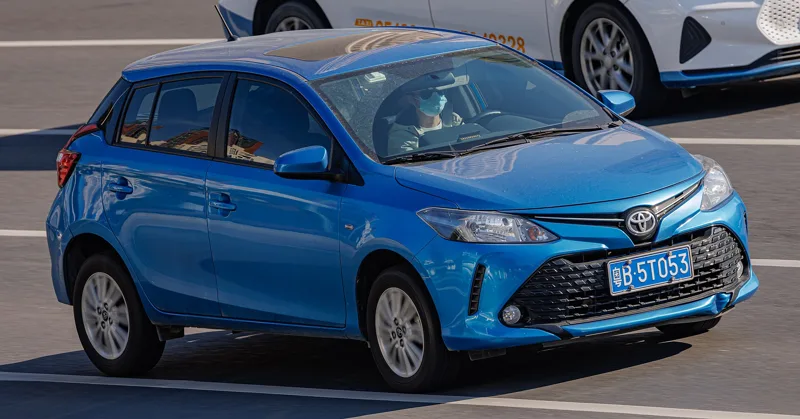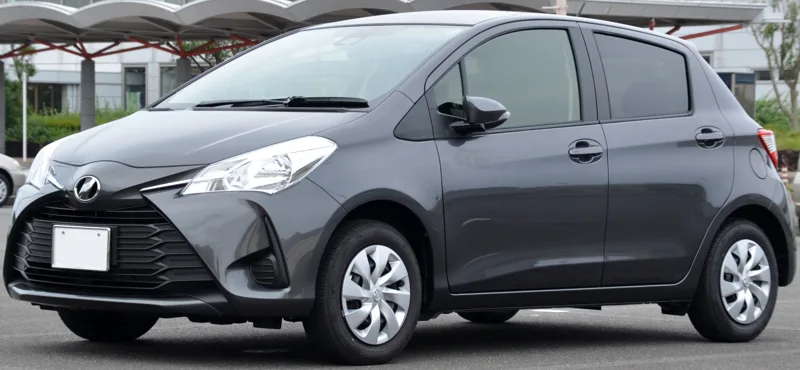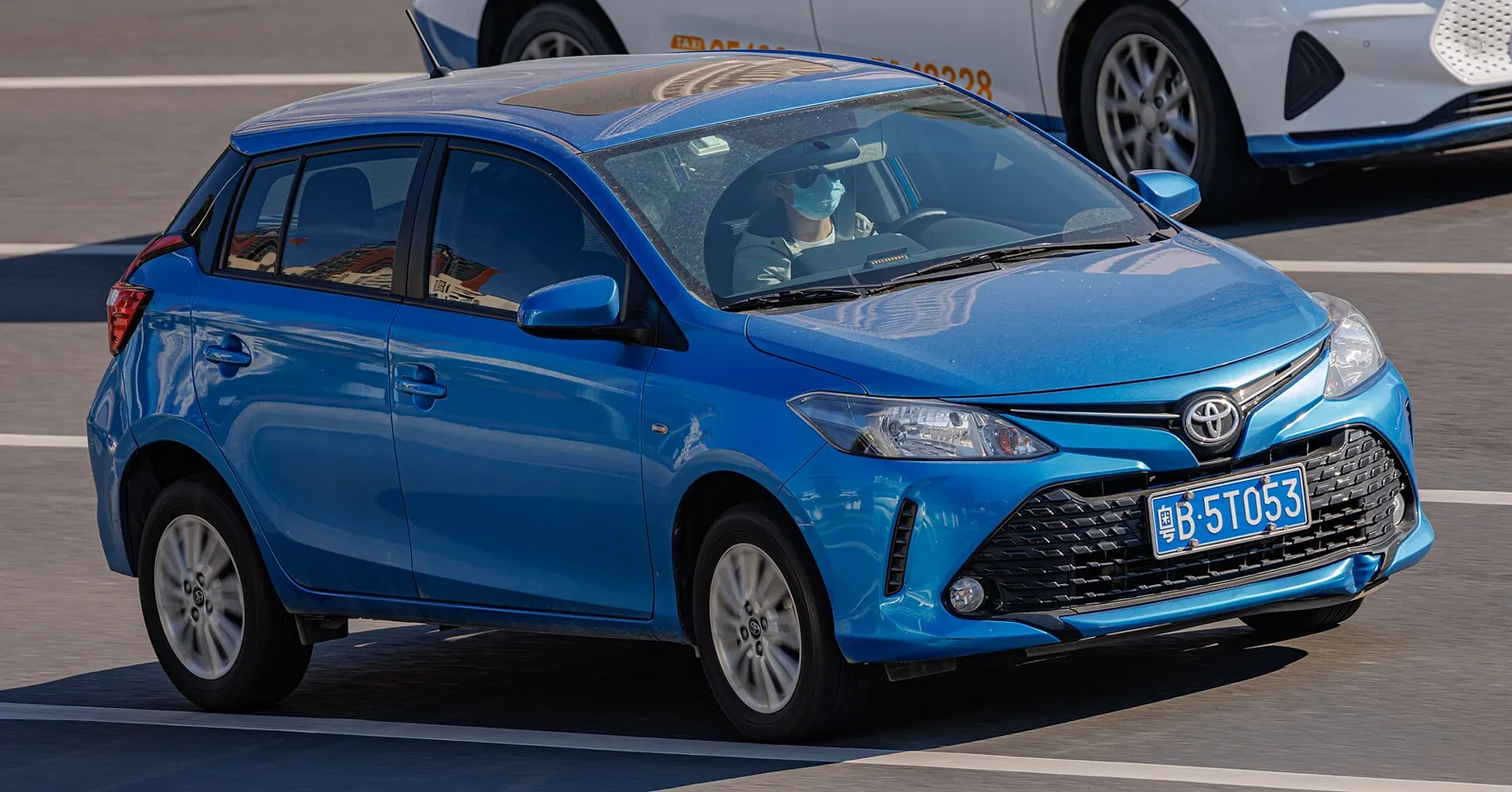
A Japanese-built sedan that became the Vios in Asia and the Yaris sedan elsewhere, with a short revival on a rebadged Suzuki in Africa.
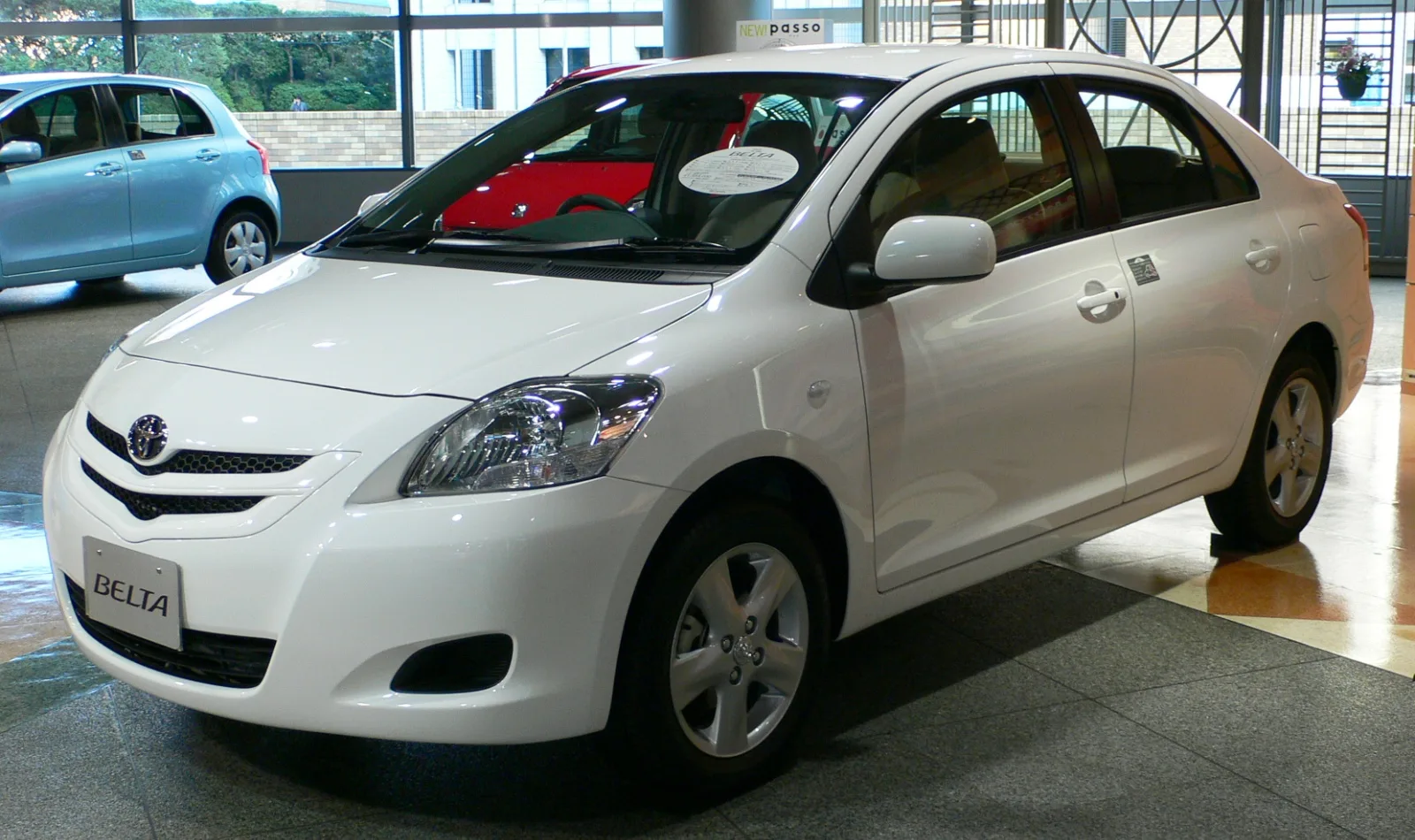
Built by Toyota from 2005, the Belta carried the Vios name in parts of Asia and the Yaris sedan name elsewhere. Its engines ran from 1.0 to 1.6 litres, and it left production market by market before a brief Suzuki-based return.
The Toyota Belta is a subcompact sedan that Toyota launched in Japan on 28 November 2005. Sold as the Vios in selected Asian markets and as the Yaris sedan elsewhere, it succeeded the Platz and grew into a car with interior space comparable to the E120 series Corolla. Its run ended market by market, and the name returned briefly on a rebadged Suzuki in Africa.
Where did the Belta come from?
The Belta succeeded the Platz and was launched in Japan on 28 November 2005 with 1.0 to 1.3 litre engines. International sales started in early 2006 with 1.3 to 1.6 litre engines, depending on the market. The name is a contraction of the Italian words bella gente, meaning beautiful people.
Toyota positioned the sedan as a step up from its hatchback sibling. The Belta was larger than its predecessor, so that its interior volume matched the E120 series Corolla. The same car later appeared as the second generation Vios and as Yaris sedans across several continents.
A subcompact sedan that wore several names across Asia and the Americas, then faded out as the market moved on.
How was the Belta designed?
The Belta shares its platform and powertrain with the XP90 series Vitz, but it was designed at Toyota's Japanese design studio rather than the French studio that drew the Vitz. The two cars share no sheetmetal, and the sedan's drag coefficient of Cd=0.29 was slightly better than the hatchback's.
Both cars used the same centralised dashboard, which Toyota adopted across its range to standardise the design for left and right hand drive markets. Small cosmetic differences still separated the sedan from the hatchback, which makes the two cars only subtly related.
How did the Japanese Belta differ from export cars?
The Japanese Belta offered a 1.0 L 1KR-FE straight-three and a 1.3 L 2SZ-FE, both paired only with a CVT, while the 1.3 L 2NZ-FE was the only engine offered with all-wheel drive. Trims were X and G, with an optional S Package, and a cheaper Business A and B package arrived in October 2006 for fleets.
The August 2008 facelift brought a honeycomb grille, new mirror wings with indicators and redesigned hubcaps. The L Package replaced the sporty S Package in the line-up, and the sedan was discontinued for the Japanese market in 2012 when the Corolla Axio took over.
What made the Southeast Asian Vios distinct?
The second generation Vios was unveiled in Kuala Lumpur on 5 October 2007 and launched on 19 October 2007. It used the 1NZ-FE 1.5 litre four-cylinder engine with VVT-i, electric power steering and a four-speed Super ECT automatic with the same gear ratios as its predecessor.
Malaysia offered J, E, G and S trims. The S added a front bumper spoiler, side skirts and a bootlid spoiler, and the TRD Sportivo replaced it from 17 June 2009 with a body kit and Enkei wheels. The Malaysian Vios was assembled locally by ASSB in Shah Alam, Selangor, and became the best-selling non-national badged vehicle in the country.
In the Philippines the Vios launched in August 2007 and was built at Toyota Motor Philippines' plant in Santa Rosa, Laguna. Toyota spent PHP 1 billion to retool the plant. The 1.5 G XX Limited followed in August 2008 with 800 units to mark the company's 20th anniversary.
How did the Thai and Chinese trims work?
Thailand offered J, E and G trims, plus the G Limited and S Limited editions. The Thai limited runs were large: the GT Street Version was capped at 1,000 units in March 2009, followed by TRD Sportivo runs of 3,000, 4,200 and 4,100 units.
The Chinese Vios arrived in February 2008 with a 1.3 L 2NZ-FE and an exclusive 1.6 L Dual VVT-i 1ZR-FE from the Corolla. The GL-i base model was joined by sporty GL-S and luxury GLX-i trims, and a factory sunroof option was exclusive to the Chinese market.
What were the North American and Australian versions?
North American sales of the Belta began in March 2006 for the 2007 model year, under the Yaris sedan badge. US buyers could choose modular convenience, power and all-weather guard packages, and the Yaris S added a standard convenience package and an all-around body kit.
In Australia the sedan was called the Yaris sedan and sold alongside the Vitz-based Yaris hatchback. It used only the 1.5 litre 1NZ-FE engine, in YRS and YRX variants, and the YRX had an all-round body kit. The Australian car ended its run at the end of 2016.
Key specifications
| Specification | Detail |
|---|---|
| Japanese launch | 28 November 2005 |
| Japanese 1.0 L engine | 1KR-FE straight-three, 71 PS (52 kW; 70 hp) |
| Japanese 1.3 L engines | 2NZ-FE or 2SZ-FE, 87 PS (64 kW; 86 hp) |
| Southeast Asian engine | 1.5 L 1NZ-FE with VVT-i |
| Chinese top engine | 1.6 L 1ZR-FE Dual VVT-i |
| US engine output | 1.5 L, 106 hp (79 kW; 107 PS), 4-speed automatic |
| 0-60 mph (MotorWeek) | 9.5 seconds |
| 0-60 mph (Motor Trend) | 10.4 seconds |
| Quarter-mile (MotorWeek) | 17.4 seconds at 80 mph (129 km/h) |
| 60-0 mph braking (MotorWeek) | 125 ft (38 m) |
| Fuel economy (Motor Trend) | 36.4 mpg-US (15.5 km/l) |
| Global output | Under 2.5 million units across the Belta family |
How safe was the Belta?
Japanese cars came with dual airbags, ABS with electronic brakeforce distribution and brake assist. Side airbags, electronic stability control and a rear disc brake were optional. In the United States, side airbags and ABS were optional on the 2007 and 2008 models.
From 2009 the US cars gained front and rear side curtain airbags and ABS as standard, and electronic stability control arrived as standard in the 2010 model year. The IIHS rated the Yaris sedan Good in frontal and side tests when side airbags were fitted, but Poor in side impact without them. Roof strength was rated Acceptable at a strength-to-weight ratio of 3.78.
Which recalls affected the Belta?
The Belta, Vios and Yaris sedan built between 2005 and 2013 were included in the Takata airbag recall, because the front passenger inflator could send sharp metal fragments toward the occupants. Owners were also affected by power window and seat rail issues reported in Japan and the United States.
A 2009 Japanese recall covered Belta cars built from 17 November 2005 to 7 April 2008, because the exhaust gas recirculation pipe could crack and the front seatbelt pretensioners might cause a fire in a collision. In March 2015 a US and Puerto Rico recall covered Yaris cars built from 31 August 2011 to 9 February 2015, because of a roof headliner problem.
How many Beltas were built and sold?
Toyota production data shows over 1 million Belta and export Yaris sedans built in Japan from 2005 to 2012, with around 134,000 of them sold as Belta. Over 1 million second generation Vios followed in China and Southeast Asia from 2007 to 2014. Total global output of the Belta family stayed under 2.5 million units.
Sales of the Japanese Belta were discontinued in 2012, while the export Yaris sedan continued until 2016 in Australia and Mexico. The Mexican sedan was sold alongside a Yaris R until April 2016, when the XP150 series took over two months later.
How did the Suzuki-based revival happen?
The Belta nameplate returned in November 2021 on a rebadged Suzuki Ciaz sold in Africa. The revived car was discontinued in the first half of 2025 without a replacement, which ended the Belta name for good. The car was sold in Africa only, and it did not return to the Japanese or Asian markets.
The revival used a Suzuki platform rather than Toyota's own, so the car had little in common with the Japanese Belta that started the name in 2005. It was a short-lived badge exercise rather than a continuation of the original sedan.
How did the Indonesian and Singapore Vios differ?
The Indonesian Vios was launched in April 2007 after being imported from Thailand, and it was marketed under the backronym Very Intelligent, Outstanding Sedan. The Limo version served the taxi fleet, while the E and G trims carried a V-shaped grille ornament. The top G trim added fog lamps and auto-levelling HID headlamps.
In Singapore the line-up was J, E and G. The G was the only automatic trim, and the E became the only manual variant after the local dealer dropped the manual J. Singapore's Sportivo variant arrived in December 2012, with a TRD kit and 15-inch TRD multi-spoke wheels.
How did fuel economy and performance compare?
Under EPA testing, the 2007 US Yaris sedan managed 40 mpg-US (17.0 km/L) out of town and 34 mpg-US (14.5 km/L) around town, and its tank held 42 L (11.1 US gal). The EPA later changed its method, so the 2008 manual dropped to 29 mpg-US in the city and 36 mpg-US on the highway.
On the road the sedan was not quick. Passing from 45 to 65 mph took 5.6 seconds in Motor Trend's testing. The Indonesian Vios reached 100 km/h in 11.4 seconds, or 10.6 seconds with a manual, and managed 14.7 km/L (34.6 mpg-US) on the mixed cycle.
The 2009 US facelift and options
For the 2009 model year all US Yaris sedans gained a new grille, alloy designs and new interior fabric, with standard side curtain airbags and anti-lock brakes. Options included a leather-wrapped steering wheel and shift knob, and satellite radio.
The TRD range also grew, adding a rear sway bar and a clutch assembly for manual cars. The Yaris S package with its all-around body kit continued alongside the standard car, so buyers could choose between a plain sedan and a sportier look.
Australian facelift and final years
The Australian Yaris sedan received a facelift in October 2008 with the same appearance as the international model and several minor revisions. The YRX model kept its all-round body kit and could be ordered with an automatic or a 5-speed manual.
Poor sales ended the car in late 2016. Australia was left without a direct replacement, and sales had fallen by over 27 percent before the decision was made.