A very short Toyota city car that fitted four occupants into a compact body, sold in Japan and Europe and rebadged for North America and Aston Martin.
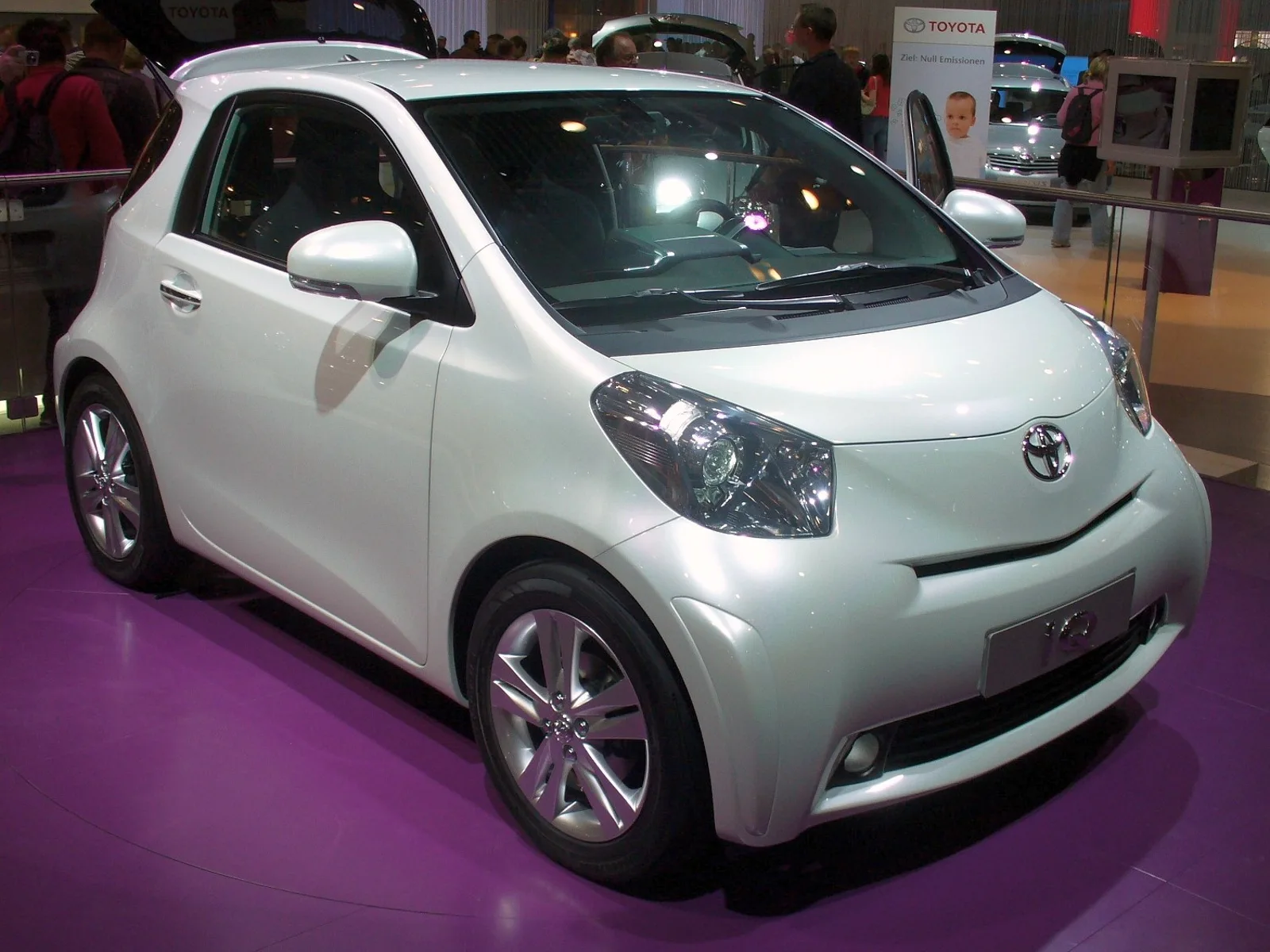
The Toyota iQ was a four-seat city car that Toyota sold in Japan from 2008 to 2016, in Europe from 2008 to 2015, and in North America as the Scion iQ from 2012 to 2015. Aston Martin later rebadged it as the Cygnet.
Toyota's iQ packed four people into an unusually short car, and it reached showrooms in Japan and Europe in 2008. Production ended in December 2015, by which time the car had also been sold in North America under the Scion badge since 2012.
What was the Toyota iQ?
The iQ was a small city car from Toyota, sold in Japan between 2008 and 2016 and in Europe between 2008 and 2015. In North America it was badged as the Scion iQ from 2012 to 2015, and Aston Martin later sold a rebadged version as the Cygnet.
Toyota's European design studio in Nice, France, did the engineering work. The team was tasked with giving passengers as much room as possible while keeping the length down, and the layout held four occupants.
The name is an initialism of intelligence quotient. The letters also stand for individuality, innovation and quality, and they hint at the car's cube-like shape.
A four-seat city car that packed space into a very short body, and then found a second life as the Scion and the Cygnet.
How did the iQ use its space?
Six design choices let the iQ keep its overhangs short and its windscreen far forward. These included a differential placed ahead of normal, a centre take-off steering gear and a flat fuel tank under the floor. The layout allowed the body to stay compact.
Rear-angled shock absorbers reduced intrusion into the rear seats, and a smaller heater and air conditioning unit sat centrally behind the dashboard.
Because the front passenger sat ahead of the driver, rear passengers gained legroom. A shallow under-floor fuel tank also reduced the rear overhang.
In Japan the car was treated as a supermini because of its width and engine size, even though its length matched kei car rules.
How did the iQ sell?
European sales peaked at 44,282 in 2009 and fell to under a thousand by 2015. Its European price of about GBP 10,000 sat above that of the bigger Aygo. Japanese showroom sales had begun earlier, in November 2008, before the European launch.
The iQ was named Japanese Car of the Year in 2008, and European sales started in January 2009.
Production ended in December 2015, and the car was discontinued in Japan in April 2016.
What engines and transmissions did the iQ use?
Early Japanese cars used a three-cylinder engine similar to the Toyota Aygo's unit. Only petrol engines were offered in the UK, and a larger option added from 2009 came with start and stop, but only with the manual gearbox. The gearbox choice was therefore tied to the market.
Japanese models used a CVT transmission only. The car was also reported capable of fitting a four-cylinder engine, and it carried a starter motor built into the engine flywheel.
By European standards the iQ achieved 65.69 mpg-imp (55 mpg-US; 4.3 L/100 km).
How safe was the iQ?
The iQ had nine airbags, including a driver's knee airbag and a rear curtain airbag that protected rear passengers' heads in rear-end collisions. Stability control, traction control and anti-lock brakes came as standard, and brake assist and electronic brakeforce distribution were included as well.
Britain's Vehicle and Operator Services Agency placed the iQ top among three-year-old cars likely to pass their first roadworthiness test in 2013.
In 2023 Toyota and its subsidiary Daihatsu disclosed irregularities in safety testing for iQ models made for Japan and Europe. Daihatsu said most affected vehicles, including the iQ, still met the required performance standards.
What was the Scion iQ?
Scion was Toyota's North American small-car brand in the early 2010s, and the iQ was sold under it in the United States and Canada. The production car was first presented in New York in 2010, and it was offered for model years 2012 to 2015.
Only one engine was offered in North America: the 1.3 L 1NR-FE, linked to a CVT automatic.
The car went out of production together with its Toyota counterpart in 2015.
What was the iQ EV?
The electric iQ was shown as a prototype at the 2011 Geneva Motor Show as the Toyota eQ, and in the US it became the Scion iQ EV. It built on Toyota's FT-EV concepts, and its exterior followed the FT-EV III shown at the 2011 Tokyo Motor Show.
Toyota first planned 600 units, with 400 for Japan and 100 each for the US and Europe. By September 2012 production had been cut to 100 units for fleet use in Japan and the US, and 90 of them were earmarked for American carsharing demonstrations.
The electric car used a 150-cell, 12 kWh pack at 277.5 V. Fully recharging took about three hours, while fast charging reached 80% in only 15 minutes, and the US rating was 80 km (50 mi).
A 47 kW motor drove the front wheels with 163 N m (120 lb-ft) of torque. The iQ EV reached 0-100 km/h (62 mph) in 14.0 seconds and topped out at 125 km/h (78 mph).
Its turning radius is 4.1 m (13 ft), and at 3,120 mm long it is 135 mm (5.3 in) longer than the standard iQ. It shares the iQ's width, height and wheelbase, and it weighs 125 kg (276 lb) more than a 1.3 L CVT iQ.
The EPA rated the 2013 iQ EV at 121 MPG-e combined, 138 MPG-e in the city and 105 MPG-e on the highway. By December 2014 it ranked second among EPA-certified vehicles of all fuel types, after the BMW i3.
The first 30 units were handed over in March 2013 to the University of California, Irvine, for carsharing use. Another 30 went to City Carshare in September 2013 for a pilot in Pleasanton, California.
What did the Aston Martin Cygnet change?
The Cygnet was Aston Martin's rebadged iQ, sold from the 2011 model year under the codename P298. Aston Martin used it to help meet European Union fleet emissions rules that applied from 2012. Demand from existing Aston Martin owners was expected to take priority at first.
UK sales began in January 2011, and other European countries followed a year later. Aston Martin expected about 4000 sales a year at around GBP 30,000, roughly three times the iQ's price.
Visually it was revised inside and out, but mechanically it stayed close to the iQ, with a 1.3 L inline-four making 97 bhp (72 kW; 98 PS) and 110 g of CO2 per km.
Sales fell far short of the plan. The Cygnet reached roughly 150 buyers in Britain and under 600 across the rest of Europe, and Aston Martin ended the car's run in September 2013, a little more than two years after launch.
In June 2018 Aston Martin built a one-off Cygnet for a customer, with a V8 of 4.7 litres making 321 kW (430 bhp). It borrowed the Vantage S's engine, transmission, suspension, brakes and wheels.
Toyota iQ specifications
| Model | Detail |
|---|---|
| Toyota iQ, Japan | 2008 to 2016; CVT only |
| Toyota iQ, Europe | 2008 to 2015; peak sales 44,282 in 2009 |
| Fuel economy (European standards) | 65.69 mpg-imp (55 mpg-US; 4.3 L/100 km) |
| Scion iQ, North America | 2012 to 2015 with a 1.3 L 1NR-FE engine and CVT |
| iQ EV battery | 12 kWh, 277.5 V, 150 cells; 80 km (50 mi) US rating |
| iQ EV performance | 0-100 km/h (62 mph) in 14.0 seconds; 125 km/h (78 mph) |
| iQ EV dimensions | 3,120 mm (122.8 in) long; 4.1 m (13 ft) turning radius |
| iQ EV economy (EPA, 2013) | 121 MPG-e combined (1.9 L/100 km) |
| Aston Martin Cygnet | 1.3 L inline-four making 97 bhp (72 kW; 98 PS); 110 g CO2 per km |
| Cygnet V8 one-off, 2018 | 321 kW (430 bhp) from a 4.7-litre V8 |
Which special editions and concepts were built?
Toyota built two limited Japanese-only editions with 100 units each, plus a supercharged version and several concepts. The first came in 2009 and the second in 2012, and both carried the Gazoo Racing tuning badge. Both were sold only in Japan, and the 2009 car went through Netz dealers.
The 2009 Gazoo Racing edition had a 1,329 cc engine, a six-speed manual, a sport suspension that dropped the ride 30 mm (1.2 in), and RAYS alloy wheels.
It made its debut at the January 2009 Tokyo Auto Salon and sold through Toyota's Netz dealer channel for JPY 1,972,000.
The 2012 GRMN iQ Supercharger was another 100-unit run for Japan, based on the manual edition of the same car. It used the supercharger from the GRMN iQ Racing Concept shown at the 2011 Tokyo Auto Salon.
The GRMN iQ Racing Concept took its base from the 2009 Gazoo Racing car and fitted with a supercharger and roll cage.
The iQ concept appeared first at the 2007 Frankfurt Motor Show. Five Axis of California later built a Scion iQ Concept for the 2009 New York Auto Show, with a 94 hp (70 kW) engine and 18-inch wheels.
The FT-EV concept, shown in January 2009 at the North American International Auto Show, was a modified electric iQ with an estimated range of 50 miles (80 km). Toyota had planned to build a production version in 2012.
The FT-EV II debuted in October 2009 at the Tokyo Motor Show, had a transparent body and sliding doors that opened electrically. Its top speed was over 100 km/h (62 mph), and its range was 90 km (56 mi).
What did other brands build on the iQ?
Singulato, a Chinese electric vehicle brand, showed its iC3 at the 2019 Auto Shanghai show. The iC3 was built on the iQ's platform and basic design under an arrangement with Toyota, which in return could use the Green Vehicle Credits Singulato earned in China.
The iC3 never reached mainstream production, because Singulato filed for bankruptcy in 2023.
Italdesign Giugiaro styled the Proton EMAS, a hybrid concept that Proton developed. It was first shown at Geneva in 2010, using the iQ's platform, steering and suspension with a three-cylinder engine and an electric motor from Lotus.
The EMAS name was an acronym for Eco Mobility Advance Solution, and Proton hoped it would become Malaysia's first global car. It was expected in production by 2012, but by August 2014 it was still a concept.
Proton's subsidiary Lotus Cars also showed a plug-in hybrid city concept based on the EMAS, called the Lotus Ethos.