A subcompact that began as a Publica replacement in 1973, gained front-wheel drive and turbo power, and ended in July 1999 as the Yaris arrived.
Toyota's Starlet was a subcompact that ran from 1973 to 1999 as the successor to the Publica. Its turbocharged GT Turbo and Glanza V gave it a performance reputation, and the Vitz took over the role when production ended.
The Toyota Starlet was a subcompact car that Toyota built from 1973 until 1999. It replaced the Publica and kept that car's P code and generation numbering, so the family ran on through five generations. Along the way it became one of the first Japanese subcompacts to offer a true high-performance variant.
Where did the Starlet come from?
The Starlet went on sale in April 1973, positioned above the Publica P30 as its larger, better-equipped sibling. Toyota kept the Publica's P code, so the new car continued the same generation numbering. Toyota offered it with 1,000 and 1,200 cc engines, and in Japan it was exclusive to Toyota Auto Store dealers. Early cars were also sold as the Publica Starlet in some markets.
The coupe's wedgy design was developed from sketches by Giorgetto Giugiaro, and the body generally looked like a shortened Corolla. The four-door arrived in October 1973, and the range was offered in Standard, Deluxe, Hi-Deluxe, ST and SR grades.
The first two generations were not sold in Europe. Toyota instead focused its export effort on the cheaper Publica, so the Starlet remained largely a Japanese product until the P60 arrived.
The 1976 update dropped the 1.0-litre and twin-carb 1.2 options in Japan. The early cars used 58 PS (43 kW) from the 1.0-litre 2K engine, while the 1.2-litre 3K-BR twin-carburettor unit produced 74 PS (54 kW). Toyota also offered a two-speed Toyoglide automatic from September 1976.
A subcompact that started as a Publica successor and ended as the first Japanese small car with a true performance variant.
How did the P60 win over Europe?
The P60 series arrived in February 1978, and it was the first Starlet extensively sold outside Japan. It was particularly well received in Europe and the United Kingdom, where superminis were rising in popularity at the time.
The P60 was also the first Toyota passenger car to use rack-and-pinion steering. Its suspension combined MacPherson struts at the front with a four-link rear, and the Van version used a leaf-spring rear instead.
The engine range ran from a 993 cc 2K to 1,290 cc 4K units. Si models used the fuel-injected 4K-E, and Sprint models offered a tachometer, a sportier interior and a five-speed K50 transmission. Sprint cars also carried the Toyota Sports Handling Suspension and the same alloy wheels as early AE86 Corollas, which made them the most driver-focused P60s in the range.
Rust was a known problem on these cars, with the usual hotspots under the rear hatch seal, around the front wiper mount, behind the front fenders and at the bottom of the doors. Facelifts followed in 1980 and 1983, and the P60 range also gained Sprint models with Toyota Sports Handling Suspension and early AE86 Corolla alloy wheels. Front brake rotors measured 203 mm in Japan and New Zealand, against 228 mm on most export cars. The 1980 update added square headlights, and the 1983 change gave the car a slant nose and a lower hatch opening, which kept the P60 looking current for its later years.
Why did the P70 switch to front-wheel drive?
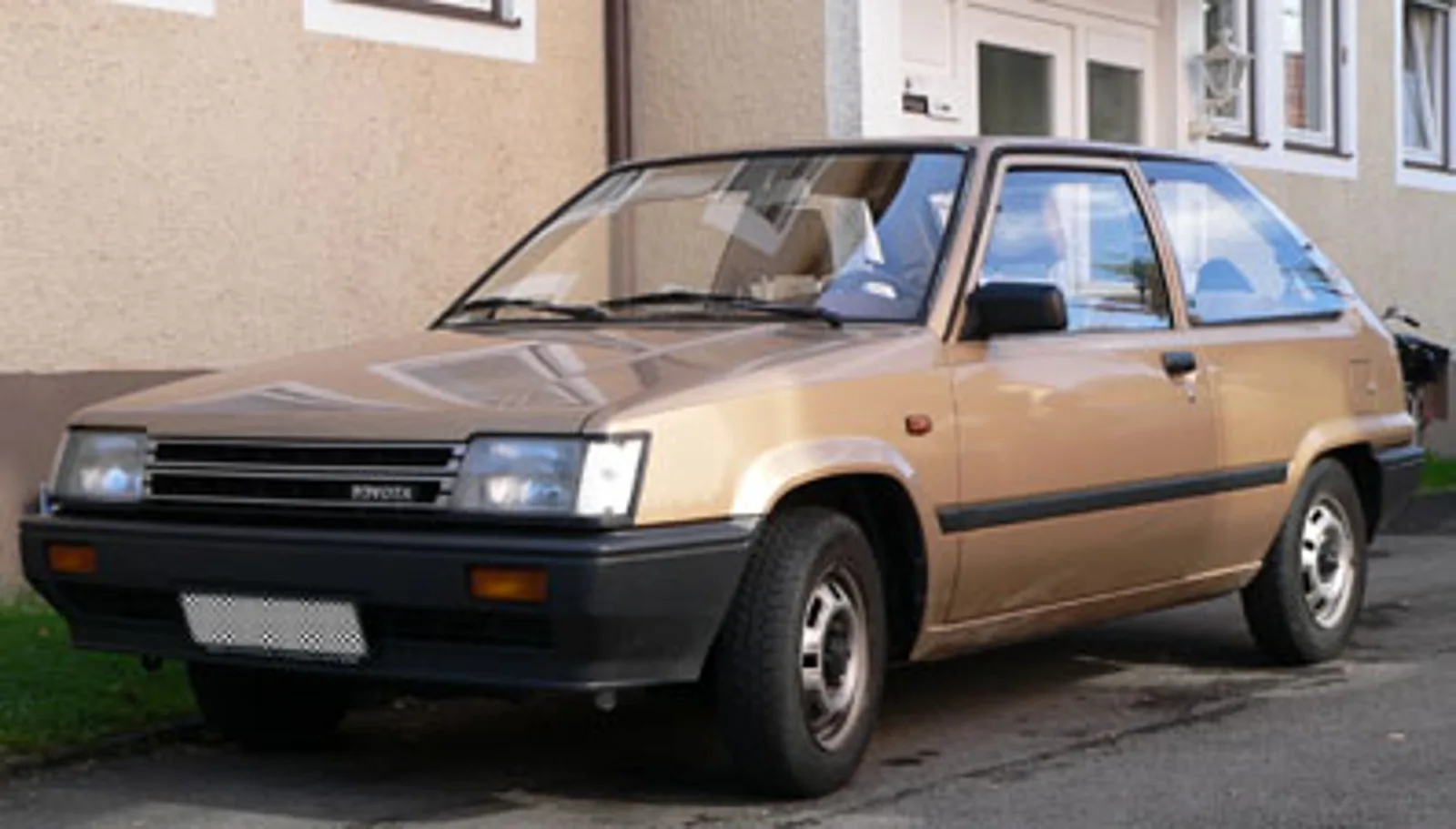
The P70 series arrived in October 1984 and switched the Starlet to front-wheel drive, which had become the normal layout for cars of this size. Hatchbacks came in three and five doors, and a three-door van was built for commercial buyers in many markets.
The P70 replaced the old K-series engines with 12-valve 1E and 2E units. Turbo models carried the 2E-TELU and were fitted with Toyota's TEMS active suspension, which set them apart from the rest of the range.
Toyota also built lightweight Turbo R and Ri models for motorsport. In export markets the 1.3-litre cars ran as 1.3 DX, XL and S, and the Si Limited had front and rear spoilers and a sporty red and black interior.
The first Starlet built outside Japan was a 1985 1.0 XL made in Indonesia, and the 1.3-litre joined the Indonesian line a year later. That local production was a sign of how far the car had moved beyond Japan. Indonesian P70 cars received the Japanese 1987 changes in 1988, while export P70s were sold as the 1.0 Standard, DX, XL and XL Lisse.
What did the P80 bring?
The P80 went on sale in Japan in December 1989 with a rounder body and interior. Japanese models received new twin-cam engines, the 4E-F and 4E-FE, along with the turbocharged 4E-FTE, while export models kept the 1E and 2E units.
The P80 reached Europe at the 1990 Geneva Motor Show. The 1.3 XLi was the main European version, and the sporty 1.3 Si was offered in Switzerland with standard sports seats, a three-spoke wheel, a sunroof and a rear spoiler.
Indonesian Starlets were five-door only and were assembled locally, which set them apart from the Japanese and European cars. In Japan the P80 range included the Soleil, Soleil L, S, X Limited, Si, a Canvas Top, the Gi and the GT Turbo. The GT had a two-mode low and high turbo, and sports bucket seats and a rear spoiler were standard on the Gi and GT.
Japan also had full-time four-wheel-drive models from August 1990, which were offered in Soleil L and X Limited grades. Japanese P80 production ended in December 1995, while Indonesia kept building the model until March 1998. Hong Kong and some European markets offered the Canvas Top with its folding roof.
What made the GT Turbo special?
The GT Turbo was the high-performance model of the fourth generation, first introduced in 1990 as the successor to the 70-series Starlet 1.3 Turbo R. It used the turbocharged 4E-FTE, which produced 135 PS (99 kW) at 6,400 rpm.
The EP82 weighed 890 kilograms (1,962 lb), which gave it a power-to-weight ratio above 100 kilowatts per tonne. Toyota's TEMS active suspension carried over from the previous generation, and the optional 14-inch alloy wheels were restyled in January 1992.
Two limited editions were made, the GT Limited and the GT Advance. Both had small changes such as different steering wheels and gear knobs, a rear strut bar and two-tone paint. Some versions had ABS, and an optional limited-slip differential was available with the C153 transaxle.
The turbocharged engine used a CT9 turbocharger. Production of the GT Turbo ended in December 1995, but its popularity continued through a cult of drivers. Many cars now run as used imports, and they are sought after in the UK and New Zealand.
How did the P90 and Glanza differ?
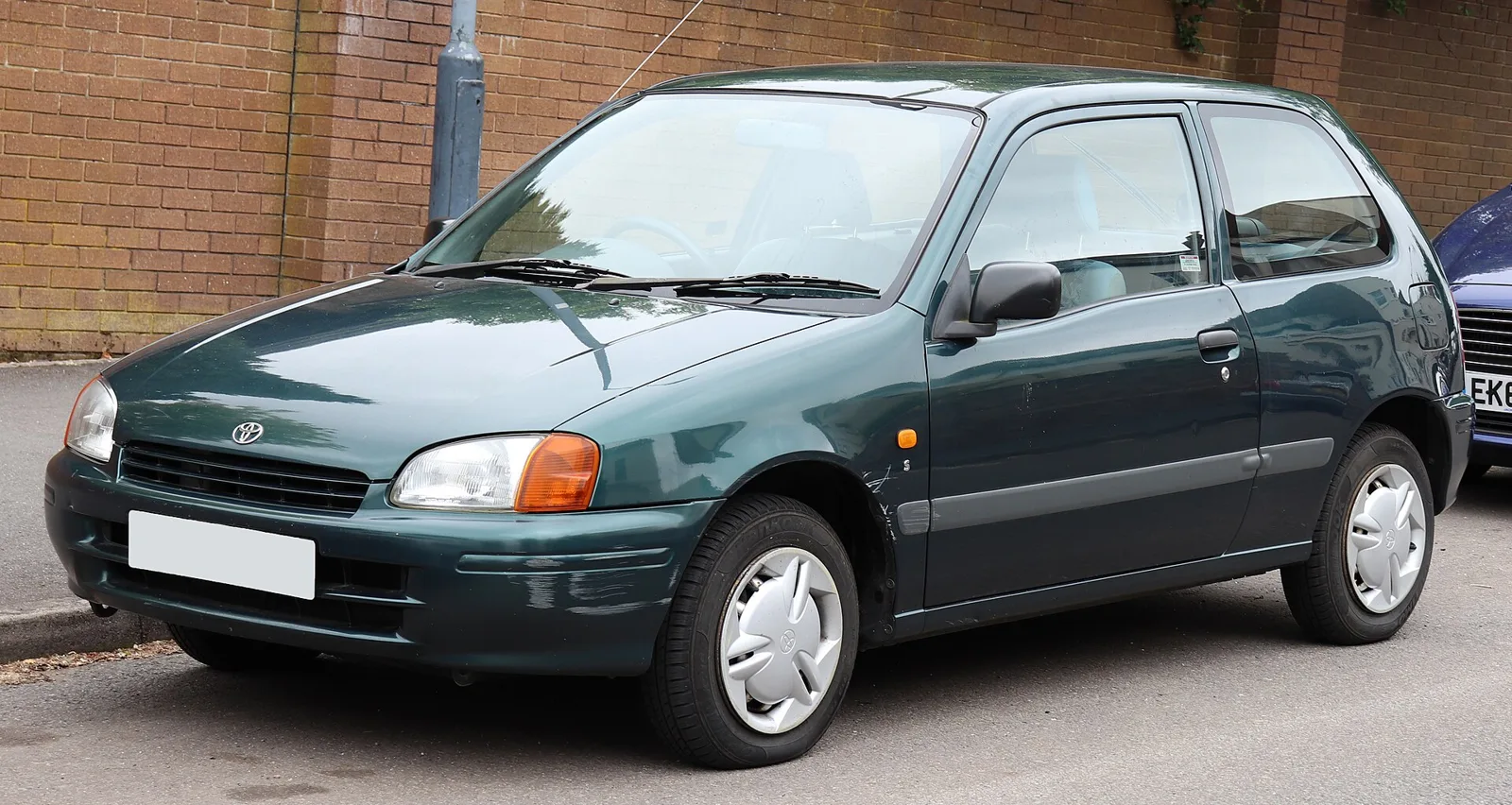
The fifth generation, the P90, was introduced in 1996 and kept the three-door and five-door hatchback layouts. The Carat was the more luxurious Japanese model, and the car shared its platform with the Paseo. Japanese versions were split into Reflet, Glanza and Carat models, and the Remix offered a rugged SUV style with over fenders and a roof rail.
The Glanza S used the naturally aspirated 4E-FE, producing 85 PS (63 kW). The Glanza V used the turbocharged 4E-FTE, whose output was 135 PS (99 kW) at the same 6,400 rpm, and viscous coupling limited-slip differentials and a rear strut bar were factory options.
In December 1996 the Glanza S Limited was released with a body kit like the Glanza V's but without the turbo. A lightweight Glanza V without air conditioning or electric windows was also available for competition use.
The EP91 reached Europe in the second quarter of 1996, with a 75 PS (55 kW) 4E-FE in 1.3 XLi form. In the UK the car started as the 1.3 Sportif, and the 1.3 CD came with a standard CD player and sunroof, and the range was later revised with the 1.3 S, SR and GLS.
Belgian buyers could choose between XS and XT trims, with the XT adding a centre console and power steering. The EP91 was the only generation sold new in Australia, from March 1996 to December 1999. Australian buyers started with Life, Group X and Style trims, and the car later dropped to a Life line as Toyota joined a price war with the Hyundai Excel and Ford Festiva.
Which variants went beyond the hatchback?
The Toyota Sera was a sport compact sold only in Japan, with a two-door coupe body, butterfly doors and the Starlet's chassis and mechanicals underneath. It was an early-1990s experiment that showed how far Toyota was willing to stretch the subcompact formula.
The Japanese-only four-wheel-drive models extended the range further, and the Limited and Advance editions of the GT Turbo gave enthusiasts two-tone paint and limited-slip options. Each variant was a reminder that the Starlet name covered far more than a single body style.
What happened after 1999?
Starlet production ended in July 1999, just after the launch of the Yaris, so the two cars briefly overlapped in showrooms. The Vitz took over alongside the bB mini MPV, and Toyota effectively left the European city car market until the Aygo appeared.
The Starlet name returned in 2020 for a rebadged Suzuki Baleno hatchback, sold in some African markets. The Glanza name had already been used in India from June 2019 for the same Baleno, produced through Maruti Suzuki.
In Indonesia the P90 was not sold, and the EP81 was instead succeeded by the Soluna sedan in 2000. The Yaris later filled that gap, and the second-generation car was marketed as a spiritual successor of the Starlet.
Did the Starlet race?
The EP81 took part in the WRC Acropolis Rally in Greece, where it won the A5 class in 1994. It also raced in the Indonesian Touring Car Championship, and it took part in rallies in the Caribbean.
The EP71, EP82 and EP91 were all raced in the Starlet One Make Race in Japan. That series showed the car's appeal as a cheap, accessible base for competition.
Starlet specification by generation
| Generation | Years | Drive | Notable engine |
|---|---|---|---|
| P40 and P50 | 1973 to 1978 | Rear-wheel drive | 1.0-litre 2K; 1.2-litre 3K-BR |
| P60 | 1978 to 1984 | Rear-wheel drive | 1.3-litre 4K; 4K-E fuel injection on Si |
| P70 | 1984 to 1989 | Front-wheel drive | 12-valve 1E and 2E; 2E-TELU turbo |
| P80 | 1989 to 1996 | Front-wheel drive | 4E-FTE turbo; GT Turbo 135 PS (99 kW) |
| P90 | 1996 to 1999 | Front-wheel drive | Glanza S 85 PS (63 kW); Glanza V 135 PS (99 kW) |