A short-wheelbase hardtop that took 80 percent of Valiant output, a Six Pack Hemi that won in New Zealand, and a company Mitsubishi bought in 1980.
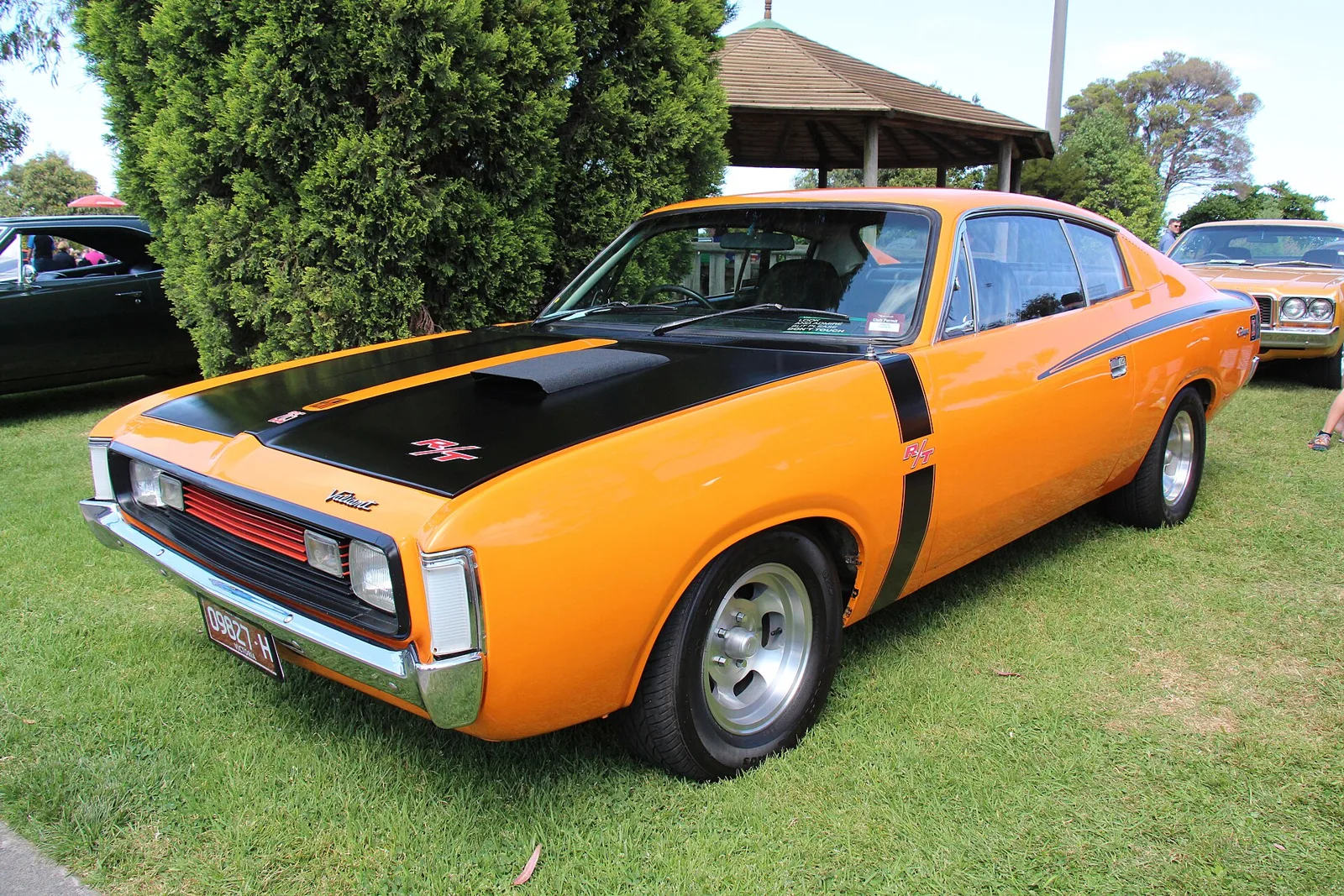
Built by Chrysler Australia from 1971 to 1978, the Valiant Charger was a sporty hardtop with Hemi-6 or V8 power and performance options such as the E49 and E55. Chrysler Australia itself was bought by Mitsubishi in 1980, and the Chrysler marque left the market in 2021.
At the height of the VH series, Chargers made up 80 percent of all Valiants built in Australia. A short-wheelbase two-door hardtop had become the biggest seller in Chrysler Australia's Valiant line.
What was the Valiant Charger?
Chrysler Australia introduced the Valiant Charger in 1971 as a two-door hardtop coupe, built on a shorter wheelbase than the Valiant sedan (105 inches). It debuted in the VH series and carried on through the VJ, VK and CL until production ended in 1978.
The name changed with the series. The VH and VJ were sold as the Valiant Charger, and the VK and CL as the Chrysler Charger. Under the skin it rode on the US Chrysler A-body platform, keeping the front suspension almost identical to the American car. The Australians widened the fenders and fitted a wider rear axle, so front and rear track were considerably wider than on any US A-body, and that made room for much wider wheels.
Wheel fitment is a detail every owner learns early. Australian Chargers used a 5-on-4.5 inch (5x114.3mm) bolt circle on 7/16-inch studs, a pattern US cars did not adopt until 1973.
Over seven years the car wore many variations of essentially two powerplants, one based on the Chrysler Hemi-6 and the other on versions of the Chrysler LA V8. The styling was distinctive and sporty, and included an integrated rear spoiler.
At one point Charger production totalled 80 percent of all Australian Valiant production.
Why did the Charger sell so well?
It arrived to applause. Wheels magazine named the VH Valiant Charger its 1971 Car of the Year. In the sales race it captured the Australian imagination in the way the Ford Mustang did in the United States and the Ford Capri in Britain. It also found buyers in New Zealand, where Chargers were assembled from imported kits.
Prices tell part of the story. The base Charger cost about A$2750, and the range climbed through luxury and performance versions up to $4850.00.
What was in the VH Charger range?
The VH range of 1971 consisted of the Charger, Charger XL, Charger 770 and the Charger R/T, which stood for Road/Track. The R/T carried on the performance image of the VG Valiant Pacer and quickly became Chrysler's platform for production car racing. The spread of models was meant to appeal to every sort of buyer.
| Model | Price | Power | Engine | Gearbox |
|---|---|---|---|---|
| Charger | $2795.00 | 140 bhp (100 kW) | 215 cu in (3.5 L) | 3-speed manual |
| Charger XL | $3195.00 | 160 bhp (120 kW) | 245 cu in (4.0 L) | 3-speed manual |
| Charger R/T | $3395.00 | 218 bhp (163 kW) | 265 cu in (4.3 L) | 3-speed manual |
| Charger R/T E38 | $3975.00 | 280 bhp (210 kW) | 265 cu in (4.3 L) | 3-speed manual |
| Charger R/T E49 | $3975.00 | 302 bhp (225 kW) | 265 cu in (4.3 L) | 4-speed manual |
| Charger 770 | $3625.00 | 203 bhp (151 kW) | 265 cu in (4.3 L) | 3-speed automatic |
| Charger 770 | $4105.00 | 230 bhp (170 kW) | 318 cu in (5.2 L) V8 | 3-speed automatic |
| Charger 770 SE E55 | $4850.00 | 275 bhp (205 kW) | 340 cu in (5.6 L) V8 | 3-speed automatic |
The Six Pack and the E49
The R/T option E37 offered a tuned Six Pack version of the six, with three sidedraught Weber carburettors. It formed the basis of Chrysler's 1971 touring car and could be ordered on any model. The E49 used the same 265 cu in engine, and its seven-bearing design was said to give such strong torque that no production six matched its power until the Porsche 911 Turbo of 1975.
What was the story of the 340 V8?
The Charger 770 SE carried the E55 option, a 340 cu in four-barrel V8, and the car's origins were disputed from the start. Motoring journalists reported at the time that Chrysler had imported the engine for an aborted touring car homologation exercise. Racing manager John Ellis said that a ute with the 340 had been tested at Mallala in South Australia by Leo Geoghegan, and that it ran 2 to 3 seconds slower than the E49 because the heavy V8 caused severe understeer and demanded earlier braking. The extra power, it was expected, would have suited the straights and climbs at Bathurst. Ellis nevertheless said the engines had not been imported for Bathurst and that an R/T 340 Charger was not being considered, a statement later shown to be wrong.
In fact 336 of the 340 cu in V8 engines, with four-speed gearboxes, had been imported by Colin Adey on direct orders from chief engineer Walt McPherson. General manager David Brown and McPherson had talked through the shortcomings of the 265 E49 and chosen the 340 as the next R/T touring car, news that never reached Ellis. Bad press killed the programme, and Chrysler recovered its outlay by fitting the stock of engines to the upmarket 770 SE.
That fitting came with trimmings. The SE got an imported Torqueflite 727 automatic and a single-pipe exhaust that watered down the engine's output. It also had a turned-metal dashboard, black and white or maroon vinyl trim, and a choice of just three colours: Vintage Red, Limelight and Sunfire. Production records show 125 were made, two painted white and one Deep Maroon.
How did the Charger do in racing?
Chrysler raced the Valiant Charger officially in 1971 and 1972, mostly in a touring car series and at the annual Bathurst 500 mile race. It hired Leo Geoghegan to help develop the car, and the Charger won the first race it entered, the Toby Lee 100 at Oran Park, with Doug Chivas driving.
At Bathurst in 1972, Chivas took a VH Charger R/T E49 to third overall, behind Ford's XY Falcon GTHO and Holden's Torana XU-1. The Falcon was far too quick, some 6 seconds a lap faster, with brake pad trouble hurting the Chrysler. Chrysler's official involvement in Australian touring car racing stopped after the 1972 season.
New Zealand was kinder. Touring car rules there were less open, and from 1971 to 1979 the Charger proved unbeatable at the B&H 500 mile race, later a 1000 km event, at Pukekohe Park Raceway. Leo Leonard and Jim Little were the most successful drivers. Allan Moffat, in the Falcon GTHO, found the Charger far too quick there and called the winning car "The Fastest Charger in the World".
How did the VJ, VK and CL differ?
VJ (from March 1973)
The VJ replaced the VH in March 1973. Cowl, grille, lights and rear quarter panels changed, and 7-inch round headlights replaced rectangular units. Except for four cars built as E49s, the new range marked the end of the R/T, which fitted the timing of Chrysler's departure from touring car racing. The Six Pack lived on as the E48 street-tune option, with three two-barrel Webers and a four-speed manual.
E55 cars lost the SE label, and the only outward clue to the 340 was a "340 4BBL" badge on the front guards. When stocks of that V8 ran out, the 360 cu in (5.9 L) V8 from the Chrysler by Chrysler sedan arrived in late 1974 as option E57, with 255 bhp (190 kW).
Electronic ignition replaced points, which made cold starts easier and ended the need to retune the ignition every 10,000 km or so. Carburettors were less tidy: some cars had the Carter ThermoQuad, which raised flow from 625 cfm to 800 cfm, while others kept the older AVS, and the date of the changeover is unknown. The heads also changed, with inlet valves falling from 2.02 inches to 1.88 inches at an unknown point.
In August 1974 Chrysler built 500 limited-edition Charger Sportsman cars (option A23) on the XL, in Vintage Red and white with cloth trim, the standard 265 engine and a four-speed manual.
VK and CL (1975 to 1978)
The mildly revised VK, released in October 1975, came in just two variants, the XL and the 770. The Six Pack was gone and only the basic 4.3 L engine remained. The car was now the Chrysler Charger, with Chrysler script replacing Valiant on the badges, a white-out grille and revised tail-lights. In June 1976 the emissions rule ADR 27A removed both the 3.5 L engine and the 5.9 L V8. Chrysler released 200 White Knight Special XLs after July 1976, in Arctic White or Amarante Red.
The CL appeared in late October 1976 as the last Charger built in Australia. It was expected to be called VL, but became CL to reflect the Chrysler name now used across the range. The XL was deleted except for police duties, leaving only the 770 for the public, and the late Drifter pack offered four colours: Spinnaker White, Impact Orange, Sundance Yellow and Harvest Gold. Production stopped on 16 August 1978.
Where did Chrysler Australia come from?
Chrysler Australia Ltd came into being in June 1951, when Chrysler Corporation bought Chrysler Dodge Distributors (Holdings) Pty Ltd, a business that 18 independent distributors had formed in 1935. It consolidated assembly in Adelaide and built an aircraft division making parts for Canberra bombers and Jindivik drones. Its most popular 1950s cars were a badge-engineered trio based on the 1954 US Plymouth, and in 1957 these merged into the Chrysler Royal, which sales could not rescue as Holden surged. It ceased in 1963.
The saving grace was the French Simca Aronde, assembled from kits at Forestville. A new plant at Tonsley Park opened in 1964 and an engine factory at Lonsdale in November 1967, and Chrysler Australia secured its place as the third of the Big 3 behind Holden and Ford.
The Valiant began as an American Plymouth assembled from 1962, and by 1963 the AP5 Valiant had a local look, since local managers worried that Australia could not afford to restyle as fast as the US and might be accused of selling "last year's model". In 1966 Chrysler USA bought Britain's Rootes Group, and Chrysler Australia took over Rootes Australia and its Port Melbourne factory too, and the Hillman Hunter became a steady seller until 1973.
Then came the Hemi. Introduced in 1970 with an endorsement from Stirling Moss, this six-cylinder engine was unique to Australia. With triple Webers it became the most powerful six produced in the country, and although based on a US truck engine design it was never built in North America.
What went wrong in the 1970s?
The Valiant sold well but never matched the acceptance enjoyed by the Holden and the Falcon. By the mid-1970s sales stalled. The oil crisis pushed buyers to small economical four-cylinder cars, Japanese competitors, whose speciality those cars were, gained ground, and the Valiant looked dated despite a major facelift in 1971 and lighter ones in 1973 and 1975. A significant facelift in 1976 stopped the slide, and the Valiant sold steadily until 1981.
The 1975 Centura, offered with a 2-litre four or a 3.5-litre or 4-litre six, was meant to take on the Holden Torana and Ford Cortina. It was based on the European Chrysler 180, and embargoes on French imports, imposed because of French nuclear tests in the Pacific, held up the launch for several years. By the time it arrived it looked dated, and it vanished by the end of 1978.
How did Mitsubishi take over?
Chrysler Australia's parent began working closely with Mitsubishi Motors after Mitsubishi bought a 15 percent stake in 1971, and Chrysler Australia started building the Mitsubishi-designed Valiant Galant. The 1977 Chrysler Sigma, with 4-cylinder Silent Shaft engines, sharp pricing, Japanese styling and an SE version with optional leather, brought a sales comeback and soon led its class.
In 1979 the two Mitsubishi companies, Motors Corporation and Corporation, took one sixth each, and in April 1980 they bought the rest from the US Chrysler Corporation, then in bailout negotiations with the American government. The business became Mitsubishi Motors Australia Limited on 1 October 1980. Valiants with Chrysler badges were built until August 1981, and Sigma production carried on under Mitsubishi's own name to 1987, then Colt, Magna, Verada and 380 cars followed until passenger vehicle production ended in March 2008.
What is left of Chrysler in Australia?
Chrysler came back in 1994, importing the Jeep Cherokee first and then the Neon, Grand Cherokee, PT Cruiser, Crossfire, 300C, Voyager and others. The 300C found a niche as an alternative to extended-wheelbase Australian prestige cars, the Holden Statesman and Caprice and the Ford Fairlane and LTD. In 2012 the company took over Alfa Romeo and Fiat distribution, and in 2013 RAM trucks arrived, converted in Australia by ASV, in Clayton, Victoria, at the Holden Special Vehicles site.
Chrysler withdrew the marque from Australia on 19 November 2021, when its only model, the 300, was discontinued. The Stellantis subsidiary for Australia and New Zealand, formerly FCA Australia, now distributes Leapmotor, Fiat, Alfa Romeo, Abarth, Dodge, Jeep and Chrysler vehicles.
What should a Charger buyer know?
Production records give 125 for the 770 SE, 500 for the Sportsman, 200 for the White Knight Special and four VJ E49s. Mechanical details vary even within a model: carburettor, valve size and ignition all differ from car to car in the VJ, and the changeover dates are unknown. Track and wheel bolt pattern, meanwhile, set Australian Chargers apart from US A-body cars.