A Canadian-born driver who became one of Australia's dominant touring car stars with Ford, won four Bathurst races and then turned his Ford and Mazda successes into a long Holden and European career.
Moffat, born in Saskatoon, won four ATCC titles and four Bathurst races. He also took the 1975 Sebring 12 Hours in a BMW and drove for Ford, Mazda and Holden before retiring after his 1989 Fuji win. His career ran from 1960s Trans-Am racing to a long rivalry with Peter Brock.
Allan Moffat was a Canadian-born driver who became one of Australia's leading touring car champions, winning four Australian Touring Car Championship titles and four Bathurst races. He also won the 1975 12 Hours of Sebring with BMW, and his rivalry with Peter Brock defined much of Australian touring car racing in the 1970s and 1980s.
Where did Allan Moffat come from?
Moffat was born in Saskatoon, Saskatchewan, on 10 November 1939, the eldest of three sons. His father worked as an executive at Massey-Harris, and the family moved around for business, so Moffat spent his teenage years in Vereeniging, South Africa, and his college years in Melbourne, Australia.
At Monash University he studied marketing on a Volkswagen cadetship, but he gave up his studies to race amateur events in a Triumph TR3. Short of money, he went back to Canada and sold door to door in Toronto before meeting Team Lotus mechanics at Watkins Glen in 1964.
Four ATCC titles, four Bathurst wins and a Sebring triumph, all before a Holden and European chapter that closed with a Fuji win.
How did Moffat start in touring car racing?
His first ATCC start came in 1965, in a Lotus Cortina. Earlier, in 1964, he had shared a Ford Cortina Lotus with Jon Leighton to fourth place at the Sandown 6 Hour, the first race that later became the Sandown 500.
In 1966 he raced in the United States Trans-Am Series and won the Bryar 250 at Bryar Motorsports Park in an Under 2L Lotus Cortina, leading home Bruce Jennings by more than a lap. He then drove Ford Mustangs for Carroll Shelby, and he raced a Mercury Cougar for Bud Moore Engineering in several Trans-Am events.
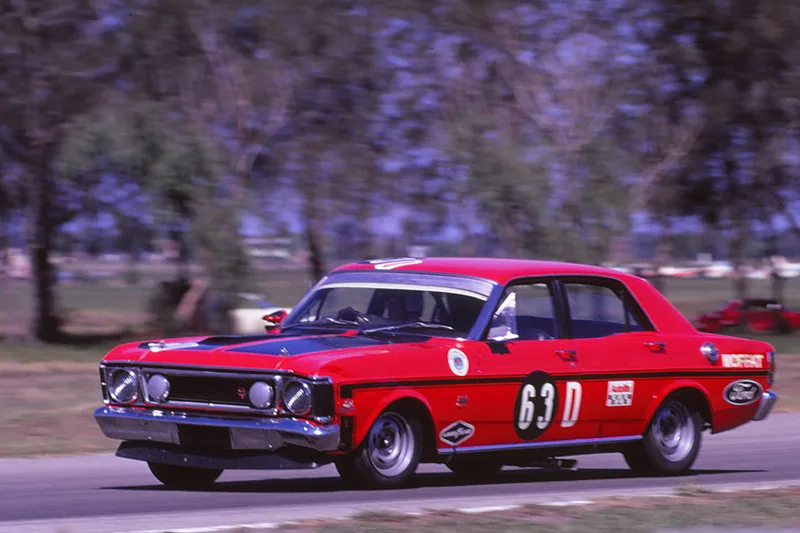
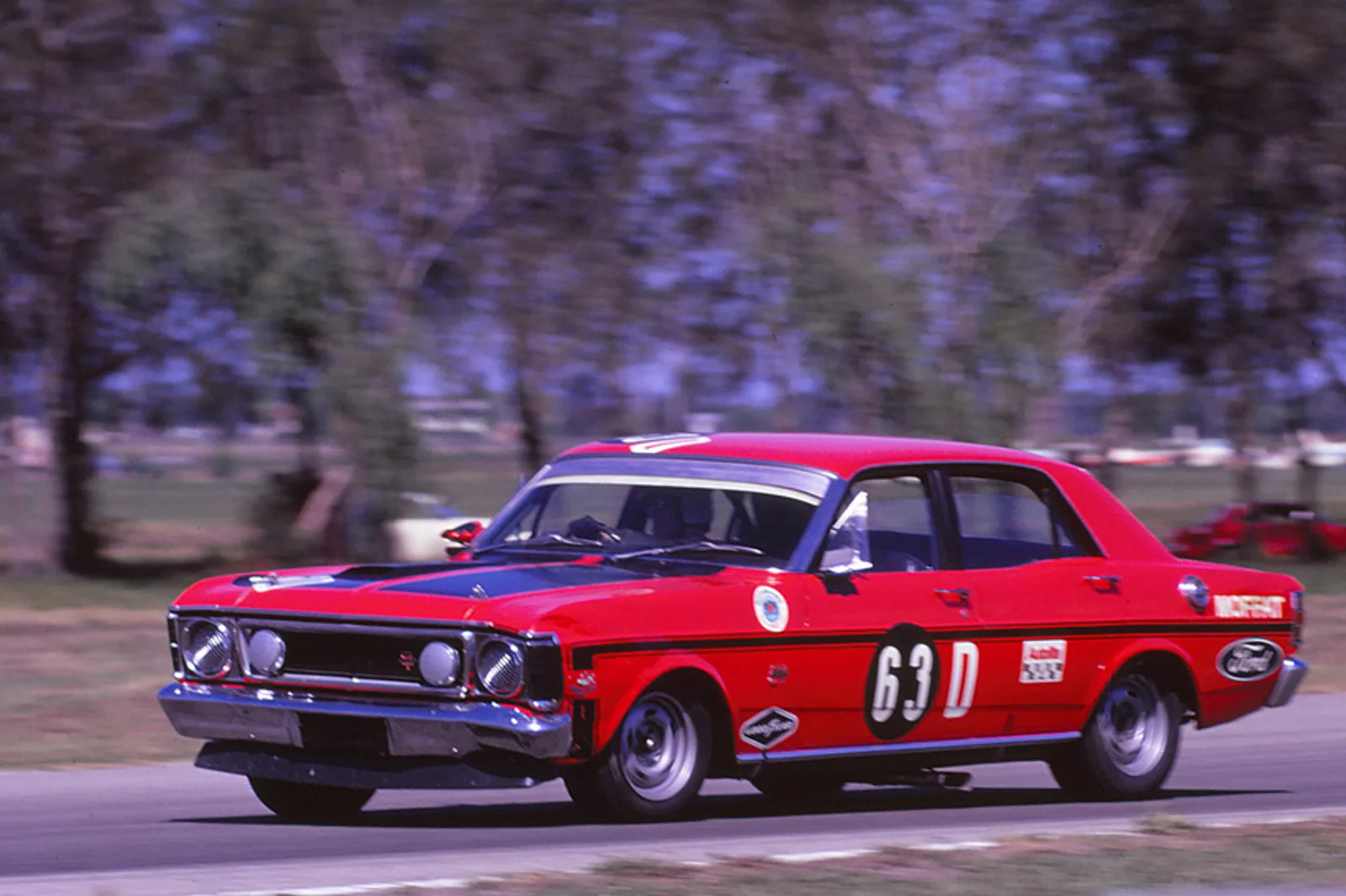
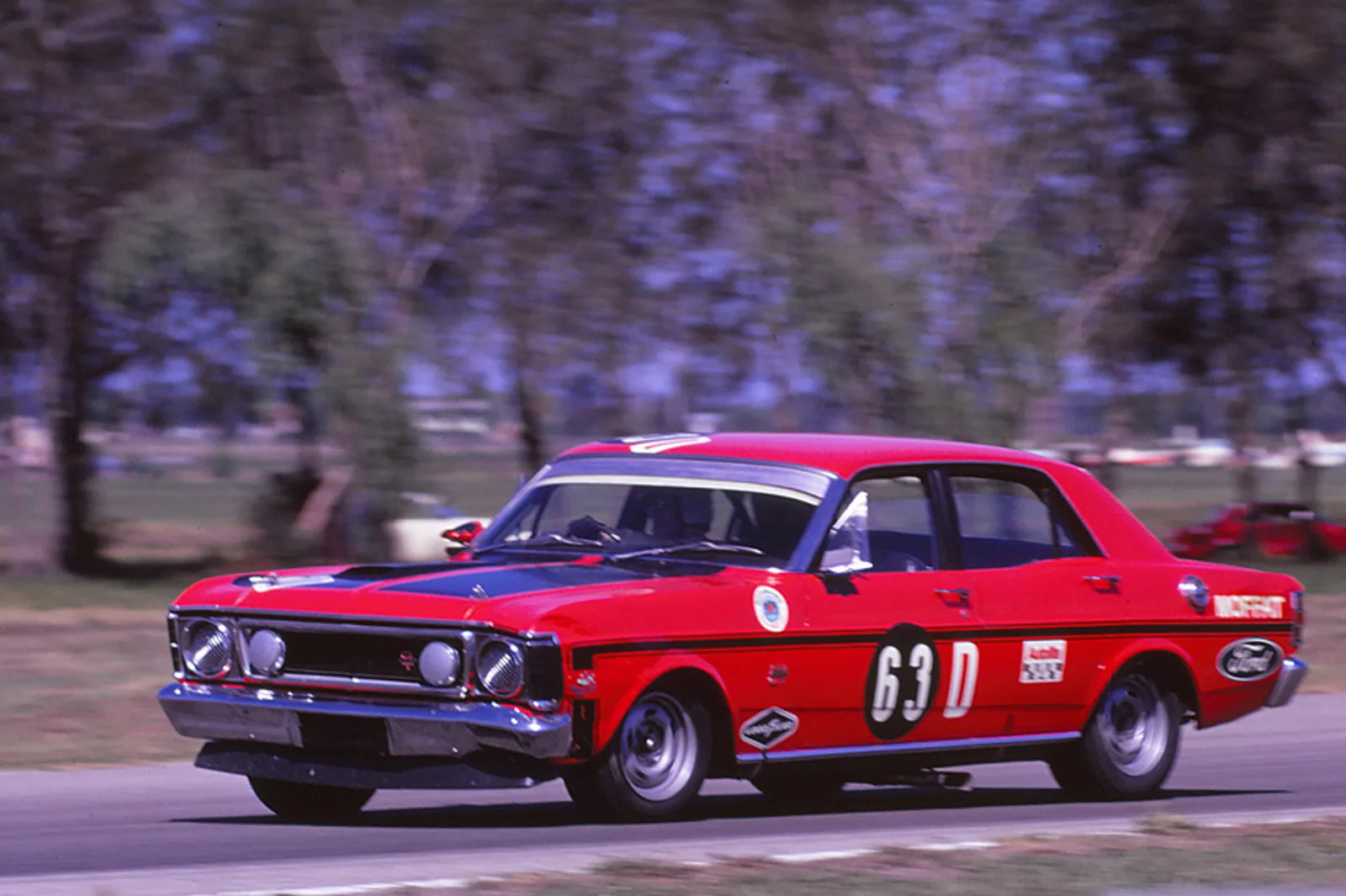
By 1969 he had settled back in Australia and was a regular in a vivid red Coca-Cola-backed Ford Boss 302 Mustang.
What made the Boss 302 Mustang years important?
The Boss Mustang was supplied new from Ford's American race car facility and finished by Bud Moore Engineering. With Tom Hamilton and chief mechanic Lou Mallia's support, he took 101 touring car victories, title and non-title, across 151 outings from 1969 to 1972. The first of those wins came at the Southern 60 at Sandown in May 1969.
The ATCC title eluded him in the Mustang. The title stayed out of reach: outside the top ten in 1969, sixth in 1970, runner-up in 1971 and third in 1972. The seasons still showed how fast he was, and they set up his switch to the Ford Falcon GTHO in the years that followed.
How did the Falcon GTHO years make Moffat dominant?
Moffat made his Bathurst debut in 1969 in a Ford works Falcon XW GTHO, finishing fourth with Alan Hamilton. In 1970 and 1971 he drove the Falcon without a co-driver to victory in both Bathurst races. He also took the 1970 Rothmans 250 Production Classic, and in 1971 he was the first to lead the Bathurst 500 from flag to flag.
The 1971 ATCC finale at Oran Park was one of the most memorable races of the era. Moffat went into the seventh and final round only four points behind three-time champion Bob Jane. He lost time to a jammed gearbox but battled back to finish six-tenths of a second behind Jane.
In 1972 he raced Ian Geoghegan's more powerful Super Falcon at the Easter round at Bathurst. He stayed within reach on the handling and brakes, and lost by less than a second. Afterwards he protested the Falcon over oil on his windscreen, but the protest was dismissed.
How did the 1972 Phase IV controversy shape the rivalry with Brock?
Ford had planned a faster Phase IV Falcon GTHO for 1972, and Moffat looked set for a third straight Bathurst win. A Sydney motoring journalist's report about the car's speed caused a public outcry, and the government and media pressure led Ford to scrap production of the Phase IV.
Moffat and the other Ford drivers were forced to race year-old Phase III cars at Bathurst that year. Peter Brock won for Holden after wet weather and brake problems hobbled the Fords. Many see that race as the opening chapter of the Moffat-Brock feud, which shaped touring car racing for years.
How did Moffat win Bathurst in 1973 and 1977?
In 1973 Moffat won the ATCC title, his first, and he won the Hardie-Ferodo 1000 with Ian Geoghegan. The pair were the first winners of Bathurst after the race was converted from 500 miles to 1000 kilometres. That year Ford's factory teams withdrew, and Moffat continued as a privateer.
His 1977 Bathurst win came with Jacky Ickx, the Belgian Formula One driver and four-time Le Mans winner. Colin Bond finished second in the sister Ford, and the two cars crossed the line side by side in a 1-2 that many still regard as Ford's finest hour in Australian motor sport.
What was Moffat's 1975 Sebring win?
Moffat shared a BMW 3.0CSL with Hans-Joachim Stuck, Brian Redman and Sam Posey, and the four-driver effort took the 12 Hours of Sebring for BMW Motorsport in March 1975. Many regard it as the crowning achievement of the 3.0CSL in racing.
That year he was a privateer in the ATCC and had limited success at Bathurst. His Sebring win came in an international event, which showed the strength of his reputation beyond Australia.
Why did Moffat leave Ford for Mazda?
In 1981 he left the Blue Oval brand for a Peter Stuyvesant-backed Mazda RX-7, as the series moved towards lighter cars with less raw power. Between 1981 and 1984 he finished in the top six at Bathurst four times in a row, including second in 1983 and third in 1984.
His Mazda years included wins in the 1982 and 1984 Australian Endurance Championships. He also took a class win at the 1982 24 Hours of Daytona with Lee Mulle and Kathy Rude, and he finished sixth in class at Le Mans in 1982.
How did Moffat win his fourth ATCC title in 1983?
In 1983 Moffat turned down a factory drive at Le Mans because the final ATCC round at Lakeside fell on the same weekend. A fifth-place finish or better was all he needed to take the title. He finished third behind Peter Brock's HDT Commodore, and his RX-7 teammate Gregg Hansford was second, which was enough for the championship by six points.
His title came in a close fight, but 1984 proved frustrating. He finished third at Sandown, claimed pole at Symmons Plains but retired on lap one with a rotary engine failure, and then crashed out of the championship at Surfers Paradise. The crash fractured his sternum and broke a finger, and the RX-7 was written off.
He returned after the crash to win the Valvoline 250 at Oran Park with Hansford, despite suffering from flu. The result came in a season that also saw him record a second place at the Surfers Paradise 300.
How did Moffat's Holden and European years go?
In 1985 Moffat sat out the Australian touring car season, taking commentary work and testing cars for television coverage. In 1986 he joined the Holden Dealer Team alongside his longtime rival Peter Brock, and the pair won the Wellington 500 in a new VK Commodore SS.
The Holden team also raced in Europe, where Moffat and Brock took fifth places at Donington and Hockenheim. At the 1986 Spa 24 Hours the team won the Kings Cup prize for the best overall team placings, even though Moffat's car finished 22nd after two head gasket failures.
In 1987 Moffat left the HDT and bought a new VL Commodore SS to race in the World Touring Car Championship. He finished seventh on the road at Monza and was declared the winner after the works BMWs were disqualified, although the team had not paid the championship entry fee and received no points. At Spa he and John Harvey took fourth outright and a class win.
How did Moffat's career end?
In 1988 he turned to a Ford Sierra RS500 built by Swiss tuner Ruedi Eggenberger. With Gregg Hansford, he won the Enzed 500 at Sandown, which was his last win in Australia. At Bathurst the car was running strongly until a head gasket failure ended the race on lap 129 of 161.
His last race win came in 1989 at the InterTEC 500 km at Fuji Speedway in Japan, driving with Klaus Niedzwiedz. He then retired from competitive driving, keeping a promise he had made that he would not race beyond his 50th birthday. The Fuji race was held two days after his 50th.
What did Moffat do after retiring?
Moffat ran Allan Moffat Enterprises, which kept the RS500 Sierras racing until Group A ended in 1992. The team later built an EB Falcon for Bathurst in 1993, which retired after 41 of the race's 161 laps, and in 1994, with engines supplied by Dick Johnson Racing, it finished eighth.
He also worked as a television commentator for Channel 7, and he was a spokesman for BMW. In 2004 he received Australian citizenship at a ceremony in Melbourne, having been eligible since the early 1970s, and Peter Brock gave the citation.
What is Moffat's legacy?
Moffat is remembered for four ATCC championships, four Bathurst wins, six Sandown 500 victories and his Sebring win. He was one of only two drivers to win the Bathurst race in both its 500-mile and 1000-kilometre formats, alongside Peter Brock.
The V8 Supercars Hall of Fame recognised him in 1999, and the Sport Australia Hall of Fame followed in October 2018. In 2019 it was reported that he had been diagnosed with Alzheimer's disease, and he died in Melbourne on 22 November 2025 at the age of 86.
Season by season, how did Moffat's career progress?
| Period | Car or team | Main result |
|---|---|---|
| 1969 to 1972 | Ford Boss 302 Mustang | 101 wins from 151 starts; ATCC second in 1971 |
| 1970 and 1971 | Ford Falcon GTHO | Bathurst wins without a co-driver |
| 1973 | Ford privateer | ATCC title; Bathurst win with Geoghegan |
| 1975 | BMW 3.0CSL | 12 Hours of Sebring win |
| 1976 | Ford XB Falcon GT Hardtop | ATCC title |
| 1977 | Moffat Ford Dealers Team | ATCC title; Bathurst win with Jacky Ickx |
| 1981 to 1984 | Mazda RX-7 | ATCC title in 1983; Bathurst top six each year |
| 1986 to 1987 | Holden Dealer Team and privateer | Wellington 500 win; Spa 24 Hours class win |
| 1988 and 1989 | Ford Sierra RS500 | Enzed 500 win; Fuji win in 1989 |