Ford and Holden have won all but six Bathurst 1000s. How a dealer team, a scrapped Falcon and a side-by-side finish built a tribal war.
The Holden against Ford rivalry is Australia's contest between two home-grown car makers, fought at the Bathurst 1000, where they have won all but six races. Holden leads 34 to 21, and the feud was personified by drivers Peter Brock for Holden and Allan Moffat for Ford.
Ford and Holden between them have won all but six runnings of the Bathurst 1000. That one statistic, from the race fans call The Great Race, explains why a motor race on a mountain became a tribal war.
What is the Holden against Ford rivalry?
It is the contest between Australia's two home-grown car makers, fought most visibly at Mount Panorama. Holden has won the Bathurst 1000 34 times and Ford 21. Nissan is the only other make to win more than once, with 2. For the races of 1995 to 2012 the rules allowed only Ford Falcons and Holden Commodores to compete.
The scale of that rivalry shows in the rules as well as the results. In 2013 the regulations changed and other marques began to enter, including the return of past winner Nissan. Until then the sport had been built around two badges.
Ford and Holden between them have won all but six runnings of the Bathurst 1000.
How did Bathurst become the battleground?
It started as a race for ordinary cars. The Armstrong 500 was first held on 20 November 1960 at Phillip Island over 500 miles, for standard production saloons, and moved to Bathurst in 1963. The cars had to be the same as those on the showroom floor, so a win doubled as an advertisement. Makers used it to show off their products, and a result in such a long and tough event added credibility to the car and its brand.
Small cars dominated at first. Cortinas and Mini Coopers took early wins, and in 1966 a Mini Cooper S won what proved to be the last four-cylinder victory for more than two decades. Then the rules changed. A minimum number of pit stops was introduced in 1967, which favoured larger, thirstier Fords and Holdens, and Ford's V8 Falcon GT won that year. The result gave Australia an adage that still sums up the mountain: there is no substitute for cubic inches.
This was also when the "Big Three" rivalry between Holden, Ford and Chrysler took shape. The road-going cars it produced became known as Bathurst Specials: the Falcon GT and later GT-HO, the Holden Monaro and Torana, and the Chrysler Pacer and Charger. Holden won for the first time in 1968 with the Monaro GTS 327, a coupe with a 327 cubic inch Chevrolet V8. In 1969 Ford introduced the Phase One GT-HO with a 351 cubic inch V8 and Holden answered with the GTS 350. After a multi-car accident on lap one, the Monaro of Colin Bond and Tony Roberts held off the Falcons, whose tyres failed in numbers, and Ford later made a joke about deflation in its own advertising.
Why did Holden start a dealer team?
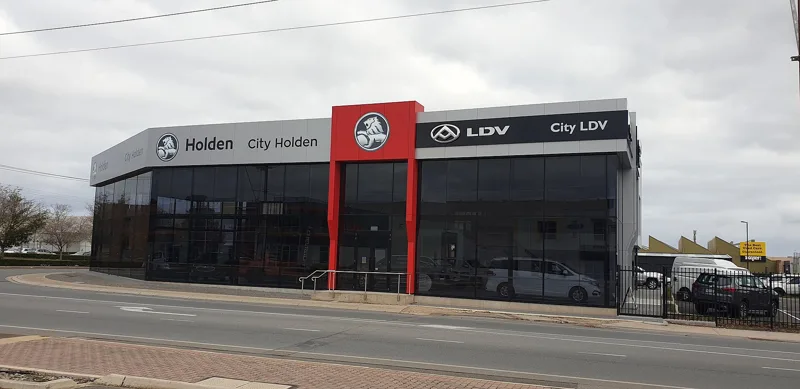
General Motors, Holden's parent, forbade its manufacturers from officially entering circuit racing worldwide. Holden's way around the ban was clever. It called the squad the Holden Dealer Team and had it officially owned by its dealers, while Holden paid for everything. Executive John Bagshaw built the financial arrangement that kept the funding out of sight in Detroit, and Holden hired the former Ford Works Team manager Harry Firth to run it.
The team made its debut at the 1969 Sandown 3 Hour. Later that year Firth hired two untested drivers, Colin Bond and Peter Brock, for the Hardie-Ferodo 500. They formed the backbone of the team for years.
Ford's Falcon GT-HO, with its V8, proved hard to beat, so in 1970 Firth turned to a smaller six-cylinder car, the Torana GTR XU-1. It matched the Falcon at most circuits but was weaker on the long straight and steep climb at Bathurst. Allan Moffat won the 1970 and 1971 races for Ford. In the wet 1972 race, Brock broke through in an LJ Torana, in a solo drive, for the first of his nine wins.
Behind the scenes Firth developed a V8 version of the Torana to take on Ford's anticipated Falcon Phase IV. Four prototypes were built and none survived, because Holden crashed them to recoup the costs, and Firth said he lost about A$55,000 of his own money. Brock himself claimed the car was faster in a straight line but handled terribly, and that the first time he and Bond used full throttle in testing, the torque cracked the windscreen.
The payoff came with the L34 Torana. It finished first, second and third at Bathurst in 1975 and took the first seven places in 1976. The A9X followed in 1977, though teething problems let Moffat's Ford team beat it that year. Firth retired at the end of 1977, 59 years old, frustrated that Holden was not listening to his advice.
Who was Allan Moffat?
Moffat was born in Saskatoon, Canada, and raced as an Australian. He won the Australian Touring Car Championship four times, the Sandown 500 six times and the Bathurst race four times, and also won the 1975 12 Hours of Sebring in a BMW. He was inducted into the V8 Supercars Hall of Fame in 1999.
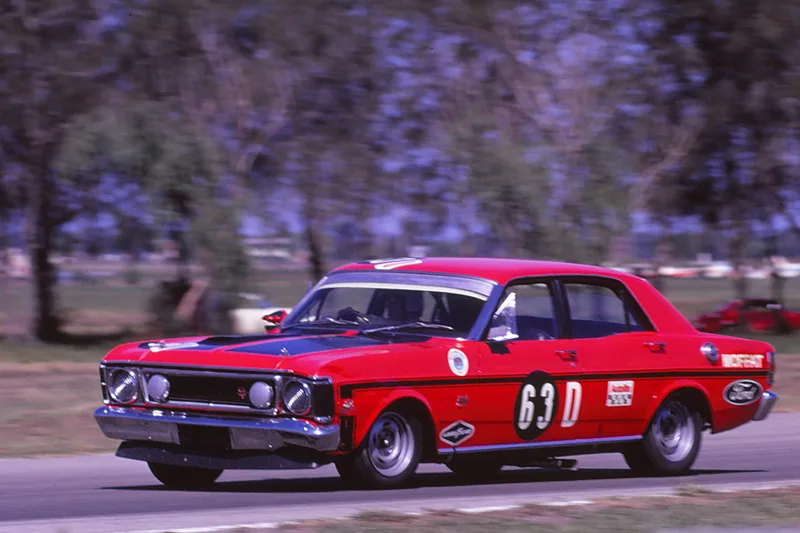
His bright red Boss 302 Mustang won 101 races from 151 starts between 1969 and 1972. It could not run at Bathurst, which was limited to standard production cars before 1973, so he made his debut there in a Falcon GTHO in 1969 and finished fourth. In 1971 he became the first driver to lead the race from start to finish, in the Falcon GTHO Phase III.
Two of his near misses are remembered. In the last round of the 1971 championship at Oran Park he arrived four points behind Bob Jane's Chevrolet Camaro ZL-1, started on pole and finished only six-tenths of a second behind. And at the Easter round of the 1972 championship at Bathurst he drove more than half the race with his belts undone, so he could put his head out of the window, because a small oil leak on Ian Geoghegan's Falcon was spraying his windscreen. His protest after losing by less than a second was dismissed.
What was the Supercar scare?
In 1972 Ford planned a Phase IV Falcon GTHO, even faster than the Phase III that had given Moffat his 1971 win. Motoring journalist Evan Green learned of it, and his story ran under headlines across the country that screamed that 160mph supercars were coming to Australian roads. Entering the car at Bathurst required at least 200 units to be sold at dealerships, and with media and government pressure mounting, Ford scrapped the car. Moffat and the other Ford drivers had to use year-old Phase III cars.
Brock won that year for Holden, after wet weather and brake trouble hobbled the Fords. The race is seen as the start of the Moffat and Brock rivalry that dominated Australian touring car racing for years afterwards. Ford, smarting from the controversy, withdrew its factory teams from competition at the end of 1973, leaving Moffat to run his own privateer team. Even so, he won the 1973 championship, his first, and the 1973 Hardie-Ferodo 1000 with Ian Geoghegan, making them the first winners after the race moved from 500 miles to 1,000 km.
Brock and Moffat compared
| Peter Brock | Allan Moffat | |
|---|---|---|
| Lifespan | 26 February 1945 to 8 September 2006 | 10 November 1939 to 22 November 2025 |
| Bathurst wins | Nine | Four |
| Australian Touring Car Championships | Three | Four |
| Sandown 500 wins | Nine | Six |
| Hall of Fame | V8 Supercars, 2001 | V8 Supercars, 1999 |
| Best known with | Holden | Ford |
What happened in 1977?
By 1977 the rivalry had sharpened. Colin Bond, who had driven eight years for the Holden Dealer Team, switched to Moffat's two-car factory-supported Ford team. Moffat won his second straight championship, and then, with the Belgian Jacky Ickx as co-driver, led the Hardie-Ferodo 1000 with Bond and Alan Hamilton in the second car. Late in the race Moffat's car developed brake trouble from Ickx's hard driving, and Bond caught up. The two Falcons completed the last two laps side by side, crossing the line together with Moffat just in front.
That finish is remembered as one of the most famous moments in Australian motorsport, and many still regard it as Ford's finest hour. Moffat received an Order of the British Empire the following year for services to motor sport.
How did Brock become the King of the Mountain?
Brock first visited Bathurst in 1966 on leave from National Service, watched the 500-mile race, and decided to become a race driver. He debuted there in 1969, finishing third. Between 1972 and 1987 he won nine times, a feat no one has equalled, and he took pole position a record six times. That record earned him the nickname King of the Mountain.
His 1979 win with Jim Richards came by six laps, and on the 163rd and final lap he broke the circuit lap record for touring cars. The margin may never be beaten, because the Safety Car was introduced in 1987. He won three in a row from 1978 to 1980 with Richards, and again from 1982 to 1984 with Larry Perkins and John Harvey.
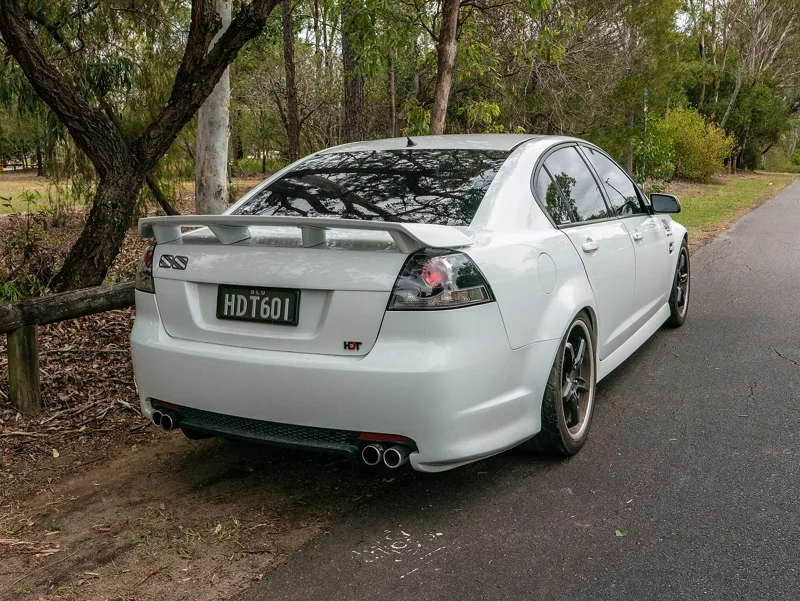
The partnership reached road buyers too. From 1980 the team, then owned by Brock, built modified road Commodores for selected dealers through HDT Special Vehicles, and some of its homologation specials were one step away from race cars.
Did Brock ever race anything but a Holden?
Briefly. Holden ended its association with Brock's businesses in February 1987. In 1988 he ran a BMW M3, and in 1989 and 1990 a turbocharged Ford Sierra RS500, in which he took his sixth Bathurst pole in 1989. He returned to Holden in 1991 and raced Commodores, joining the factory Holden Racing Team in 1994 before retiring from full-time driving after the 1997 season. He won the final Bathurst 24 Hour in 2003 in a Holden Monaro 427C and counted it as his tenth Bathurst win.
The rivalry reached into his own past. When Brock did National Service from 1965 to 1967, a young Dick Johnson was stationed at the same barracks. Johnson made a single start for the Holden Dealer Team in 1974, but in the 1980s he became a Ford folk hero and one of Brock's chief rivals.
Brock died on 8 September 2006. The winner of the Bathurst 1000 now receives the Peter Brock Trophy, introduced at the 2006 race.
Mount Panorama by the numbers
Mount Panorama has 174 metres of elevation between its highest and lowest points. The cars hit 255 km/h on Mountain Straight, enter The Esses at 220 km/h and reach 300 km/h on Conrod Straight, and the 23rd and final turn is Murray's. The race has run as a championship-points round of the Supercars category since 1999.