Holden's coupe went through three generations, a Chevrolet V8 phase, a racing record at Bathurst and a farewell sold on eBay for three times its list price.
Built in three generations by Holden, the Monaro first appeared as a 1968 coupe, returned in 2001 and bowed out in 2006 with the CV8-Z. Its engines moved from Chevrolet units to Holden's own V8s, and its racing record includes Bathurst wins.
The Holden Monaro was a two-door coupe that General Motors' Australian division built in three generations, It ran from 1968 to 1976, returned from 2001 to 2006, and carried a four-door sedan spin-off from 1973 to 1979. Each generation had its own character and its own engine story.
Where does the Monaro name come from?
The name comes from the Monaro region of New South Wales, although Holden's coupe was pronounced Mon-AH-ro. The car went on sale in July 1968 as a two-door pillarless hardtop, and it was built in a mix of base, GTS and GTS 327 models.
The coupe's look came from GM's American designs. Its "coke bottle" shape was similar to that of the Camaro, the Corvair and the Nova coupes of the late 1960s.
A coupe that rode on Chevrolet power in one decade and became a Holden V8 in another.
What was the HK Monaro's engine line-up?
The base HK had a 2,640 cc straight-six, with optional 3,050 cc six-cylinder engines. The GTS came standard with the more powerful 186 S engine, and both the base car and the GTS could take a 5,030 cc Chevrolet V8 at 307 in3. The GTS 327 used a 5,360 cc Chevrolet V8 rated at 250 hp (186 kW), available only with a four-speed manual.
Holden engineers first said the Monaro's engine bay was too small for the 327 Chevrolet V8. The company then sped up work on its own first Australian-built V8, the 253 in3 (4.1 L) and the larger 308 in3 (5.0 L). That project ran behind schedule, and when engineers remeasured the engine bay they found the original calculations had been wrong. The imported Chevrolet engines could fit after all.
How did the HK Monaro perform on track?
The HK GTS 327 gave Holden its first victory in the 1968 Hardie-Ferodo 500, with Bruce McPhee and Barry Mulholland sharing the car. Mulholland drove only one of the 130 laps, and McPhee took the remainder. McPhee also scored pole position and fastest lap.
In 1969 Norm Beechey finished third in the Australian Touring Car Championship in an HK GTS 327. That was the first season the championship ran as a series rather than a single race, and Beechey won the final two rounds at Surfers Paradise and Symmons Plains to show what the Monaro could do.
Why did the HT Monaro get a Chevrolet 350?
The HT replaced the HK in June 1969, and its GTS 327 became the GTS 350 with a 300 hp (224 kW) Chevrolet 350 in3 (5.7 L) V8. The change was mainly a response to Ford's XW Falcon GTHO Phase I, which had appeared in 1969 and was a serious rival in Series Production racing. The HT also introduced an automatic GTS 350, with a lower-power version of the engine and a two-speed Powerglide.
The HT also marked the end of the 5.0-litre Chevrolet V8 in favour of Holden's own 4.2-litre 253 and 5.0-litre 308 units. Late in the HT run a locally made three-speed automatic, the Trimatic, was offered as an option, though not on the GTS 350.
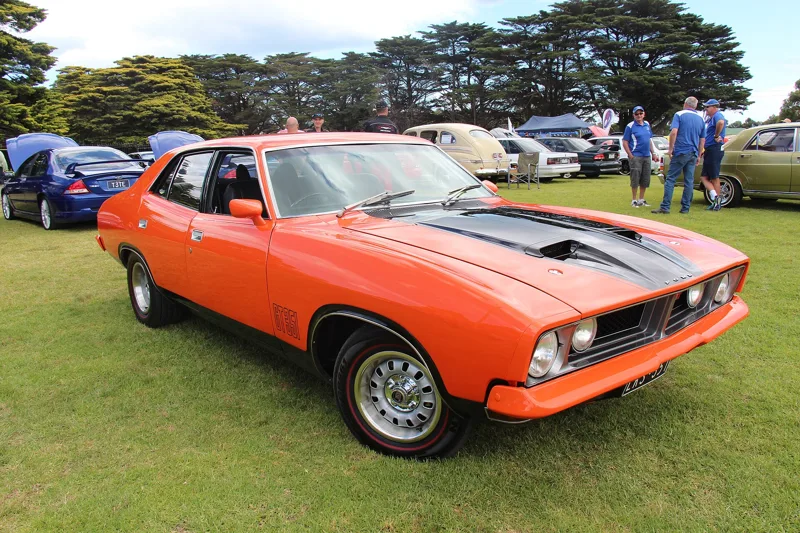
The HT was easy to pick out from the HK. It had plastic grilles in place of metal ones, two-section taillights separated by a blacked-out panel, and a round speedometer. Its front suspension used rubber bushings instead of the HK's sintered bronze. The HT also had twin air scoops in the bonnet, which fed nothing into the engine bay. A total of 14,437 HTs were built.
How did the Holden Dealer Team win with the Monaro?
The Holden Dealer Team was formed in 1969 by Harry Firth, the longtime boss of the Ford Works team. HDT ran GTS 350s in competition, and its three Monaros in the 1969 Hardie-Ferodo 500 took first, with Colin Bond and Tony Roberts winning from the 1968 winners, McPhee and Mulholland, who had switched to a Falcon GTHO. Des West and Peter Brock finished third in the team's third car.
Early in 1970, Bond and Roberts took the Rothmans 12 Hour at Surfers Paradise in their HDT Monaro. The Monaro was Holden's main car in Series Production racing at the time.
Norm Beechey moved up to an HT GTS 350 and won the 1970 Australian Touring Car Championship, Holden's first championship in the series. He won three of the seven rounds, at Bathurst, Sandown and Lakeside, and wrapped up the title there. His car produced 550 bhp (410 kW) after he and chief mechanic Pat Purcell bored it from 5.7 to 6.0 litres.
Beechey's rivals included defending champion Ian Geoghegan in a Ford Mustang, Allan Moffat in a Boss 302 Trans-Am, and Jim McKeown in a Porsche 911S. Beechey missed the Warwick Farm round after an engine failure, and he did not start the final round at Symmons Plains after another in qualifying. He still finished second to Geoghegan at Mallala.
Beechey kept the car running for two more seasons, but unreliability hurt it in 1971 and 1972. He finished fifth in 1971 with one round win at Calder, and in 1972 he retired from the first three rounds.
What changed with the HG Monaro in 1970?
The HG was unveiled on 26 July 1970 as the last car of the original coupe concept. It had cleaner lines and redesigned exterior trim, and its stripes, known as sidewinders, ran along the fenders beneath the windows and stopped just before the rear pillar. The Monaro badge appeared on both rear pillars of every model.
Most of the HG's mechanics matched the HT. The GTS 350 kept the suspension of the HT GTS 350, and the thicker power front discs from that car became standard on all V8 models and the six-cylinder GTS. The HG was the last of the first generation and the last to use the original body shell.
How did the Monaro sell in South Africa?
In 1970 HT Monaro GTS coupes began to be assembled in South Africa from imported parts by General Motors South Africa at the Port Elizabeth plant. From 1971 the later HG series was assembled there and sold as the Chevrolet SS until 1973. General Motors South Africa had decided to sell most of its products as Chevrolets.
The Chevrolet SS had its own front styling, with four headlights and large indicators set into the front edges of the fenders. South African sales totalled 1,828 Monaros and 1,182 SS models. Both were offered with the 5.0-litre Holden 308 and the 5.7-litre Chevrolet 350.
What did the second-generation HQ Monaro look like?
The second generation arrived with the HQ series in July 1971 and a completely new body. The LS version, commonly believed to mean Luxury Sports, had four headlights and chrome rings shared with the Holden Premier sedan. The top GTS 350 coupe used an imported 5.7-litre Chevrolet engine, and the six-cylinder GTS had gone.
The base car's engine grew to 2,830 cc, while the LS offered everything from a 3,310 cc six to the 5.7-litre V8. The coupe had a much larger rear window and a squarer rear quarter window. Some people thought it looked less sporting than the HK, HT and HG, though many now rate it among the best-looking bodies Australia has produced.
Its rectangular rear lights sat in dual units integrated into the bumper. The car's outline recalled the 1970 to 1972 Chevrolet Chevelle, while its tail was not unlike the 1969 Chevrolet Bel Air and Biscayne.
How powerful was the HQ GTS 350?
The HQ GTS 350 used the 5.7-litre Chevy L48 V8. It produced 205 kW (279 PS; 275 hp) at 4,800 rpm, with 488 N m (360 lb ft) of torque at 3,200 rpm. The power figure was a little lower than in the earlier HT and HG versions, and an optional Turbo-Hydramatic 400 three-speed automatic was available.
The same 350 engine was offered in the large Statesman luxury sedan, and that weakened the GTS 350's image as a muscle car. The replacement of the coupes by the inline-six Torana GTR XU-1 as Holden's touring car choice also cost the Monaro some prestige in racing.
Why did the Monaro get a four-door sedan?
In 1973 Holden added a four-door sedan to the HQ GTS range, and the bonnet and boot paint-outs arrived with it. It is generally considered that the paint-outs were created so the new GTS sedan would not be mistaken for the Kingswood sedan it was based on.
The GTS 350 lost some of its cachet after 1973, when the "350" decals were removed and every GTS received a generic V8 bootlid badge. In the last year of HQ production, 1974, the manual GTS 350 was discontinued, and automatic sales were minimal before that engine option was also dropped.
Was the Monaro in a famous film?
The film Mad Max used a two-door base Monaro from the 1972 model year as its MFP Pursuit Special. It was driven by the Nightrider during the film's opening chase scene.
What were the HJ, HX and Limited Edition cars?
The HJ arrived in October 1974 with a heavy facelift and some model cuts. Its front end resembled the 1970 to 1972 Chevrolet Monte Carlo. The 350 V8 option and the base coupe were dropped, and the GTS came with a 4.15-litre V8 or an optional 308 V8 of 5,050 cc. The LS coupe kept its 3.3-litre six. The body paint-outs were discontinued on the HJ, but optional front and rear spoilers appeared for the first time.
Only 337 HJ LS coupes were built, which makes it close to the rarest regular production car ever built in Australia. The HJ GTS coupe ended in 1976 because demand fell, after 606 examples had been made.
The mildly facelifted HX Monaro GTS sedan was announced in July 1976. It used liberal black paint-outs against bold body colours, with a choice of chrome or body-coloured bumper bars.
The Limited Edition, or LE, was released on 27 September 1976. Holden had a limited number of HJ coupe panel sets from 1975, and more than 600 body shells had been assembled at the Pagewood body plant. Delays meant the HX arrived first, so many shells had to be converted, and the LE was painted in an exclusive metallic LE Red. A total of 580 were built, priced at AUD$11,500.
The LE was a mix of Monaro GTS and Statesman Caprice parts, with an eight-track cartridge player fitted well after cassette tapes had become common. Its honeycomb wheels were a plastic mould fixed to steel rims. Holden did not market the LE as a Monaro.
Why did the HZ drop the Monaro name?
For the HZ range, General Motors removed the Monaro name altogether and called the car the Holden GTS. The HZ GTS sedan is still often called a Monaro unofficially. Radial Tuned Suspension improved its handling, and the car was released on 5 October 1977 with a four-headlight grille, front and rear air dams, four-wheel disc brakes and sports wheels.
The 4.2-litre V8 was standard at launch, and the 5.0-litre V8 became standard in June 1978. The Commodore VB arrived in October 1978 with its own V8 option, and GTS production ceased in January 1979. An estimated 1,438 HZ GTS cars were built.
How did the Monaro return in 2001?
The Monaro came back in November 2001, after 25 years without a full-size Holden coupe. The public and media response to the 1998 Sydney concept, codenamed Monica, had been overwhelming. The concept was based on the VT Commodore. Journalists christened it the Monaro, and orders flooded in, which encouraged Holden to build it.
The production car was the third-generation Monaro, the V2 series, based on the VX Commodore. Holden spent A$60 million on it. Development took 22 months, against the 12 to 18 months originally planned.
What were the V2 Monaro models?
The V2 came in two forms. The CV6 used a 3.8-litre supercharged Ecotec V6 with a four-speed automatic. The CV8 used the 5.7-litre LS1 V8 with either a six-speed manual or a four-speed automatic. A Series 2 model arrived in January 2003 with the revised dashboard from the new VY Commodore, and the CV6 was dropped after disappointing sales.
Reputedly, ten times as many CV8s were built as CV6s. The V2 series ended in August 2004, alongside Holden and HSV cars built on the VY Commodore's Series 2 platform.
Limited editions came along too. The CV8-R appeared in July 2003 in 350 examples finished in Turbine Mica grey, and a revised CV8-R in Pulse Red followed in May 2004 in 320 examples. The 2004 cars had 18-inch five-spoke machined alloys and a Holden By Design electric sunroof.
How did the VZ Monaro end?
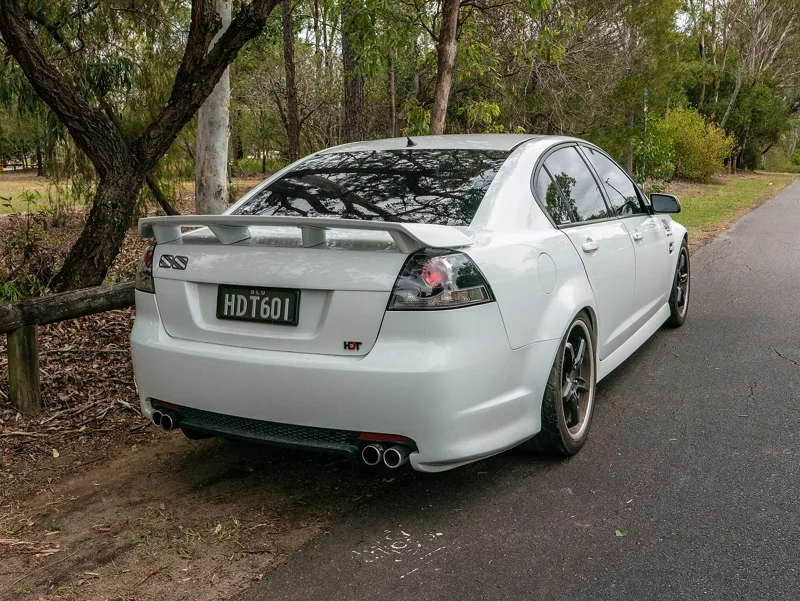
On 12 September 2004 Holden introduced the VZ Monaro CV8, which had 15 kW more than the V2 cars. The VZ came in four colours at first, with Fusion added later and seen only on the closing cars. It gained a 10-speaker audio system with two subwoofers, new bumpers and a dual exhaust.
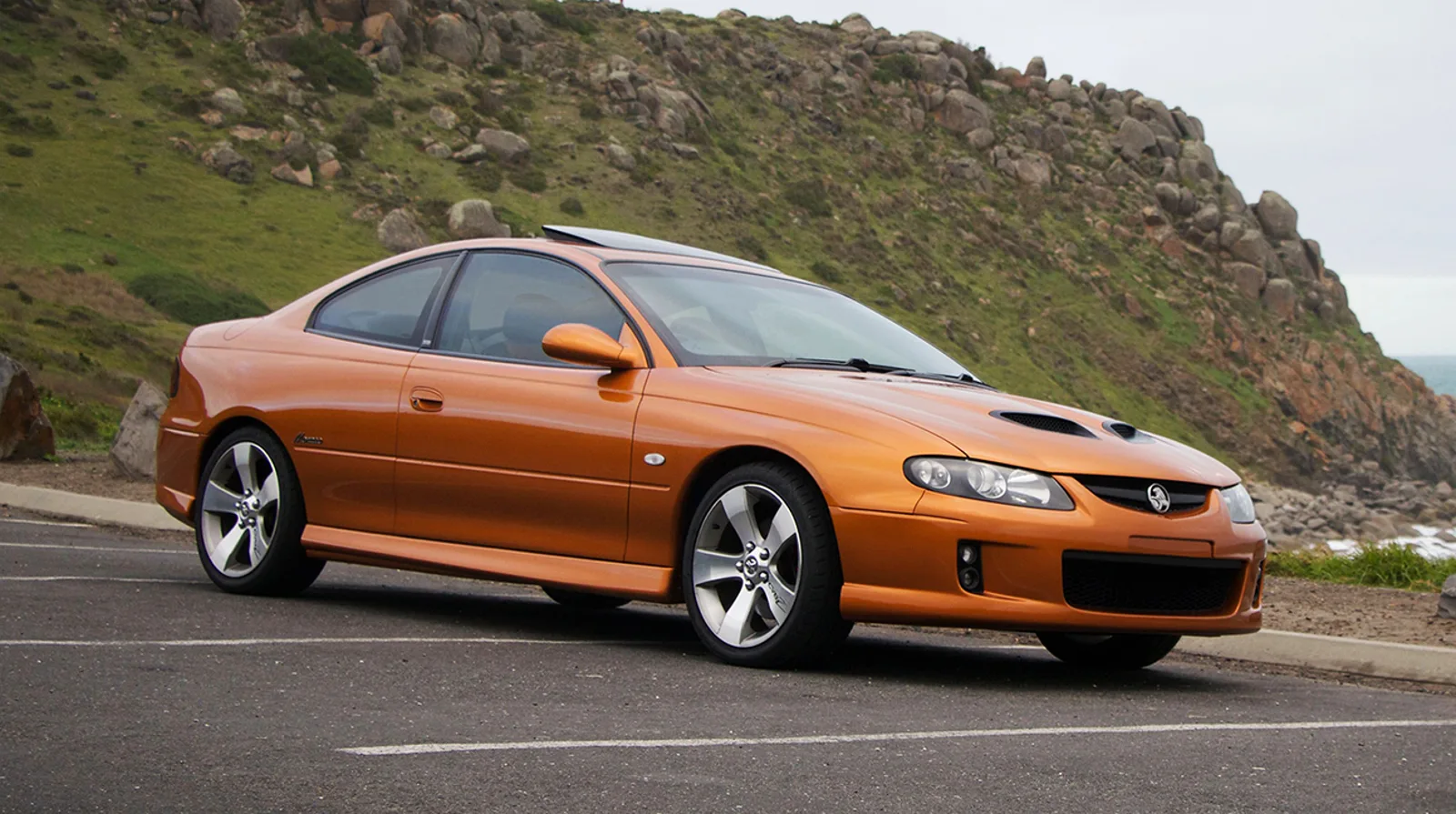
In July 2005 Holden announced that the VZ Monaro would end in early 2006, and it made a special edition called the CV8-Z to mark the farewell. A total of 1,605 were built. The CV8-Z had a sunroof, darkened taillights, a black bonnet scoop, special wheels and CV8-Z badging inside and out, in Fusion orange-gold.
The last Holden Monaro-badged coupe was bought by Emerald, Queensland businessman Darryl Mattingley for A$187,355.55 on 19 February 2006. The car was sold on eBay and the money went to the Leukaemia Foundation, and the price was around three times the normal retail price.
What were the badge-engineered Monaros?
The Monaro was used as a basis for several cars under other badges. HSV in Australia, Chevrolet in the Middle East, Pontiac in North America and Vauxhall in the United Kingdom all sold versions of it.
The HSV Coupe was built by Holden Special Vehicles from 2001 to 2006 on the V2 Monaro, although it did not carry the Monaro name. It was built at Holden's Elizabeth plant in South Australia and modified at HSV's Clayton facility. The line-up began with the GTO and the GTS, and the luxury Coupe4 of May 2004 added HSV's first all-wheel-drive system.
The Pontiac GTO arrived in 2004 with styling based on the VY Series 2 Commodore, and it was facelifted in 2005 to the VZ look. Complaints about its bland design led to twin hood scoops, which vented cool air to the engine bay without feeding it directly. Australian commentators thought the scoops spoiled the lines. The 40,808th GTO built was the last Monaro-based unit.
The Vauxhall Monaro was sold in the United Kingdom, where it won Top Gear magazine's best muscle car award in 2004. A limited VXR 500 followed, with a Harrop supercharger on the 6.0-litre LS2, producing 373 kW (500 hp) and 677 N m (500 lbf ft) of torque. Its 0 to 62 mph (100 km/h) time was 4.8 seconds. Vauxhall replaced the Monaro in 2007 with the VXR8, a rebadged HSV Clubsport R8.
What concepts never reached production?
In the early 1980s the Monaro badge briefly looked likely to return on a combination of the VH Commodore and the Opel Monza. Peter Brock brought a Monza to Australia, but Holden shelved the project while it was busy with the Statesman, the Gemini and the new JB Camira.
A four-seat convertible called Marilyn was put together in 2002 by TWR Engineering, reportedly for A$2 million, and displayed at the 2004 Sydney Motor Show. It was a one-off and never meant for production. In 2008 a VE Commodore-based coupe called Coupe 60 was shown in Melbourne to mark Holden's 60th anniversary, at a cost of A$2.5 million.
How did the Monaro race in the 2000s?
Garry Rogers Motorsport built a pair of Monaro GT race cars with an Australian-built version of the 427 cubic inch Corvette C5-R engine, to compete in the Australian Nations Cup Championship. They won the Bathurst 24 Hour in 2002 and 2003. The programme was headed by Holden Motorsport's manager, John Stevenson, and it was announced months before the HRT 427.
The HRT 427 won both the first and last races it entered. Garth Tander, Steven Richards, Cameron McConville and Nathan Pretty drove it to a debut win in the 2002 Bathurst 24 Hour. James Brock, son of Peter Brock, took the last of the GRM-built 427 Monaros to victory in the closing Nations Cup race of 2004 at Mallala.
Holden Monaro generations at a glance
| Generation | Years | Series | Key figures |
|---|---|---|---|
| First | 1968-1971 | HK, HT, HG | HK 8,945 built; HT 14,437 built; GTS 350 300 hp (224 kW) |
| Second | 1971-1979 | HQ, HJ, HX, HZ | GTS 350 205 kW (279 PS; 275 hp); HZ GTS about 1,438 built |
| Third | 2001-2006 | VX, VY, VZ | CV6 3.8 L V6; CV8 5.7 L LS1 V8; CV8-Z 1,605 built |