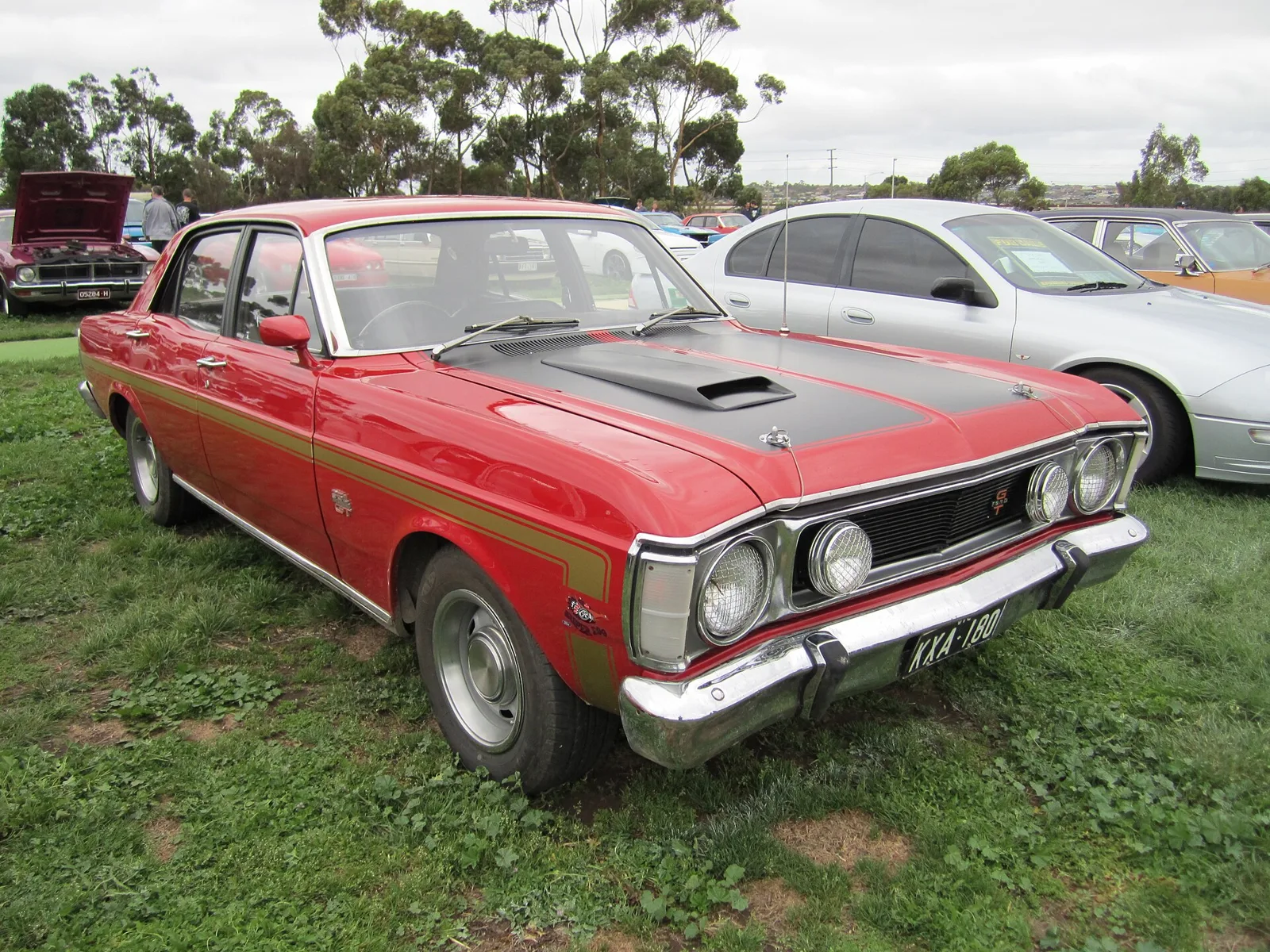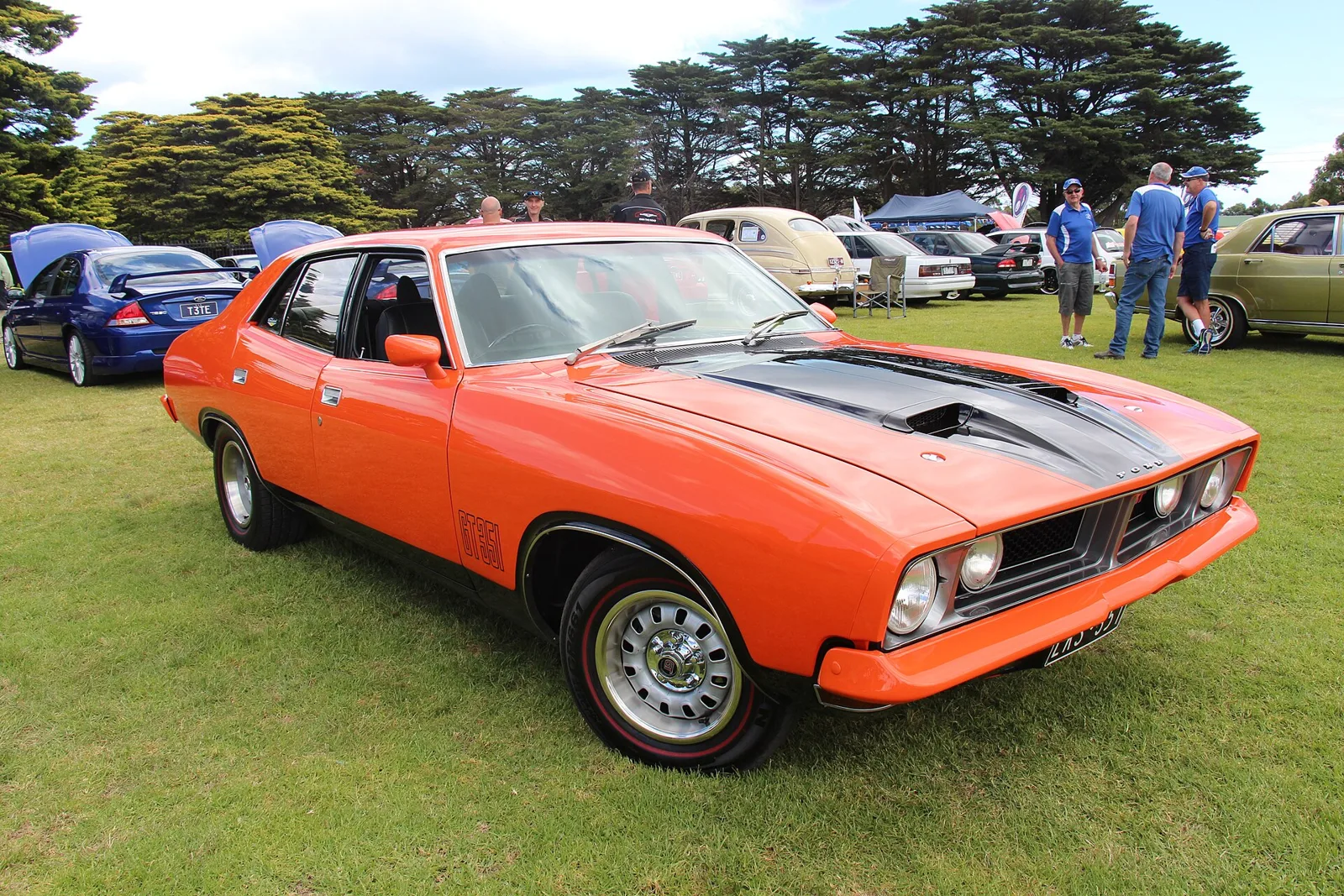
A police-spec V8, a Bathurst one-two, a newspaper headline that killed the genre and a cancelled Falcon that sold for $2 million.
The Ford Falcon GT-HO Phase III of 1971 and the Holden Monaro GTS defined Australian muscle cars. Ford built only 300 Phase IIIs, and good ones have sold for over A$1,000,000. A 1972 newspaper scare cancelled the Phase IV, whose prototype later sold for $2 million.
The most valuable Australian sports sedan on record was never put on sale. Ford's Falcon GT-HO Phase IV was cancelled before it could be released, and the single car meant for Allan Moffat's racing effort fetched $2 million at auction in 2018, a record for an Australian sport sedan. How a cancelled car reached that figure is the story of Australian muscle cars.
Falcon GT-HO origins: a police V8 in a family sedan
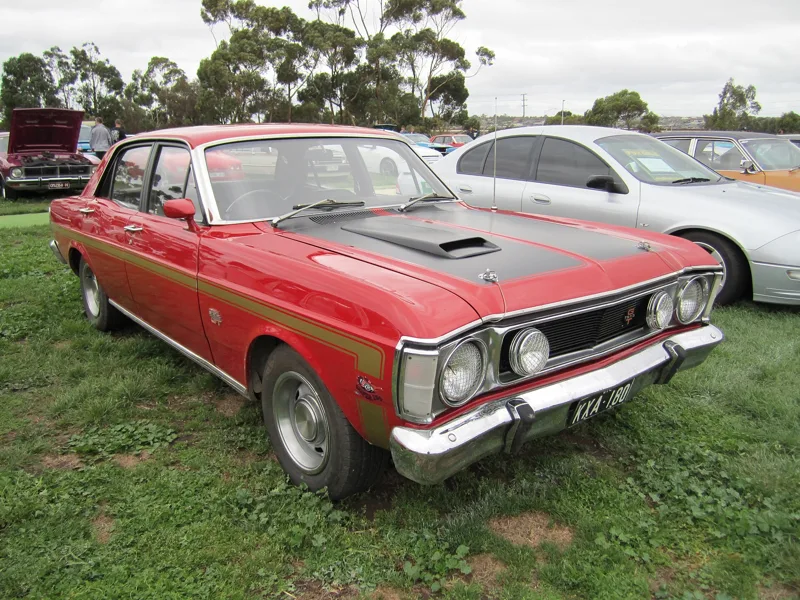
Ford Australia built the Falcon GT from 1967 to 1976 as the performance version of its everyday family car. The first, the XR GT of 1967, was the first Falcon with a V8, the 289 cubic inch engine then fitted to the Ford Mustang. The idea grew out of police testing. Ford built a Police Interceptor Pack Falcon and handed two prototypes to Victoria Police to assess, one to the Mobile Traffic Section and one to the Wireless patrol. Neither passed. Ford took the advice, tuned the engine and stiffened the suspension, and the GT went into production on that foundation.
Managing director Bill Bourke wanted a Falcon that would sell the way Ford's Cortina GT did. The XR GT came with a charcoal interior, a wood-grained steering wheel, Stewart-Warner instruments and a body lowered by 5 cm (2.0 in). It was sold only with a manual gearbox and only in GT Gold. Ford made 596.
Then came Bathurst. In 1967 the factory team, led by the veteran driver and engineer Harry Firth, fought three Alfa Romeos for a full day and finished one-two. Firth and Fred Gibson won by 11 seconds. Sales soared, and General Motors-Holden and Chrysler Australia, neither of which had a performance sedan planned, hurried to build one for 1968. The Australian muscle car era had begun.
A cancelled Falcon that never went on sale became the most valuable Australian sport sedan.
What does HO mean, and why was the Phase III special?
HO stands for handling option, a point often missed by people who assume it means high output. Ford introduced the package with the 1969 XW, creating a two-tier range in which the HO was a racing car you could register for the road. The XW's Windsor V8 grew to 351 cubic inches, making 216 kW (290 bhp) and 522 Nm (385 lb ft). The first GT-HO went to 224 kW (300 bhp) with a bigger carburettor, a different camshaft and intake, stiffer shock absorbers and springs and thicker roll bars.
Early results were mixed. Tyre problems at the 1969 Hardie-Ferodo 500 forced the factory drivers into frequent pit stops, though a privately entered XW GT-HO driven by Bruce McPhee and Barry Mulholland took second. In 1970 the Cleveland V8 replaced the Windsor, and the Phase II carried a 700cfm carburettor instead of the Cleveland's original 600 cfm. Moffat won his first Bathurst in one, with McPhee second for a Ford one-two.
The Phase III of 1971 was the high point. It looked almost identical to the ordinary GT, but underneath it had a heavily upgraded 351 Cleveland V8, a four-speed top-loader gearbox, a Detroit locker nine-inch differential, special brakes and handling parts, and a 164-litre fuel tank. It was a modified XY GT, and the XY itself is recognisable by the shaker scoop taken from the 1969-70 Mach 1 Mustang. Of the 1,557 XY GTs built between September 1970 and December 1971, only 300 were Phase IIIs, produced from May to November 1971.
The official power figure was 220 kW (300 bhp), which was understated to keep insurers happy. The accepted range is 260 to 280 kW (350 to 380 bhp). An electrical rev limiter cut in at 6,150 rpm, and with it disabled the engine was said to pull past 7,000 rpm even in fourth gear. Performance figures: a top speed of 228 km/h (142 mph), 0-100 km/h in 6.9 seconds and a standing quarter mile in 14.4 seconds, or 13.9 seconds with the optional 3.9:1 differential.
Ford billed it as the world's fastest four-door production car. Wheels magazine clocked 142 mph in October 1971, but the Michigan State Police had recorded 147mph for a 1969 Dodge Polara Pursuit with the 440ci V8 at Chrysler's Chelsea Proving Grounds. Because equivalent Polaras were never tested, nobody can say whether Ford's claim was true. Sports Car World, for its part, rated the Phase III among the best cars in the world, a real GT capable of taking on Ferraris and Astons.
The Phase III's race record is long. It took the 1971 Hardie-Ferodo 500 and the 1973 Australian Touring Car Championship in Moffat's hands, and the fastest lap ever set at Bathurst in one was Moffat's 2:36.5 in the 1972 Hardie-Ferodo 500. Ian Geoghegan won round three of the 1972 championship at Mount Panorama after a long fight with Moffat's Mustang, a race many call the best in the series' history.
Not every Ford experiment worked. In 1970 the works team under Al Turner built two "Super Falcons" from the XW GT-HO Phase II, with a fuel-injected 5.8-litre Cleveland that made 447 kW (600 bhp). The drivers found the engine overwhelmed the light chassis, and the tail stepped out whenever they accelerated. Turner did not believe Moffat until Moffat took him for a lap of the Mallala circuit. Moffat then largely gave up the car in favour of his Boss 302 Mustang, while Geoghegan went the other way in 1972 and swapped his own Mustang for a Falcon once the chassis was sorted.
Holden Monaro GTS: the answer from the other side
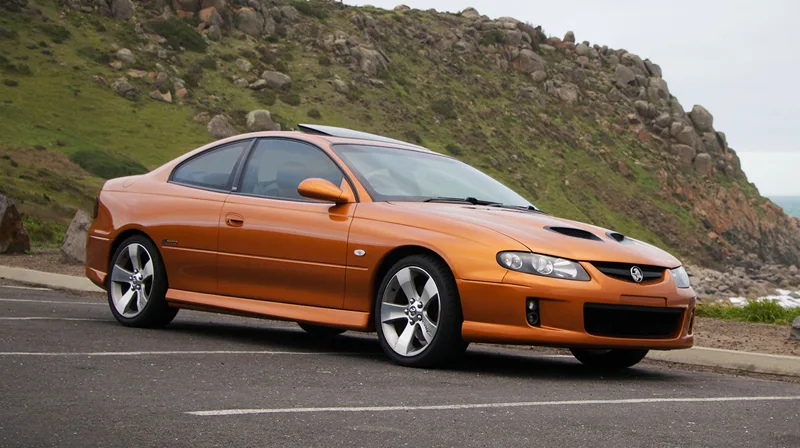
Holden's response was the Monaro. The coupe appeared in July 1968 as a pillarless two-door hardtop and echoed the Camaro with its coke-bottle shape. Its top version, the GTS 327, had a Chevrolet V8 of 327 cubic inches (5,360 cc) rated at 186 kW (250 hp) and a four-speed manual only. Holden built 8,945 HK Monaros, and the GTS 327 gave Holden its first Bathurst victory in 1968, when Bruce McPhee drove all but one of the race's 130 laps.
The HT of June 1969 became the GTS 350, with a 5.7-litre Chevrolet V8 making 224 kW (300 hp), a direct response to Ford's new XW GTHO Phase I. The Holden Dealer Team, formed that year by Harry Firth, who had run Ford's works team, entered three Monaros at Bathurst in 1969. Colin Bond and Tony Roberts won, with a rookie named Peter Brock third. Norm Beechey bored his GTS 350 out to 6.0 litres and 410 kW (550 bhp) and won Holden its first Australian Touring Car Championship, in 1970. In all, 14,437 HT Monaros were made.
Scarcity became part of the legend later. The HJ Monaro LS coupe sits among the rarest regular-production cars Australia has made, with just 337 built. Just 606 HJ GTS coupes were made before it was dropped in 1976 for falling demand.
Torana GTR XU-1 and Brock's Bathurst
If the Monaro was the big gun, the Torana GTR XU-1 was the sniper. Holden developed it in August 1970 with Harry Firth to challenge the more powerful Falcon GT-HO at Bathurst. The 119 kW (160 hp) three-litre six-cylinder engine breathed through three Zenith-Stromberg carburettors, and the car had a front air dam, a rear spoiler and heavy-duty Australian-designed gearboxes in place of weaker Opel units. A good power-to-weight ratio let it replace the Monaro GTS 350 as Holden's frontline race car in 1970.
Ford still won Bathurst in 1970 and 1971. In the wet 1972 race, Brock drove the Holden Dealer Team's LJ XU-1 solo for 500 miles (800 km) and finally beat the Falcon, the first of five Torana wins at Bathurst across a decade of racing. The LJ's race-bred 3300 engine made 142 kW (190 bhp), and the Bathurst Special version could reach 217 km/h (135 mph).
The supercar scare of 1972
What happened next ended the era in about a week.
- Sunday 25 June 1972: a Sun-Herald front-page headline warned that 160mph supercars were coming.
- Within three days: New South Wales Transport Minister Milton Morris called for a ban on the cars.
- 29 June, a Thursday: the Confederation of Australian Motor Sport said Group E would end, with Group C taking over for 1973.
- Sunday 2 July: Ford cancelled the Phase IV programme.
Under Group C, race-modified road cars could compete, so manufacturers no longer had to build race specials for the street. At the end of 1972 the Improved Production class closed, and the Monaro was not eligible for the new class. Holden had developed a V8 Torana, nicknamed The Beast, with 224 kW (300 bhp) from a 308 cubic inch engine, but it never got past the prototype stage. Holden put its V8 Torana off for two years, until the LH series in 1974.
Ford had planned around 200 XA-based Phase IVs for June and July 1972. By the cancellation, one production car had left the line, with three XA GT sedans part-built for the Sandown 500 and Bathurst at Ford Special Vehicles. Only one was ever raced. One went to the rally driver Bruce Hodgson and was destroyed in a crash in 1981, though it has since been rediscovered. The sole production-plated car was sold the following year by Jack Brabham Ford and resprayed from Calypso Green to Zircon Green.
Falcon GT-HO price: why Australian muscle cars are worth millions
Demand for the Phase III is high with collectors and investors, and the reasons are plain: a small production run of 300, with fewer than 100 reported to remain.
| Car | Sale price | Detail |
|---|---|---|
| Falcon XY GTHO Phase III | A$683,650 | Bonhams and Goodmans, March 2007; 40,000 km on the clock |
| Falcon XY GTHO Phase III | A$750,000 | June 2007 |
| Falcon XY GTHO Phase III | $1,030,000 | Lloyds Auctions, Bathurst; once owned by cricketer Jeff Thomson |
| Falcon XA GT Phase IV prototype | $1,750,000 | One of three prototypes; 20 years with one owner, Paul Carthew |
| Falcon XA GT Phase IV (Moffat car) | $2 million | 2018; record for an Australian sport sedan |
The 2007 buyer of the A$683,650 car said it would be garaged and not driven, and that he was keeping it as an investment.
The Falcon GT after the HO years
The XB GT, launched in September 1973, was the last Falcon GT for almost 20 years. It was also the most popular, with 2,899 sold, 1,950 sedans and 949 hardtops. In August 1975 Ford offered the John Goss Special to honour the sole driver to have won the Australian Grand Prix as well as the Bathurst 1000.
The badge returned in October 1992 with the GT 25th Anniversary on the EB II Falcon, followed by a 30th Anniversary car in 1997, both built by Tickford Vehicle Engineering. These cars moved away from pure performance toward refined touring. From 2003 the GT became a permanent part of the Ford Performance Vehicles range, a joint venture with Prodrive, to compete with Holden Special Vehicles.
Limited editions followed. The 40th Anniversary of March 2007 had 200 sedans, 25 of them exported to New Zealand. The Cobra of October 2007 covered 400 sedans and 100 Super Pursuit utes, with 290 to 302 kW (389 to 405 hp) and 540 Nm (398 lb ft). The 5th Anniversary of October 2008 added 200 more sedans with six-piston Brembo brakes.
Where this goes next
The Falcon GT line ended in 2014 with the last GT-F "351". Ford Performance Vehicles closed that year, as part of Ford Australia's end of local production by 2016.