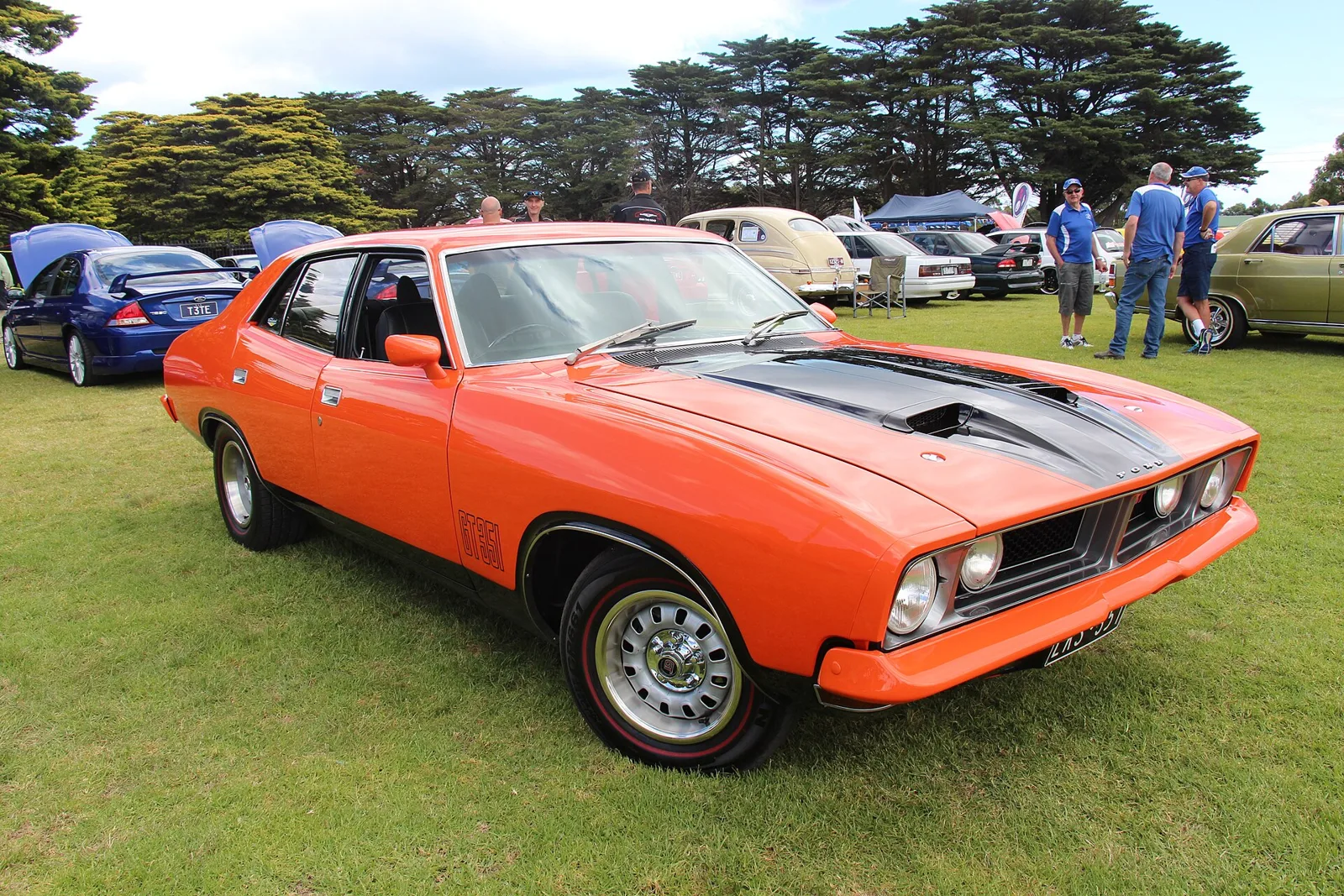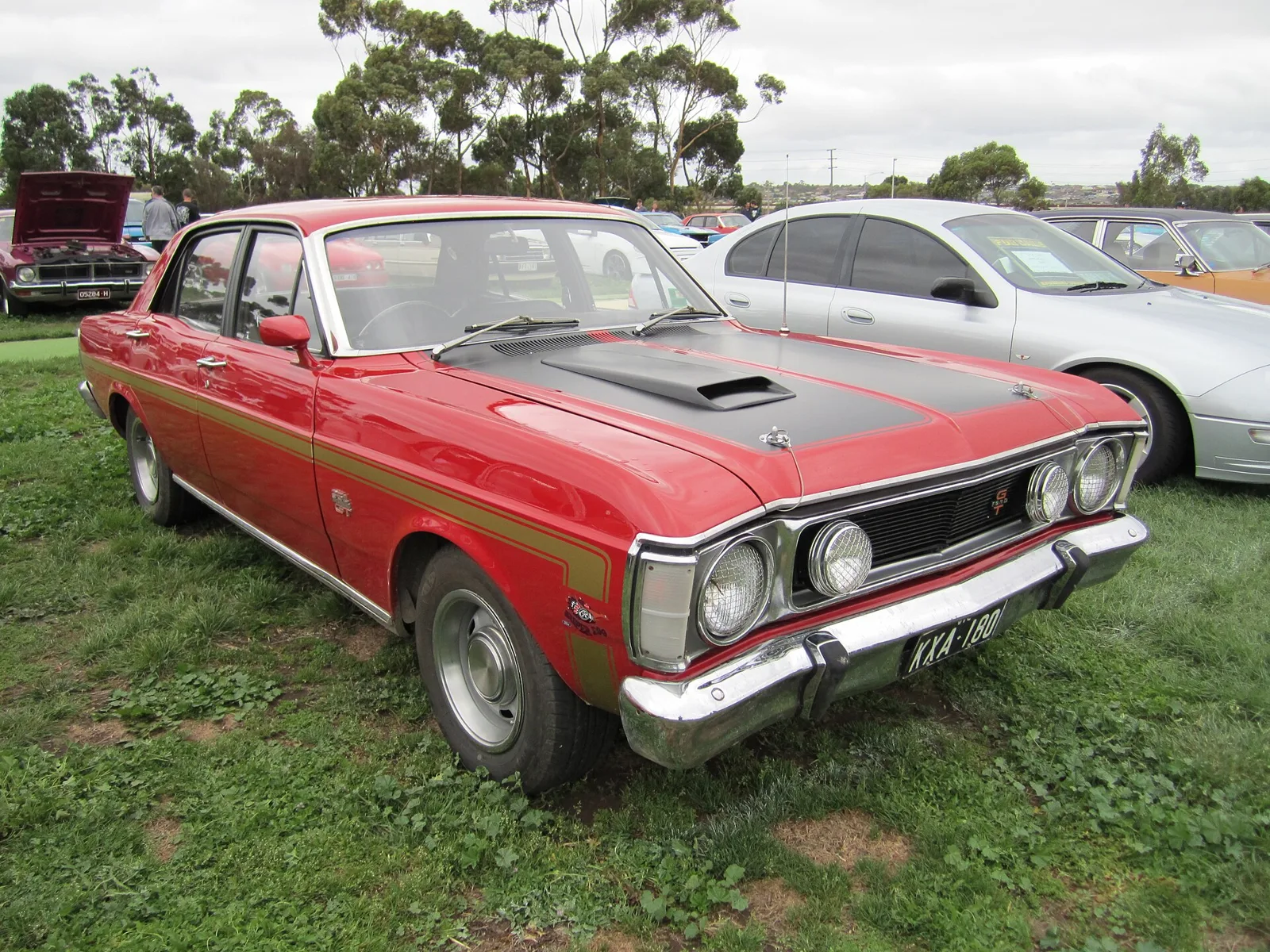
Police origins, Bathurst wins, a cancelled GT-HO Phase IV and the FPV years that carried the badge to a final 351 edition.
The Ford Falcon GT was a performance version of the Falcon range built from 1967 to 1976, with a V8 and a Bathurst-winning pedigree. It returned in 1992, 1997 and from 2003 to 2014 as the FPV GT, ending with the GT-F 351.
The Ford Falcon GT was the performance version of the Falcon range, produced by Ford Australia from 1967 to 1976. The badge returned through a joint venture with Tickford in 1992 and 1997, and again from 2003 to 2014 with Prodrive as the FPV GT and GT-P. Its history is tied closely to Australian sports sedans and to the country's Bathurst racing.
When did the Falcon GT first appear?
The Falcon GT was introduced in 1967 as a performance variant of the XR Falcon. It was the first Falcon to offer a V8, using the 289-cubic-inch engine that Ford had used in the Mustang. Ford Australia had adapted the Falcon from its American counterpart, and the XR was a major step in that process.
The XR GT was sold only with a manual gearbox, in the exclusive GT Gold paint, and 596 units were built. A fleet of eight cars in Gallaher Silver promoted the Gallaher tobacco brand, and five more were finished in colours chosen by racing teams. The 1967 Gallaher 500 winner was painted in Ivy Green.
The factory racing team led by veteran driver and engineer Harry Firth entered two cars at Bathurst. Firth and Fred Gibson won by 11 seconds, and the team took a 1-2 finish. That result captured the public imagination and sent sales soaring, and it pushed General Motors-Holden and Chrysler Australia to respond with their own performance editions the following year.
Police roots, a 1967 Bathurst upset and a cancelled Phase IV made the Falcon GT one of the most argued-over performance cars in Australian history.
Why was the XR GT built?
The GT grew out of a police opportunity. Ford built a Police Interceptor Pack Falcon with the V8, and the GT was built on that basis. Two prototype interceptors were offered to Victoria Police, one for the Mobile Traffic Section and one for the wireless patrol, but both were rejected at first.
Engine tuning and stiffer suspension were then adapted, and the Falcon GT went into production with a police variant that kept the Falcon 500 appearance. Ford Australia's managing director, Bill Bourke, introduced the GT on the back of the success of the Cortina GT, and the competition arm prepared production racing cars for Bathurst.
The road car set itself apart inside as well. It had unique charcoal seats not found on any other Falcon, a wood-grained steering wheel and dash, a matching gear knob and Stewart-Warner instruments. The suspension was lowered and firmed by 5 cm (2.0 in), and upgraded shock absorbers added to the sporty character.
How did the XT, XW and early GT-HO change the range?
The XT Falcon increased the capacity of the Windsor V8 to 302 cubic inches, and sales doubled the figures of the previous range. The XT also took the Teams Prize at the 1968 London-Sydney Marathon, finishing third, fifth and eighth against rally-focused opposition.
Ford introduced the HO, or handling option, package with the 1969 XW range. It created a two-tier line-up in which the HO was essentially a road-registered racing car for leading touring car teams. The XW also offered the Windsor in a bigger 351 cubic-inch size, delivering 290 bhp (216 kW; 294 PS) with 385 lb ft (522 N m) of torque.
The first GT-HO produced 300 bhp (224 kW; 304 PS) through a larger carburetor and revised camshaft and intake. Its suspension was stiffened with stronger shock absorbers, springs and larger roll bars. Even so, poor tyre performance at the 1969 Hardie-Ferodo 500 forced drivers to pit more often than their rivals.
What made the GT-HO Phase II special?
In 1970 the Cleveland V8 replaced the earlier Windsor engines. The 351 Cleveland first appeared in a small batch of Phase I XW GTs, now called Phase 1.5s. Ford then modified the engine for the Phase II, fitting a 700cfm carburetor in place of the 600 cfm unit of the original Cleveland.
Allan Moffat claimed his first Bathurst win in a Phase II in 1970, with Bruce McPhee second. That gave the Ford works team a 1-2 finish. A privately entered XW GT-HO driven by McPhee and Barry Mulholland had already claimed second outright in the 1969 race.
How strong was the GT-HO Phase III?
The Phase III arrived with the XY range in 1971, when the GT was released almost a year after the XY Falcon. It received the shaker scoop ram-air intake from the 1969-70 Mach 1 Mustang, and it appeared in the Australian film Running on Empty as a Phase III GT-HO.
The homologation specials reached their peak in the Phase III. Allan Moffat used one to defeat all opposition in the 1971 Bathurst enduro. It remained among the fastest production four-door sedans in the world, and a Maserati QP was much faster until the Lotus Carlton arrived 19 years later.
Headlines about 160 mph street cars then stirred a fear campaign against the homologation specials. Ford dropped the planned Phase IV programme in response, and touring car rules changed as well. The 1973 Group C regulations allowed production cars to be modified for racing independently of the road cars.
Why was the GT-HO Phase IV cancelled?
Ford developed the HO further with the XA Falcon, readying the Phase IV to homologate the car for Group E Series Production Touring Cars, including the 1972 Hardie-Ferodo 500. On 25 June 1972 a Sun-Herald front page set off a chain of responses, and the New South Wales Minister for Transport, Milton Morris, called for these supercars to be banned three days later.
The Confederation of Australian Motor Sport announced on 29 June that Group E would end and be replaced by Group C for 1973. Group C allowed modified road cars to compete, which removed the need to build road-going race specials. Ford then cancelled the Phase IV programme on 2 July.
One production car had been built by that point, and three XA GT sedans were in various stages of construction at Ford Special Vehicles, Ford's internal race division. Only one of them was ever used in competition. One was sold to rally driver Bruce Hodgson and was later destroyed in a crash in 1981, while another was later rediscovered and is being restored.
What did the XA GT look like?
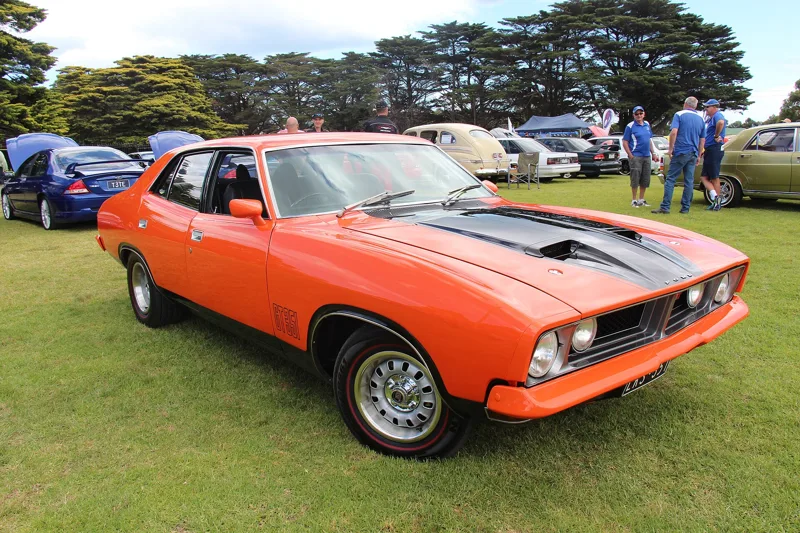
The GT continued with the new Australian-designed XA, and for the first time it was offered as a two-door hardtop. The front fenders carried dummy air vents on their leading edges, and the bonnet had NACA-style ducts. Buyers could choose from a wider range of colours, and the GT blackouts on the bonnet and lower edges could be ordered in silver.
What are surviving Phase cars worth?
The Phase cars have become some of the most valuable Australian vehicles. A Ford Falcon GTHO Phase III sold for A$750,000 at auction, making it the most expensive Australian vehicle sold that way, after an earlier sale at A$683,650. A Phase IV car linked to Allan Moffat sold at auction in 2018 for $2 million, a record for an Australian sport sedan.
The sole production-plated Phase IV was not sold until the following year, when Jack Brabham Ford sold it to a Sydney owner, who had it resprayed from Calypso Green to Zircon Green. Later owners restored it to factory specification in a build documented by an Australian Fords publication.
What did the XB GT bring?
The XB GT launched in September 1973 and was the last Falcon GT for almost 20 years, until the 25th Anniversary EB II GT of October 1992. It had a new aggressive front end with a twin nostril bonnet, similar in style to the 1971-1973 Mach 1 Mustang. Ford sold 2,899 XB GTs, made up of 1,950 sedans and 949 hardtops.
In August 1975 Ford launched the John Goss Special hardtop, a limited run with its own colour scheme, GT styling touches and a special interior. It celebrated Goss as the only driver to win both the Australian Grand Prix and Bathurst 1000.
How did the Tickford years revive the GT?
In 1991 Ford Australia entered a joint venture with Tickford, establishing Tickford Vehicle Engineering as its high-performance arm. Alongside developing XR sports models and fitting accessories such as LPG systems and sunroofs, TVE returned a V8 to the range after a gap since 1982, releasing 25th Anniversary and 30th Anniversary editions of the GT based on the EB II series.
These anniversary cars were dated from the first GT of 1967, and they were the first GTs in 16 years. Their interiors drew on the luxury-oriented Fairmont Ghia, a shift from pure performance towards a refined grand tourer.
How did the FPV years carry the GT badge?
After the T-series sold between 1999 and 2002 under the Ford Tickford Experience brand, the GT nameplate was revived by Ford Performance Vehicles, a joint venture between Prodrive and Ford Australia set up in 2003. The FPV GT range covered the BA (2002), BF (2006) and FG (2008) series, with a base GT, a higher-performance GT-P and a luxury GT-E added in 2008.
Limited editions followed. The GT 40th Anniversary of March 2007 commemorated the first 1967 Falcon GT, with 200 sedans, 25 of which were exported to New Zealand. The GT Cobra of October 2007 marked the 30th anniversary of the original Ford Falcon Cobra, with 400 sedans and 100 Super Pursuit utes, and it raised engine power to 290-302 kW (389-405 hp) with 540 N m (398 lb ft) of torque.
What were the later FPV limited editions?
The later FPV-era cars became increasingly exclusive. The GT 5th Anniversary of October 2008 came as 200 sedans for FPV's fifth birthday, with Lightning Strike or Silhouette paint and a Nudo leather interior. The GT Black of August 2011 was painted entirely in Silhouette, and its 5.0-litre supercharged Boss 335 V8 made 335 kW (449 hp).
The GT R-Spec of August 2012 added the supercharged V8, an R-Spec handling package and wider 9-inch rear wheels, with 350 sedans and 75 utes built. The GT-F 351 of June 2014 closed the line with 550 sedans and 120 utes, taking its name from the 351 cubic-inch engines of the XW to XB era.
What were the Falcon GT model specifications?
| Model | Years | Key figure |
|---|---|---|
| XR GT | 1967 | 596 units; manual only; lowered by 5 cm (2.0 in) |
| XT | 1968 | 302 cubic inch Windsor V8; Teams Prize at London-Sydney |
| XW GT-HO | 1969 | 351 cubic inch Windsor, 290 bhp (216 kW; 294 PS); first GT-HO 300 bhp (224 kW; 304 PS) |
| GT-HO Phase II | 1970 | Cleveland V8 with 700cfm carburetor |
| GT-HO Phase III | 1971 | Shaker scoop intake; 1971 Bathurst winner |
| GT-HO Phase IV | 1972 | Cancelled; one production car built |
| XB GT | 1973 to 1976 | 2,899 sold, 1,950 sedans and 949 hardtops |
| 25th and 30th Anniversary | 1992 and 1997 | Based on the EB II series; Tickford built |
| FPV GT Cobra | 2007 | 290-302 kW (389-405 hp); 540 N m (398 lb ft) |
| FPV GT Black | 2011 | Boss 335 5.0-litre V8, 335 kW (449 hp) |
| GT-F 351 | 2014 | 550 sedans and 120 utes |
How did the Falcon GT perform in motorsport?
The Falcon GT had considerable success in the Australian Touring Car Championship, the Australian Manufacturers' Championship and the Bathurst races. The Ford works team ran Falcon GTs from 1967 to 1973, and its results at Bathurst ran through the decade.
The 1967 Bathurst result was a team 1-2 against three Alfa Romeos, while Moffat's Phase II win in 1970 gave Ford another 1-2. In 1971 Moffat in a Phase III GT-HO won the enduro, showing how far the homologation cars had come.
The XT Falcon also took part in the 1968 London-Sydney Marathon, where it won the Teams Prize. That rally result showed the range could handle more than circuit racing.