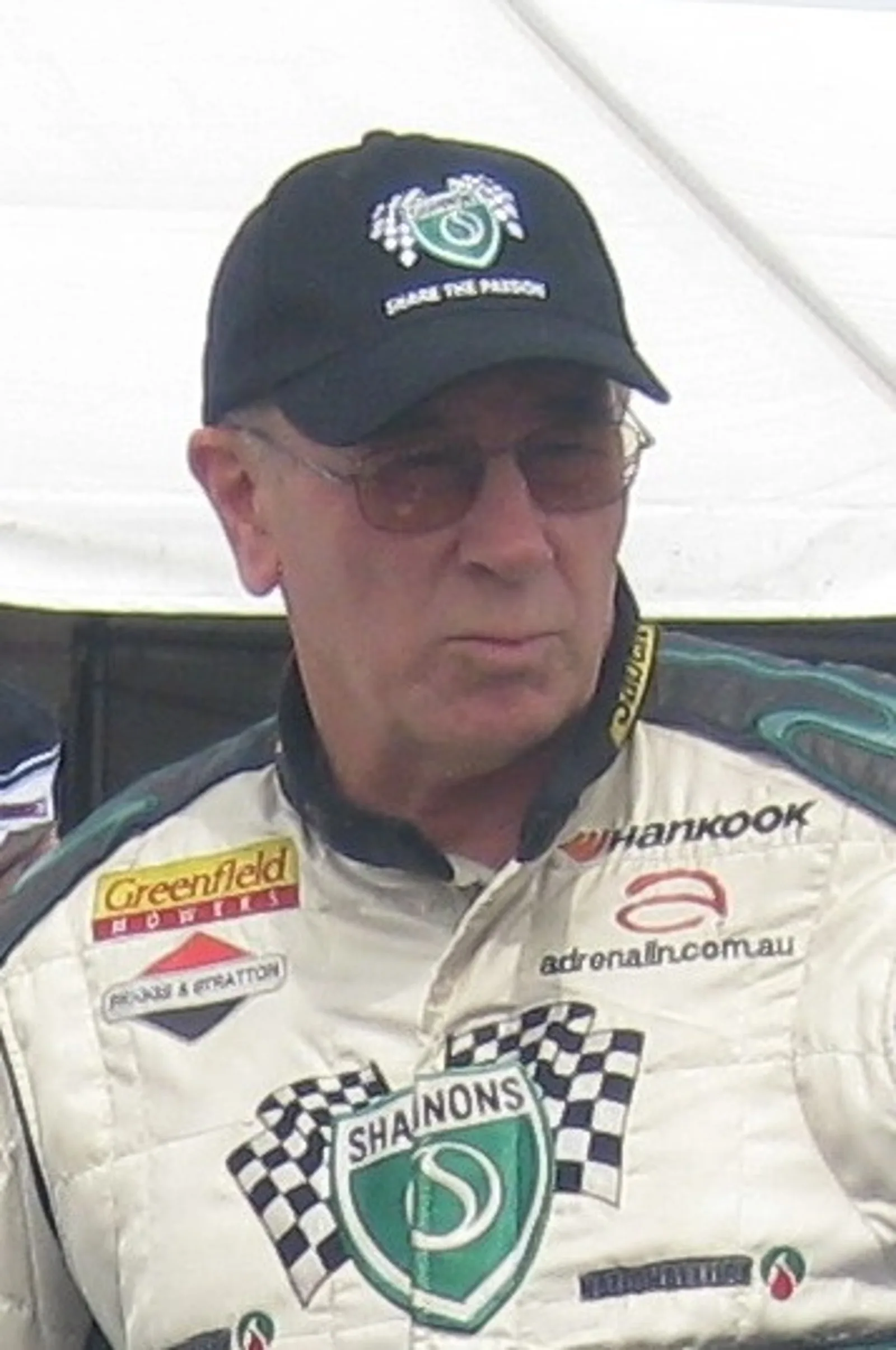
A New Zealand mechanic who raced Escorts at home, won the Australian Touring Car Championship four times and took seven Bathurst 1000 wins.
Jim Richards is a New Zealand racing driver who won the Australian Touring Car Championship four times and the Bathurst 1000 seven times. Before racing Escorts and Mustangs at home he served a mechanic's apprenticeship, and he moved to Australia in 1975. His Bathurst wins came with Peter Brock, Mark Skaife and Rickard Rydell.
Jim Richards' racing life crossed two countries and several generations of touring car machinery. He learned his trade as a mechanic in South Auckland, raced Escorts and Mustangs at home, and then moved to Melbourne in 1975. The four national titles and seven Bathurst 1000 wins that followed made him one of the best-known drivers of his era.
Who is Jim Richards and where did he start?
James Charles Richards was born on 2 September 1947 and grew up in South Auckland. Leaving school at 16, he trained as a mechanic, and by 18 he had bought his first proper car, an Anglia, on hire-purchase. He used that car for two seasons of race meetings, hill-climbs and rally sprints.
The Anglia wore red paint with yellow trim and the number 105, a combination that became his trademark in New Zealand racing. A first race at Pukekohe ended at the back of the field, followed by a crash once the flag had fallen.
The workshop where he learned his trade was in Manurewa, run by Brian Yates, once a leading New Zealand midget driver. Before that, he had been winning in junior go-karts built by his father, so he arrived in the workshop already comfortable with speed and machinery.
A South Auckland mechanic who raced Escorts at home and became the rainmaster of Australian touring cars and a seven-time Bathurst 1000 winner.
How did his New Zealand racing develop?
In 1968 he worked as a mechanic at Barry Pointon Motors and bought one of the new 1300cc Mark I Ford Escorts. Its modest power still sharpened his racecraft. A year later the backing of Jim Carney put him in a 1600cc BDA twin-cam Escort rated at about 140 bhp, and victories began to follow.
The turning point came in 1970, when Carney bought the Escort TC that Mike Crabtree had campaigned that season in British touring car racing for the John Willment Group. Richards won with it at his first attempt, then took the class title that year and again in the 1971-72 season.
He was soon racing the Escort in open-class events as well, beating V8 Mustangs, Camaros and Firebirds. His tow car was a Holden Monaro, and he raced a Hillman Imp in the small class for a local owner. That partnership brought in Sidchrome, an Australian tool maker, whose New Zealand division became his main sponsor for the next decade.
What were his New Zealand titles?
Richards won the 1972-73 championship in a Team McMillan Ford Falcon GT-HO, with Murray Bunn preparing the engine. For 1973-74 he took a Ford Mustang with a Cleveland 351 V8 to the Saloon Car Championship, and in 1974-75 he lost the title by a narrow margin to Paul Fahey.
Endurance racing was a separate discipline, and he was just as strong in it. He won the Benson and Hedges 500 in 1971 and 1972 with Rod Coppins in a Chrysler Charger, a 6-hour production car race that opened each season. In 1974 Coppins bought a Holden Torana, and the pair took it to the Hardie-Ferodo 1000 for its debut.
Racing rules were moving toward the Australian Group C formula, which ended standard production-car racing in New Zealand. In the 1974-75 GTX season he ran a McMillan-Ford Falcon XA and won 17 races in a row before his last New Zealand outings.
Did rallying play a part in his career?
It did, and it was a serious part. He rallied from 1968, co-driving with Jim Carney at the Shell Silver Fern Rally, and in 1973 a works Ford drive at the Heatway Rally ended with a roll down a bank.
In 1969 he drove a Triumph 2.5 PI at the inaugural Heatway Rally, with Mary Carney navigating. The gearbox broke after he had been among the leaders, leaving him with top gear only. A year later Leyland New Zealand gave him a Morris Marina alongside works driver Andrew Cowan, but the suspension could not take the strain, and he finished mid-field.
In 1973 Ford offered him a place as the third driver in its works team, alongside Hannu Mikkola and NZ champion Mike Marshall in Escort RS1600s. Richards ran second to Mikkola before the first mountain stage, then his car slid on ice he had never driven on, went off the road and rolled about 100 metres down a bank.
He and co-driver Richard Halls came to rest on a narrow outcrop above a deeper gorge, and they were hauled out at dawn. The car needed surprisingly little work, and they rejoined the event out of contention. Richards was consistently quicker than Mikkola after that, but the damage to his chances was done.
How did Richards move to Australia?
In mid-1975 Richards moved across the Tasman after Sidchrome New Zealand ended its sponsorship and the Australian parent company stepped in. He arrived in Melbourne days before the Sandown round in July, with little preparation, and won both races in pouring rain.
Promoters wanted him on their cards straight away, and they paid appearance fees to bring his Mustang to meetings against the country's best drivers. He had planned to commute from Auckland, but after two very successful months he moved to Melbourne with his family, including two young sons, to chase a full-time career.
The 1975 season delivered 27 podiums and 13 wins from 30 starts. Richards finished ninth at Bathurst that year after gearbox problems, sharing a Holden Torana with Rod Coppins, and in 1976 he co-drove with John Goss at Bathurst, where a broken clutch ended their race in 29th place.
Why did Peter Brock's team make Richards a Bathurst legend?
Richards became Peter Brock's co-driver for the Holden Dealer Team in 1978, and the pair won Bathurst that year after starting from pole. They repeated the win in 1979 by a record six-lap margin, then took a third win in 1980, making three in a row.
Brock had come to know Richards after the two shared a Ford Falcon panel van on the drive from Perth back to Melbourne following a round at Wanneroo Park. That trip took about 24 hours, against a normal two to three days, and it helped Brock suggest Richards for the Bathurst seat.
The 1980 race was hard fought. Brock made an uncharacteristic error with a back-marker, and then fought back into the lead before handing over. Richards drove matching lap times to take the win, and the three consecutive victories changed the character of the race into a sprint in which the co-driver had to be almost as fast as the leader.
How did Richards perform for the JPS BMW team?
In 1982 Richards became lead driver for JPS Team BMW under team manager Frank Gardner, driving the BMW 635 CSi. The team's first victories came in 1983 with the smaller, nimbler BMW, which won the first two rounds of the year before an Adelaide crash ended Richards' title hopes.
The 635 CSi was not the car the team wanted. The M535is had a better power-to-weight ratio, but BMW had not built enough of them. Richards and David Hobbs finished fifth at the 1982 Bathurst 1000, six laps behind the winners and first non-V8 car home, which was a respectable result for a foreign car in that field.
The GT series of that era ran to Group 5 and IMSA rules, and the JPS team fielded a turbocharged 318i for Richards. It faced Porsche 935s, Holden LX Torana and Alfa Romeo Alfetta GTV entries. 1982 was a steep learning period for the team, which ended with an unexpected pole position in the last race.
The 1983 Bathurst had Gardner as co-driver. The car was updated with Group A engine parts from Germany and developed 390 bhp, and they had taken heart from a second place at Sandown, where Allan Moffat's Mazda RX-7 finished ahead. Fuel contamination ended the race on lap 6, and rumours of sabotage were never proven, although reliability kept Richards second in the endurance championship.
How did the Group A rules change his results?
The switch to Group A in 1985 made the BMW a regular winner. The rules kept cars closer to production trim and removed the bias toward any one manufacturer, Richards won the 1985 Australian Touring Car Championship, finishing on the podium in nine of ten rounds and winning seven of them.
He also took the 1985 Australian Endurance Championship, collecting four wins from five starts, and the Sandown 500 alongside Tony Longhurst, driving the BMW 635 CSi. Bathurst that year was a different story. Tom Walkinshaw's Jaguars filled the first and third places, with the Schnitzer BMW between them.
At Bathurst 1985 the JPS team's pace was undone by oil on the track, and both team cars ended in a sandtrap and lost four laps. Richards and Tony Longhurst recovered to fourth, the first local car home. BMW recognised his season with a driver of the year award presented at a ceremony in Munich.
In 1986 the field caught up with the JPS team. Robbie Francevic took the title in a Volvo 240T turbo, while Richards finished third with one victory. For 1987 the smaller M3 replaced the 635 CSi, and Richards won the Australian title in it. Gardner closed the JPS team at the end of that year.
What did the Nissan years deliver?
Richards rejoined Peter Brock's team for 1988, which now ran BMW M3s after nearly two decades in Holdens. By then the Ford Sierra RS500 had overtaken the M3, and at the end of the year Fred Gibson signed Richards for his factory-backed Nissan team, which ran from 1989.
In Nissan machinery Richards won the Australian Touring Car Championship in 1990 with the Skyline HR31 GTS-R and the four-wheel-drive, twin-turbo R32 GT-R, nicknamed Godzilla. He repeated as champion in 1991, finishing ahead of his young teammate Mark Skaife. With Skaife on pole, the pair then took the 1991 Bathurst 1000 in record time, finishing a lap clear of Win Percy and Allan Grice in a Holden Commodore.
The 1992 championship went to Skaife, with Richards second, and the pair won Bathurst again that year. The 1992 Bathurst race was a crash-shortened one in which Richards crashed the GT-R in heavy rain on lap 145.
Richards was only told of Denny Hulme's death in the middle of the podium ceremony. The 1967 Formula One world champion and former JPS BMW teammate had suffered a heart attack in his BMW M3 and died on lap 32, and Richards delivered a bitter speech to a crowd that booed him. He later apologised, explaining the shock of the news.
How did the 1992 Bathurst result happen?
Heavy rain caused a string of crashes, and the race was stopped on lap 145. The result was wound back further than usual to allow more cars to be placed, which made Richards and Mark Skaife the winners even though Dick Johnson had briefly led on the track.
The decision was unpopular with fans, most of whom supported Ford or Holden. Richards' car was barely driveable after an earlier crash, and the crowd booed the pair on the podium. Skaife spoke briefly, and a commentator joked about a champagne bath, which Richards turned down.
How many Bathurst 1000s did Richards win?
Richards won the Bathurst 1000 seven times, second only to Peter Brock, who won it nine times. His wins came in 1978, 1979 and 1980 with Brock, in 1991 and 1992 with Skaife, in 1998 with Rickard Rydell in a Volvo S40, and in 2002 with Skaife in a Holden VX Commodore.
Two Sandown 500 victories also belong on his list, in 1985 with Tony Longhurst in the BMW and in 1989 with Skaife in the Nissan.
Of his 36 Bathurst starts, 22 were with factory-backed teams for Holden, BMW, Nissan or Volvo. Those starts produced 13 podiums: seven wins, three seconds, three thirds and a class win. All of his Bathurst wins came in Holden, Nissan and Volvo machinery, and none in a BMW.
What did Targa Tasmania add to his record?
Richards and navigator Barry Oliver won Targa Tasmania eight times, a record for the event. He made his debut in 1993 in a Porsche 968 CS, and his final victory made him only the fourth driver to win in a two-wheel-drive car, and nobody has done it since.
The pairing, known affectionately as Team Grandpa in later years, won in 1996, 1997, 1998, 2000, 2001, 2002, 2003 and 2006. Most of those wins came in Porsche 993, 996 and 997 machinery, and the 2006 win was in a 997 GT3.
His other titles stretched across formats. An AMSCAR crown came in 1985 in the BMW and a second in 1992 in the R32 GT-R, with the 1996 Australian NASCAR title and a Carrera Cup crown in 2003 with a 996 GT3 Cup. The Porsche years also brought Australian GT Production Car titles in 1995 and 1999.
What honours has Richards received?
He was welcomed into New Zealand's Motor-racing Hall of Fame in 1994, and the V8 Supercars Hall of Fame followed in 2006. The Australian Motorsport Hall of Fame added him in 2015. The 2026 Australia Day Honours named him Honorary Member of the Order of Australia for service to motor sport as a team owner and driver.
The Supercars Championship later named an award in his honour for the best driver of the year. His son Steven is also a racing driver, and between them the father and son have won 12 Bathurst 1000s, most recently in 2018.
Career summary at a glance
| Year | Event | Car or team | Result |
|---|---|---|---|
| 1974 | Hardie-Ferodo 1000 | Holden LH Torana, with Rod Coppins | Third, wet-weather drive |
| 1975 | Australian debut season | Sidchrome Mustang | 13 wins from 30 starts |
| 1978 | Bathurst 1000 | Holden Dealer Team Torana, with Peter Brock | Winner from pole |
| 1979 | Bathurst 1000 | Holden LX Torana, with Peter Brock | Winner by six laps |
| 1980 | Bathurst 1000 | Holden VC Commodore, with Peter Brock | Winner, third consecutive |
| 1982 | Bathurst 1000 | BMW 635 CSi, with David Hobbs | Fifth, first non-V8 home |
| 1985 | Australian Touring Car Championship | BMW 635 CSi | Champion, seven wins |
| 1987 | Australian Touring Car Championship | BMW M3 | Champion |
| 1990 | Australian Touring Car Championship | Nissan Skyline HR31 GTS-R and R32 GT-R | Champion |
| 1991 | Australian Touring Car Championship | Nissan Skyline R32 GT-R | Champion, Bathurst winner with Mark Skaife |
| 1992 | Bathurst 1000 | Nissan Skyline R32 GT-R, with Mark Skaife | Declared winner after the race was wound back |
| 1998 | Bathurst 1000 | Volvo S40, with Rickard Rydell | Winner |
| 2002 | Bathurst 1000 | Holden VX Commodore, with Mark Skaife | Winner |
| 1996 to 2006 | Targa Tasmania | Porsche, with Barry Oliver | Eight wins |