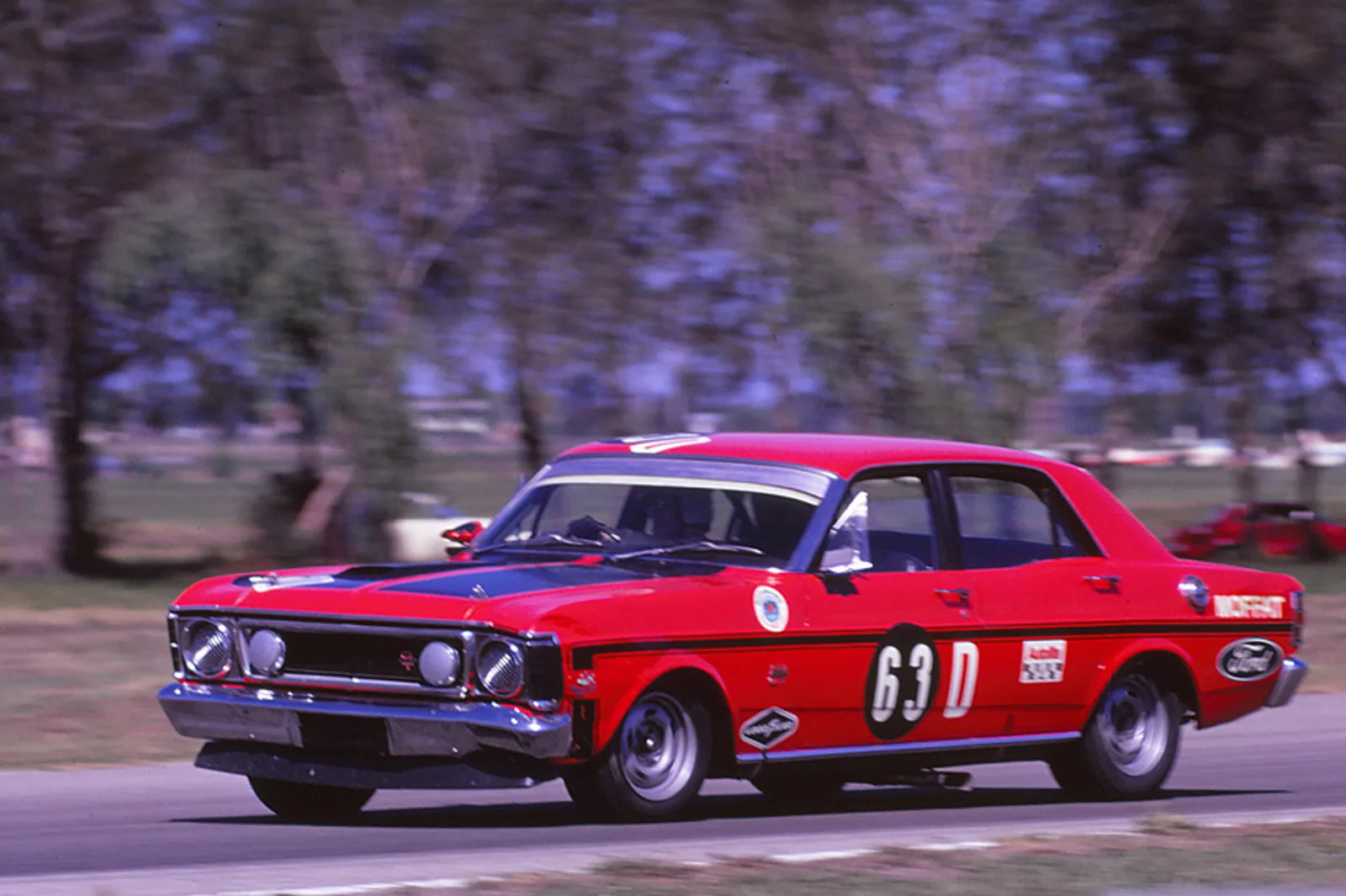
A Canadian-born Ford driver, a Belgian Le Mans star and a team-mate who held back: how the 1977 Hardie-Ferodo 1000 became Ford's most remembered day.
Allan Moffat, a Canadian-born Ford driver, won the 1977 Bathurst 1000 with Jacky Ickx in a Falcon XC while team-mate Colin Bond finished second beside them. Brake trouble had slowed Moffat's car, and Bond chose to cross the line in tandem rather than pass.
Late in the 1977 Bathurst 1000, Allan Moffat's Falcon was slowing with brake trouble and his own team-mate was catching him. Colin Bond could have gone by. Instead the two Fords took the final two laps side by side, and Bond let Moffat cross the line barely in front.
Who was Allan Moffat?
Allan George Moffat, born on 10 November 1939 and died on 22 November 2025, was a driver with roots in both Canada and Australia. He won four Australian Touring Car Championships, six Sandown 500s, four Bathurst races and the 1975 Sebring 12 Hours. He entered the V8 Supercars Hall of Fame in 1999.
He and Peter Brock, his long-time friend and rival, share a distinction: each won Bathurst's Great Race both when it ran over 500 miles and after it switched to 1000 km. Sport Australia's Hall of Fame took Moffat in during October 2018.
Born in Saskatoon, Saskatchewan, the eldest of three sons, he moved around because his father was an executive with Massey-Harris. As a teenager he lived in Vereeniging, South Africa, and in his college years in Melbourne. He studied marketing at Monash University with a Volkswagen cadetship, but gave it up to race a Triumph TR3 in amateur events, and went back to Canada when the money ran out.
In Toronto he sold goods door to door. Then, during 1964, at a United States Road Racing Championship round at Watkins Glen, he befriended some Team Lotus mechanics, joined the team as a gofer and ended the season by buying one of their Lotus Cortinas.
Colin Bond let Allan Moffat stay barely in front for a crushing 1-2 for Ford.
How did Moffat build his name before 1977?
With Jon Leighton he took a Ford Cortina Lotus to fourth in the 1964 Sandown 6 Hour, the race that grew into the Sandown 500. He entered the Australian Touring Car Championship for the first time in 1965, then raced in the new Trans-Am series in the United States, where on 10 July 1966 he won the Bryar 250 outright in an Under 2L Lotus Cortina, more than a lap clear of a Plymouth Barracuda.
More Trans-Am followed in Mustangs for Carroll Shelby, in the Daytona 24 Hours and Sebring 12 Hours, and for Bud Moore Engineering in a Mercury Cougar. By 1969 he was back in Australia full time, driving a Ford Boss 302 Mustang painted bright red and sponsored by Coca-Cola. It came new from Ford's Kar Kraft facility in America and was finished off by Bud Moore Engineering.
In that car he won 101 championship and non-championship races from 151 starts between 1969 and 1972. The title still escaped him: outside the top ten in 1969, sixth in 1970, second in 1971 and third in 1972. In 1971 he went into the final round at Oran Park four points behind three-time champion Bob Jane. A jammed gearbox forced him to slow mid-race, and he finished six-tenths of a second behind Jane's Camaro.
The 1972 Easter round at Bathurst brought another close defeat. Ian Geoghegan's more powerful 5.8-litre Super Falcon was faster down the Mountain and Conrod Straights, but Moffat kept up through the corners and lost by less than a second. Oil from the Falcon sprayed on to his windscreen, so he drove more than half the 13-lap race with his belts undone, head out of the window. He protested, but the oil was wiped away before inspection and the protest was dismissed.
How did the Falcon GTHO win Bathurst in 1970 and 1971?
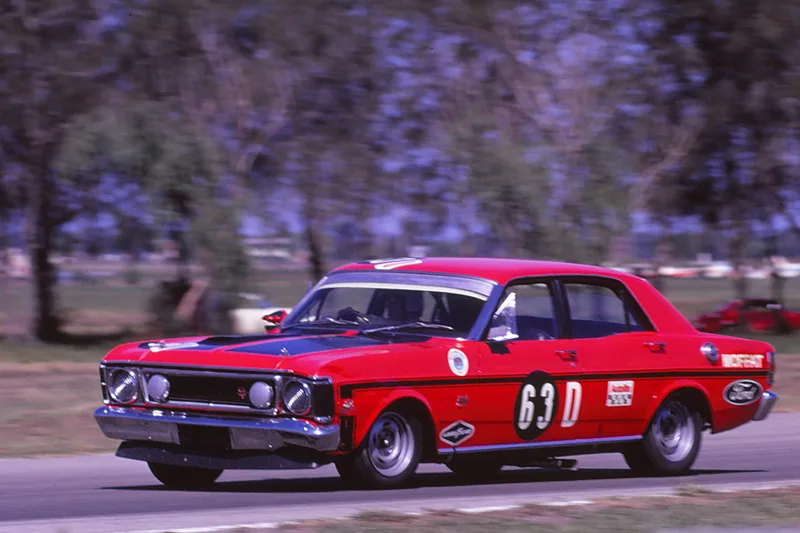
The Mustang could not run at Bathurst, where only standard production cars were allowed before 1973, so Moffat made his debut there in 1969 in a works Falcon XW GTHO, finishing fourth alongside Alan Hamilton. In 1970 and 1971 he took the GTHO to two crushing victories, racing without a co-driver, and in 1971 he was the first to lead the Bathurst 500 from flag to flag.
The 1969 debut gave a hint of what was coming. Moffat's tyres were not as worn as those of the leading cars when he was called in early, which showed he could be kind to a car and still go fast. He had been almost last on the opening lap after the Falcon stuck in neutral leaving the Cutting, a stroke of luck that kept him clear of Bill Brown's rollover at Skyline, which blocked the track and caught about a quarter of the field.
Then came 1972. Moffat looked set for a third straight win when Ford planned a faster Phase IV GTHO. Journalist Evan Green learned of it, and his piece, splashed across the country under screaming headlines about supercars on Australian roads, created the Supercar scare. Entering the car would have required at least 200 sales to the public. Under pressure from media and government, Ford scrapped the Phase IV and forced its drivers back into year-old Phase III cars. Brock won for Holden, and the Moffat-Brock rivalry that dominated the next years began.
What happened between 1973 and 1976?
For 1973 both the championship and Bathurst were opened only to the new Group C touring cars. Ford, still smarting from the Phase IV episode, pulled its factory teams out after the season, leaving Moffat and other Ford drivers to run as privateers. Before that, the factory team and Moffat won both the 1973 championship, his first, and the Hardie-Ferodo 1000 with Ian Geoghegan, making them the first winners of the race over 1000 km.
The season had its dramas. The night before the Adelaide round, Moffat's Falcon was stolen from a dealership in the suburb of Medindie. Murray Carter lent him his own GTHO, and Moffat held his championship lead with second place, though he began at the back of the grid. The stolen car turned up later, abandoned in the Adelaide Hills by thieves who had run out of fuel.
The Mustang, no longer eligible, ran in Sports Sedans in 1973 and 1974. Moffat refused to move its engine back into the cabin, later saying he would not contaminate such a jewel. Sent back to America, it was bought and restored in 1995 by Queensland entrepreneur David Bowden, and readers of Australian Muscle Car magazine voted it the most popular muscle car ever to race in Australia.
As a privateer in 1974 and 1975 Moffat took third in the 1974 championship with two round wins, plus the 1974 Sandown 250 and 1975 Rothmans 300. On 21 March 1975 he won the Sebring 12 Hours in a factory-backed BMW 3.0CSL, sharing with Hans-Joachim Stuck, Brian Redman and Sam Posey. In 1976 he won his second title in an XB Falcon GT Hardtop, even after a transporter fire destroyed his race car and he had to borrow one from rival John Goss for two rounds. At Bathurst that year he took pole and led comfortably with Vern Schuppan, but failed to finish.
How did the 1977 race unfold?
The Bathurst 1000 of 2 October 1977, the race's 18th running, ended in a formation finish for the Moffat Ford Dealers Team. Moffat and Belgian co-driver Jacky Ickx led Colin Bond and Alan Hamilton home in a pair of Falcon XCs, with Peter Janson and Larry Perkins third in a Holden Torana.
Moffat had rebuilt his position that year with a two-car, factory-supported team. Bond arrived after eight years with the Holden Dealer Team, and by the end of the season Moffat had also taken a second straight championship, the third of his career. Ickx, who had won Le Mans four times, was his partner for the endurance race.
By mid-race the Moffat and Ickx car and the Bond and Hamilton car led the field by more than two laps. Then trouble: Ickx's hard driving of an unfamiliar car left Moffat's Falcon with serious brake problems, and it had to slow. Bond closed up, and the two cars covered the last two laps together before crossing the line in tandem, with Bond leaving Moffat barely in front.
| Position | Drivers | Car |
|---|---|---|
| 1st | Moffat and Ickx | Falcon XC |
| 2nd | Bond and Hamilton | Falcon XC |
| 3rd | Peter Janson and Larry Perkins | Holden Torana |
Peter Brock's number 25 took pole at 2:24.1, and Moffat's number 1 set the lap record at 2:26.4. The winning car's race time was 6:59:07.8, an average of 144 km/h (89 mph). Three classes, split by engine capacity, ran the same afternoon.
Many rank the moment among the best-known episodes in Australian motor sport, and some still call it Ford's finest hour. Yet the harmony did not last: a dispute over prize money between Bond and Moffat dragged on until 1985, and the two split at the end of the 1978 season. In 1978 the Order of the British Empire honoured Moffat for his services to motor sport.
What was the Falcon XC he drove?
The Ford Falcon XC was built by Ford Australia from 1976 to 1979, the third and last version of the third-generation Falcon. It was a facelift of the XB, itself an upgrade of the XA that entered production in 1972. Introduced in July 1976, it carried major changes to meet new emissions rules under ADR27A.
To comply, Ford lowered engine compression ratios and added a valve to recirculate exhaust gas, plus positive crankcase ventilation. To win back lost power, it spent $16 million on the six-cylinder engines, fitting a new crossflow head with larger valves, and gave every V8 a four-barrel carburettor. Quoted outputs fell because power was now measured the DIN way, as installed in the car, yet Ford said the upgraded engines produced around ten per cent more than their XB predecessors.
Weight climbed from 1,385 to 1,478 kg (3,053 to 3,258 lb), partly because of bigger bumpers and stronger doors required by ADR29 for side impacts. The restyle softened the nose, and a lower dashboard and higher front seats improved visibility. No two-door Falcon was built in Australia after the XC hardtop.
It sold well. In September 1976 the XC outsold the Holden Kingswood by 4.8 per cent in monthly sales, and in 1977 it passed the Kingswood for the year, 54,506 to 53,934, making it Australia's best-selling car for the first time. The improved HZ Kingswood took the lead back in 1978, and the Commodore, launched that October, pushed the Falcon further down. Total XC production reached 171,082 before the XD replaced it in March 1979.
Racing shaped the range. In December 1977 Ford made 12 special hardtops with a pack of parts that it persuaded CAMS were standard on GS hardtops, including spoilers, twin electric radiator fans, body braces and a reverse bonnet scoop. The same pack underlay the 30 Option 97 Bathurst Cobras. In August 1978 the Falcon Cobra arrived, a limited 400 made up of 4.9-litre and 5.8-litre road cars plus 30 Bathurst Specials. In 1977 Ford also sold 500 Falcon 500 sedans as Allan Moffat Specials, with blackouts like the XB GT, a door sticker bearing his signature and an Australian flag, a Rally Pack and sports suspension.
What did Moffat do after 1977?
He could not repeat the 1977 form over the next three years. After splitting with Bond he raced Falcons until the 1980 Bathurst, his last in a Falcon, an XD. In 1980 he also won the Australian Sports Car Championship in a Porsche 934 turbo.
He drove at Le Mans in 1980 as well, sharing a Porsche 935 turbo with future Indycar star Bobby Rahal, but they withdrew while running fourth. A guest drive in a Holden Commodore for the Holden Dealer Team, his old rivals, brought third in the 1980 Hang Ten 400 at Sandown.