A farmer's wife, a trade tax and a folding wall behind the back seat each led to a pickup that was not an ordinary truck.
The Chevrolet El Camino was a car-based coupe utility, the S-10 a domestically built compact pickup, and the Avalanche a Suburban-chassis truck with a folding midgate. Each departed from the standard full-size pickup in cab design, overall size or bed layout.
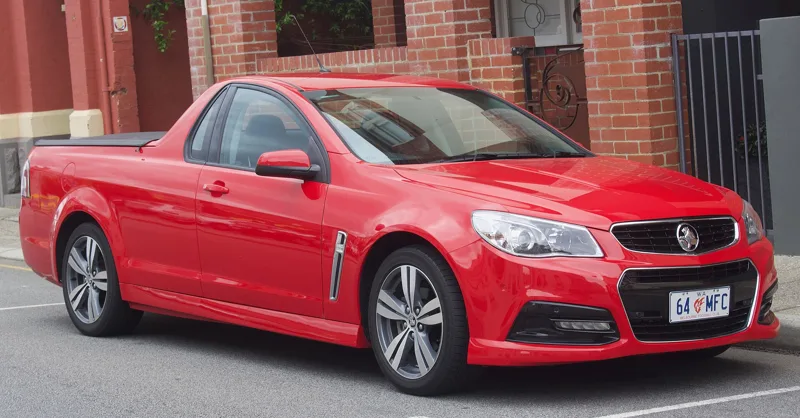
The pickup truck with a car's body began, if the story is right, with a letter. In 1932 a farmer's wife in Victoria, Australia, wrote to Ford Australia asking for a vehicle she could take to church on Sundays and load with pigs for market on Mondays. Ford's designer Lew Bandt came up with an answer, and the coupe utility reached the market in 1934. The El Camino, S-10 and Avalanche each bent the ordinary Chevrolet pickup in a different direction for a different kind of driver.
Each of the three bent the full-size pickup in its own direction. The El Camino took the front half of a car and added a tray. The S-10 shrank the truck and built it at home. The Avalanche kept the size and rearranged the cab and bed, so that one vehicle could be a five- or six-seat SUV or a pickup with a long load floor.
Where did the coupe utility come from?
A coupe utility is a two-door vehicle with a car chassis underneath and an open tray behind the seats. The idea existed in the United States as the roadster utility from the 1920s, but Ford Australia produced the first true coupe utility in 1934, and the Ford Ranchero brought the style to America in 1957.
Holden, General Motors' Australian arm, built a Chevrolet coupe utility in 1935, and Studebaker offered its Coupe Express from 1937 to 1939. By 1939 buyers wanting comfort had pushed coupe utility sales well past the open roadster utility, which was all but a fading memory. The style then vanished from American showrooms until the Ranchero created a new segment of pickups based on car platforms.
Chevrolet answered in 1959 with the El Camino. The first-run El Camino and the Ranchero competed head to head for only the 1959 model year.
The El Camino took a car's front half, the S-10 shrank the truck, and the Avalanche folded a wall out of the cab.
What was the original 1959 Chevrolet El Camino?
It was a pickup built on the new Brookwood two-door station wagon, itself part of the redesigned full-size Chevrolet range. Highly styled, the El Camino outsold the more conservative Ranchero by about 22,000 to 14,000 at first, and Chevrolet built 22,246 of them in 1959.
According to Chevrolet stylist Chuck Jordan, GM's Harley Earl had suggested a coupe pickup as early as 1952. When it came, the El Camino had a single trim level, with the exterior brightwork of the mid-range Bel-Air and the interior of the cheaper Biscayne. Unlike the Brookwood wagon it could be ordered with any full-size Chevrolet drivetrain, and its X-frame chassis and full-coil suspension were the same as the cars'.
The wheelbase was 119 inches (3,000 mm), and the payload rating ranged from 650 to 1,150 lb (290 to 520 kg). The soft passenger-car suspension kept the truck level when empty, while the Ranchero's heavy-duty rear springs gave it a noticeable rake. Chevrolet promoted the El Camino as its first pickup to have a steel load floor rather than a wooden one, a corrugated insert held down by 26 recessed bolts. Beneath it sat the Brookwood's own floor pan, foot wells included, and the box held almost 33 cubic feet (0.93 m3).
There was real performance on offer. The Turbo-Thrust 348 cu in V8 produced up to 335 bhp (250 kW; 340 PS), and there were fuel-injected 283s of 250 and 290 bhp. Hot Rod magazine tested an early 1959 car with a 315 bhp triple-carburettor 348 and four-speed gearbox, recorded 0-60 mph in around seven seconds and estimated a top speed of 130 mph (210 km/h).
Why did the first El Camino disappear after 1960?
Orders dropped by a third to just 14,163 for 1960, and Chevrolet dropped the model. Ford, meanwhile, sold 21,027 Rancheros, which had moved onto the new Falcon compact. American buyers had not taken to car-based pickups in large enough numbers.
The reasons are open to argument. Three people across the seat was the most these pickups could carry, while young baby-boomer families were what the market revolved around. Cargo volume was meagre next to a proper truck. Low-level trim and marketing aimed almost entirely at commercial customers may have hurt as well. The 1960 car started at $2366 for the six-cylinder, with the V8 costing another $107; the fuel-injected engines were gone and the base 283 was detuned to 170 bhp (127 kW; 172 PS).
For the four years in between, the Greenbrier, built on the Corvair platform, took over as the car-based pickup in the Chevrolet range.
How did the El Camino come back on the Chevelle?
Chevrolet reintroduced the El Camino in 1964 on its mid-size Chevelle. It looked like the Chevelle two-door wagon ahead of the B-pillars, carried both badges, and was sold as a utility, so the Chevelle's most powerful engines were left off the list at first.
The 1964 engine range started with sixes of 194 and 230 cubic inches, producing 120 and 155 hp, and a 283 V8 of 195 hp. During the year 327 V8s of 250 and 300 hp were added. Rear air shocks, which allowed a driver to level the truck under a load, remained on every generation. The fully boxed frame stayed only until 1967. The 1965 car brought a facelift and the 350 hp L79 version of the 327, and in 1966 a 396 cu in (6.5 L) V8 of between 325 and 375 hp joined the list. A 1965 car with a 327 would run the quarter mile in the low 15s, at some 90 mph, while the 1966 to 1969 cars were comfortably in the mid- to upper-14s.
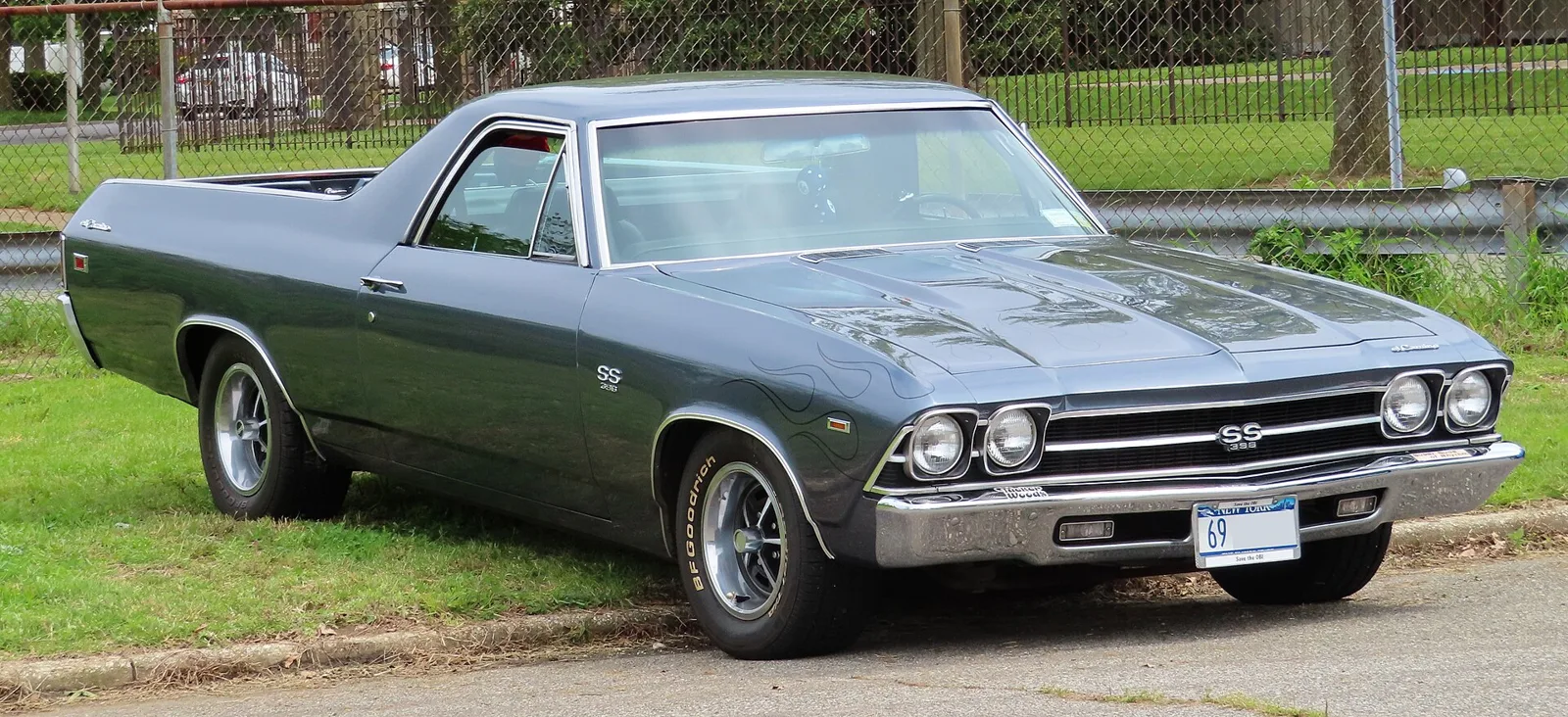
The 1967 model gained a collapsible steering column, optional disc brakes and a Turbo Hydramatic 400 automatic. A factory Super Sport did not arrive until 1968, so many owners cloned their own 1967 SS396s with Chevelle badges and trim. The 1968 car rode on the longer wheelbase of the Chevelle four-door, 116 inches (2,946 mm), and the SS396 appeared with 325 or 350 bhp, or the 375 bhp L78 with solid lifters and an 800 cfm Holley carburettor. For 1969 the first Chevrolet 350 V8 went into an El Camino. One oddity was that back-up lights moved to the tailgate, where they were useless whenever the gate was down.
The most powerful El Camino of the era came in 1970. A new SS396 actually displaced 402 cu in (6.6 L), although every badge still read 396, and a select few cars received the LS6 454, a 450 hp (336 kW) engine with 500 lb-ft (678 N-m) of torque. It put the El Camino into upper-13-second quarter-mile times at around 106 mph (171 km/h). A year later mandated lower-octane unleaded fuel cut compression, and an emissions pump called the A.I.R. system was added, so power and performance fell.
The Chevelle-based run lasted until 1977, and the El Camino continued from 1978 to 1987 on the GM G-body platform. It was classified as a pickup in the United States despite its car underpinnings. GMC sold its own version, the Sprint, from 1971 and renamed it Caballero in 1978. Both ended in 1987.
Why did the Chevrolet S-10 matter in compact pickup history?
The S-10, introduced in 1981 for the 1982 model year, was the first domestically built compact pickup from any of the big three American makers. It replaced the Japanese-built LUV, whose import costs were driven up by a 25% tax on foreign utility vehicles.
The 1973 Arab oil embargo had pushed demand towards smaller, cheaper trucks. General Motors' first reply was the Chevrolet Light Utility Vehicle, a rebadged Isuzu KB from 1972. The American chicken tax charged 25% on imported utility vehicles, so many LUVs were shipped in pieces to dodge it. Building a domestic truck solved the problem, and GM drew parts from its G-body intermediates. The base engine was a 1.9-litre Isuzu four-cylinder, imported from Japan, with a 2.8-litre V6 as the option. The Chevrolet and GMC versions, the latter called the S-15, differed only in grille, tailgate and badges.
The truck grew quickly. For 1983 came an extended cab called the Maxi-Cab, Insta-Trac four-wheel drive, a 2.0-litre four and an Isuzu 2.2-litre diesel. The S-10 Blazer and S-15 Jimmy debuted for 1983 as GM's compact SUVs; GM was first in the class, followed by Ford and then Jeep the next year. The Iron Duke four arrived in 1985, a 4.3-litre V6 in 1988 and anti-lock brakes in 1989. A pack of appearance options filled the late 1980s, including the Baja (1989 to 1991) for four-wheel-drive trucks, with roll bar, off-road lights and underbody shields, and the Cameo for two-wheel-drive ones.
What were the Syclone, Sonoma GT and S-10 SS?
They were the fast S-series trucks. The 1991 GMC Syclone had all-wheel drive and a turbocharged 4.3-litre V6 of 280 hp, with only 2998 built. The Sonoma GT of 1992 was a cheaper, non-turbo alternative, and the Chevrolet S-10 SS followed in 1994.
The Syclone also carried four-wheel anti-lock brakes, lower-compression pistons and a water intercooler. The Sonoma GT, of which only 806 were produced, had a non-turbocharged 4.3-litre V6 with 195 hp (145 kW) and 260 lb-ft (353 N-m). It used a Syclone-inspired cladding kit and interior, but because it was not built for outright speed it kept its payload and towing ratings. The GMC Typhoon SUV appeared in 1992 as well.
The S-10 SS, introduced in 1994, was the Chevrolet-badged version, with a 4.3-litre V6 of between 180 and 200 hp (149 kW) as standard and annual production of fewer than 3,000 on average. It was dropped in 1998 and replaced by the Xtreme package for 1999. The second generation of the S-10 arrived for 1994 and dropped the Syclone, Typhoon and Sonoma GT while aligning the truck with its chief rival, the Ford Ranger. A driver's airbag was added for 1995, a third door on extended cabs in 1996, and a four-door Crew Cab in 2001, three years before the full-size Silverado 1500 offered one. An electric S-10 EV, using the front-drive powertrain of the GM EV1, was introduced in 1997.
North American production ended in January 2004, and the Colorado, GMC Canyon and Isuzu i-Series replaced the S-series there. Brazil kept the S-10 name on its S-series trucks until 2012, when the Colorado replaced them.
What made the Chevrolet Avalanche different from a Silverado?
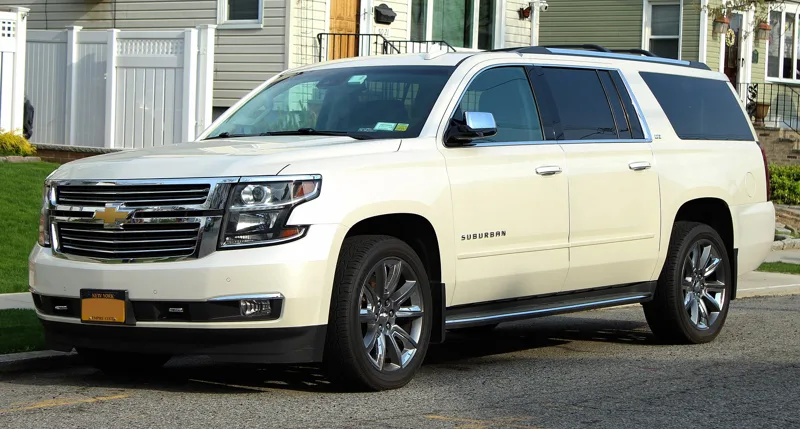
The Avalanche was a four-door pickup built on the Suburban SUV chassis, with the bed integrated into the cab body. Its midgate, a divider behind the second row, folded down with the seats to lengthen the load bed. It was built in two generations from 2001 to 2013.
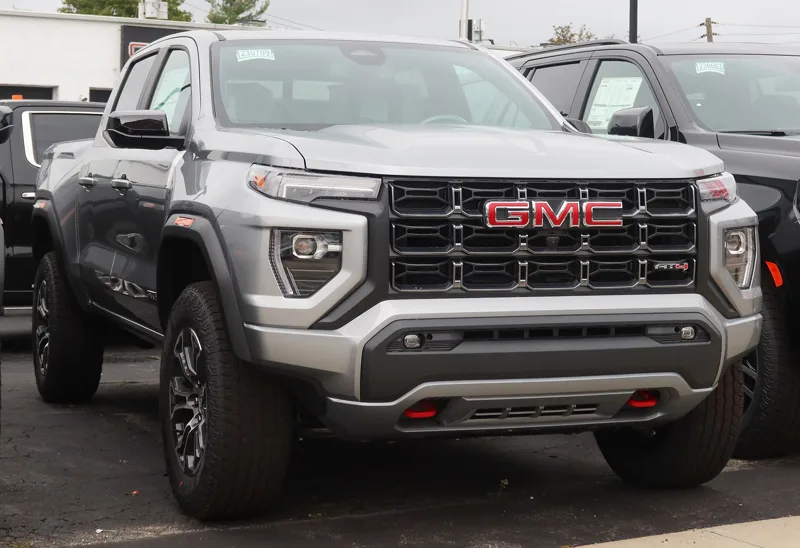
The advertising promised an SUV that could turn into a super SUV, with a plastic cover completing the system. Sales began in September 2001 of the 2002 model, which sat on the GMT800 platform, and the truck was named Motor Trend's Truck of the Year for 2002. Light gray plastic cladding marked it out from the Suburban, and its front end gave the public a first look at the next generation of GM styling.
Breaking with long-standing practice, General Motors gave it no GMC twin. Cadillac sold a rebadged version as the Escalade EXT, and the midgate also appeared on the GMC Envoy XUV, the Hummer H2 SUT and, from outside the company, the Subaru Baja. The half-ton 1500 used a 5.3-litre V8 of 285 hp (216 kW), and the three-quarter-ton 2500 an 8.1L V8 of 340 hp (253 kW). Z71 Off-Road and Z66 Premium On-Road packages let buyers pick between trail and tarmac.
The cladding became a problem, since heat and sunlight left it chalky and streaked, and GM, with a coating partner, developed a product to restore it for customers within the factory warranty. Rick Wagoner, GM's new president, demanded the trim be removed for 2003, and from mid-year the truck could be ordered without it. Marketers called the result slicksides.
Shown at the Chicago show in February 2006, the second generation entered production at Silao in Mexico that April, on the GMT900 platform. It shed the 2500 and moved from recirculating-ball to rack-and-pinion steering. The flex-fuel 5.3-litre V8 made 320 hp (239 kW) on petrol and 326 hp (243 kW) on E85 ethanol. For 2009 a six-speed automatic arrived, and the 6.0L V8 was dropped after that model year, leaving the 5.3L alone. Three trims, LS, LT and LTZ, were offered. For 2013 all three were sold as Black Diamond Edition cars to mark the final year, each with a personalised coffee-table book for the owner.
Three pickups compared
| Model | Years | Built on | How it differed from a full-size pickup |
|---|---|---|---|
| El Camino | 1959 to 1960; 1964 to 1987 | Full-size wagon, then Chevelle, then G-body | Cab and bed built into one car-style body |
| S-10 | 1982 model year to 2004 in North America | Parts from the G-body intermediates | Compact size, built domestically to avoid the chicken tax |
| Avalanche | 2001 to 2013 | Suburban chassis (GMT800, then GMT900) | Midgate joins cab and bed into one space |
When did each of the three stop production?
The El Camino ended in 1987 along with the GMC Caballero. The S-10 was replaced by the Colorado in 2004 in North America, and again in Brazil in 2012. The Avalanche left production after the 2013 model year, having kept the midgate idea alive for two generations.