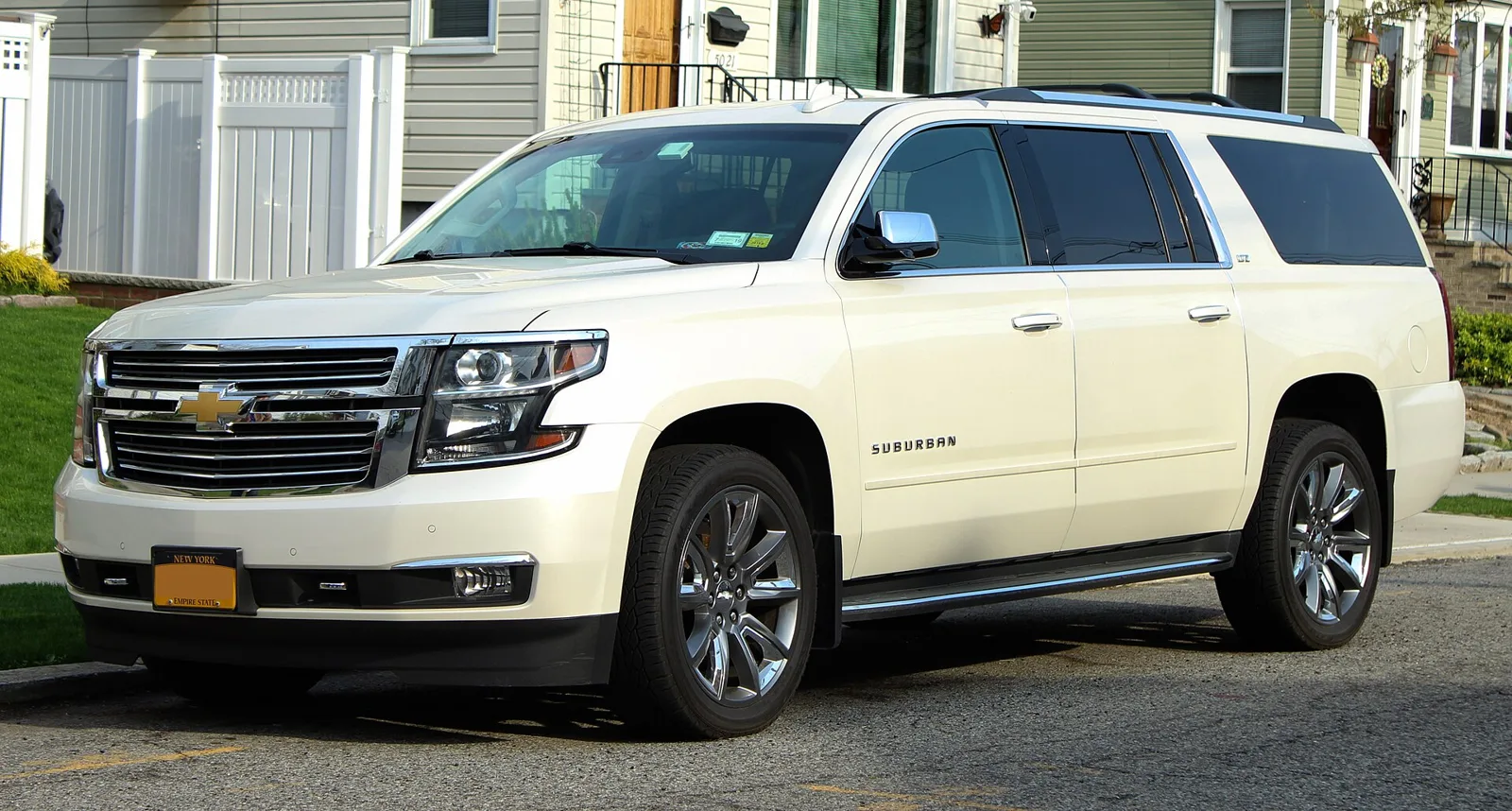
A wagon body on a pickup frame became the longest-produced nameplate in the world, and the same formula now sits under a shorter Tahoe and a Cadillac Escalade.
Chevrolet has built the Suburban since 1934, and no other car name has been in production for as long. Its wagon body on a truck chassis also became the shorter Tahoe from 1995 and, through the Yukon Denali, the Cadillac Escalade from 1999.
On 5 December 2019 the Hollywood Chamber of Commerce put a star in the pavement at Hollywood Boulevard and Highland Avenue, and for the first time it went to a vehicle. The recipient was a station wagon bolted to a truck frame, the Chevrolet Suburban, which had turned up in more than 1,750 films and television series from 1952 onwards. It has been on sale since 1934, making it the world's longest-produced car nameplate, and the same recipe now sits behind the Chevrolet Tahoe and the Cadillac Escalade.
Chevrolet Suburban history: where the name came from
Chevrolet did not coin the word. Several American manufacturers used "Suburban" to describe a windowed wagon body fitted to a commercial chassis, among them DeSoto, Dodge, Plymouth, Studebaker and Nash. Strictly, the name was a trademark held by a Tell City, Indiana, firm, U.S. Body and Forging Co., which built wooden wagon bodies for every one of those chassis and others besides under the Westchester Suburban banner.
Chevrolet began production of an all-steel "carryall-suburban" in 1934, and GMC followed with its own in 1937. For a time both wore the Suburban Carryall label before General Motors trimmed it. Competitors faded one by one. When the Plymouth Fury Suburban wagon ended in 1978, GM was the only company still building a vehicle with the name, and it was awarded an exclusive trademark in 1988.
The idea predates even that. In 1933 the Chevrolet Master offered a wagon body on a half-ton truck frame, made mainly of wood and intended for National Guard and Civilian Conservation Corps use. It seated up to eight.
People name what they love, and they love their Suburbans.
How a wagon body ended up on a truck chassis
Think of it as a pickup that has traded its open bed for a family room. The first Carryall Suburban took the front sheet metal and frame of the half-ton pickup and added an all-metal wagon body that looked very much like the wooden "woodie" wagons of the day.
Seating ran to eight: three up front, two in the centre row and three behind. Passengers got only two doors, and cargo was reached through side-hinged panel doors or a tailgate with a lift window.
That truck-first construction has never changed. The modern Suburban is a full-size SUV with three rows, a full pickup frame and a V8, and it is one of the few wagons offered with bench seats in every row. The marque's own pickups have always supplied its bones, from the Advance Design and Task Force trucks through the C/K generations to today's Silverado.
The early generations, from 1941 to 1967
The second generation was built in the 1941, 1942 and 1946 model years and also served as a military transport during the Second World War. Chevrolet versions used a 216 cubic-inch six, while the GMC used a 228. Rear panel doors earned the code 3106 and a tailgate 3116.
The 1947 third generation was based on the Advance Design pickups and was the last series to include "canopy express" models. A Hydra-Matic four-speed automatic arrived in GMC models in 1953 and in Chevrolet Suburbans for 1954. More than half a century later its shape inspired the Chevrolet HHR.
Chevrolet and GMC trucks were restyled on 25 March 1955, in the middle of a model year, as the Task Force and Blue Chip series. A flatter hood, flush front fenders and a trapezoid grille came with them, plus small-block V8s. Chevrolet used a 265 and later a 283 cubic-inch unit, while GMC based its V8 on a Pontiac design. Four-wheel drive was added in 1957, with codes 3156 for panel doors and 3166 for tailgates.
The fifth generation, from 1960, brought independent front suspension on the two-wheel-drive models, known as "C", alongside a four-wheel-drive option badged "K". A 1964 update gave a flatter windscreen and larger door glass, and the cargo area could take 1,150 lb (520 kg). Stageway of Fort Smith, Arkansas, converted some into 15-passenger machines with three doors on the right, a wheelbase of 171 in (4,343 mm) and a weight of 6,300 lb (2,858 kg).
From 1967 the Suburban was lengthened to leave room in the range for the K5 Blazer, which debuted in 1969. That stretch is the origin of the size gap that still separates Suburban and Tahoe.
Chevy Tahoe vs Suburban: the same body, two lengths
The Tahoe is the shorter sibling. It is a line of full-size SUVs marketed since the 1995 model year, and it succeeded the K5 Blazer. The Suburban shares its height and width but runs 380 to 510 mm (15 to 20 inches) longer, and the extra length becomes a big load bay behind nine seats.
The five-door Tahoe arrived in 1995 as a response to the decline of three-door SUVs of every size. To fit a second pair of doors, GM added six inches to the wheelbase and 11 to the length. Even so, the Tahoe sat 12 inches short of the Suburban's wheelbase and 20 inches short of its overall length, and it never offered a third row. A visual giveaway is the bottom edge of the rear doors: on the Tahoe and Yukon it is notched to clear the rear wheel arch, whereas the Suburban's door runs down to the rocker panel.
Production of the five-door Tahoe and Yukon began on 20 January 1995 at Janesville Assembly, and Motor Trend named the Tahoe its Truck of the Year for 1996. In the United States it has often been the top-selling full-size SUV, commonly beating its rivals two to one.
Why the names Tahoe and Yukon exist
The names are geography. Tahoe refers to Lake Tahoe and Yukon to the Canadian Yukon, both in western North America. They exist because of a muddle. In 1983 GM launched its first mid-size SUVs, the S-10 Blazer and GMC S-15 Jimmy, which borrowed the names of their full-size counterparts. To end the confusion GMC renamed its full-size Jimmy the Yukon for 1992, and Chevrolet followed in 1995 by turning the full-size Blazer into the Tahoe.
Underneath, the 1992 redesign took the range off the Rounded-Line C/K chassis and onto GMT400 underpinnings that had debuted for 1988. The Blazer turned into what was effectively a three-door Suburban, with a fixed steel roof in place of the removable hardtop and a liftgate window instead of the retracting tailgate glass. The Chevrolet Tahoe was offered in base, LS and LT trims until the 1999 model year, after which the three-door was dropped for good. The GMC Yukon came in base, SLE and SLT forms, with a Yukon GT flagship between 1992 and 1994.
The standard engine was a 350 cubic-inch (5.7 L) small-block V8. In 1994 buyers could specify a 6.5 L (395 cu in) turbodiesel V8 from Detroit Diesel, but only on three-door four-wheel-drive models, and it was detuned to 360 lb ft (488 N m) to suit the rear axle of the 1500-series Tahoe. In 1998 the old part-time 4x4 system gave way to AutoTrac, which added an automatic mode: the front axle was engaged only if wheel slip was sensed at the transfer case.
The 2000 model year brought two special editions, a rear-wheel-drive Tahoe Limited and a 4x4 Tahoe Z71. The Limited was a road-focused version of the 1996 Tahoe SS concept, painted nearly monochrome Onyx Black and lowered by two inches. The name Super Sport had fallen out of favour with GM because insurers were demanding higher premiums for SUVs. The Z71 took its name from the off-road package introduced on K-series pickups in 1989 and added skid plates, a G80 locking differential and a two-row radiator.
How the Cadillac Escalade copied the formula and added a badge
General Motors had a problem in 1998. Lincoln had just launched the Navigator, and GM had nothing to put against a full-size luxury truck. The answer was the Yukon Denali, the first model of GMC's Denali sub-brand, with new bodywork ahead of the windscreen, upgraded leather, woodgrain trim and a Bose stereo. A year later the same vehicle became the Cadillac Escalade, a way of giving GM's flagship brand an SUV of its own. The project reached production only ten months after approval.
Cadillac was pitching against the Navigator, Range Rover, Lexus LX and Mercedes-Benz M-Class, but the first Escalade was close to a Denali with a different grille and badges. It added Zebrano wood trim, redesigned perforated-leather seats and a Cadillac crest on the headrests, and OnStar was standard rather than optional. Buyers had just two boxes left to tick: barn doors or a split tailgate at the rear, and a dealer-fitted telephone.
It was also underpowered next to the Lincoln. The 5.7 L Vortec 5700 V8 made 190 kW (255 hp), against 224 kW (300 hp) and 365 lb ft (495 N m) from the Navigator's 5.4L engine. The Escalade cost $46,225 in both 1999 and 2000, while the 2000 Yukon Denali rose to $43,535. General Motors still holds the first Escalade built at Arlington Assembly, a 1999 Aspen White car with VIN 400001, in its Heritage Collection.
Cadillac Escalade generations and what changed
The second generation arrived late. Cadillac held its changeover to the GMT820 chassis back to February 2001, making it a 2002 model and the last of GM's three full-size truck brands to move. It was unveiled in August 2000 at Pebble Beach. Rear-wheel drive and a 5.3 L V8 were standard, and from mid-2005 every Escalade carried the 6.0 L engine. The long Escalade ESV debuted for 2003, and in 2004 a Platinum Edition ESV at $71,025 offered the segment's first factory 20-inch chrome wheels, heated and cooled seats, and monitors for rows two and three.
The third generation, on the GMT900 platform, launched for 2007 with production starting in January 2006 and a price from US$57,280. It used an all-aluminium 6.2L Vortec V8, a pushrod design with variable valve timing that was the first of its kind in mass production. The body recorded a drag coefficient of 0.363. A two-mode hybrid followed as a 2009 model from $74,085, and in August 2008 hybrids made up 20% of Escalade sales. The Northeast takes 60 percent of all Escalade sales.
| Escalade engine | Years | Output |
|---|---|---|
| 5.7 L Vortec 5700 V8 | 1999-2000 | 190 kW (255 hp) |
| 5.3 L LM7 Vortec V8 | 2002-2003 | 213 kW (285 hp) |
| 5.3 L LM7 Vortec V8 | 2004-2005 | 220 kW (295 hp) |
| 6.0 L LQ9 HO Vortec V8 | 2002-2006 | 257 kW (345 hp) |
| 6.2L Vortec 6200 V8 | 2007-2014 | 301 kW (403 hp) |
Who actually drives a Suburban
Everyone, if the record is to be believed. A 2018 iSeeCars.com study identified it as the car driven the most each year, and a 2019 study ranked it the second longest-lasting vehicle. It has served as a police truck, fire chief's car, ambulance, taxi and limousine. Gothic black Suburbans are common with federal intelligence services, and the Secret Service runs fully armoured versions for the President at less formal engagements.
On screen it has been in a television series every year since 1956 and in a film every year since 1960, a streak no other car of any type has matched. Rivals did not last: the International Harvester Travelall, Jeep Wagoneer and Ford Excursion all came and went, and the Ford Expedition EL is the latest competitor.
The 10 millionth Suburban was built at Arlington Assembly in 2015, the year it marked 80 years on sale. Car and Driver credited its longevity to strong sales, appeal across all kinds of customers and unusual loyalty. A Chevrolet marketing executive, Sandor Piszar, put the loyalty down to naming: people name what they love.
The Suburban around the world
Chevrolet markets the Suburban across Canada, Mexico, the United States, Central America, Chile, the Dominican Republic, Bolivia, Peru, the Philippines and the Middle East. GMC's long version, now the Yukon XL, stays in North America and the Middle East. Cadillac has marketed its own long version as the Escalade ESV since 2003.
Australians briefly had a version too. In the late 1990s GM sold a right-hand-drive Suburban badged as a Holden, but sales were low and it left the lineup in 2000. Chevrolet weighed a comeback in 2019, as a converted import through Holden Special Vehicles, then held off amid GM's plan to retire Holden in 2020. Today, the right-hand-drive Escalade is available in Australia only through third-party converters without any agreement with Cadillac.
Brazil had its own take. In 1964 Chevrolet there introduced a five-door version called the C-1416, renamed Veraneio from 1969, a Portuguese word for "summertime". It used a 4.3L inline-six and later the 250 cubic-inch (4.1 L) engine from the Opala sedan, and the second generation ran from 1989 to 1995. It was followed by the Grand Blazer, which lasted until 2001 with a 138 hp (101 kW) six or a 168 hp (124 kW) MWM turbodiesel.
The Suburban and Escalade today
The Suburban is now on its twelfth generation, built since the 2021 model year. Alongside it, the Escalade has turned electric. GM presented the Escalade IQ on 8 August 2023; after the Celestiq and Lyriq it was the third electric Cadillac. Sales began in late 2024 as a 2025 model, priced from $130,000. The fifth-generation Escalade, introduced in 2021, is nearly two metres high and drew criticism from The Verge for its size and what the magazine called a hazard to pedestrians.