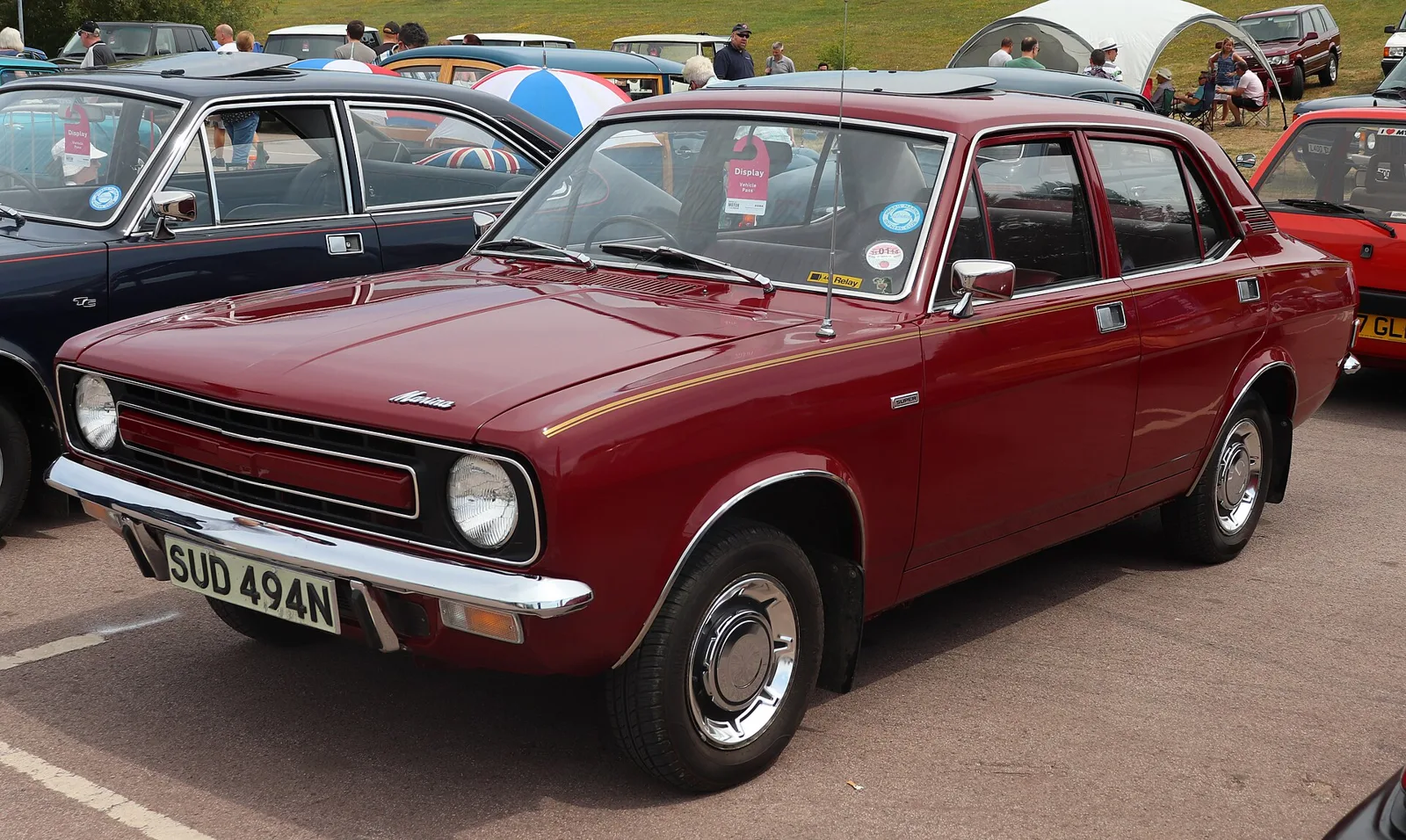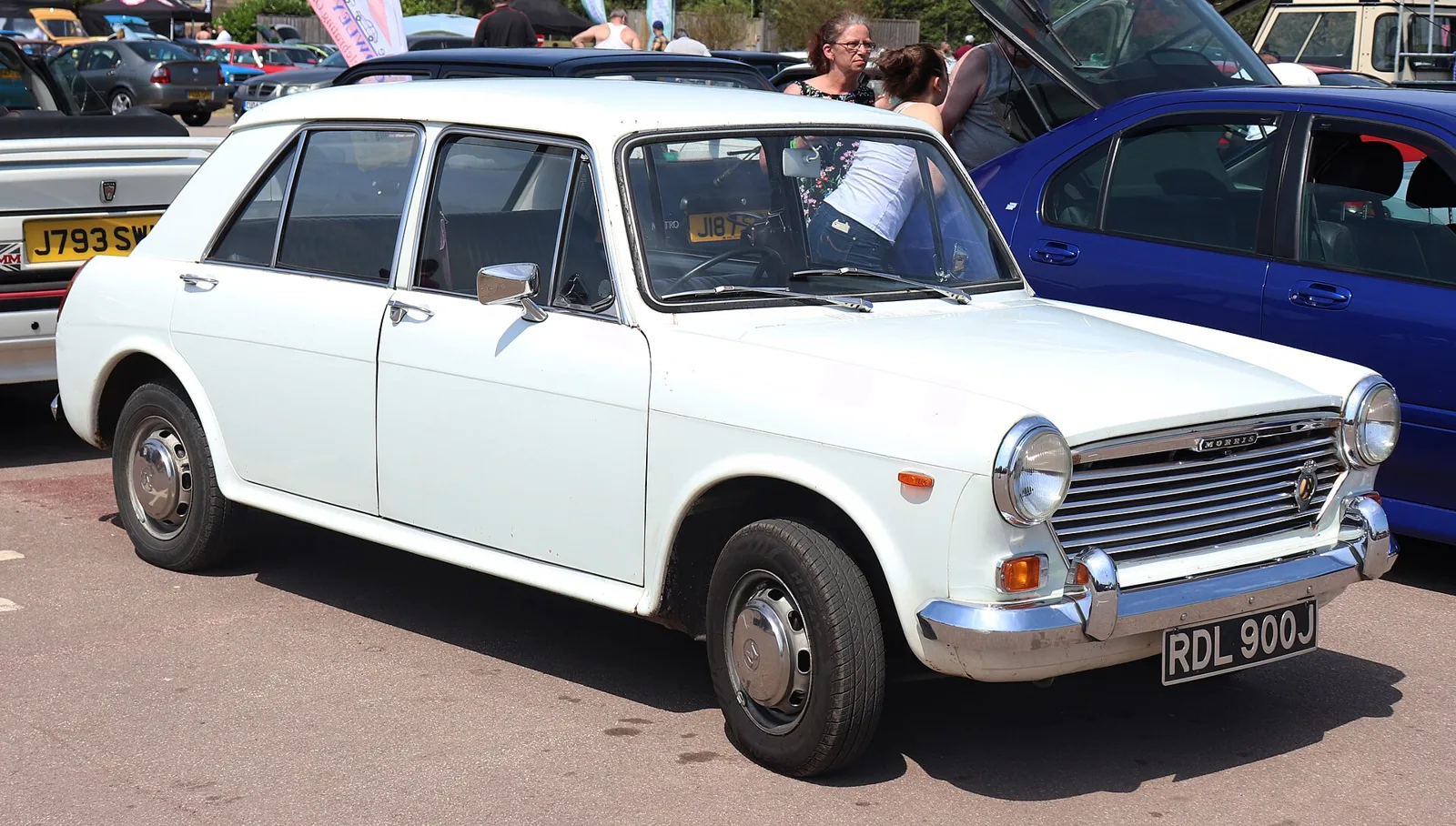
Two front-drive family cars on Hydrolastic suspension: a best-seller that led the British charts from 1963 to 1966 and 1968 to 1971, and a wide saloon rally crews likened to a crab.
The ADO16 was BMC's small front-drive family car, launched in 1962 as the Morris 1100 and sold under many badges until 1974. The ADO17 was the larger Austin 1800, nicknamed Landcrab, built from 1964 to 1975. Both used Hydrolastic suspension and both were badge-engineered across BMC's marques.
Britain's best-selling car for much of the 1960s was sold as an Austin, a Morris, an MG, a Riley, a Wolseley, a Vanden Plas Princess and, in Italy, an Innocenti. It was the ADO16, and it led the British charts from 1963 to 1966 and again from 1968 to 1971.
What was the BMC ADO16?
The ADO16 was a family of small front-wheel-drive saloons from the British Motor Corporation, launched in 1962 and later built by British Leyland. It was best known as the Austin and Morris 1100 and, with the 1275 cc engine, the 1300. Production reached 2.3 million between 1962 and 1974, and more than half of them went to buyers in the UK.
ADO stands for Amalgamated Drawing Office, and 16 was the project number. The first car was the Morris 1100, launched on 15 August 1962. The twin-carburettor MG 1100 followed within weeks, and then came the Austin 1100 in August 1963, the Vanden Plas Princess 1100 that October and the Wolseley 1100 and Riley Kestrel in 1965. A three-door estate arrived in 1966, called the Countryman by Austin and the Traveller by Morris.
The car became part of British culture. An Austin 1100 Countryman appears in the Fawlty Towers episode Gourmet Night, where Basil Fawlty gives it a beating, although the episode was shown in October 1975, when the car was already out of production. In 1964 Wheels magazine named the 1100 its Car of the Year.
How popular was it?
At its peak the ADO16 held around 15% of the new car market. During 1970 the 1100 and 1300 remained the top seller with 132,965 registrations against 123,025 for the Ford Cortina, which was then in its third incarnation. The two millionth car was built at the end of June 1971, and 1971 was the last year at the top. The Cortina outsold it in 1972, and Autocar reported in October 1973 that about 2,365,420 had been produced.
Britain's best-selling car of the 1960s came as an Austin, Morris, MG, Riley, Wolseley, Vanden Plas and Innocenti.
Why did BMC sell the same car under so many badges?
The Morris and Wolseley versions of the 1800 were launched to cater for the dealerships selling those marques, and the 1100 was spread across the same marques. Under BMC's policy at the time, Austin versions of the ADO16 were built at Longbridge, while Morris and MG versions were assembled at Cowley.
The names ran long. Beyond the 1100 and 1300, Austin used 11/55, America, Apache, De Luxe, Glider and Victoria, Innocenti sold the Austin I4 and Morris IM3 in Italy, and MG offered the 1100, 1275 and 1300. Riley called its version the Kestrel until October 1968, when it dropped that name, and Vanden Plas sold the Princess. Denmark got the Morris 1100 under the name Morris Marina in 1962, and sales there were slow at first because of a new tax regime.
The cars were also built beyond Britain. Authi in Spain, Innocenti in Italy, IMV in Yugoslavia and BMC's own plant in Belgium all assembled them, and the design inspired locally adapted cars in Australia and South Africa. New Zealand and Malta assembled kits from 1963 until 1974.
The badge ladder collapsed in the 1970s. The Riley 1300 Mark II ended in July 1969, signalling the demise of the Riley marque, and British Leyland later dropped Wolseley and sold most of its models under a single brand.
How was the ADO16 designed?
Sir Alec Issigonis designed it after the success of the Mini. He aimed for a larger and more sophisticated car, and Pininfarina, which had already worked for BMC on the Austin A40 Farina, styled it. The cabin was roughly as roomy as the bigger Ford Cortina's. Like the Mini, it used a transverse A-Series engine to drive the front wheels, and it had front disc brakes with single-piston swinging calipers, uncommon on mass-produced cars in the early 1960s.
The cleverest part was the suspension. Hydrolastic, designed by Alex Moulton, was an interconnected fluid system rather than a conventional set of independent springs. Moulton and Issigonis had studied the interconnected suspension of the Citroen 2CV in the mid-1950s, according to an interview Moulton gave Car magazine in the late 1990s. They wanted its ride comfort, body levelling and grip, and added roll stiffness that the 2CV lacked.
Charles Griffin took over development at the end of the 1950s while Issigonis finished the Mini. He pushed the 1100 toward greater refinement, comfort and polish, and he would later carry overall responsibility for the Princess, Metro, Maestro and Montego ranges.
What changed between the Mark I, Mark II and Mark III?
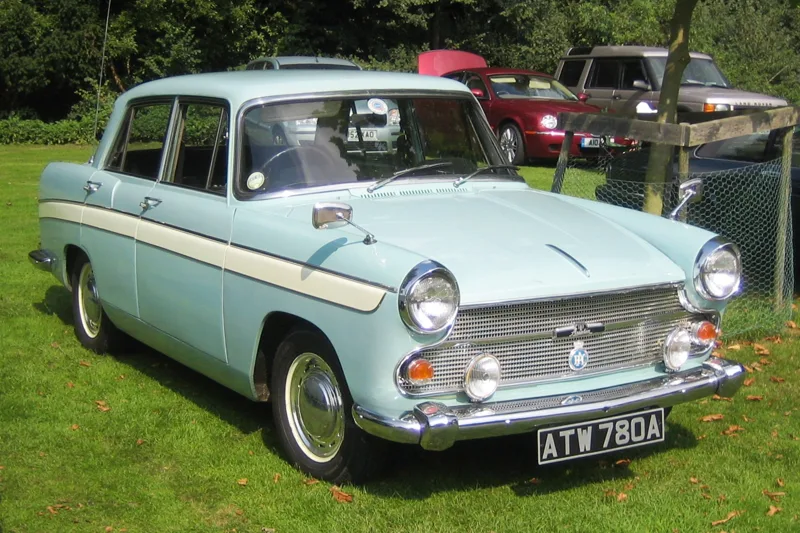
The Mark I of 1962 to 1967 used a 1098 cc A-Series four and, at first, came only as a four-door. Its sales material stressed cabin space against conventional rivals such as the Ford Anglia, Vauxhall Viva and Morris Minor, nearly all of them rear-drive. An AP four-speed automatic was added as an option in November 1965, with a new carburettor and a higher compression ratio to limit the usual power loss. The two-door home-market saloon had to wait for the Mark II in 1967.
A larger engine arrived with the Mark II. In May 1967 BMC announced a 1275 cc unit, already familiar from the Mini Cooper S and Austin-Healey Sprite, for the MG, Riley, Vanden Plas and Wolseley models, and Austin and Morris versions followed in October as the 1300. Waiting lists of several months formed in the closing months of 1967, because BMC was working flat out on export orders after the devaluation of the pound. The Mark II had a wider grille and a smoother tail lamp, with wavy bars for Austin and straight bars for Morris, and every gearbox gained synchromesh on all forward gears.
In October 1969 the Austin and Morris 1300 GT was shown at the London Motor Show, with the twin-carburettor 1275 cc engine of the MG 1300, a black full-width grille and a black vinyl roof. It was BMC's reply to the sporty Escort GT from Ford, and the car sat slightly lower because the Hydrolastic pressure was reduced from 225 to 205 psi. A 1498 cc E-Series engine was also fitted between 1969 and 1971, and in Australia it created the Morris 1500.
The Mark III came in September 1971, and the range then shrank. The MG 1300 went in 1971 and the Wolseley 1300 in 1973. On 19 June 1974 the last British-built ADO16, a Vanden Plas Princess 1300, rolled out of the factory. British Leyland replaced the family with the Austin Maxi in 1969, the Morris Marina in 1971 and the Austin Allegro in 1973. By then the Cortina had grown larger, leaving the 1100 and 1300 in the small-car class against the Escort, the Viva, the Hillman Avenger and the Datsun Sunny.
What was the BMC ADO17, and why was it called the Landcrab?
The ADO17 was BMC's larger front-drive family car, built from September 1964 to 1975. It was sold as the Austin 1800, then as the Morris 1800 from 1966 and the Wolseley 18/85 from 1967, and later with a 2.2-litre engine as the Austin 2200, Morris 2200 and Wolseley Six. Enthusiasts called it the Landcrab because it was wide and low, and it was named European Car of the Year for 1965.
BMC conceived it as a larger follow-up to the Mini and the Austin 1100. Its look was unconventional, with a large glasshouse, a minimalist interior of leather, wood and chrome, a ribbon speedometer, an umbrella-handle handbrake under the dash and two front seats that met in the middle and could serve as a bench. Issigonis and Pininfarina both worked on the exterior.
The engineering ran ahead of its time. It used Hydrolastic suspension and a valve that moved braking force between the front and rear axles according to sensed deceleration, instead of fluid pressure. Its lights dimmed at night through a resistance circuit to avoid dazzling following drivers. The bodyshell was exceptionally stiff, with a torsional rigidity of 18,032 Nm per degree.
The nickname came from the car's stance. The Landcrab was never quick, but its strong shell and refined suspension let it hold up average speeds over long distances on poor roads, and BMC rally crews thought of a crab scuttling over rough ground. The 1800 finished second in the 1968 London-Sydney Marathon and took three of the top 20 places in the 1970 London to Mexico World Cup Rally.
How did BMC sort out the early cars?
Fixes came thick and fast, and to some observers it looked as though the car had been launched without enough development. A month after the November 1964 launch, reclining front seats and a centre rear armrest were added. In January 1965 the final drive went back from 4.2:1 to the 3.88:1 of the prototype, a response to oil consumption, which cut 2 bhp but cured valve crash near top speed on the new motorways.
The flat-section dipstick was swapped after, it was said, inattentive owners overfilled the sump by refitting it back to front. Over 1965 and 1966 the handbrake was repositioned, the rear anti-roll bar removed, and engine mounts and side covers strengthened. A June 1967 update arrived without fanfare, bringing walnut veneer, repositioned heater controls, separate front bucket seats and steering geared at 3.75 turns lock to lock instead of 4.2. Rumours spread that early engine trouble had come from a miscalibrated dipstick, but the maker insisted the change was one of several unspecified modifications.
The Mark II of May 1968 had a cheaper, more conventional interior, vertical fin tail lamps for the Austin and Morris, conventional bushes in place of the Mark I's superior roller bearings, and a compression increase that lifted claimed power by 5 bhp to 86 bhp. An 1800S with twin carburettors and 95 bhp arrived in October 1968, and by 1970 a 97 bhp (72 kW) version had a 120 mph speedometer. The Mark III of 1972 added a floor-mounted handbrake and a shared grille for Austin and Morris, along with the six-cylinder 2200s, and the Wolseley 18/85 was dropped.
Where else did the ADO17 go?
In Australia, BMC's leading world market by 1966, the Austin 1800 went on sale in November 1965 with local content claimed at 65 to 70%, rising to 95% by the end of 1968. It had a raised ride height, a heavy sump guard and better dust sealing. Australian buyers took it in greater numbers per head of population than anyone else, as a roomy four-cylinder alternative to the six-cylinder Holden Kingswood. A coupe utility, the 1800 Utility, was built from 1968 to 1971 and over 2,000 were made.
One Australian experiment put a Rover 3.5-litre V8 into an 1800 Mark II, but costs counted against it and Leyland Australia chose the P76 instead. In 1970 the Austin Tasman and Kimberley, the X6 models, replaced the 1800 there with a 2.2-litre six derived from the E-Series four, one of the first front-drive cars with a transverse straight-six. The British ADO17 got the same engine in 1972.
How do the two cars compare?
| Feature | ADO16 | ADO17 |
|---|---|---|
| Built | 1962 to 1974 (UK) | September 1964 to 1975 |
| Main names | Austin and Morris 1100 and 1300, MG, Riley, Wolseley, Vanden Plas | Austin and Morris 1800, Wolseley 18/85, later 2200 and Six |
| Engines | 1098 cc, 1275 cc, 1498 cc A-Series and E-Series fours | Four-cylinder 1800, 2.2-litre six from 1972 |
| Production | About 2.3 million | Some 386,000 |
| Honours | Wheels Car of the Year 1964 | European Car of the Year 1965 |
| Replaced by | Marina, Allegro | ADO71, then Princess |
Which details set the early and late cars apart?
Few ADO17s have survived outside enthusiasts' hands, because of an unfashionable image and the car's popularity in banger racing and demolition derbies, where the strong shell is an advantage. Mark I Landcrabs have the roller bearings that the Mark II dropped, while the Mark II brought a more conventional interior. On the ADO16, the Hydrolastic fluid pressure sets the ride height, which is why the 1300 GT was lowered by reducing it.
What replaced the ADO16 and ADO17?
The ADO71 replaced the Austin, Morris and Wolseley 1800 range in early 1975 as the wedge-shaped 18-22 series, and from late 1975 all ADO71 cars were sold as the Princess, while the Wolseley marque ended. The ADO16's own heirs were the Marina and Allegro.