From the rounded Cambridge of 1954 to the Italian-styled A99 and A40 Farina, and what each Austin offered buyers.
The Austin Cambridge was a medium saloon built from 1954 to 1971, the Westminster a large six-cylinder saloon and estate sold from 1954 to 1968, and the A40 Farina a small economy car from 1958. Pinin Farina's styling reached the Cambridge in 1959, the A99 Westminster in 1959 and the A40 in 1958.
Battista Farina and his son Sergio travelled to Britain for the launch of the Austin A40 Farina. Turin studios had mostly worked for makers of costly exotics, and BMC made a great deal of the Italian pedigree. The same studio shaped the Cambridge from 1959 and the A99 Westminster.
What was the Austin Cambridge?
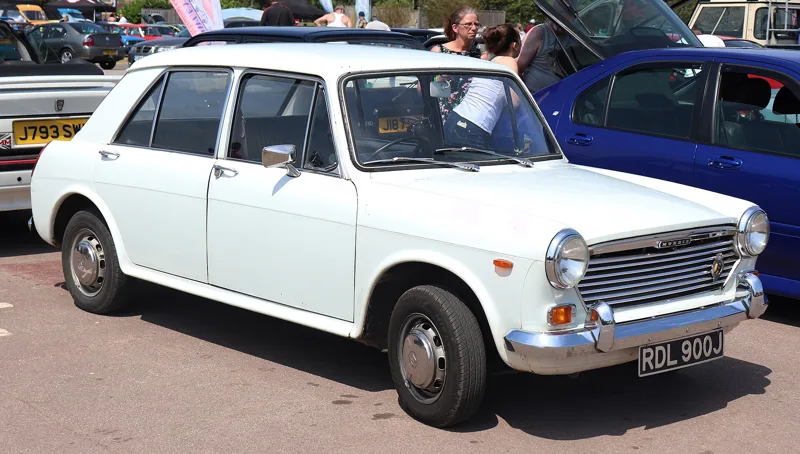
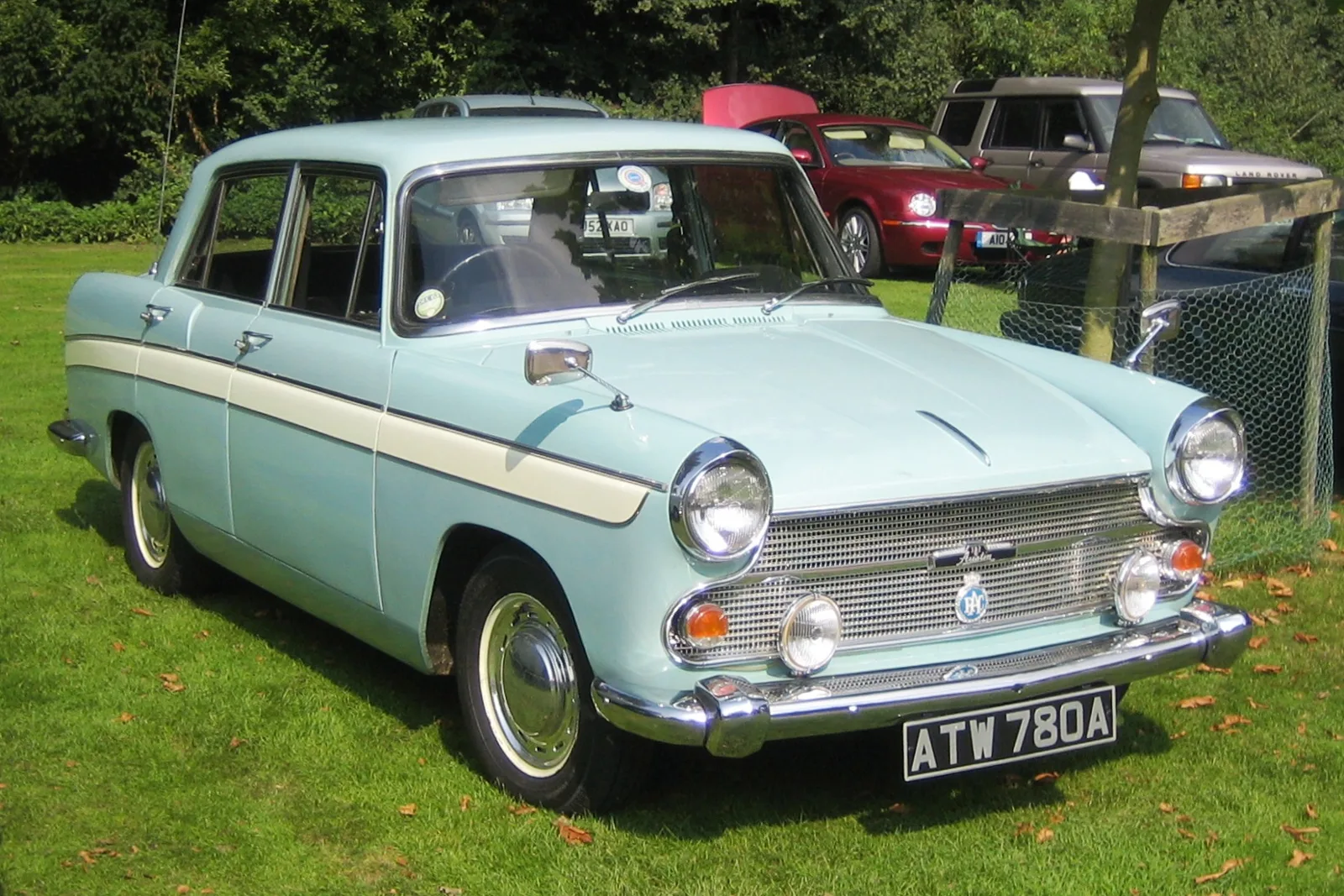
The Austin Cambridge, sold as the A40, A50, A55 and A60, was a medium-sized car range built by the Austin Motor Company from September 1954 to 1971, and as light commercials until 1973. Replacing the A40 Somerset, it was a clean-sheet design with unibody construction. Two basic body styles ran through the range: a rounded shape on the A40, A50 and early A55, and Pininfarina styling on the later A55 Mark II and A60.
At first the Cambridge was a four-passenger, four-door saloon only, with independent front suspension on coil springs and wishbones and a live rear axle with an anti-roll bar. It had integrated wings and a full-width grille. A van followed in November 1956 and a coupe utility in May 1957, and both outlived the cars. From 1958 to 1968 the A40 number went to a smaller car, the A40 Farina, while the Cambridge name had earlier been one body option on the pre-war 10 hp range.
Turin studios had mostly served builders of exotic cars before BMC took Farina's pen to a family saloon.
How did the A40, A50 and A55 Cambridge differ?
The A40 Cambridge used a 1.2-litre B-Series pushrod four of 42 bhp (31 kW) and a four-speed gearbox with a column lever. A two-door body was planned but never reached production. Only 30,666 were built, and the car was dropped early in 1957.
The A50 shared the A40's body but had a new 1.5-litre (1,489 cc) B-Series engine with a single Zenith carburettor and 50 hp (37 kW). It sold better, with 114,867 built through 1957. The deluxe had a heater, leather seat facings, carpets, door armrests, a passenger sun visor, twin-tone horns and extra chrome. An optional Borg-Warner overdrive worked on the top three of four gears, and a semi-automatic transmission branded manumatic, which removed the clutch pedal, was unpopular. In October 1956 Austin fitted smaller 13 in (330 mm) wheels and raised compression to 8.3:1. A deluxe tested by The Motor in 1955 found a top speed of 73.6 mph (118.4 km/h); reaching 60 mph (97 km/h) took 28.8 seconds, fuel use was 28.0 mpg imperial (10.1 L/100 km; 23.3 mpg-US) and the price was 720 pounds including taxes.
The A55 arrived in January 1957 with the same engine at a higher compression ratio, rated at 51 hp (38 kW) at 4,250 rpm. It was restyled with a larger boot and a much bigger rear window, and its 13 in wheels made it lower. Austin built about 154,000 before the Pininfarina car replaced it. A deluxe A55 with manumatic reached 77.1 mph (124.1 km/h), took 27.0 seconds to reach 60 mph and managed 31.6 mpg imperial for The Motor in 1957, at 870 pounds including 291 pounds of tax.
Nissan built the A50 under licence in Japan until 1959, and 20,855 licensed Austin vehicles were produced there between 1953 and 1959. The A55 also gave rise to half-ton commercials in 1957, a van in February and a pick-up in May, which got a restyled front in October 1962 and the 1,622 cc A60 engine from September 1963 and ran to 1973. In Australia BMC assembled the saloon, and the Sydney-based Pressed Metal Corporation designed a coupe utility.
What changed with the Farina Cambridge?
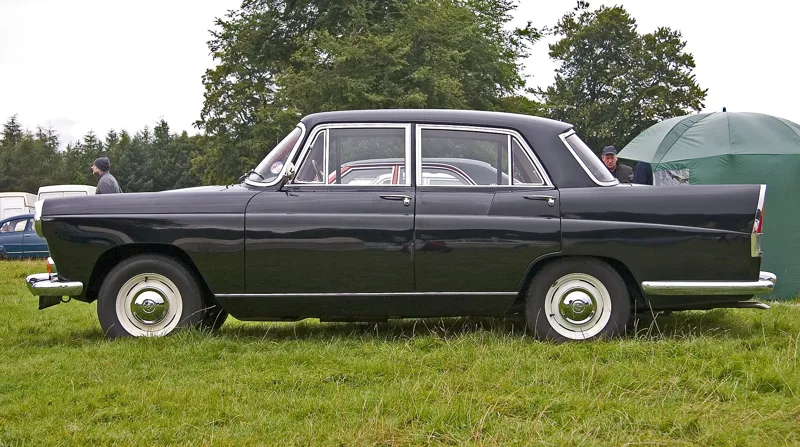
The A55 Cambridge Mark II, built from 1959 to 1961, was the first Farina model, named for its Pinin Farina design. Morris sold the same car as the Oxford. The 1.5-litre engine now had an SU carburettor and made 55 bhp (41 kW) at 4,350 rpm. Inside, individual leather-trimmed front seats sat close enough together to carry a middle passenger, and the luggage compartment was bigger, with a counterbalanced lid.
A Countryman estate appeared in 1960, called a Traveller on the Morris Oxford. Underneath it was straightforward: coil springs and independent front suspension, semi-elliptic leaf springs at the back and Girling 9 in (229 mm) drums. Austin built 149,994. The Motor's 1959 test recorded 75.5 mph (121.5 km/h), 24.5 seconds to 60 mph and 31.0 mpg imperial. In Australia the car went into production in 1959 with a 1,622 cc engine as the A60, two years before British cars used that name, and a six-cylinder 2,433 cc Blue Streak version became the Austin Freeway in 1962.
The British A60 followed in October 1961 with a 1.6-litre B-Series engine first used in the MGA, rated at 61 hp (45 kW) at 4500 rpm. It had side chrome stripes and reduced rear fins, a longer wheelbase and wider track that seated three on the rear bench, and anti-roll bars at both ends. A diesel arrived for export in 1961 and in Britain in 1962, and the Borg-Warner Type 35 three-speed automatic made the A60 the first British car to offer it. A 1.5-litre diesel for the taxi trade, introduced in November 1962, had only 40 hp (30 kW) and topped out at 110 km/h (68 mph).
The A60 sold well, with 276,534 built before production ended in 1969. The front-drive Austin 1800 was meant to succeed it in 1964, yet sales held up, so the Cambridge continued at the Morris plant at Cowley until the Austin Maxi took the line in April 1969. The Oxford carried on until 1971, when the Morris Marina replaced it. In 1961 The Motor tried a manual A60, which topped out at 80.4 mph (129.4 km/h), took 19.8 seconds to get to 60 mph and returned 25.1 mpg imperial, for 883 pounds including 278 pounds of tax. The automatic was a little slower at 77.9 mph (125.4 km/h).
Why was the Austin A40 Farina a landmark?
The Austin A40 Farina was a small economy car introduced as a saloon in 1958 and as the Countryman estate in 1959, with a two-box body. Austin gave it the A40 badge by its approximate engine output in horsepower, and the Farina suffix recognised the all-new design from Battista Farina's Pinin Farina studio in Turin, although the car was marketed without the name.
Austin had merged into BMC in 1952, and unusually no other BMC brand received a rebadged A40 Farina; it was an Austin alone. It was the first A40 not named after an English county and the last in the line. The Countryman had a tailgate that opened upward and downward, which made it one of the earliest volume-production hatchbacks, although earlier Austin estates, since the 1948 A40 Devon Countryman, had opened sideways. The Pinin Farina shape offered more shoulder and headroom for rear passengers, and with the rear seat folded it gave a very large luggage space. In Sweden the car became the Futura, since a mix-up with a brown sugar of similar name seemed unavoidable.
The Mark I was presented at the London Motor Show in October 1958 to replace the A35, whose running gear it largely inherited. It used the 948 cc A-Series four, rated at 34 hp (25 kW) at 4750 rpm and 50 ft lbf (68 Nm) at 2000 rpm, with coil springs at the front and a hybrid brake system, hydraulic at the front and cable-operated at the rear. The Countryman followed exactly a year later. Door windows were raised by finger grips rather than winders. A de luxe model tested by The Motor in 1958 managed 66.8 mph (107.5 km/h), needed 19.5 seconds to reach 50 mph (80 km/h) and did 38 mpg imperial, at 689 pounds including 230 pounds of tax.
How did the A40 Farina develop and compete?
The Mark II of 1961 had a wheelbase 3.5 in (89 mm) longer, a new grille and dashboard, 37 hp (28 kW) and an SU carburettor in place of the Zenith. In autumn 1962 the 948 cc engine gave way to a 1098 cc unit with 48 bhp (36 kW) at 5100 rpm, shared with the Morris Minor and the front-drive Morris 1100.
The Morris 1100, and an Austin-badged version a year on, made the A40 seem cramped and outclassed, and Mark II sales grew more slowly than the Mark I's. The A40 stayed in production until 1967. A blue 1963 Mark II appeared in the television series Heartbeat.
Innocenti built the car under licence from 1960, first from kits and then entirely in Italy, as the A40 Berlina and Combinata, which corresponded to the saloon and Countryman. In 1965 the Combinata got a single-piece, top-hinged rear door, a true hatchback that was never developed in Britain. Innocenti produced 67,706 A40 and A40S cars. BMC Australia built the Farina in Sydney from 1959 to 1962 with a high degree of local content, and in New Zealand it was assembled at Petone from English kits.
The A40 was a popular competition car. In the January 1959 Monte Carlo Rally, Pat Moss and Ann Wisdom won the Coupe des Dames and several other awards, finished second in class among standard touring cars up to 1000 cc and placed tenth overall. Doc Shepherd broke the saloon car record at Brands Hatch in August 1959 in an A40 and won the 1960 British Saloon Car Championship in an A40 Farina.
What was the Austin Westminster?
The Austin Westminster was a line of large saloons and estates sold from 1954, replacing the A70 Hereford. Its models were the A90, A95, A99, A105 and A110, ending in 1968 when the Austin 3-Litre took over. Wolseley and Vanden Plas built badge-engineered versions, and Austin built 101,634 Westminsters.
The A90 Six was introduced at the 1954 London Motor Show with the small A40 and A50 Cambridge. Power came from BMC's new C-Series straight-six of 2.6 litres (2639 cc), which with a single Zenith carburettor produced 85 hp (63 kW), and had coil-and-wishbone front suspension, four speeds with synchromesh on the top three and overdrive from 1955. The de luxe had leather trim and the standard PVC, and a split bench seat could take three across, although both fronts adjusted individually. A 1955 magazine test of a de luxe recorded 85.7 mph (137.9 km/h), 0-60 mph in 18.9 seconds, 20.2 mpg imperial, and the car cost 834 pounds. Austin built 25,532.
How did the A95, A105 and A99 differ?
In May 1956 a short-boot A105 was announced for a brief period with the twin-SU, 102 hp version of the 2.6-litre engine and overdrive. In October 1956 the A105 gained a longer wheelbase, standard overdrive and an optional automatic.
For autumn 1956 the A90 became the A95, with more power, more length and an estate body, with overdrive and automatic both novelties in British cars of the time.
Austin built 28,065 A95s and 6,770 A105s, both until 1959. The Westminster name left the sales literature, although the handbooks kept using it, and the estate was called the Countryman. In Australia a version of the A95 was the Morris Marshal from 1957 to 1960. The Motor's 1956 A105 with overdrive reached 96.3 mph (155.0 km/h) and 60 mph in 15.4 seconds.
One A95, a blue saloon, has a place in history as the car that carried the monk Thich Quang Duc to the site in Saigon where he set himself alight in protest at the religious persecution of the Diem government. It is preserved at the Thien Mu pagoda in Hue.
Vanden Plas first dressed up a mass-produced Austin family car with the A105, at Leonard Lord's personal request in 1957, adding new interior fittings, a grey stripe bearing the Princess crown and mostly sombre colours.
The A99 of 1959 had new Pinin Farina bodywork. Pininfarina had restyled the compact A40 and mid-sized A55 Cambridge the year before, and a very similar shell went onto the Peugeot 404. The design appears to have been based on the Lancia Flaminia, also by Battista Farina. Under the bonnet was the 2.9-litre (2912 cc) C-Series six, fed by twin SU carburettors and borrowed from the Austin-Healey 3000, producing 103 hp (77 kW), a three-speed all-synchromesh gearbox with Borg-Warner overdrive or an optional Borg-Warner automatic, and new power-assisted Lockheed brakes with 10.75 in (273 mm) front discs.
An automatic A99 tested by The Motor in 1960 was good for 98.1 mph (157.9 km/h), covered the sprint to 60 mph in 17.9 seconds and gave 23.0 mpg imperial (12.3 L/100 km; 19.2 mpg-US). It cost 1219 pounds, and the manual 1148. A specially trimmed A99 became the Princess 3-Litre and later the Vanden Plas Princess, and Wolseley sold the 6/99. Production ended in 1961 with 15,162 A99s built.
What was the Austin A110?
The A110 of 1961 was the final major update. Its wheelbase was extended by 2 in (51 mm) to give rear passengers more room and improve roadholding, and it had a floor-mounted gear lever. The Mark II models of 1964 switched to 13 in wheels.
Wolseley sold a 6/110, and the Vanden Plas Princess Mark II used the C-Series engine uprated to 120 hp (89 kW). A Rolls-Royce-engined Princess used the same basic body, and the same body even featured in a prototype Bentley. The Austin 3-Litre replaced the range in 1968, after 26,105 A110s.
How many Cambridges and Westminsters were built?
| Model | Built |
|---|---|
| A40 Cambridge | 30,666 |
| A50 Cambridge | 114,867 |
| A55 Cambridge Mark II | 149,994 |
| A60 Cambridge | 276,534 |
| A90 Six Westminster | 25,532 |
| A95 Westminster | 28,065 |
| A99 Westminster | 15,162 |
| A110 Westminster | 26,105 |
| Innocenti A40 and A40S | 67,706 |