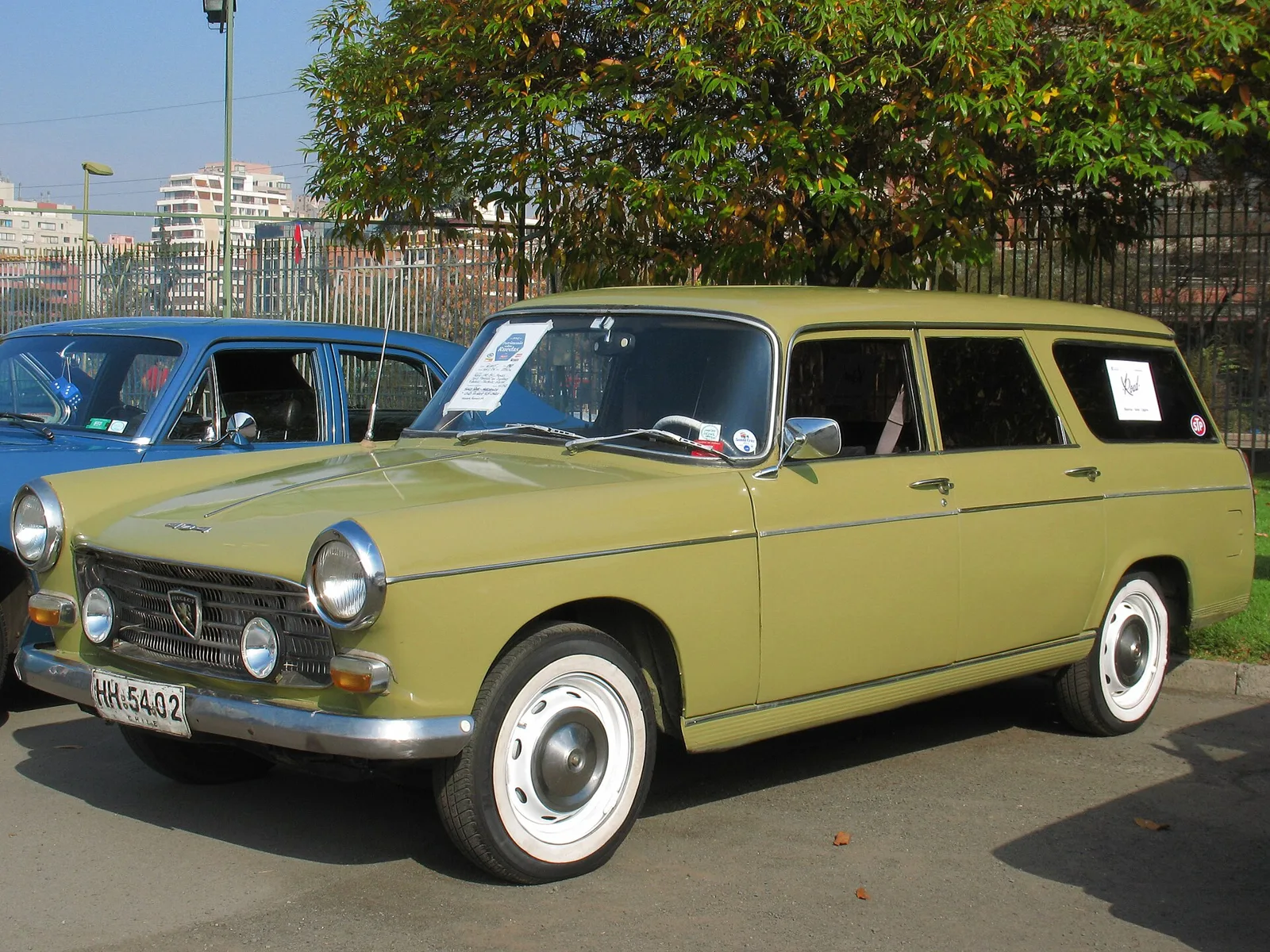
A Pininfarina-styled family car that became a taxi favourite, a licensed export and a Safari Rally winner.
The Peugeot 404 was a large family car that Peugeot built from 1960 to 1975, styled by Pininfarina in saloon, estate, pickup, convertible and coupe forms. Total worldwide production reached 2,885,374 units, and the car earned a reputation for durability, especially as a taxi.
Pininfarina styled the Peugeot 404, and Peugeot offered it in more forms than most family cars of its day. Its durability and rally record kept it in service long after the French line closed. The model was also licensed in several other countries, where it lasted considerably longer.
Where did the Peugeot 404 come from?
The 404 arrived in 1960 as a saloon with a 73 PS (54 kW; 72 bhp) petrol engine and a column-shifted four-speed gearbox. Pininfarina had styled the bodyshell, which looked very like the 1959 Austin Westminster, and estates, a pickup and the later convertible and coupe followed.
The convertible made its debut at the Paris Motor Show in October 1961, and the coupe arrived in 1963. Pinin Farina built the convertible and coupe bodies in Turin, so the open and closed cars differed from the saloon in their bodywork.
The 404 was popular as a taxicab, and that work did much to build its reputation for durability and value. The model was also built under licence in several countries, which spread its name well beyond France.
A Pininfarina-styled family car that built its name on durability, taxi work and Safari Rally wins.
How did the 404 change between 1960 and 1975?
The 404 changed steadily through its run. The 1961 Super Luxe added a silver superstructure and chromed headlight rims, the 1962 cars moved to circular directional air vents, and a dashboard with three round dials arrived in 1967. Front disc brakes followed on the 404/8 in 1968 and on all petrol models in 1969.
The 1963 model year brought a diesel, the Indenor XD85, which was launched in March. The XD88 followed in 1964 with a more reliable Bosch pump. The KF2 injection engine, rated at 96 PS (71 kW; 95 bhp), became the most powerful petrol option in the range.
A ZF automatic gearbox was offered as an option, and the 1967 cars gained a larger fuel tank that grew from 50 L to 55 L. In 1970 the XC7 engine was tuned down to 73 PS (54 kW; 72 bhp), and the Super Luxe was discontinued. European passenger production finally ended in May 1975.
Braking also advanced during the run, with a brake compensator on petrol models from 1966 and disc fronts on the 404/8 in 1968.
What engines powered the Peugeot 404?
The 404 used petrol engines of 1,468 cc and 1,618 cc and a 1,948 cc diesel. The 9 CV carburettor engine made 72 PS (53 kW; 71 bhp), and the injected KF engine made 85 PS (63 kW; 84 bhp) at 5,500 rpm.
The KF2 unit, with 96 PS (71 kW; 95 bhp) at 5,700 rpm, was the strongest petrol option. Fuel-injected coupe and cabriolet versions reached 167 km/h (104 mph).
The diesel was rated at 64 PS (47 kW; 63 bhp). The XD88 replaced the XD85 with a more reliable Bosch pump.
Suspension used coil springs with hydraulic shock absorbers at the front and a solid rear axle located by a Panhard rod. The 9 CV engine returned 10.8 L/100 km (26 mpg-imp; 22 mpg-US), and transmissions included a manual, a semi-automatic and the ZF automatic.
How fast was the Peugeot 404 in road tests?
Motor tested a fuel-injected coupe in December 1965 and recorded 0-60 mph in 12.2 seconds, with a top speed of 105.2 mph (169.3 km/h). Autocar's saloon test recorded a mean maximum of 100 mph, and a Canadian test timed the injected car to 60 mph in 12.1 seconds.
The coupe also covered the standing quarter mile in 18.8 seconds and returned 23.8 mpg-imp (11.9 L/100 km; 19.8 mpg-US). Autocar's saloon averaged 25.1 mpg-imp (11.3 L/100 km; 20.9 mpg-US), which placed the two cars in a similar economy range.
Diesel testing told a different story. Autocar's diesel test recorded 0-60 mph in 25.5 seconds and a top speed of 81 mph (130 km/h), but the car's 32.2 mpg-imp (8.8 L/100 km; 26.8 mpg-US) economy was strong for the period.
Price mattered as well. In Britain the diesel cost 1,396 pounds, against 1,093 pounds for the petrol car.
Each test car was a single example, so the results are best read as snapshots of one car rather than a rating for the whole model.
How did the estate differ from the saloon?
The Break, Commerciale and Familiale estates used a 190 mm longer wheelbase than the saloon. At 4,590 mm long and 1,190 kg, they were longer and heavier than the 4,445 mm, 1,100 kg saloon, and the longer body formed the basis of the estate versions.
The Family estate was the seven-seat version, introduced in 1962, and the Commerciale was the utility model. Both used the longer wheelbase, which is why their figures differ from the saloon's.
Among the estates, the utility model was the lowest-powered, rated at 60 hp DIN in its smallest engine form.
How much did the 404 convertible cost in America?
The 1965 convertible was priced at US$3,899 in America, which placed it in the same price bracket as the Jaguar E-Type in that market. That made it a premium product for American buyers rather than an ordinary family car.
Fuel-injected models were the strongest versions. The KF2 unit produced 96 PS (71 kW; 95 bhp) at 5,700 rpm, and the cabriolet and coupe were quoted at 167 km/h (104 mph) as their maximum.
Production of the two-door models finished in October 1968 at 17,223 units. The fixed-roof coupe arrived in 1963, so buyers had both open and closed two-door options.
How many Peugeot 404s were built?
Peugeot built 1,847,568 404s in France before French production ended in 1975. Worldwide production reached 2,885,374 units, with Argentina, South Africa and Australia among the countries that assembled the car locally. Assembly abroad was carried out under licence, and some plants kept building the model long after the French line closed.
Argentina's Safrar plant, later run by Sevel, built 162,583 cars, and South Africa accounted for 79,045. Chile built 14,892 cars, and Australia, through the local Renault business, built 8,600.
Quebec's SoMA plant built the car from 1965 to 1968, and about 3,100 saloons were produced there, shared with Renault. New Zealand's Campbell Industries assembled 2,800 cars.
The one millionth 404 left Peugeot's Sochaux plant in June 1966, a milestone for the model.
How did the Peugeot 404 perform in motorsport?
The 404 won the Safari Rally in 1963, 1966, 1967 and 1968, and the last three of those wins were achieved with Kugelfischer fuel-injected cars. The rally record is the car's clearest competition legacy.
The fuel-injected Kugelfischer variants took the wins from 1966 onward, which links the injection engines with the car's rally success.
In 2014 a 1963 404 entered the 24 Hours of LeMons and won the Index of Effluency award, decades after its rally wins.
The 404's wins across 1963 to 1968 give it a distinct place in the event's history, and the Kugelfischer cars marked the high point of that run.
Which special 404 versions were made?
The 404 A8 was built for French government agencies, with 525 examples made in total. The 404/8 Confort launched at the October 1967 Paris show, and it was discontinued in October 1969 so that it did not overlap the 304.
The range offered a convertible, a coupe, estates and a pickup. The Family estate offered seven seats from 1962, and the Commerciale used a 1,468 cc engine producing 60 hp DIN.
A canvas-top pickup was unveiled in March 1967. The coupe with a fixed roof arrived in 1963, and the last coupes and cabriolets were built in October 1968, a run of 17,223 units.
How did critics judge the Peugeot 404?
Motor magazine praised the 404's build quality in 1968, and it said the saloon suited African safaris and Arctic gales alike. It also called the styling square cut and rather dated, and the interior austere next to British rivals.
The contrast between critics is instructive: the styling drew criticism, while the build drew praise. Reviewers judged the car on its substance rather than its looks.
Taxi use tested those qualities every day, and the car's reputation for durability and value grew from that work. That reputation was a practical asset for buyers who ran a car hard every day.
What are the Peugeot 404 specifications?
| Specification | Detail |
|---|---|
| Type | Large family saloon, estate, pickup, convertible and coupe |
| Years | 1960 to 1975 (passenger); truck body to 1988 |
| Petrol (9 CV) | 1,618 cc carburettor, 72 PS (53 kW; 71 bhp) |
| Injected petrol | KF 85 PS (63 kW; 84 bhp) at 5,500 rpm; KF2 96 PS (71 kW; 95 bhp) at 5,700 rpm |
| Diesel | 1,948 cc, 64 PS (47 kW; 63 bhp) |
| Top speed | 167 km/h (104 mph), KF2 coupe and cabriolet |
| Economy (9 CV) | 10.8 L/100 km (26 mpg-imp; 22 mpg-US) |
| Suspension | Coil springs front; solid rear axle with Panhard rod |
| Gearbox | Manual, semi-automatic or ZF automatic |
| Production | 1,847,568 in France; 2,885,374 worldwide |
.jpg)