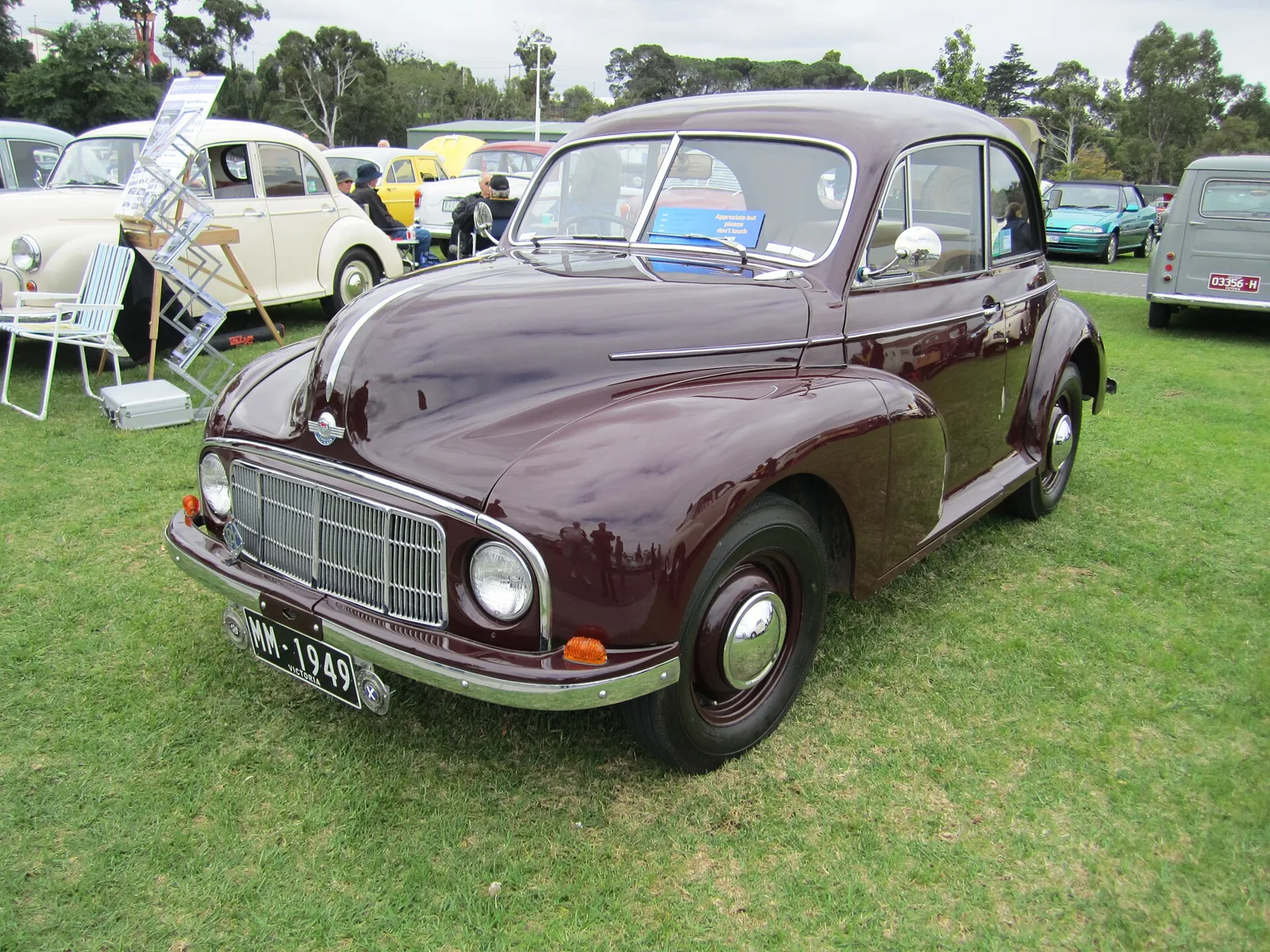
One Pininfarina body carried five British brand names, and a licensed Argentine copy became a popular taxi.
The BMC ADO9 was a four-door mid-size saloon family sold from 1958 to 1961 under the Austin, MG, Morris, Riley and Wolseley names. Pininfarina styled the body, which carried a 1.5-litre B Series four-cylinder, and the ADO38 replaced it in 1961.
Between 1958 and 1961 British Motor Corporation sold one Pininfarina-styled saloon under five brand names, and the models differed mostly in details of grille, lamps and trim. Austin, MG, Morris, Riley and Wolseley each offered its own version of the ADO9 before BMC replaced the range with the ADO38.
Where did the ADO9 come from?
BMC asked Pininfarina in 1955 to restyle several of its model ranges, following a path that its rival Standard had already taken with Giovanni Michelotti. The first result was the small A35, whose rounded shape dated from 1951. The mid-size car that followed used a four-door notchback body in the then modern trapezoid line.
The A35 was succeeded by the Austin A40 Farina, a two-door saloon with a sloping rear that also came as a Countryman with a large tailgate. The mid-size versions reached the market at one-month intervals. Pininfarina used a close variant of the same shape for the Peugeot 404, shown in 1960.
The ADO10 family looked similar to the ADO9 but used a 2.9-litre (177 cu in) C Series six-cylinder and sat in the upper mid-size class.
The engineering was regarded as "conservative and boring," and both engine versions were considered underpowered for the size and weight of the cars.
Who styled the ADO9 and how did it look?
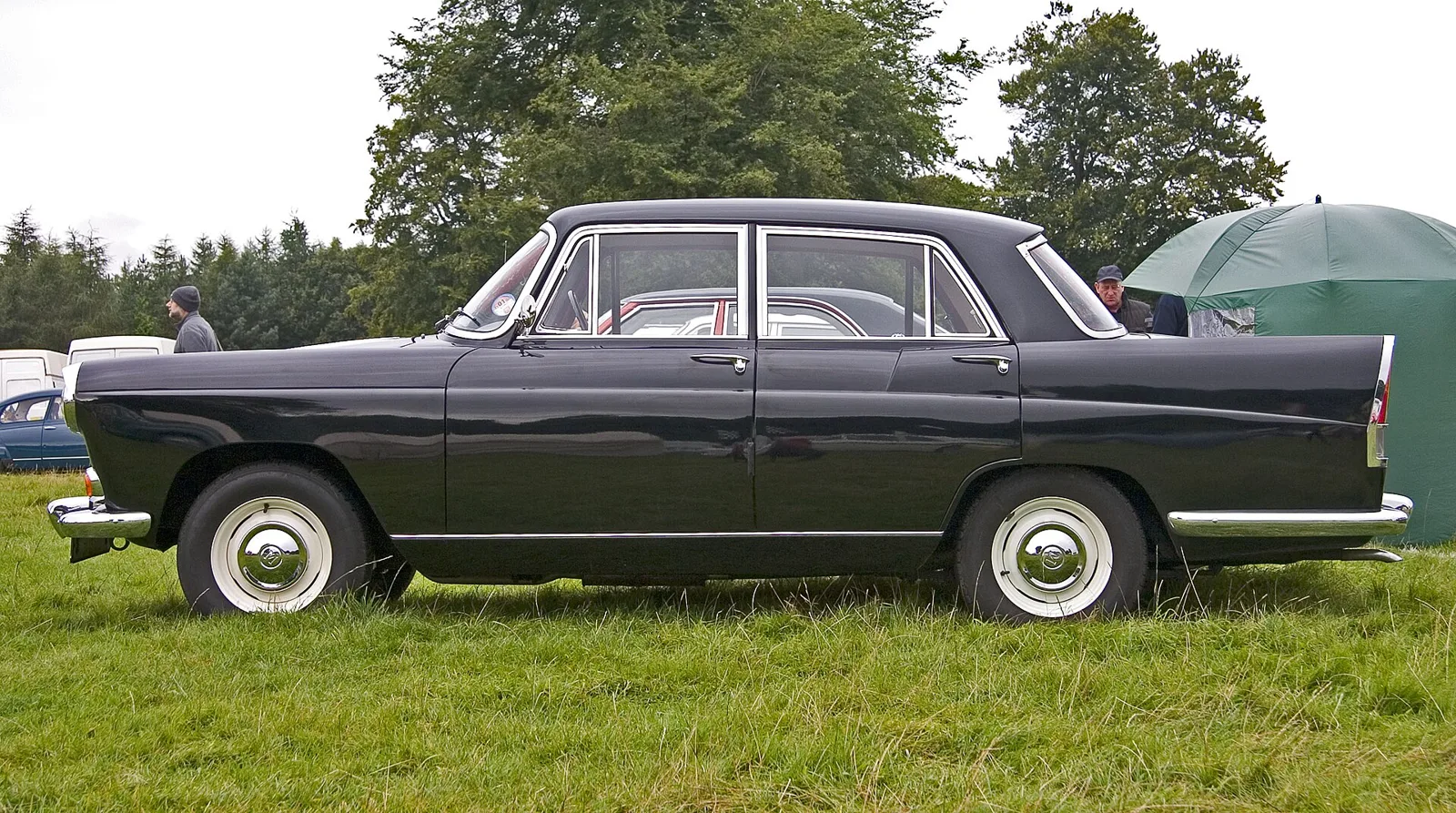
Pininfarina designed the body, and two BMC staff members, Riccardo "Dick" Burzi and Sid Goble, were responsible for the individual design of each model. The body was pressed steel with a self-supporting structure, round single headlamps and slightly rising tail fins.
Apart from front details, radiator grilles and tail lamps, the cars looked alike, although some interiors carried individual equipment. The Wolseley wore a shield-shaped chrome grille with an illuminated emblem at the top centre, while the Austin Cambridge had a grille stretching almost the full width of the car.
How was the ADO9 engineered?
The ADO9 used double wishbones with coil springs at the front and a live axle on semi-elliptic leaf springs at the rear. Hydraulic drum brakes were fitted to all four wheels, and the four-speed manual was operated by a centre lever or a steering-column lever. No automatic was offered.
The 1.5-litre (91.5 cu in) four-cylinder came from BMC's B Series, with a bore and stroke of 73.02 x 88.9 mm. The Austin, Morris and Wolseley had a single carburettor and 55 bhp (41 kW), while the MG and Riley versions had two carburettors and 64 bhp (49 kW).
The engineering was regarded as "conservative and boring," and both engine versions were considered underpowered for the size and weight of the cars. BMC had already fitted the B engine in models like the MG Magnette ZA and the MG A since 1953.
Which variants did BMC sell?
Five models shared the platform: the Wolseley 15/60, the Austin A55 Cambridge Mark II, the MG Magnette Mark III, the Morris Oxford Series V and the Riley 4/68. The Wolseley occupied the upper segment of the group's brand hierarchy, the Riley combined Wolseley luxury with the MG engine, and the Austin and Morris were the basic versions.
Wolseley 15/60
The 15/60, also called Fifteen-Sixty, appeared in December 1958 with no direct predecessor. A shield-shaped chrome grille and leather-covered seats gave it a conservative air, and it reached 123 km/h (76 mph). It cost 991 pounds sterling in 1959, and many police forces were among its customers, often preferring it to other ADO9 versions. Up to 1961, 24,579 were built.
Austin A55 Cambridge Mark II
The Cambridge followed one month after the Wolseley and replaced the Mark I, which had been built since 1957. Its top speed was 121 km/h (75 mph), its interior had a continuous seat front and rear, and from autumn 1960 Austin added a five-door estate called the Countryman.
MG Magnette Mark III
BMC took up the Magnette name, which MG had used for its mid-size cars before the war, for the ADO9 variant launched in February 1959 to replace the Magnette ZB. It carried a separate radiator grille in the traditional MG form. Its more powerful engine gave a top speed of 137 km/h (85 mph), and it sold for 1,013 pounds sterling. No estate was offered.
Morris Oxford Series V
Morris launched its version in March 1959 as the Oxford Series V, a name it had used repeatedly since 1913. It looked and felt much like the Cambridge, although Morris offered its own colour palette. The Oxford came off the line at Cowley and cost 14 pounds sterling more than the Cambridge. Up to 1961, 87,432 were built, and a Traveller estate followed from 1960.
Riley 4/68
The 4/68, also written Four Sixty-Eight, arrived in April 1959 as the last ADO9 variant. Apart from its grille it matched the MG Magnette III, including the more powerful engine, and its equipment was high quality. At 1,028 pounds sterling it was the most expensive model in the range, and 10,940 vehicles were built up to 1961.
How did the models differ in character?
Each model was a different combination of equipment and engine components. The Wolseley was the conservative, respectable choice, the MG offered the stronger engine, and the Riley, the most expensive model, mixed Wolseley luxury with MG power under one roof.
The Wolseley's conservative look conveyed "a breath of respectability," and sportiness was not emphasised. Within the group it occupied the upper market segment.
The Magnette was perceived as a "jazzed-up" version of the Austin Cambridge. Its interior almost matched the Wolseley's, and its engine was the more powerful version of the four-cylinder. Austin and Morris, by contrast, were the near-identical basic versions.
Where were ADO9 cars built?
Only the Austin A55 Cambridge Mark II came from BMC's Longbridge works in Birmingham. Every other version, the Oxford, Wolseley, MG and Riley included, was made at Cowley in Oxford.
How was the ADO9 built in Argentina?
Siam Di Tella built a licensed version of the Riley 4/68 near Buenos Aires from 1959 to 1965, known as the Di Tella 1500. It used a slightly detuned B Series engine with one carburettor, and the company also produced the higher-positioned Di Tella Magnette.
Up to 1966 Di Tella built 45,700 examples of the 1500 and 2,664 of the Magnette, which was similar overall. The cars were popular as taxis in Argentina, and in Buenos Aires their economy helped them displace American-built taxis. Di Tella also made about 2,000 estate versions and pick-ups the company had designed itself.
After Siam Di Tella ended production, Compania Industrial de Automotores continued building the cars until April 1967, now under the MG, Morris and Riley names.
What changed with the ADO38?
The ADO38 replaced the ADO9 in 1961 with almost the same body and a bigger engine. The five brands kept it, and it remained on sale in Britain until 1971. The Australian subsidiary also built it from 1962 to 1965 as the Austin Freeway.
The ADO38 family kept the engineering and styling largely unchanged. The engine was bored out to 1.6-litre (97.6 cu in), the wheelbase grew by 2 cm (0.8 in), and the track was about 4 cm (1.6 in) wider. The tail fins became slightly smaller, and the automatic gearbox that the ADO9 never had arrived with this family.
In Australia, the local BMC operation manufactured the ADO38 at its own factory between 1962 and 1965, marketing it as the Austin Freeway. That car used a six-cylinder engine developed locally, based on the B engine with two extra cylinders.
Specifications at a glance
| Model | Carburettors | Output |
|---|---|---|
| Austin A55 Cambridge Mark II | One | 55 bhp (41 kW) |
| Morris Oxford Series V | One | 55 bhp (41 kW) |
| Wolseley 15/60 | One | 55 bhp (41 kW) |
| MG Magnette Mark III | Two | 64 bhp (49 kW) |
| Riley 4/68 | Two | 64 bhp (49 kW) |
Why does the ADO9 still matter?
The ADO9 is a clear case of badge engineering in the British mid-size class, where one body wore five different names. Its licensed life in Argentina added a second chapter, because the cars became popular taxis in Buenos Aires and kept being built until 1967.
The family also shows how far the Pininfarina shape travelled, from the Peugeot 404 to the licensed cars that Argentina built.