A frogeye that was meant to have folding headlights, a 100 mph Healey built from Austin parts, and the MG Midgets that carried the idea from 1936 to 1979.
The MG T-type was a series of open two-seaters built from 1936 to 1955, the Austin-Healey 100 a 100 mph sports car made from 1953 to 1956, the Austin-Healey Sprite a low-cost roadster from 1958 to 1971, and the MG Midget its badge-engineered sibling from 1961 to 1979.
The Austin-Healey Sprite was meant to have headlights that folded flat, lenses facing the sky when parked, the same trick Porsche used on the 928 years later. BMC cut the mechanism to save money, so the lamps stayed permanently upright on top of the bonnet. That one economy gave the car its face and its nickname: frogeye in Britain, bugeye in America. It also summed up the car's whole proposition. It was cheap enough that every corner got cut, and clever enough that nobody cared.
Four British sports cars made that proposition work across four decades. The MG T-type Midget came first, from 1936 to 1955. The Austin-Healey 100 followed in 1953 as a faster, bigger sibling. Then the Sprite arrived in 1958, with the MG Midget following in 1961 as its badge-engineered twin. Taken together they show how sports cars moved from a niche toward a car the average buyer could afford.
The MG T-type: a Midget before the Midget
The MG T-type was a series of open, body-on-frame two-seaters built by MG from 1936 to 1955, known to the company as the Midget. The line ran through the TA, TB, TC, TD and TF, and MG replaced it with the all-new MGA in 1955. The TA took over from the PB in 1936 with a 1292 cc overhead-valve engine from the Wolseley Ten, fitted with twin SU carburettors and making 50 hp. It topped almost 130 km/h (80 mph) and reached 60 mph in 23.1 seconds. MG made 3,003 of them, and the price in 1936 was 222 pounds.
The TB followed in May 1939 with a smaller, more modern 1250 cc XPAG engine and 54 hp, but only 379 were built before MG turned its factory over to aircraft parts and tank work. The TC, launched in 1945, was the first postwar MG. Its 54.5 bhp version of the XPAG sat in a car built only with right-hand drive, yet MG exported it to the United States with sealed-beam headlights and twin tail lights. Production reached 10,001, more than any MG before it, and a TC cost 527 pounds in 1947.
TD and TF
The TD, announced in January 1950, kept the TC's drivetrain but added independent front suspension with coil springs taken from the MG Y-type saloon, rack-and-pinion steering and 15-inch disc wheels. It was wider, and a left-hand-drive option arrived. Many enthusiasts found it mild and said it was largely designed to expand North American sales. They were right about the market: nearly 30,000 were built, all but 1,656 exported, and 23,488 of those went to the United States. American owners disliked the 12-volt electrics and the missing water temperature and fuel gauges, though surveys leaned positive. A TD Mk II Competition Model raised the compression ratio to 8.1:1 for 57 bhp.
The TF, launched on 15 October 1953, was a facelifted TD with headlights faired into the wings and a sloping grille. In mid-1954 the engine grew to 1466 cc and 63 bhp (47 kW) as the TF1500. Production ended on 4 April 1955 after 9,602 cars, including 3,400 TF1500s. The MGA took over. The TD name returned in 1998, when a Malaysian company acquired the rights and built the TD2000.
Healey meant the headlights to fold away; cost-cutting left them upright, and the frogeye was born.
The Austin-Healey 100: Healey's Hundred
The Austin-Healey 100 was assembled by Austin from 1953 to 1956 using A90 Atlantic mechanicals. Donald Healey had developed it from his Nash-Healey, and a single Healey Hundred, built by Tickford, appeared at the 1952 London Motor Show. It impressed Leonard Lord, the managing director of Austin, who needed a replacement for the unsuccessful A90. Gerry Coker styled the body, while Barry Bilbie designed a stiff chassis with the front bulkhead welded to the frame and an underslung rear axle to keep the car low.
Lord agreed terms with Healey for volume production, with Jensen supplying bodies and Austin fitting its mechanical parts at Longbridge. Healey named it the 100 for its ability to reach 100 mph (161 km/h); the Austin-Healey 3000 that succeeded it took its name from an engine of almost 3000 cc. In all, 14,634 100s were produced. Three cars came to be called Big Healeys, to set them apart from the much smaller Sprite, and the 100 was the first.
BN1 and BN2
The first cars, the BN1, used the A90's 2660 cc four-cylinder with 90 bhp (67 kW), but with a three-speed floor-shift gearbox and a switched overdrive working on second and top. Austin blocked off first gear, which was too short for the car's final drive and light weight. The Motor's 1953 test gave 171 km/h (106 mph), 11.2 seconds to 60 mph and 22.5 miles per gallon, and the test car cost 1063 pounds with tax. Austin built 10,030 BN1s between May 1953 and August 1955.
The BN2 had a proper four-speed gearbox with overdrive on the top two gears, slightly larger front wheel arches, and optional two-tone paint. By January 1956 production was running at 200 cars a month, with 150 a month sold in California. The last BN2 was built in July 1956, and 4,604 were produced in total.
100M and 100S
The 100M of 1955 had larger carburettors, a cold air box, a high-lift camshaft and 8.1:1 pistons, which brought 110 bhp (82 kW), plus stiffer front suspension and louvred bonnet. Factory output was 640, about 70% of them in two-tone paint. The same parts were sold as a Le Mans kit that could lift a BN1 or BN2 to around 100 bhp.
The 100S, named for Sebring, was built for racing. Its aluminium body and Weslake-designed aluminium head helped it make 132 bhp (98 kW), and Dunlop disc brakes front and rear made it the first production car so equipped. About 200 lb (91 kg) came off the weight by dropping the bumpers, hood and overdrive. Only 50 production cars were built, delivered between February and November 1955. A works 100S test car sold in December 2011 for a record 843,000 pounds, and it was the same car that was involved in the 1955 Le Mans disaster.
The Austin-Healey Sprite: the frogeye and its successors
BMC announced the Sprite to the press in Monte Carlo on 20 May 1958, two days after the Monaco Grand Prix. It was to be a low-cost sports car and the heir to the sporting pre-war Austin Sevens, so cheap and small that a man might keep it in the bike shed. The Donald Healey Motor Company designed it, and MG's Abingdon works built it. The first cars sold for 669 pounds, with a tuned Austin A-Series engine and as many parts from existing cars as possible.
Coker styled the body, with later changes by Les Ireland after Coker emigrated to the US in 1957. The front end bore a strong resemblance to the American 1951 Crosley Super Sport. Bilbie solved the problem of a rigid open car by adapting an idea from the Jaguar D-type, routing the rear suspension forces through the floor pan, which made the Sprite the world's first volume-production sports car with unitary construction. The Austin design office thinned the metal in the rear structure, but testing at MIRA showed distortion and the original specification returned.
The 948 cc engine came from the Austin A35 and Morris Minor 1000, with twin SU carburettors lifting output to 43 bhp. There were no exterior door handles and no boot lid, and owners reached the luggage space by folding the seat backs forward and groping beneath the rear deck, which some likened to potholing. The Motor's 1958 test found the little car good for 133.4 km/h (82.9 mph), with a 20.5-second sprint to 60 mph, and it returned 43 miles per gallon. John Sprinzel and Willy Cave took a class win on the 1958 Alpine Rally, and a class win at Sebring in 1959 introduced the Sprite to the US market. In all, 48,987 frogeyes were made.
Mark II to Mark IV
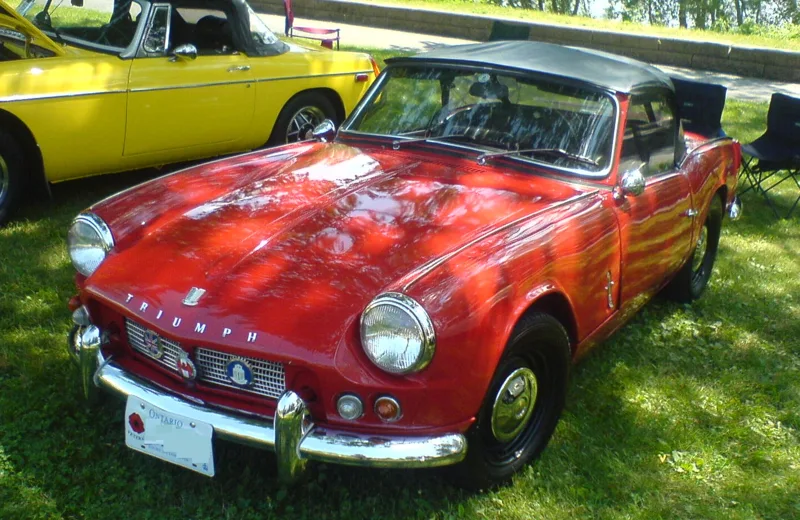
Announced in late May 1961, the Mark II brought a completely new body with conventional headlights in the wings, a full-width grille, an opening boot lid and squared-off rear wheel arches to keep the structure stiff. It weighed about 100 lb more. In October 1962 both the Sprite and the Midget gained a 1098 cc engine with 56 bhp, along with front disc brakes and optional wire wheels. Italy's Innocenti also built its own version, styled by Tom Tjaarda at Ghia, from 1961 to 1968.
The Mark III arrived in March 1964 with a curved windscreen, wind-up side windows, exterior door handles and separate locks. Semi-elliptic rear springs replaced the quarter-elliptic type for a more comfortable ride, which helped the car compete with the Triumph Spitfire. The Mark IV, shown at the London Motor Show in October 1966, had a 1275 cc engine and a permanently fixed folding top, and enthusiasts were disappointed that the engine was tuned lower than the Mini-Cooper S unit. US cars lost performance from 1968 as emissions equipment was added, and 1969 was the last year of Sprite exports there.
After the 1970 facelift under British Leyland, the Sprite and Midget differed only in their badges. In 1971 the Healey connection ended, a move credited to Donald Stokes that let British Leyland end its royalty payments to Healey's company, so the last 1,022 cars were simply Austin Sprites. There was no direct successor, because the MG Midget and the Triumph Spitfire already covered the territory. The Sprite had also raced: a Sprite-based car finished 12th at Le Mans in 1965, and a streamlined body designed by Bilbie produced a reliable 110 bhp and about 150 mph down the Mulsanne.
The MG Midget: Abingdon's version of the Sprite
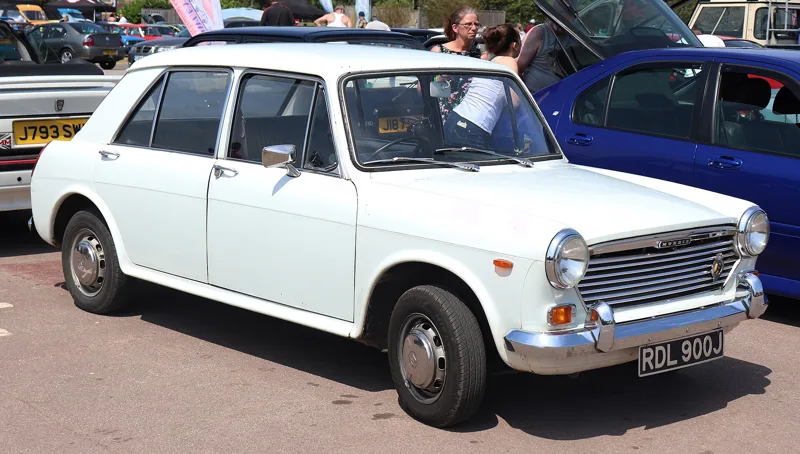
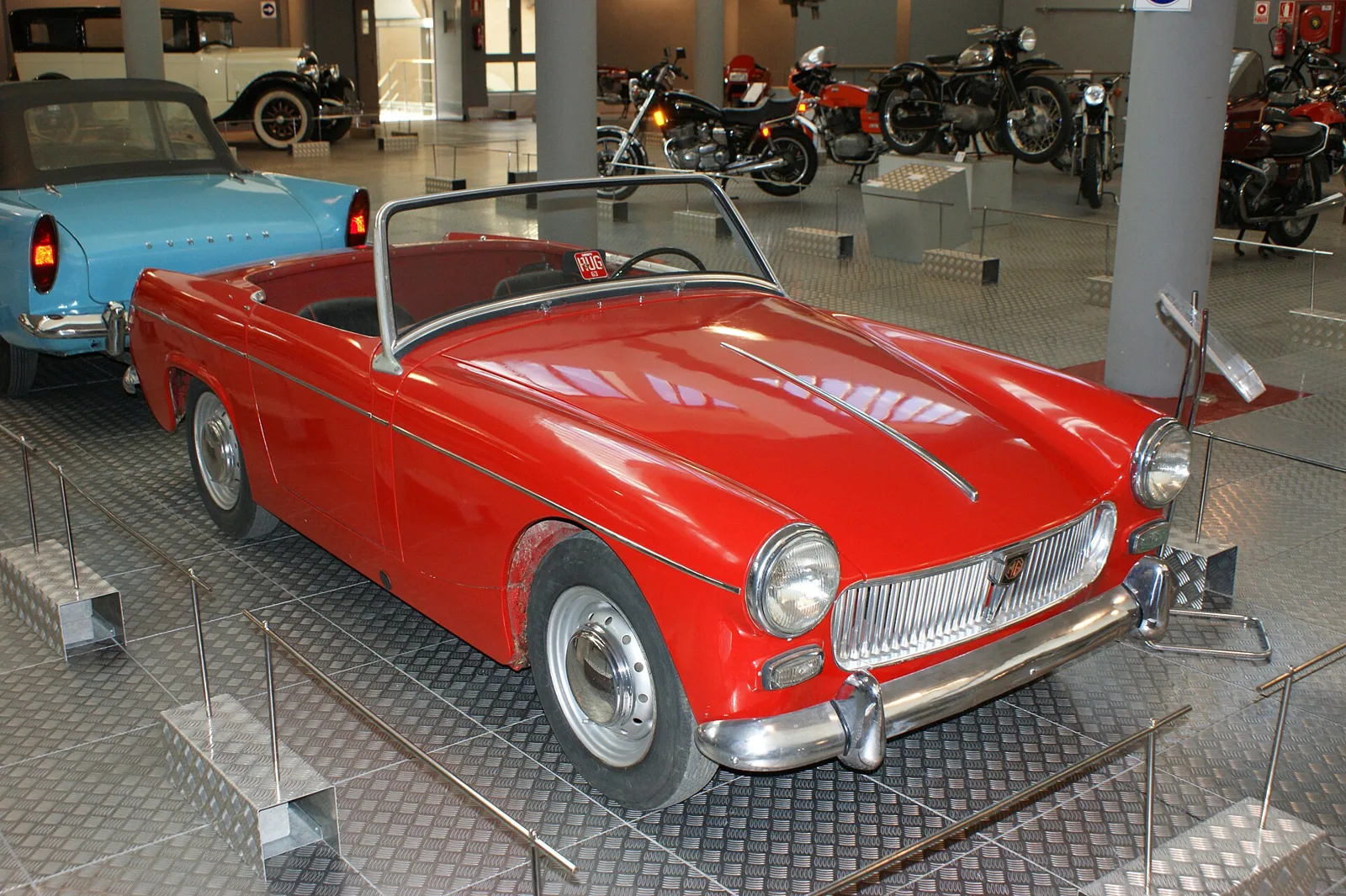
The MG Midget was a small, lightweight two-seater made by MG from 1961 to 1979, reviving a name used on the M-type, D-type, J-type and T-type. The first Midget, unveiled in late June 1961, was little more than a marginally dearer badge-engineered Sprite. The frogeye had been introduced to fill the hole left when the T-type Midget ended, as the larger, costlier MGA could not do that job, and many MG buyers had drifted to the Sprite. A Midget with its own grille, badging, better trim and instruments, and polished exterior trim made sense. Enthusiasts call the two cars together Spridgets.
The MkI had the Sprite's 948 cc engine with 46 hp (34 kW), and 7-inch (178 mm) drum brakes. Buyers could add a hard top, heater, radio or luggage rack from the factory. The 1098 cc engine and front discs came in October 1962, though the early 1098s were less reliable than the 948s because of crankshaft bearing failures. MG built 16,080 of the smaller-engined cars and 9,601 of the larger. A 948 cc Midget tested by The Motor in 1962 managed 141.5 km/h (87.9 mph) and needed 18.3 seconds to reach 60 mph; the test car cost 689 pounds.
The MkII of 1964 to 1966 gained wind-up windows, external handles, a stronger engine block and 59 hp (44 kW), and 26,601 were made. The MkIII ran from 1966 to 1974 with a 1275 cc engine developed from the Mini-Cooper S. Enthusiasts were let down that it was detuned to 65 hp (48 kW), against 76 bhp (57 kW) for the Cooper S. MG used a lower compression ratio of 8.8:1 against 9.75:1, partly so the Midget could not beat the more expensive MGB. The hood was now permanently attached, and in late 1967 US cars received a padded fascia, a collapsible steering column and extra safety equipment. The rubber bumper blocks added in 1974 to meet US impact rules were nicknamed Sabrinas.
Midget 1500 and the end
To meet US federal rules, the Midget 1500 of 1974 gained large black plastic bumpers and a higher ride height, with anti-roll bars to cope. A 1493 cc unit from the Triumph Spitfire took over from the A-Series, paired with a reworked Morris Marina gearbox. In home-market form it still produced 65 hp (48 kW), but the extra torque and taller gearing cut 0 to 60 mph to 12 seconds from 13 and gave a top speed a shade over 100 mph. In the US, British Leyland struggled to keep power up under emissions rules, and output fell to 50 hp (37 kW). The final car left the line on 7 December 1979, when 73,899 examples of this version had been built, and the last 500 sold at home were painted black.
An unbuilt car and two special coupes are worth knowing about. The ADO34 project, active from 1960 to 1964, was a Pininfarina front-wheel-drive Mini-based roadster meant to replace the Midget or Sprite; it was cancelled. Dick Jacobs talked Abingdon into building two lightweight GT-bodied Midgets inspired by the Aston Martin DB4, with a nose by Syd Enever that wind-tunnel tests showed needed 13 hp less to reach 100 mph. They were registered BJB 770 and BJB 771, and a third car was built for John Milne.
Sprite and Midget generations side by side
| Sprite | Years | Engine and power | Built | Midget twin |
|---|---|---|---|---|
| Mark I (frogeye) | 1958 to 1961 | 948 cc, 43 hp | 48,987 | None |
| Mark II | 1961 to 1964 | 948 cc, 46 hp; 1098 cc, 56 hp from 1962 | 31,665 | Midget MkI |
| Mark III | 1964 to 1966 | 1098 cc, 59 hp | 25,905 | Midget MkII |
| Mark IV | 1966 to 1971 | 1275 cc, 65 hp | 22,790 | Midget MkIII |
What this means if you drive or buy one
The Midget outlived the Sprite by eight years, and only the Midget received the 1500 engine. Many owners in the United States consider the 1967 model year the best stock performer, because its 1275 cc engine carried no power-sapping smog equipment and none of the later, heavier bumpers. Anyone looking at a frogeye should expect no boot lid and no outside door handles. Among the bigger cars, the 100M and the Le Mans kit cars are hard to tell apart without the factory chassis numbers, since only those numbers separate the 640 original 100Ms from converted cars. The Austin-Healey 100 in BN1 and BN2 form has also done well in vintage racing, where modified four-cylinder cars compete with six-cylinder Aston Martins and twelve-cylinder Ferraris of the same era.