A staff ballot, a shared platform and a rebuilt Longbridge: how three Austins were meant to remake British Leyland in the 1980s.
The Austin Metro (1980), Maestro (1983) and Montego (1984) were British Leyland's 1980s answer to the small, lower-medium and upper-medium segments. The Maestro and Montego shared the LC10 platform, and all three were built into the 1990s under the Rover Group.
When British Leyland asked its staff to name a new small car in 1980, the ballot offered three choices: Match, Maestro or Metro. Metro won, and the Maestro name went to the next car along. That small piece of corporate theatre is the neatest way into the story of the Austin Metro, Maestro and Montego, a trio meant to rebuild a bankrupt company in the 1980s and tied together by names, platforms and shared troubles.
Austin Rover Metro, Maestro and Montego: the three-car plan
The company dates from 1975, when the bankrupt British Leyland Motor Corporation passed into state ownership. In 1977 the South African-born troubleshooter Michael Edwardes became chairman, and part of his plan was an entirely fresh line-up of mass-market cars, built with state-of-the-art technology. It called for a new car for the small, lower-medium and upper-medium classes in turn. The Metro was first, in 1980, followed by the Maestro and Montego, which were designed to share a platform.
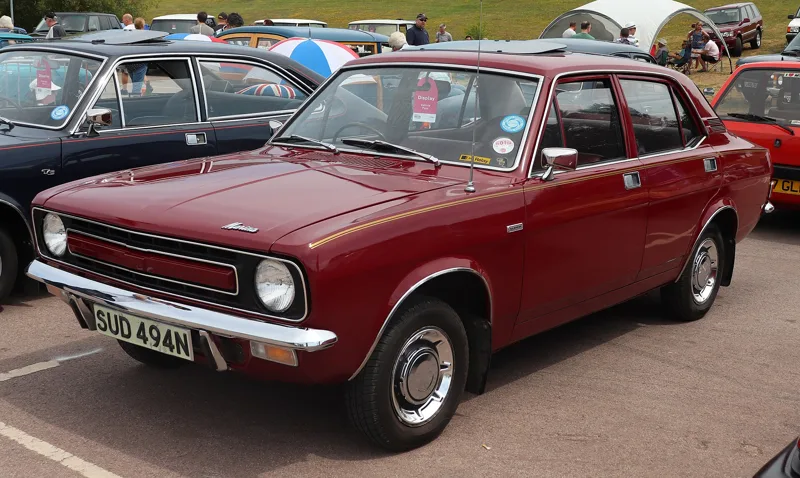
Between them the three would replace a crowd of ageing cars. The Maestro would stand in for both the Allegro and the Maxi, and the Montego for the Ambassador and Ital, which were recent facelifts of the Princess and Marina. Cowley built every one of them except the Allegro, so the consolidation promised savings through automation and flexibility.
Match, Maestro or Metro: the ballot that named two of the three.
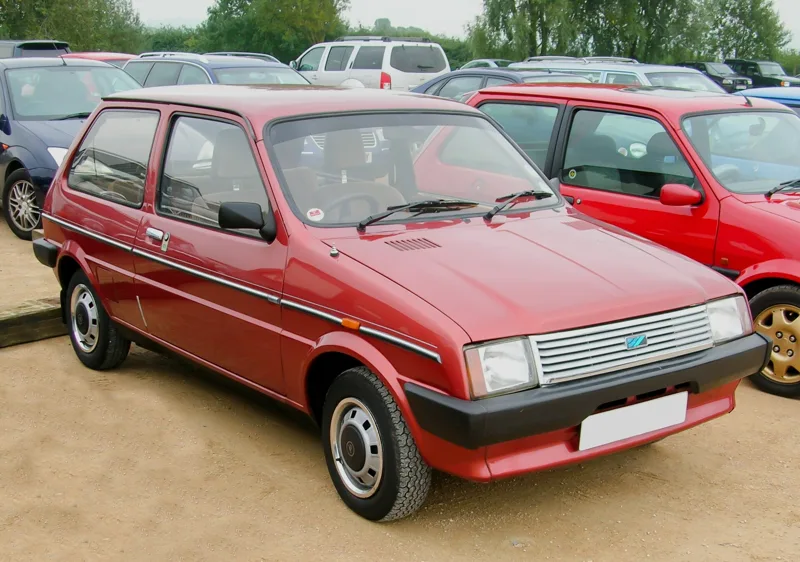
Austin Metro history: from ADO88 to LC8
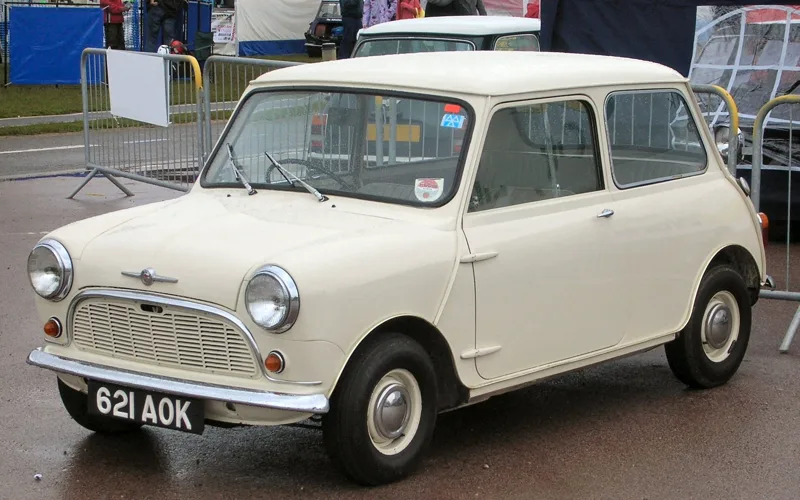
The Metro began life as ADO88, short for Austin Drawing Office and an 88-inch wheelbase, intended as a direct replacement for the Mini. Plans for one had been afoot since the early 1970s, but a shortage of funds and the company's bankruptcy and 1975 bailout stopped each design at an early stage. Meanwhile the supermini had arrived: first the Fiat 127 in 1971 and Renault 5 in 1972, then the Ford Fiesta, Volkswagen Polo and Vauxhall Chevette.
By 1977 ADO88 had running prototypes, but customers disliked its styling at clinics and the market was shifting towards superminis. In late 1977 Edwardes ordered an eleventh-hour redesign to make the car larger and less utilitarian. It became the LC8, shaped under David Bache and Harris Mann, making it BL's first true supermini instead of a budget runabout.
With little time or money, LC8 carried over big parts of the Mini: the A-Series engine, updated as the A-Plus, front-wheel drive through a transmission in the sump, and steel subframes. It borrowed the Hydragas suspension developed for the Allegro. New for the Metro were 12-inch wheels and four-piston front discs with servo assistance and fully split hydraulics, where the Mini still had 10-inch wheels and drum brakes. The new parts reached the Mini soon after, which kept the older car cost-effective as an entry-level model.
In 1978 Longbridge gained a robotised body line, the New West Works, at a cost of GBP 200mn, in the hope of selling 100,000 or more Metros a year in Britain alone.
Launch of the Austin Mini Metro
BL introduced the Austin Mini Metro on 8 October 1980 at the British Motor Show with Prime Minister Margaret Thatcher in attendance. Dealers and company-car buyers had already driven it, on a cruise ship, the MS Vistafjord, sailing between Liverpool and the Isle of Man over three weeks in September. The name came from the staff ballot, but the train-and-bus builder Metro-Cammell objected. BL resolved it by promising the car would be advertised solely as the Mini Metro, though "Mini" was soon dropped.
It was a three-door hatchback with a 998cc or 1275cc petrol engine, a spacious body for its size, a novel 60/40 split rear seat and a symmetrical Bache dashboard that saved tooling two moulds for left- and right-hand drive. A planned two-door saloon was dropped. Launch prices ran from GBP 3,095 for the 1.0 to GBP 4,296 for the 1.3HLS.
Leo Burnett's advertising portrayed rivals as foreign invaders and promised "a British car to beat the world". Strikes at Longbridge disrupted output in November 1980, from December to January 1981, and again in May and November that year. Lady Diana Spencer, then 19, became its first celebrity owner. Sales peaked in 1983 at over 130,000 in Britain, a total beaten only by the Escort and Sierra, although the updated Fiesta took the best-selling mini-car crown in 1984.
MG Metro Turbo and the sporting Metros
MG made a comeback in May 1982 on the Metro, alongside a luxury Vanden Plas version. The MG engine came from the Mini Cooper, with a modified head, larger valves and a bigger carburettor, giving 72 bhp, a 20% increase. It was good for 0-60 mph in 10.9 seconds and 103 mph.
The MG Metro Turbo was shown at the Birmingham Motor Show in October 1982 with 93 bhp, a 9.9-second 0-60 mph time and 112 mph (180 km/h) flat out. It had stiffer suspension, purportedly with Lotus engineering input, a nitrided steel crankshaft, sodium-cooled exhaust valves and ventilated front discs. Rivals soon arrived in the form of the Renault 5 GT Turbo, Peugeot 205 GTI and Ford Fiesta XR2.
Austin Maestro: the break from the Mini formula
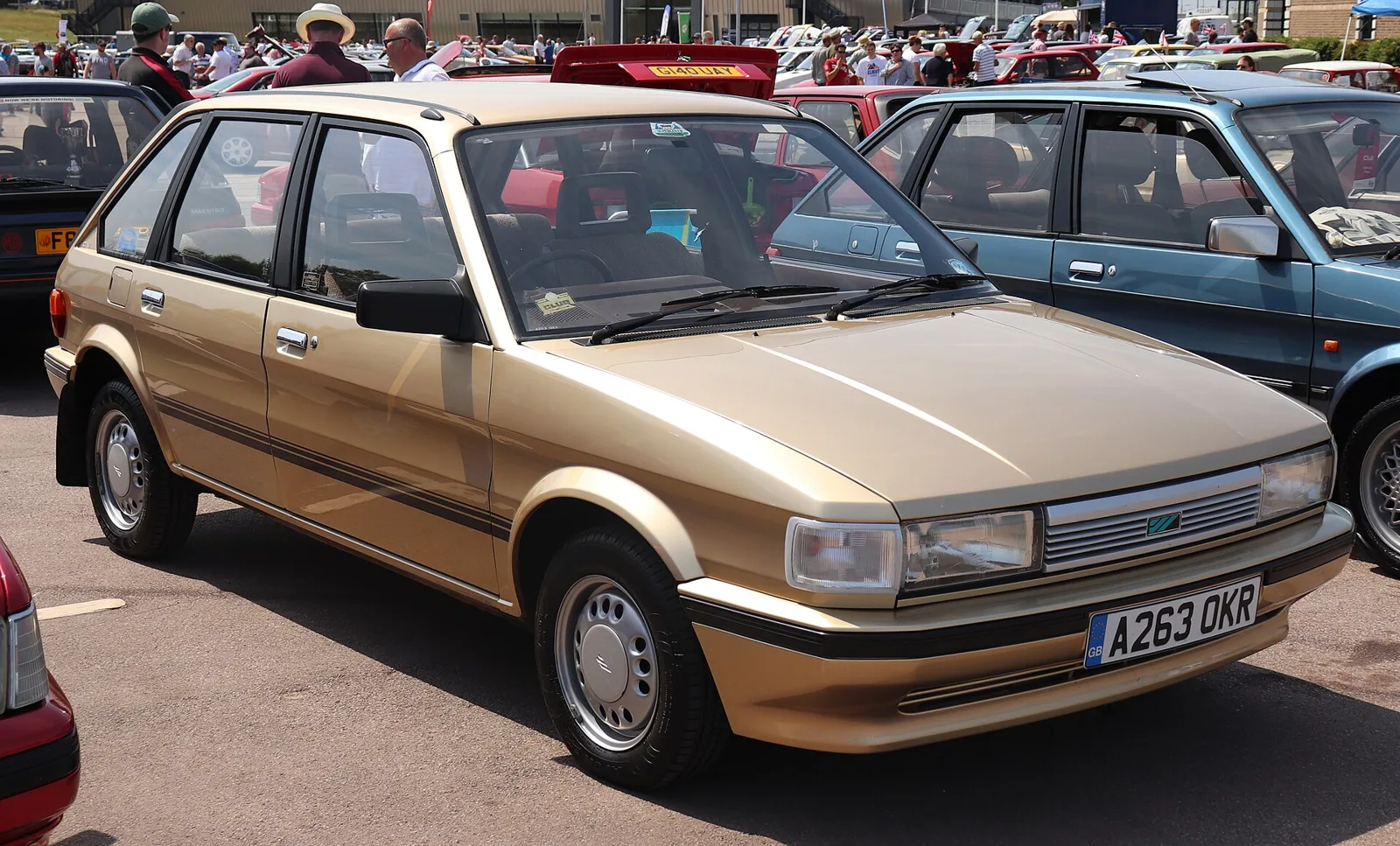
The Maestro began as LC10, styled by Ian Beech under David Bache, in five-door hatchback and four-door notchback forms. It abandoned the Issigonis transmission-in-sump layout for an end-on gearbox bought from Volkswagen. Hydragas went too, on cost grounds, replaced by MacPherson struts in front and a Golf-style torsion beam behind, and prototypes even ran with real Golf suspension parts. The Maestro turned out larger and heavier than the first Golf.
| Model | Launch | Built | Ended |
|---|---|---|---|
| Austin Metro | 8 October 1980 | 2,078,218 | 23 December 1997 |
| Austin Maestro | 1 March 1983 | 605,000 | December 1994 |
| Austin Montego | 25 April 1984 | 546,000 Austin/Rover, 23,000 MG | Saloon 1993, estate December 1994 |
Its list of innovations ran to body-coloured plastic bumpers, bonded laminated glass for the windscreen, homofocal headlamps, electronic engine management, an asymmetrically split rear seat, white front indicators and a 12,000-mile (19,300 km) service interval. Top MG and Vanden Plas versions got solid-state instruments and a voice synthesis system, voiced by New Zealand actress Nicolette McKenzie.
Production began in November 1982 and the car was launched on 1 March 1983. Which? found it spacious, comfortable and pleasant to drive, and by January 1984 judged its passenger room better than comparable rivals. Britain's sixth biggest seller in both 1983 and 1984, it topped 80,000 sales in its second year, a decent showing but short of what BL needed.
Problems of the early Maestro and the MG Maestro
An early reputation for poor build quality did not help. The 1.6-litre R-series, a hurriedly modified version of the E-series engine from the Maxi, suffered hot-starting trouble and early crankshaft failure. That was especially true of the MG Maestro 1600, pushed out despite engineers' objections and badly tuned by dealers used to SU carburettors; more than 15,000 were built before it was dropped in 1984.
The S-series engine arrived in July 1984. In October 1984 the new MG Maestro EFi gave 115 bhp (86 kW) from a fuel-injected 2-litre O-series engine, with uprated suspension and ventilated front discs. In February 1986 the flimsy original dashboard gave way to the Montego's, and the unreliable voice unit was dropped.
The Perkins diesel arrived in 1987, and the MG Maestro Turbo appeared in October 1988 and reached showrooms on 17 March 1989. At 129 mph (208 km/h) it was faster than the Ford Escort XR3i, Escort RS Turbo and Volkswagen Golf GTI. Rover's second-generation 200 cut into the range from autumn 1989, MG variants ended in 1991, and the Rover 600 of 1993 closed the Maestro and Montego line, though knock-down production continued until December 1994.
Austin Montego: the saloon that arrived late
The Montego started as the four-door notchback version of LC10. Development began in 1977, but the car arrived seven years later. The Triumph Acclaim, a Honda-based car launched in 1981, filled the gap meanwhile. Roy Axe replaced David Bache as design director, and Beech, Bache and Roger Tucker all contributed to the Montego's styling. When Axe saw the prototypes of both cars he recommended starting the styling again, but the development cycle was too far advanced, so he settled for last-minute fixes, including plastic trim pieces on the doors that faded quickly.
The launch came on 25 April 1984, initially as a four-door saloon only. The estate followed at the British International Motor Show that October, with self-levelling suspension, two additional rearward-facing child seats and more luggage space than rivals. It won a Design Council award. The MG Montego Turbo of early 1985 made 150 bhp (112 kW) with 169 lb ft (229 N m) of torque, and covered 0-60 mph in 7.3 seconds on the way to 126 mph (203 km/h), making it the fastest production MG ever.
The Montego's reputation suffered all the same. Its "talking" dashboard became an embarrassment, body-coloured bumpers cracked in cold weather and the S-series engine leaked oil at the top end. The car depended on the British fleet market, where Ford and Vauxhall could discount heavily and import tariff-free from continental plants.
The Maestro and Montego also shared a single platform that had to serve two size classes, an error the same group had committed in the 1960s with the Austin 1800 and the Maxi.
The Montego facelift and its diesel
A replacement proposed by Roy Axe in 1986 would have clothed the existing structure in new panels to look like the Rover 800 and been called the Rover 400-series. The AR16 and AR17 plans were abandoned in November 1988 for lack of funds, and instead a facelift (AR9) appeared at the NEC Motor Show in October 1988, along with a Perkins-engineered turbodiesel and a seven-seat Countryman estate. The Austin name was phased out at the same time.
In a March 1989 Car magazine test of turbodiesels the Peugeot 405 finished first, then the Citroen BX, then the Montego and finally the Audi 80, though the Montego was judged the most economical by a margin of more than 10%. The turbodiesel was popular with the Royal Air Force for officer transport.
Survivors and legacy of the Montego
The Montego saloon ended in early 1993 and the estate in December 1994. Some 546,000 Austin and Rover Montegos and 23,000 MGs were built, and 436,000 were sold in the UK between 1984 and 1995. An August 2006 Auto Express survey ranked it Britain's eighth-most scrapped car of the previous 30 years, with just 8,988 still in working order. Unpainted bodywork behind plastic trim contributed, and cars from before 1989 with A-series or S-series engines needed a converted cylinder head or fuel additives to burn unleaded petrol, which pushed many owners to scrap them when leaded fuel left sale after 1999.
What Car? summed up its final year by saying it had matured into a decent car that nobody noticed. The last Montego, signed by the people who built it, is on display at the British Motor Museum in Gaydon.
What came next
The Metro was redesigned in 1990 under the Rover brand, sold abroad as the Rover 100, and finished on 23 December 1997. The Rover 200 of 1995 was designed as its replacement but was not marketed as one. The development of the Maestro and Montego rear suspension was used as the basis for later Rover cars and well regarded. After UK production ended, knock-down kits of the Maestro were assembled in Varna, Bulgaria, in 1995 and 1996, and derivatives were made in China from 1998 to 2017. The redeveloped Cowley site now turns out the BMW Mini.