A quad-cam V8 family shared across Audi, Volkswagen, Porsche, Bentley and Lamborghini, from a 3.6-litre gasoline unit in 1988 to FSI and TDI versions still in production.
Built since 1988 by the Volkswagen Group with Audi, the V8 family covers 90-degree petrol and diesel engines. It debuted in the 1988 Audi V8, and diesel versions followed in 1999. Many Audi, Volkswagen, Porsche, Bentley and Lamborghini models use it.
The Volkswagen-Audi V8 is a family of mechanically similar petrol and diesel V8 engines, developed and produced by the Volkswagen Group with Audi since 1988. The family powers most Audi, Volkswagen, Porsche, Bentley and Lamborghini models, and a larger diesel version has gone into Scania trucks, buses and marine craft.
What is the Volkswagen-Audi V8 family?
The Volkswagen-Audi V8 engine family covers mechanically related gasoline and diesel 90-degree V8s. The first spark-ignition gasoline V8 arrived in the 1988 Audi V8, and the first compression-ignition diesel V8 followed in 1999 in the Audi A8. Both families have been used across the group ever since.
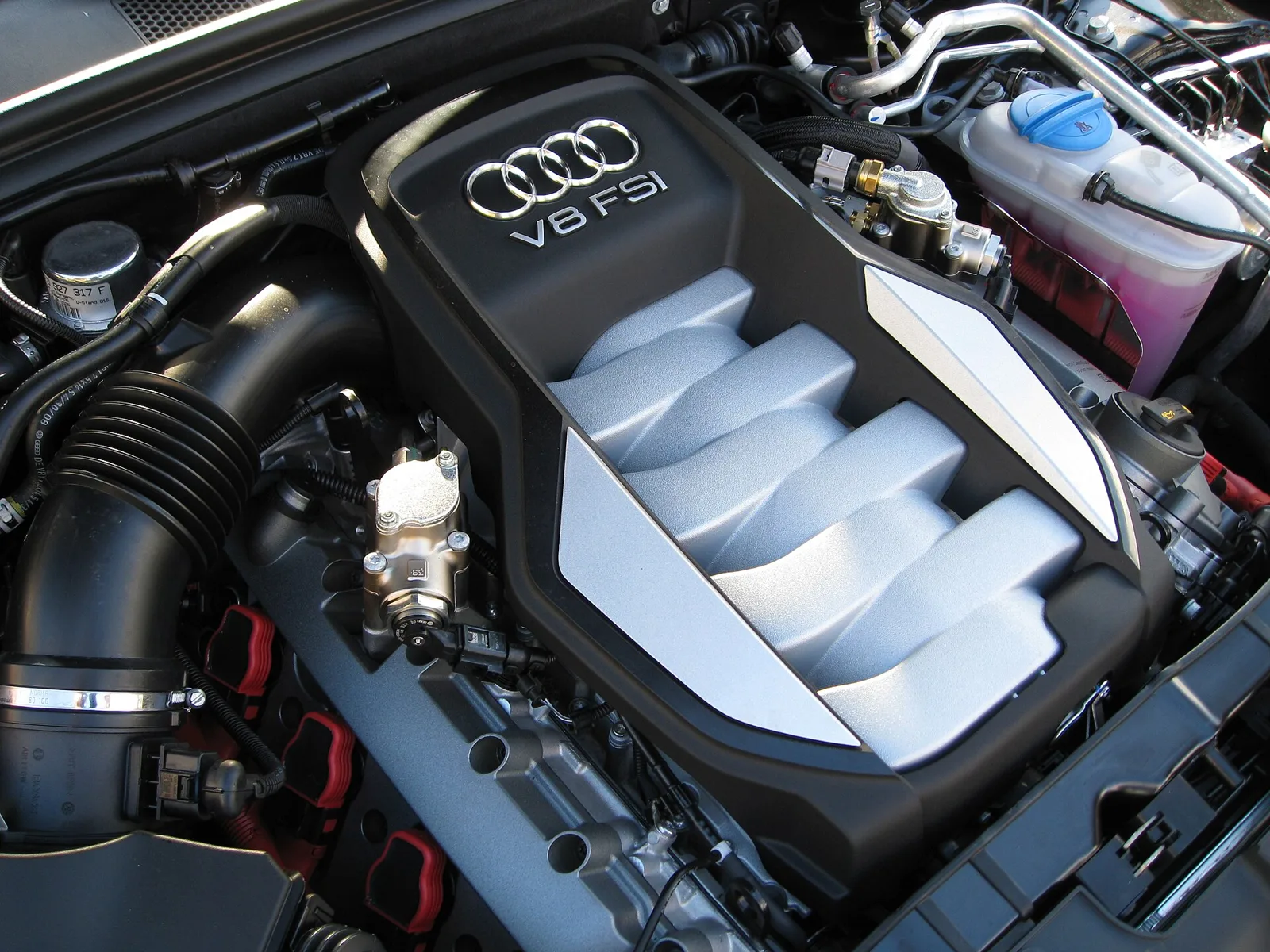
Gasoline versions have cast aluminium alloy blocks and cylinder heads, with multi-valve technology and two overhead camshafts per bank, often called quad cam. Robert Bosch Motronic units carry out all engine control. The engines sit longitudinally at the front of the car, except for the mid-mounted Audi R8.
One V8 layout, from a 1988 Audi to a 575 kW Bentley, carried across four brands and two racing series.
How did the early gasoline V8s develop?
The first gasoline unit was a 3,562 cc, 32-valve V8 measuring 81.0 mm across the bore and 86.4 mm of stroke, giving a compression ratio of 10.6:1. It produced 184 kW (250 PS; 247 bhp) at 5,800 rpm and 340 N m (251 lbf ft) at 4,000 rpm, and it was used in the Audi V8 from late 1988 until the early nineties.
Its successor was a 3,697 cc unit in two forms. The 32-valve version made 169 kW (230 PS; 227 bhp), while the 40-valve version made 191 kW (260 PS; 256 bhp) and later a 206 kW (280 PS; 276 bhp) BFL variant. The 40-valve design used five valves per cylinder and three-stage variable intake manifolds, and it earned a Golden Pegasus award as the best technical innovation at the Moscow Motor Show.
What were the 4.2 litre V8 versions?
The 4.2 litre family displaced 4,172 cc, with an 84.5 mm bore and a 93.0 mm stroke. The 32-valve version ranged from 206 kW (280 PS; 276 bhp) to 250 kW (340 PS; 335 bhp), and the top variant produced 420 N m (310 lbf ft) at 3,500 rpm. Its mass was 208 to 211 kg (459 to 465 lb), depending on the variant.
The 40-valve 4.2 litre introduced five valves per cylinder and outputs between 220 kW (299 PS; 295 bhp) and 265 kW (360 PS; 355 bhp). It powered the Audi C5 A6, the D2 A8, the C5 S6 and the S8 Plus, and the Japan-only versions of the Audi S8 Plus used the same engine.
| Version | Capacity | Peak power | Peak torque | Example application |
|---|---|---|---|---|
| 3.6 V8 32v | 3,562 cc | 184 kW (250 PS; 247 bhp) at 5,800 rpm | 340 N m (251 lbf ft) at 4,000 rpm | Audi V8, 10/88 to 11/93 |
| 3.7 V8 40v (BFL) | 3,697 cc | 206 kW (280 PS; 276 bhp) at 6,000 rpm | 360 N m (266 lbf ft) at 3,750 rpm | Audi D3 A8, 11/02 to 05/06 |
| 4.2 V8 32v (AKH) | 4,172 cc | 250 kW (340 PS; 335 bhp) at 6,600 rpm | 420 N m (310 lbf ft) at 3,500 rpm | Audi D2 S8, 08/97 to 12/98 |
| 4.2 V8 40v (AQH) | 4,172 cc | 265 kW (360 PS; 355 bhp) at 7,000 rpm | 430 N m (317 lbf ft) at 3,400 rpm | Audi S8 Plus (D2), 05/99 to 02/01 |
| 4.2 V8 40v turbo (BCY) | 4,172 cc | 331 kW (450 PS; 444 bhp) at 5,700 to 6,400 rpm | 560 N m (413 lbf ft) at 1,950 to 5,600 rpm | Audi C5 RS6, 07/02 to 09/04 |
| 4.2 V8 FSI 32v | 4,163 cc | 257 kW (349 PS; 345 bhp) at 6,800 rpm | 440 N m (325 lbf ft) at 3,500 rpm | Audi Q7 and Volkswagen Touareg |
| 3.3 V8 TDI CR | 3,328 cc | 165 kW (224 PS; 221 bhp) at 4,000 rpm | 480 N m (354 lbf ft) at 1,800 to 3,000 rpm | Audi D2 A8 quattro, 12/99 to 09/02 |
| 4.0 V8 TDI CR | 3,937 cc | 202 kW (275 PS; 271 bhp) | 650 N m (479 lbf ft) at 1,800 to 2,500 rpm | Audi D3 A8 4.0 TDI quattro, 05/03 to 07/05 |
| 4.2 V8 TDI (CTEC) | 4,134 cc | 283 kW (385 PS; 380 bhp) at 3,750 rpm | 850 N m (627 lbf ft) at 2,000 to 2,750 rpm | 4.2 TDI range for Audi, Volkswagen and Porsche |
How did the C5 RS6 biturbo come about?
The RS6 engine started from the 4.2 litre 40-valve V8 of the Audi C5 S6. Cosworth Technology, a Volkswagen Group subsidiary now known as MAHLE Powertrain, helped tune it. Two parallel turbochargers, one per bank, fed two side-mounted intercoolers, and the cylinder heads received enlarged ports.
The initial 331 kW (450 PS; 444 bhp) version delivered 79.3 kW (107.8 PS; 106.3 bhp) per litre, and the RS6 Plus raised output to 353 kW (480 PS; 473 bhp), or 84.6 kW (115.0 PS; 113.5 bhp) per litre. Its compression ratio was 9.8:1, and the engine used a re-calibrated Motronic system.
Why did the diesel V8s matter?
The 3.3 litre V8 TDI was the first diesel in the family, with a 90-degree layout, a 3,328 cc capacity and a compression ratio of 18.5:1. Its turbochargers had variable turbine geometry, and the engine reached 165 kW (224 PS; 221 bhp) with 480 N m (354 lbf ft) of torque. Its best specific consumption was 205 g/kWh, a 41.1 per cent energy efficiency.
The 4.0 V8 TDI arrived in May 2003 and was, at its launch, the highest-power and highest-torque diesel V8 fitted to any production car. It produced 202 kW (275 PS; 271 bhp) and 650 N m (479 lbf ft), and it was replaced by the bored-out 4.2 V8 TDI in July 2005.
What changed with the 4.2 V8 TDI?
The 4.2 V8 TDI was made at Gyor in Hungary by Audi Hungaria Motor Kft. It displaced 4,134 cc, with 83.0 mm bores and a 95.5 mm stroke, and its mass of 255 to 257 kg (562 to 567 lb) was 15 kg (33 lb) lighter than the 4.0 predecessor. The 4.2 TDI used Euro 4 emissions standards and covered a wide output range.
Output rose to 235 kW (320 PS; 315 bhp) in the early BMC version, 240 kW (326 PS; 322 bhp) in the BVN and BTR, and 283 kW (385 PS; 380 bhp) in the CTEC. The CTEC also produced 850 N m (627 lbf ft) between 2,000 and 2,750 rpm, and a marine variant in the CEM produced 257 kW (349 PS; 345 bhp).
What is the current FSI V8?
The current 4.2 litre FSI V8 displaces 4,163 cc, with a bore of 84.5 mm and a 92.8 mm stroke, and it uses a compression ratio of 12.5:1. It was the first eight-cylinder road car engine to use Fuel Stratified Injection, which Audi had developed in the Le Mans-winning R8 racing car. The 5.2 V10 FSI was later developed directly from this V8.
The comfort version appeared first in the Audi Q7, while the high-revving sports version powered the B7 RS 4 quattro and the R8. Output rose from 257 kW (349 PS; 345 bhp) at 6,800 rpm in the Q7 to 331 kW (450 PS; 444 bhp) at 8,250 rpm in the B8 RS 4 and RS 5, which used a rev limit of 8,500 rpm.
How did the 4.0 TFSI differ?
The 4.0 TFSI is a twin-turbo V8 of 3,993 cc with an 84.5 mm bore and an 89.0 mm stroke. It shares its V-angle and 90 mm cylinder spacing with the Audi V6 family. Its turbochargers sit inside the vee, a hot-vee layout that lets boost build quicker and helps the exhaust hardware reach temperature sooner.
Outputs run from 309 kW (420 PS; 414 bhp) in the Audi S6 C7 to 575 kW (782 PS; 771 bhp) in the Bentley Continental GT Speed. Between them sit the Porsche Panamera Turbo S E-Hybrid at 505 kW (687 PS; 677 bhp), the Lamborghini Urus at 478 kW (650 PS; 641 bhp), and the Bentley Continental GT V8 at 373 kW (507 PS; 500 bhp). The Bentley version uses a dipstick and switchable hydraulic mounts instead of Audi's electrohydraulic mounts.
What role did the V8 play in racing?
Audi built a Group A version of its V8 for the Deutsche Tourenwagen Meisterschaft, with a 3.6 litre engine rated at 309 kW (420 PS; 414 bhp) and later 340 kW (462 PS; 456 bhp). It started racing in 1990 with Schmidt MotorSport, and the drivers that year included Hans-Joachim Stuck, Walter Rohrl and Frank Jelinski.
The R8 sports racer used a 3.6 litre twin-turbo V8 producing between 600 and 640 hp (447 to 477 kW). Official power was 610 hp (455 kW) in 2000, 2001 and 2002, and it fell to 520 hp (388 kW) by 2005 as the rules tightened. Bentley's Speed 8 used the R8 engine for its first season, producing 637 hp (475 kW) before the engine grew to 4.0 litres.
The DTM cars that followed used naturally aspirated 4.0 litre V8s, built with Neil Brown Engineering. The Audi TT-R DTM produced about 455 hp (339 kW), the A4 DTM about 460 hp (343 kW), and the RS5 DTM more than 500 hp (373 kW) after its rename in 2012.
How did the racing R8 engines compare with road cars?
The R8 racer used a 3.6 litre twin-turbo V8 that produced between 600 and 640 hp (447 to 477 kW) in the R8C and R8R. The R8R was estimated at around 610 hp (450 kW) and could reach 335 km/h (208 mph) at Le Mans in 1999, though the original claims had been for 350 km/h (217 mph). The R8 that followed was officially rated at 610 hp (455 kW) in 2000, 2001 and 2002.
The official figures were quoted at speed, with about 50 extra horsepower coming from twin ram-air intakes above 150 mph (240 km/h). Unofficially, the works Le Mans team was thought to have around 670 hp (500 kW). Restrictor changes for 2003 reduced the car to 550 bhp, and by 2005 the ACO had reduced the restrictor again and required ballast, which limited the R8 to 520 bhp.
What did the 4.0 V8 TDI add?
The 4.0 V8 TDI was a successor to the 4.2 TDI, with a 3,956 cc capacity, two turbochargers, a 48-volt electrical system and a 7 kW electric compressor. It produced 310 kW (421 PS; 416 bhp) in the Porsche Panamera II 4S Diesel and 320 kW (435 PS; 429 bhp) in the Audi SQ7, SQ8 and A8 D5, and in the Bentley Bentayga.