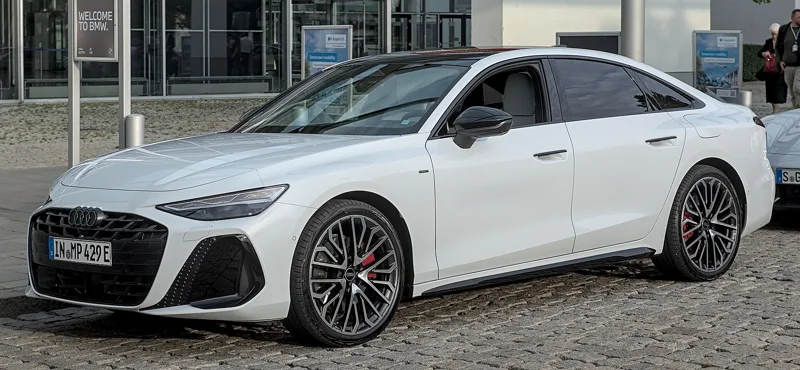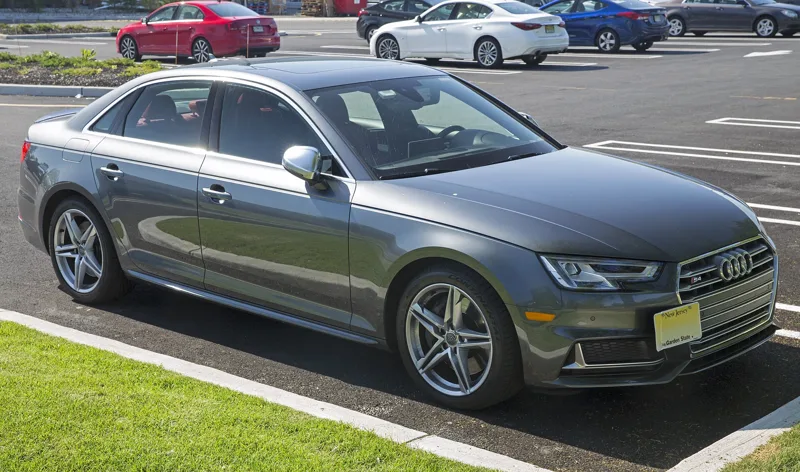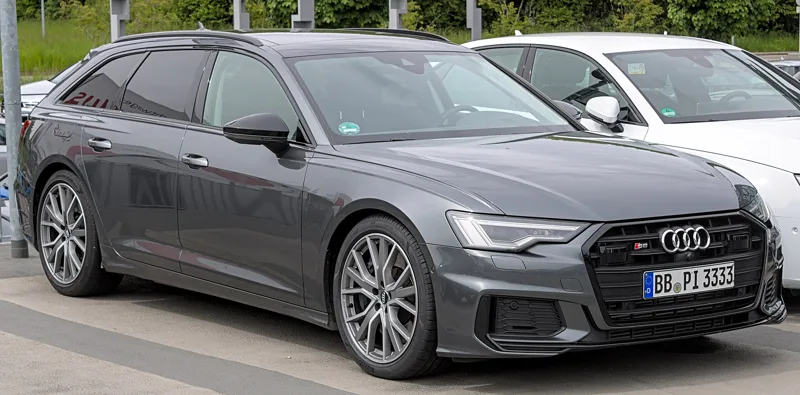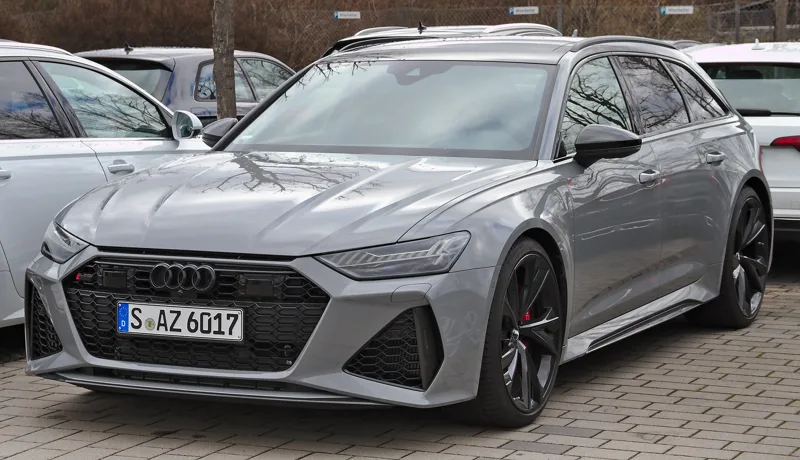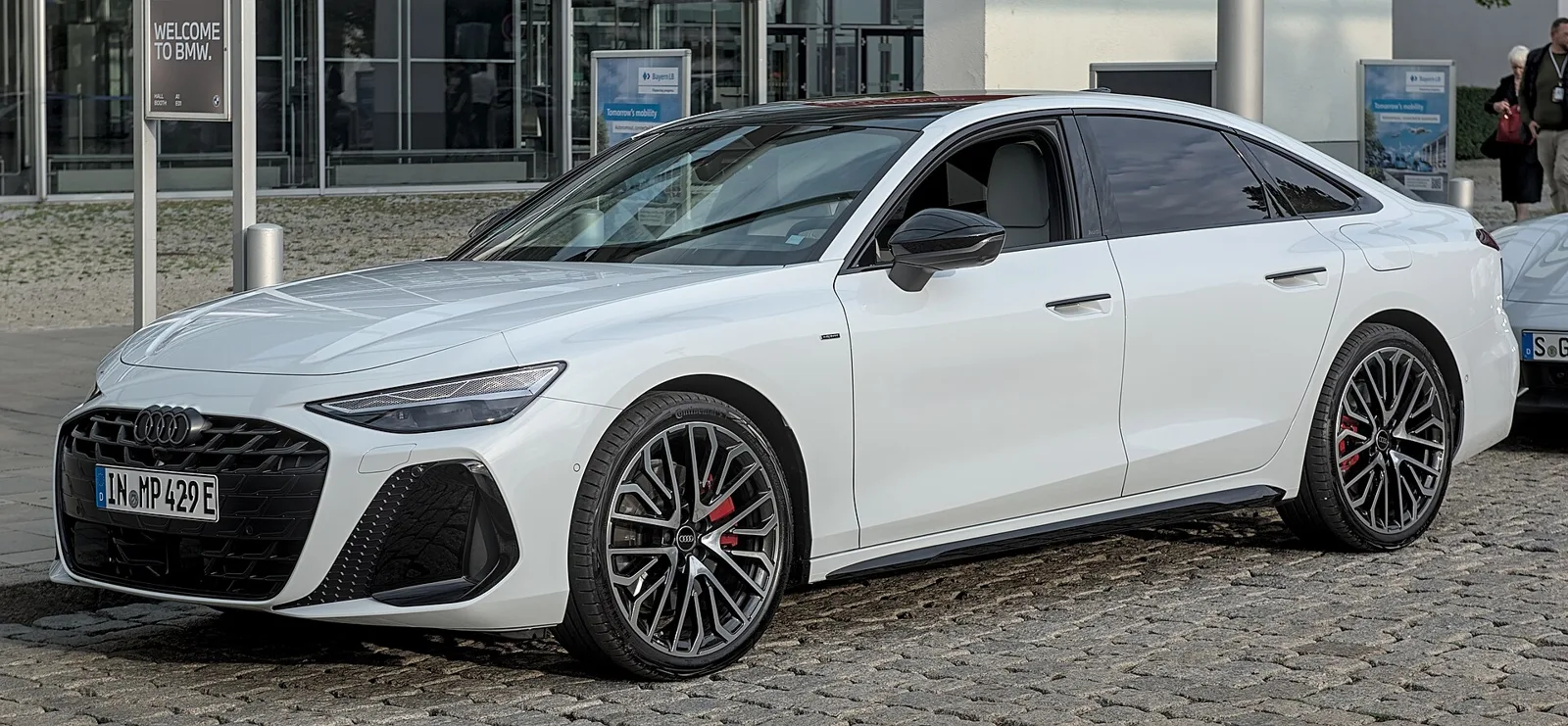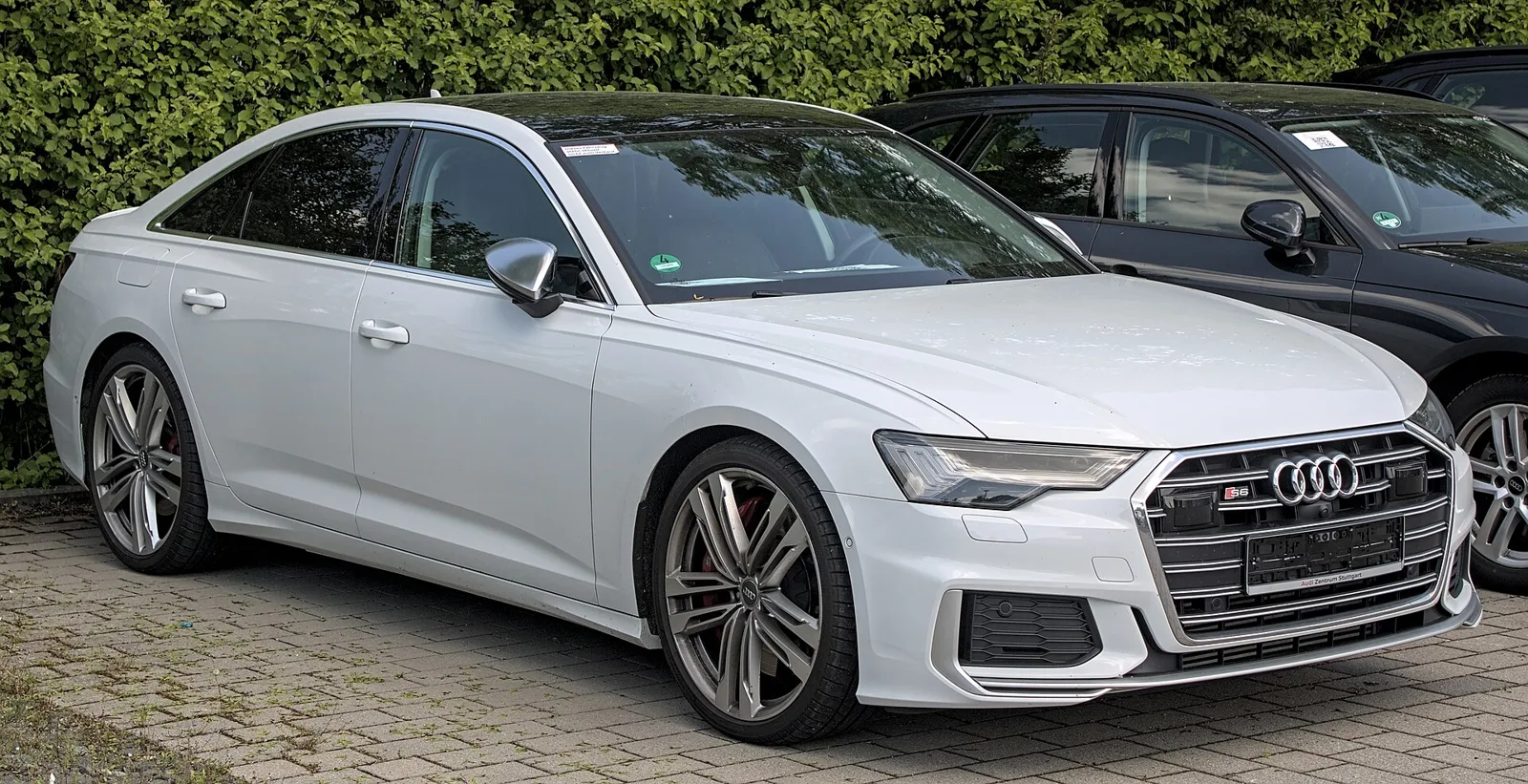
From a 1994 S4 derivative with a turbo five-cylinder to a 2019 twin-turbo V6 hybrid, the S6 has been the sporting heart of Audi's executive saloon.
The Audi S6 is the sporting version of Audi's A6 executive car, with quattro four-wheel drive as standard. Launched in 1994 as an S4 derivative, it has since used V8, V10, twin-turbo V8 and twin-turbo V6 engines.
The Audi S6 is the performance version of the A6 executive saloon, and it has used quattro four-wheel drive from the start. The first car appeared in 1994 as a modified S4, and later generations added V8 and V10 engines before turning to twin-turbo V6 and V8 units. Across its generations it has offered more power than the standard A6 while keeping the executive-car layout.
What is the Audi S6 and how does it fit the A6 range?
The S6 sits as the sporting trim of the A6 family and, where the higher-performance RS 6 is not sold, it is the most powerful A6 on offer. Like every Audi S model, it comes with the company's quattro system as standard, which uses a Torsen-based permanent four-wheel drive layout. That mechanical link has defined the car from the first generation to the latest.
The name itself has changed over time. The A6 badge arrived in late 1994, when the Audi 100 was renamed, and the S6 came in the same period. The S4 name was later reused on a completely different model based on the smaller A4, which left the S6 as the sole descendant of the original sporting saloon.
Quattro grip and a turbo or V8 heart, carried from a 1994 S4 derivative to a twin-turbo hybrid.
Where did the first S6 come from?
In late 1994 Audi began selling the fifth-generation C4 model as the A6, and it wanted to keep a sports saloon in the range. Engineers revised the earlier S4 and gave it the S6 name. Because it was the first S6, enthusiasts sometimes call it the Ur-S6, using the German word for original.
Outwardly the car differed from the standard A6 mainly through extra body cladding and badging. Buyers in Europe and the United States could choose a saloon or an Avant estate, but Canada, Asia and Australia received only the saloon. Audi's procon-ten safety system was fitted as standard on the C4 cars.
What engines did the C4 S6 use?
From launch the S6 used a 2,226 cc turbocharged inline five-cylinder petrol engine, identified by the code AAN and controlled by a Bosch Motronic unit. It made 169 kW (230 PS) at 5,900 rpm, and its 350 N-m of torque arrived at about 1,950 rpm; premium Super Plus 98RON petrol was required.
Audi also offered a 4.2-litre V8 as an upgrade. That engine delivered 213 kW (290 PS), peaking at 5,800 rpm, and 400 N-m of torque arriving at 4,000 rpm. V8 cars came standard with a four-plus-one automatic and four-wheel drive, while the turbo five could be ordered with a six-speed manual, which was a five-speed in North America.
How quick was the C4 S6?
The five-cylinder car topped out at 149.8 mph (241 km/h). It accelerated from 0 to 100 km/h in 6.7 seconds, from 0 to 60 mph in 6.1 seconds and from 0 to 160 km/h in 17.5 seconds. Those times were strong for a family-size executive car of that period.
The V8 version was quicker still: 5.9 seconds to 100 km/h and 154.7 mph (249 km/h) at the top. Its braking came from 314 mm front discs and 269 mm rear discs, with Bosch anti-lock braking and EDS fitted as standard across the range.
What was the S6 Plus?
The S6 Plus was a limited-production model built for European buyers. Developed by Audi's wholly owned performance subsidiary quattro GmbH, it was sold during the 1997 model year and was built between June 1996 and October 1997. Just 952 cars were produced, of which 855 were Avants and 97 were saloons.
The Plus used a revised version of the 4.2-litre 32-valve V8, which gave 326 PS (240 kW). It came only with a revised six-speed manual gearbox, larger 323 mm front discs and seventeen-inch wheels fitted with 255/40 R17 tyres. The saloon reached 100 km/h in 5.6 seconds, while the Avant needed 5.7 seconds, and Hella xenon headlamps were standard.
What changed with the C5 S6 in 1999?
In late 1997 Audi introduced a new A6 on the Volkswagen Group C5 platform, and in 1999 the S6 quattro followed. It was offered as a four-door saloon and as a five-door Avant. In North America only the Avant was sold, and production of this generation ended in 2003.
The C5 engine was a new 4.2-litre 40-valve V8 with five valves per cylinder and a 90-degree layout. It used a two-stage variable intake manifold and produced 340 PS (250 kW) at 6,600 rpm, with 420 N-m of torque at 3,400 rpm. It met EU3 standards and was run by a Bosch engine management unit.
A six-speed manual was standard, while a five-speed ZF tiptronic automatic with steering wheel paddles was optional. Quattro was standard on every car, with an electronic differential lock on both axles. The suspension was 30% stiffer than the A6's and sat 10 mm lower, and the power steering came from ZF.
What was the RS 6 in the C5 generation?
A higher-performance RS 6 ran from 2002 to 2004 and was built by quattro GmbH. It used a twin-turbo version of the 4.2-litre V8, which produced 331 kW (450 PS) between 5,700 and 6,400 rpm, along with 560 N-m of torque. The only gearbox was a five-speed tiptronic automatic.
The RS 6 used the Dynamic Ride Control system, which linked the shock absorbers diagonally for better control under hard cornering and braking. Its brakes grew to 365 mm at the front and 335 mm at the rear, and the car reached 100 km/h in 4.6 seconds. The saloon took 16.6 seconds to reach 200 km/h, while the Avant needed 16.8 seconds.
Why did the C6 S6 get a V10?
The S6 5.2 FSI quattro arrived with the C6 generation, presented to the North American show circuit in January 2006. It rode on the Volkswagen Group C6 platform and came as a saloon or an Avant, with production starting in June 2006. A facelift arrived in late 2008, and a third-generation MMI controller was added in 2010.
The engine was a 5,204 cc FSI V10 with 40 valves, identified by the code BXA. Audi said it was related to the 5.0-litre V10 used by Lamborghini, but with a longer stroke and wider bore for more low-speed torque in the heavier sedan. Output was 435 PS (320 kW), reached at 6,800 rpm, and torque of 540 N-m arrived between 3,000 and 4,000 rpm.
A ZF six-speed tiptronic was the only transmission, with paddle shifters on the steering wheel. Torsen quattro was fitted, first with the T-1 differential and from the 2007 model year with the asymmetric T-3, and the car ran Bosch ESP 8.0 stability control. The same V10 was used in the S8 at 450 PS, so the S6 was never allowed to match its sister car.
How did the C6 S6 perform against its rivals?
Factory figures put the saloon at 5.2 seconds from 0 to 100 km/h, and the car needed 13.5 seconds for the quarter mile. Electronics capped the top speed at 250 km/h (155.3 mph). An Edmunds test measured 5.7 seconds to 60 mph, which put it about a second behind the BMW M5 and the Mercedes-Benz E63 AMG.
Road & Track's 2007 track test recorded 5.1 seconds from 0 to 60 mph, and it found the S6 covering the quarter mile in 13.5 seconds. Edmunds also judged that the 2009 A6 3.0 TFSI, a supercharged V6, had almost equivalent performance to the S6.
On the C6 the front discs measured 385 mm across and the rear 330 mm, and the calipers were gloss black. Standard wheels were nineteen-inch five-arm alloys with 265/35 ZR19 Continental tyres, and an optional eighteen-inch set was also offered. A direct-acting tyre pressure monitor was standard.
What was the RS 6 in the C6 generation?
The C6 platform produced another RS 6 for the 2008 to 2010 model years, again built by quattro GmbH. It used a 5.0-litre twin-turbo V10 making 580 PS (427 kW) and 650 N-m of torque. Audi described it as the most powerful car it had built, and it reached 100 km/h in 4.5 seconds in saloon form and 4.6 seconds as an Avant.
The S6 V10 went out of production once the 2011 model year closed, just ahead of the C7 A6 in 2012. The V10 cars had been among the last vehicles in Audi's range with that engine layout, and their departure marked the end of a particular era for the S6.
What did the C7 S6 bring?
The S6 4.0 TFSI quattro and its twin, the S7, went on sale as 2013 models, a year after the C7 A6 and A7. The engine was a 4.0-litre twin-turbo V8 rated at 420 PS (309 kW) with 550 N-m of torque, with cylinder-on-demand and stop-start systems. Audi lifted the output to 450 PS (331 kW) for 2016.
A seven-speed S-tronic dual-clutch gearbox replaced the older automatic. The 2012 S8 ran the same basic engine with more power, 520 PS. The V8 option on the regular A6 was dropped, and the S6 took over that role, which put it in direct competition with the BMW 550i and the Mercedes-Benz E550.
UK sales started in May with a saloon price of 53,995 pounds and an Avant price of 56,050 pounds. The C7 range was facelifted in November 2014, with a revised infotainment platform and Audi connect 4G telematics.
What changed in the C7.5 facelift?
Audi unveiled the 2015 facelift in November 2014. Changes included exterior tweaks, a new engine line-up and a transmission update. The Multi Media Interface gained a faster processor and handwriting recognition, and Audi connect added 4G internet with mobile updates for maps.
Adaptive matrix LED headlights arrived, along with a night vision system that could now recognise animals. Both the TFSI petrol engines and the three TDI diesels were brought up to the Euro 6 emissions standard.
What is the C8 S6?
Under the bonnet the C8 S6 carries a 2.9-litre twin-turbo V6 with TFSI petrol injection, producing 450 PS (331 kW) and 600 N-m of torque. It reaches 60 mph in 4.4 seconds. A 48V belt starter-generator adds mild-hybrid assistance, recovering up to 7 kW (9.4 bhp) during braking.
European buyers could also pick a 3.0-litre turbo-diesel V6 with 344 PS (253 kW) and 700 N-m of torque, which reached 60 mph in 5.1 seconds. Its drag coefficient is 0.29. Both engines use an electric supercharger, a technology first seen on a diesel V8 in the 2016 SQ7 TDI.
What are the Audi S6 specifications?
| Generation | Years | Engine | Output |
|---|---|---|---|
| C4 | 1994 to 1997 | 2,226 cc turbo five-cylinder | 230 PS (169 kW), 350 N-m |
| C4 V8 option | 1994 to 1997 | 4.2 L V8 | 290 PS (213 kW), 400 N-m |
| S6 Plus | 1996 to 1997 | 4.2 L V8, 952 built | 326 PS (240 kW) |
| C5 | 1999 to 2003 | 4.2 L 40-valve V8 | 340 PS (250 kW), 420 N-m |
| RS 6 (C5) | 2002 to 2004 | Twin-turbo 4.2 L V8 | 450 PS (331 kW), 560 N-m |
| C6 | 2006 to 2011 | 5,204 cc FSI V10 | 435 PS (320 kW), 540 N-m |
| RS 6 (C6) | 2008 to 2010 | 5.0 L twin-turbo V10 | 580 PS (427 kW), 650 N-m |
| C7 | 2012 to 2018 | 4.0 L twin-turbo V8 | 420 PS (309 kW), 550 N-m |
| C8 | 2019 to 2025 | 2.9 L twin-turbo V6 mild hybrid | 450 PS (331 kW), 600 N-m |
| C8 diesel | 2019 to 2025 | 3.0 L turbo-diesel V6 | 344 PS (253 kW), 700 N-m |