How Ferrari's 1.5-litre turbo V6 moved from the 126C's lag and qualifying peaks to the Tipo 033, which reached about 950 bhp in qualifying.
Ferrari's turbocharged V6 F1 engines were 1.5-litre racing units used from 1981 to 1988. They powered the 126C, the F1/86 and the Tipo 033 family, and their qualifying output rose from about 600 bhp to around 1,200 bhp. The programme ended when turbo engines were banned from Formula One for 1989.
Ferrari built a series of turbocharged 1.5-litre V6 racing engines for Formula One between 1981 and 1988. The first was used in the 126C in 1981, and the programme ran through turbo lag, detuned race trims and a powerful but difficult 1986 car. Its successor was a normally aspirated V12 that arrived as turbo engines were banned.
Why did Ferrari switch to a turbo V6 in 1981?
The Tipo 021/1, known as the 126C engine, replaced the flat-12 that had powered the 312T series since 1975. That engine had been highly successful, but it had become obsolete. A V6 with forced induction suited the ground effect aerodynamics that the cars now needed, because the wide boxer engine of the earlier car had disrupted the airflow that ground effect depended on.
Ferrari's turbo V6 gave it 1,200 bhp in qualifying, and it also showed how much handling and fuel limits could hold back a fast engine.
Why did Ferrari choose twin turbos over the Comprex?
Ferrari first experimented with a Comprex pressure wave supercharger from a Swiss supplier, Brown Boveri Comprex. The car was initially called the 126BBC and later the 126CX. Drivers praised the system for feeling like a naturally aspirated engine with an extended power range, which removed the lag that made turbochargers notorious.
The Comprex had two drawbacks. It sat tall in the car, and there was a risk that exhaust and intake gases would mix. The team therefore chose twin KKK turbochargers, and the car using them was called the 126CK. In qualifying trim those turbos made roughly 600 bhp (447 kW; 608 PS), and race tuning brought them down to 550 bhp (410 kW; 558 PS).
Who shaped the early turbo engines?
Enzo Ferrari hired Nicola Materazzi in December 1979 to work alongside Forghieri and Tomaini. Materazzi brought experience of turbocharging from the Lancia Stratos Gr 5 Silhouette cars, and his knowledge was meant to help Ferrari match what Renault had built up over several years.
Materazzi understood both the strengths and the problems of the Comprex. He prepared a second version with two smaller Comprex units driven by a hydraulic clutch rather than a belt, but the team did not use it. The turbocharger was judged simpler and worth pursuing, so Materazzi concentrated on refining the turbo powertrain for more power and reliability.
How did the 126C perform in 1980 and 1981?
The 126CK was first tested at the 1980 Italian Grand Prix. It was far quicker in testing than the 312T5 chassis the team had been using, and Gilles Villeneuve preferred it, although he had reservations about its handling. Early unreliability of the turbo engine hurt his 1981 championship hopes.
Villeneuve still won back to back races in Monaco and Spain, and he took several podium finishes. On fast circuits with long straights, such as Hockenheim, Monza and Buenos Aires, the 126CK performed best. Villeneuve found the handling very difficult, and he described the car as a big red Cadillac.
The engine suffered from severe turbo lag, followed by a steep power climb that upset the balance of the chassis. Even so, the Ferrari engine was the most powerful unit of that year, more powerful even than the Renault.
What changed in the 1982 and 1983 engines?
Harvey Postlethwaite joined and led a total overhaul of the car in time for 1982. Development of the turbo engine went on, and reliability improved. Through the season the 126C2 gained new wings and bodywork, and its power was raised to 650 bhp (485 kW; 659 PS) in qualifying and around 600 bhp (447 kW; 608 PS) in races.
The 126C3 engine first appeared at the 1983 British Grand Prix at Silverstone, driven by Patrick Tambay. Rene Arnoux drove a 126C3 at the next race in Germany, at Hockenheim, and went on to win it. Over the season Tambay and Arnoux scored four wins between them, and both were in contention for the title until late unreliability cost them.
Ferrari still took the constructors' title for the second year running. Its rivals Brabham and Renault had second drivers with relatively poor seasons, in Riccardo Patrese and Eddie Cheever, and that helped Ferrari.
The engineers pushed power further. The 1983 engine reached around 800 bhp (597 kW; 811 PS) in qualifying and more than 650 bhp for racing, which is generally regarded as the best figure of that year.
How strong was the 1984 126C4 engine?
The 126C4 engine produced around 850 bhp (634 kW; 862 PS) in qualifying, which made it virtually the equal of the BMW and Renault units and gave it more power than McLaren's TAG-Porsche engine. The car itself produced little downforce compared with its main rivals, and both Michele Alboreto and Arnoux said through the season that it lacked grip.
Because of the grip problem, the cars ran as much wing as possible, which cost them top speed. At Kyalami in round two, the Ferraris lost roughly 25 km/h (16 mph) on the long straight to the BMW-powered Brabhams, mainly because of drag from high wing settings. The wings also hurt fuel economy, and drivers often had to slow down to finish races. Refuelling was banned in 1984, and cars were restricted to 220 litres per race.
Alboreto scored the engine's only win of 1984 at round three in Belgium, which turned out to be the last Formula One Grand Prix held at Zolder. Across the 126C series the cars won 10 races, took 10 pole positions and scored 260.5 points.
What did the Tipo 031/2 change in 1985?
The Tipo 031/2 produced around 750 bhp (559 kW; 760 PS) in race trim during 1985. It was mounted in a new chassis, the 156/85, with the exhaust systems moved outside the vee, the opposite of the previous year's 126C4. Each turbocharger sat on the outside of its bank, so the intake chambers were inside the vee.
The engine was fast and reliable early in the season, but the Ferraris became fragile as it went on, with numerous engine and turbo failures in qualifying and races. That unreliability cost Alboreto the drivers' title, even though he led the points standings for most of the year. He retired from four of the last five races, and at Spa he was classified 13th after completing 90 percent of the distance.
McLaren's Alain Prost won his first championship. Alboreto's new team-mate, the Swede Stefan Johansson, finished four of the last five races that Alboreto did not complete.
What was the Tipo 032 in the F1/86?
The Tipo 032 powered the F1/86, which was the most powerful car, racing or road, that Ferrari had ever produced. In qualifying for the French Grand Prix at the shortened Paul Ricard circuit, Alboreto used its reported 1,200 bhp (895 kW; 1,217 PS) to blast past Nigel Mansell's Williams on the long Mistral straight. For races the engines were detuned to around 850 bhp (634 kW; 862 PS).
Handling was the car's weakness. Mansell felt the F1/86 was much slower in the corners after the straight than he could have been, even though Alboreto was on a qualifying lap. The car reportedly handled well only on the smoothest circuits, such as Paul Ricard, and even there it remained slower than its rivals. Visually it recalled the 1983 championship-winning 126C3, with a bulky engine and fuel tank covering.
What was the Tipo 033 engine?
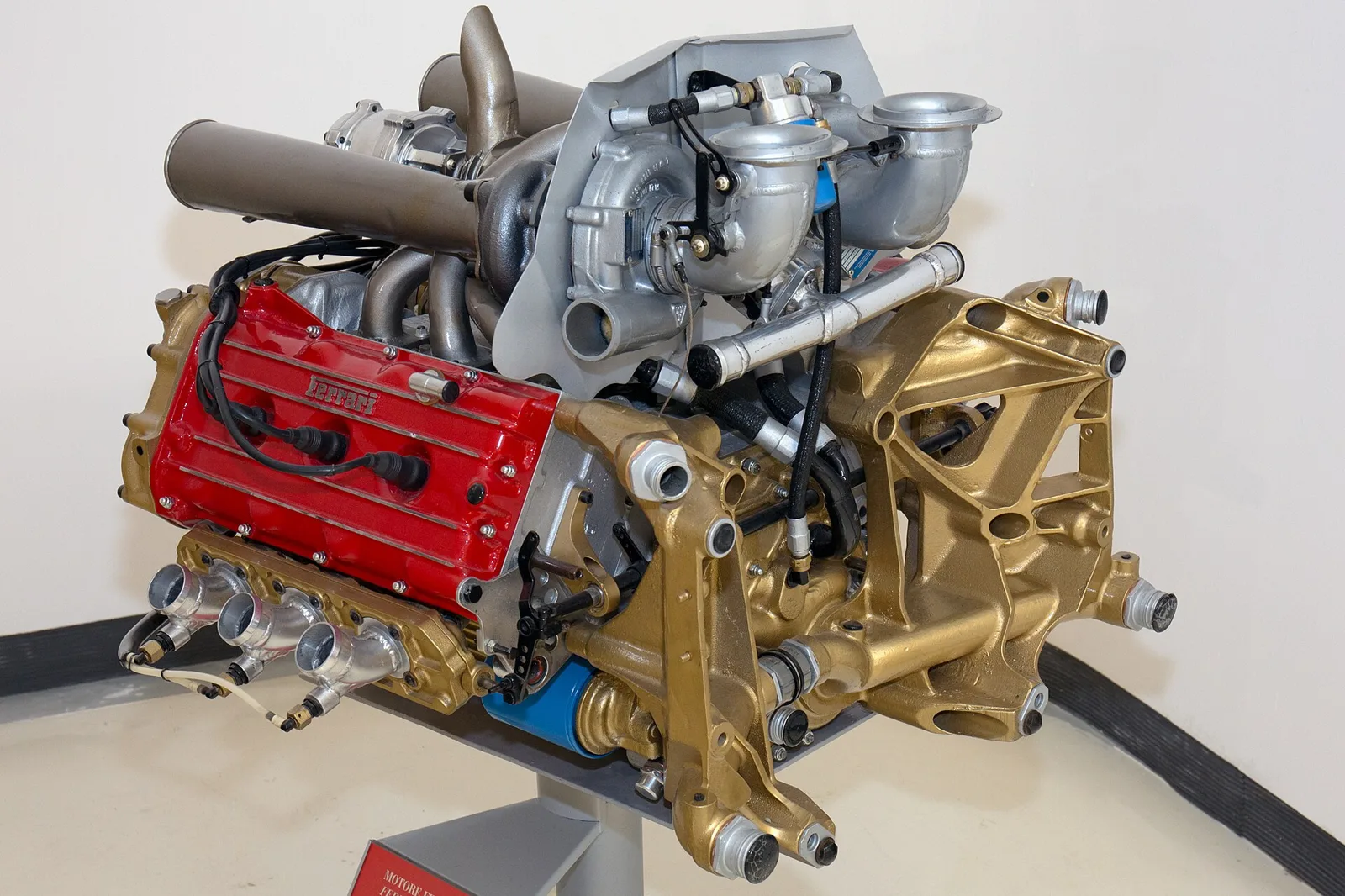
The Tipo 033 was an all-new 90 degree 1.5-litre turbo V6 that replaced the 120 degree V6 in use since 1981. Like every turbo engine, it had to carry the FIA's pop-off valves, which restricted boost to 4.0 Bar. Its output was about 950 bhp (708 kW; 963 PS) in qualifying and 880 to 900 bhp (656 to 671 kW; 892 to 912 PS) in races.
The F1/87 struggled through the first half of 1987. The team, and especially its Austrian driver Gerhard Berger, came on strong in the second half. Berger took pole in Portugal, Japan and Australia, and he won the last two races, giving Ferrari its first Grand Prix win in over 2 years, which was then the longest streak without a Grand Prix win for the team.
How did the F1/87/88C fare in 1988?
For 1988 the car was updated to meet the new regulations and renamed the F1/87/88C. It gained new front and rear wings and a slightly lower engine cover, because the fuel tank limit fell from 195 litres to 150 litres. Alboreto, in his fifth and final season with Ferrari, finished third in the drivers' championship, with Berger fifth. Ferrari finished second to McLaren in the constructors' table.
The F1/87/88C won one pole position, at the British Grand Prix at Silverstone, and one race, the Italian Grand Prix at Monza. Its power of around 650 to 720 bhp (485 to 537 kW; 659 to 730 PS) at 12,000 rpm placed it among the most powerful cars in the 1988 field, but fuel consumption was its biggest problem against the Honda engines used by McLaren.
Honda had built a completely new V6 to cope with the 150-litre fuel limit and the lower turbo boost of 2.5 bar. Ferrari had only updated the 1987 Tipo 033 engine, which became the Tipo 033A for 1988.
Early in the season the technical director, John Barnard, recommended lowering the engine speed by 1,000 rpm and remapping the engine to compensate for the lost power. The team did not act on that advice at first. Changes that matched his suggestions came before the German Grand Prix, and they improved fuel economy without losing power, although the Ferrari V6 was still thirstier than the Honda.
The Tipo 033A suffered from poor throttle response and a lack of low-end power compared with the Honda. Its top end was also weak early in the year, until a revised plenum chamber before the Canadian Grand Prix restored power parity with the Honda turbos in the McLarens. Fuel use and throttle lag remained the sticking points.
What came after the turbo era?
While the F1/87 and F1/87/88C raced in 1987 and 1988, Ferrari was developing Barnard's 3.5-litre, normally aspirated V12. It produced 660 bhp (492 kW; 669 PS) and made its debut in 1989, the season that turbo-powered engines were banned from Formula One.
What were the key Ferrari turbo V6 specifications?
| Season | Chassis | Output | Detail |
|---|---|---|---|
| 1981 | 126C (126CK) | 600 bhp (447 kW; 608 PS) | Twin KKK turbos; 550 bhp (410 kW; 558 PS) in race trim |
| 1982 | 126C2 | 650 bhp (485 kW; 659 PS) | Around 600 bhp (447 kW; 608 PS) in races |
| 1983 | 126C3 | 800 bhp (597 kW; 811 PS) | Over 650 bhp for racing |
| 1984 | 126C4 | 850 bhp (634 kW; 862 PS) | 126C series: 10 wins, 260.5 points |
| 1985 | 156/85 | 750 bhp (559 kW; 760 PS) | Race trim; Tipo 031/2 |
| 1986 | F1/86 | 1,200 bhp (895 kW; 1,217 PS) | Detuned to around 850 bhp (634 kW; 862 PS) for races |
| 1987 | F1/87 | 950 bhp (708 kW; 963 PS) | Races 880 to 900 bhp (656 to 671 kW; 892 to 912 PS) |
| 1988 | F1/87/88C | 650 to 720 bhp (485 to 537 kW) | At 12,000 rpm; Tipo 033A |
What is the legacy of Ferrari's turbo V6?
The 1.5-litre turbo V6 gave Ferrari some of its most dramatic qualifying numbers, with 800 bhp in 1983 and 1,200 bhp in 1986. It also showed how hard it was to match turbo power to handling, fuel limits and reliability at the same time.
The turbo years ended with Barnard's normally aspirated V12 for 1989, which closed this chapter of Ferrari's Formula One engine work.