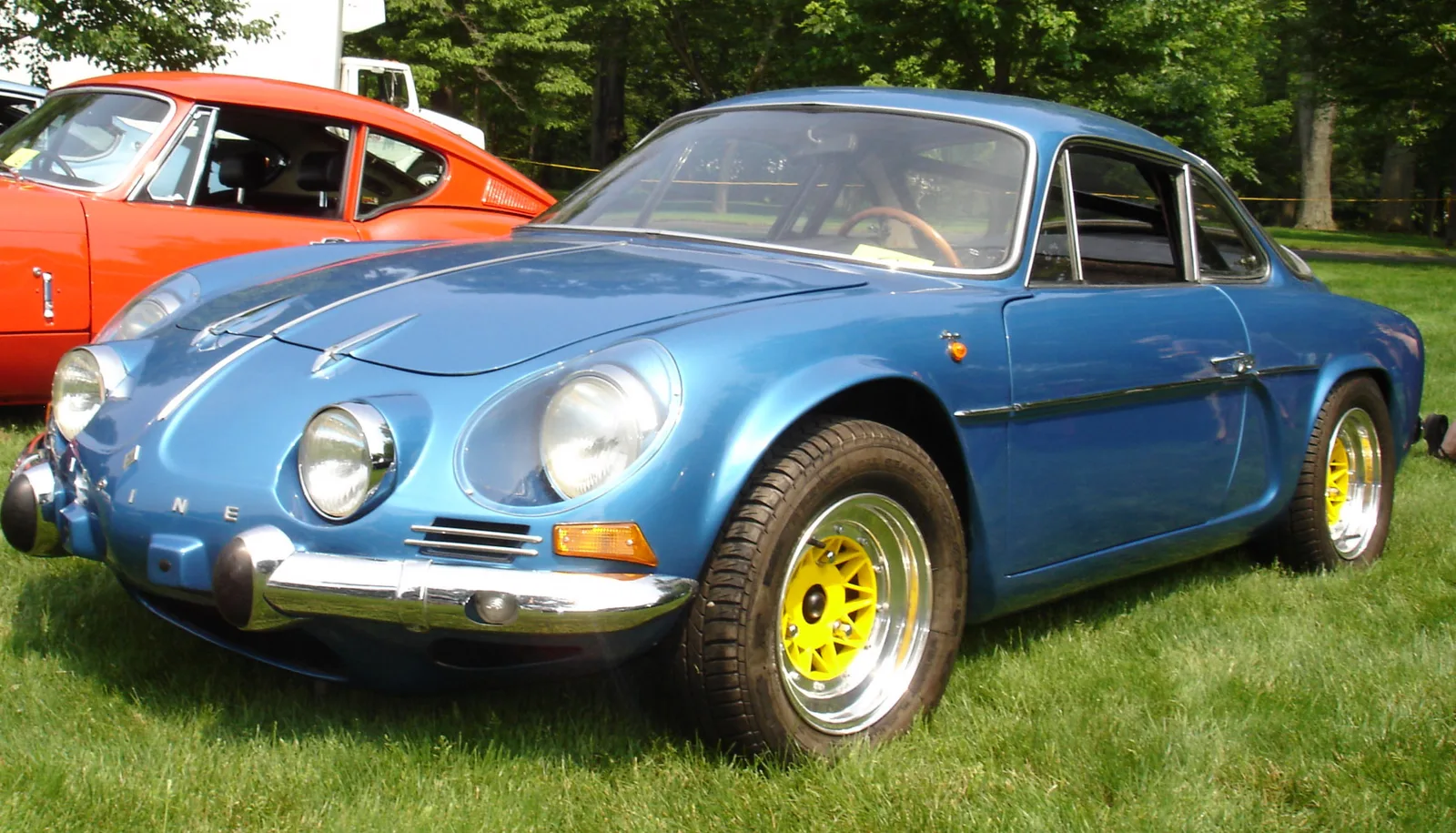
The Brie-Comte-Robert workshop that bodied early Alpines and fibreglass racers, then built its own CG cars until closing in 1974.
Chappe et Gessalin was a French coachbuilder founded in 1932 at Saint-Maur-des-Fosses. It built bodies for Alpine, Deutsch-Bonnet and other makers, and its Automobiles CG arm sold its own cars from 1966. The last CG 1300s left the plant in spring 1974, when the company closed.
Chappe et Gessalin was a French coachbuilder that began in 1932 near Paris and later built complete cars under the CG name. Its work included bodies for Alpine and Deutsch-Bonnet, along with early fibreglass bodies for sports and racing cars.
The firm grew out of a family bodyshop, and its best-known product was the CG range of small convertibles and coupes, built from 1966 to 1974 at Brie-Comte-Robert. Its history runs through rallying, racing and the Simca and Chrysler groups, and it ended with the last cars delivered in spring 1974.
Where did Chappe et Gessalin begin?
The business started in 1932 at Saint-Maur-des-Fosses, when Jean Chappe set up a bodyshop there. He was joined by his three sons, Abel, Albert and Louis, along with an apprentice, Amedee Gessalin. The shop worked in both wood and steel, and the Second World War interrupted its activity before work restarted once hostilities ended.
In 1946 Jean handed the carrosserie to his three sons. By then Amedee had married the eldest Chappe daughter, Marie-Louise, and the business was renamed Carrosserie Chappe Freres et Gessalin. When Amedee died, his son Jean took his place in the company.
Commercial vehicles were part of the mix. The firm was known for firetruck bodies built on Delahaye truck frames, and it also took specialist jobs such as duralumin bodywork for Talbot. It repaired racing cars too, including Delahaye 135 and 136 machines and Talbot T26 racers owned by Charles Pozzi, later a major dealer in Ferrari and Maserati.
Amedee had taught his son Jean to draw and plan vehicles before his death. Jean admired the Parisian designers Chapron and Figoni, and he sharpened his own skills at evening classes run by the two men.
A family bodyshop that worked for Alpine and then built its own CG cars until 1974.
How did the firm get into fibreglass?
In the early 1950s the firm started working with fibre-reinforced plastic. Drawing on American resins and methods, the firm turned out lightweight bodies for sports and racing cars, often for small makers and independent fabricators. Aluminium work continued alongside this new material.
Which early specials did the firm body?
The firm bodied the Bosvin-Michel Speciale, a tubular-steel special with an engine from a Renault 4CV, and the SCVS-DB specials built by Deutsch-Bonnet. The BMS was a regular at Montlhery, where it took Bol d'Or wins in 1952 and 1953. One of the SCVS-DB cars appeared at Le Mans in 1953.
Camille Bosvin designed and built the Bosvin-Michel Speciale, and Guy Michel drove it. The car had a tubular-steel frame and was one of the first to put its engine amidships. Chappe et Gessalin supplied the aluminium bodywork through many revisions of the car.
The SCVS-DB specials carried Renault chassis numbers 1065 and 1066. Renault dealers Jean Redele and Louis Pons began the project, and Deutsch-Bonnet built the cars, with aluminium bodies made by the firm and Renault 4CV power.
Which other makers relied on the firm?
Deutsch-Bonnet became a regular client, and the firm was asked for plastic noses for its Monomil single-seaters as well as bodywork for other racers. It then went on to build 200 copies of the DB Le Mans road car, so the link became a production one.
In 1961 Rene Bonnet and Charles Deutsch parted ways and set up separate companies. Both kept using lightweight fibreglass bodies from the firm. Bonnet turned to it for the bodywork of his new Djet, while Deutsch's Panhard-powered racing CDs were bodied there, and it built 160 Panhard CD road cars.
The firm also worked with Camille Martin's UMAP (1957-1959) and with Raymond Gaillard's Arista. Jean Redele was involved in several automotive projects of the 1950s, including the Marquis and PlastiCar, and he crossed paths with the firm often.
How did the Alpine A106 come about?
Jean Gessalin had sketched a small coupe using Renault 4CV parts as a practice project, then left it behind when he went off for military service. His family turned the drawing into a real car. Renault concessionaire Charles Escoffier saw it and put his son-in-law, Jean Redele, in touch with the firm.
Escoffier's contact led to 25 copies being ordered from Chappe et Gessalin for sale as Alpines. Renault backed the new company and gave the car the number 106. The A106 went on sale in 1955, and the Alpine company was officially born.
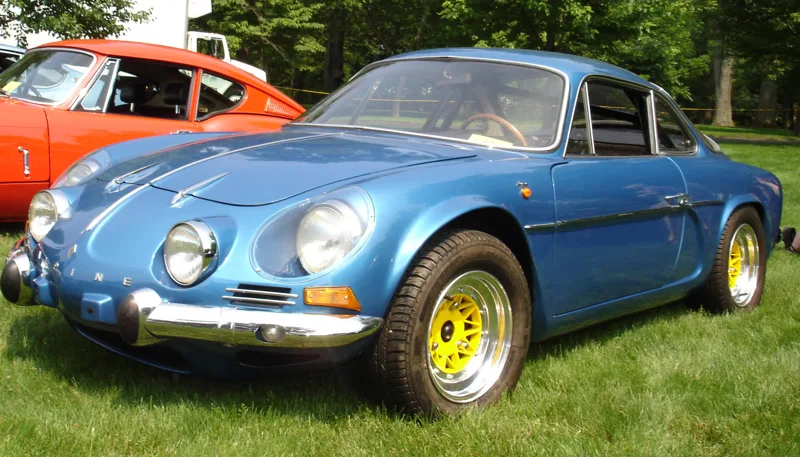
The firm kept building the A106 coupe and then the cabriolet, which Michelotti styled. After 251 copies, the A106 gave way to the A108, and Chappe et Gessalin again built the coupe, along with a new 2+2. Alpine chose to build the A108 cabriolet itself through its own bodyworks, RDL.
In 1960, as A106 production ended, the firm moved its operations to Brie-Comte-Robert, still near Paris. Its staff had grown to around 40 people in the early 1960s, but demand from Alpine was falling as RDL took over most Alpine models. The A110 GT4 2+2 left the firm with bodywork, upholstery and paintwork only, and the final assembly happened at Dieppe, where with CG badges on its flanks.
Why did Chappe et Gessalin build its own cars?
By 1964 management wanted to become an automobile manufacturer in its own right. The new venture took the name Automobiles CG, with CG standing for Chappe et Gessalin. The firm already had the skills for styling, mechanical design and bodywork, but it needed engines, transmissions and other parts from outside suppliers.
Renault was committed to Alpine, and Peugeot along with Citroen and Panhard declined to take part. Automobiles CG therefore turned to Simca and its pool of production mechanical components. The first CG used parts from a wrecked Simca 1000 supplied by the Simca dealer Roger Civet.
What was the CG 1000 Spider?
The CG 1000 Spider was a rear-engined two-door convertible with 2+2 seating and a fibreglass body on a steel chassis. It was shown first at the 1966 Salon de l'Auto in Paris and used powertrain and suspension parts from the Simca 1000. Its 944 cc engine produced 29.4 kW (39.4 hp), and the car weighed 640 kg.
Critics praised its looks and its fit and finish, but the modest output and the price drew complaints. Its design was close enough to Alpine that it shared the exposed hinges of its Dieppe cousin, a family resemblance that followed from Jean Gessalin having drawn the first Alpine.
A high-performance version later appeared. Michel Tapie of Rodez tuned the same engine, lifting its power by 50 percent to 58.9 kW (79.0 hp) for the 1000 Sport. The Sport lost its roll-up windows, bumpers and hubcaps to save money, and it weighed 600 kg.
How did the 1200S and 548 change the range?
The CG 1200S arrived in 1968 with the Simca 1200 S coupe engine. Its 1,204 cc unit gave 59.7 kW (80 hp), double the power of the original Spider, and the car was comparable to the Alpine A110. The car came as a coupe or convertible, and the factory produced just 33 soft-tops.
The 1200S brought servo-assisted dual-circuit brakes, rack-and-pinion steering and anti-roll bars at both ends. A new rear axle allowed a negative camber setup, and the radiator moved to the front behind a larger air opening. The car weighed 660 kg.
The 548 was a lightweight racing special, and its name was its weight in kilograms. Its floor was aluminium, the chassis beams were recessed, and acrylic or plexiglass deflectors took the place of standard glass. An optional Constantin supercharger lifted output to 89.5 kW (120 hp).
What was the CG 1300?
The CG 1300 was the last regular road car, released in 1972 with a 1,294 cc engine from the Simca Rallye 2. It was made only as a coupe and stayed in production for one and a half years, until 1974. Its first output was 61.1 kW (82 hp), with torque reaching 80 ft-lbs.
The 1300 featured a revised lower front valance, with a spoiler and a bigger radiator intake. Its front indicators came from a later Simca 1000, and its taillights were rectangular units from the Simca 1100. The tail had been shortened by 64 mm (2.5 in), and the rear quarters had been reshaped.
What did the CG range look like?
| Model | Years | Engine | Output |
|---|---|---|---|
| CG 1000 Spider | 1966-1969 | 944 cc Simca inline four | 29.4 kW (39.4 hp) |
| CG 1000 Sport | From a year after the Spider | 944 cc, tuned by Michel Tapie | 58.9 kW (79.0 hp) |
| CG 1000S | From 1968 | 1,118 cc | 36.5 kW (49 hp) |
| CG 1200S | 1968-1972 | 1,204 cc, Simca 1200 S | 59.7 kW (80 hp) |
| CG 1300 | 1972-1974 | 1,294 cc, Simca Rallye 2 | 61.1 kW (82 hp) |
What is the story behind the Gallic cockerel emblem?
The first CG cars appeared in 1966, but the official emblem was not designed until 1970. It drew on the Coq Gaulois, a Gallic cockerel motif, and shared a monogram with Chappe et Gessalin. The image also tied in with the firm's address on the Rue du Coq Gaulois in Brie-Comte-Robert.
The designer was Albert Uderzo, best known as the artist behind the Asterix comics.
Why did the firm turn to competition?
The 548 was the first CG made expressly for competition. In April 1969 Henri Chemin, who had earlier worked with William Reiber at Ford France, joined Chrysler to head its competition department. His goals were quick wins in races and rallies, a fresher Simca image among young drivers, and more victories for Matra to add to.
Chemin ran a 1200XS coupe fitted with the 1812 cc Simca Type 180 unit on a string of rallies, but it could not beat the Alpines. Late in 1969 CG agreed to work with the Simca division of Chrysler Europe on a jointly developed car, which became the Simca-CG Proto MC.
What was the Simca-CG Proto MC?
The Proto MC was a mid-engined two-seater with a hybrid monocoque and tubular chassis. It used a Chrysler/Simca Type 180 engine and a Porsche 914 transaxle, and over three seasons it won 32 of the 49 races it entered, with several drivers sharing the seat.
Work began in February 1970. Design was done by the end of May, and track testing was under way by late July. Through Simca's influence, Matra engineer Bernard Boyer, a former CG employee, was assigned to the development team. Early cars used the 1812 cc engine, and later ones had 2156, 2207 and 2310 cc versions of the Type 180.
Bodywork for the first cars came from the existing moulds for the CG 1200S and 548. A few later spiders were shortened by up to 200 mm (7.9 in). One example had a truncated cabin that made it look like a small truck.
The car's maiden race was on 8 August 1970 at Mont-Dore, and it won its first title race at the 1970 Criterium des Cevennes with Gerard Larrousse at the wheel. For 1972 Simca brought in engine specialists JRD to raise displacement and output and cure reliability problems. Drivers included Bernard Fiorentino, Gerard Larrousse, Michel Saliba and Philippe Renaudat.
Simca Chrysler closed its competition department in April 1973, and Matra Sports was left as the sole team still racing sports-prototypes.
Why did Chappe et Gessalin close in 1974?
The 1973 oil crisis brought national speed limits to France and a one-year ban on motor racing. Simca picked Matra's Bagheera to replace the 1200S, which ended any hope that CG could raise its profile inside Simca. The last CG 1300s were delivered in spring 1974, after which the small Brie-Comte-Robert company closed for good.
What happened to the CG name afterwards?
After the closure, Jean-Michel Ribot-Bruno's Geriplast company in Coulommiers took over after-sales service and repair for CG bodywork. Its equipment and moulds were transferred at the end of 1974. Geriplast used them to make GERIPLAST barquettes, modified CG spiders, and later GERI barquettes and single-seaters, developed with Michel Bonenfant.
Many non-MC CGs stayed active in historic racing. Some were called CG 1600s, but those were probably custom engine swaps rather than factory cars.
In 2012 Didier Malga started CG Sport, a competition group that Jean Gessalin approved and Bernard Chappe backed, aiming to bring the brand back to racing. A 50th anniversary retrospective was held at the Cite de l'Automobile in 2016.