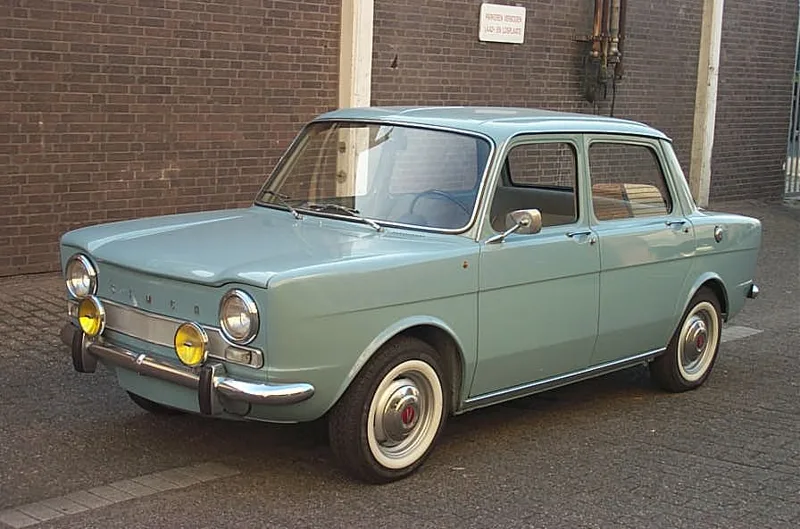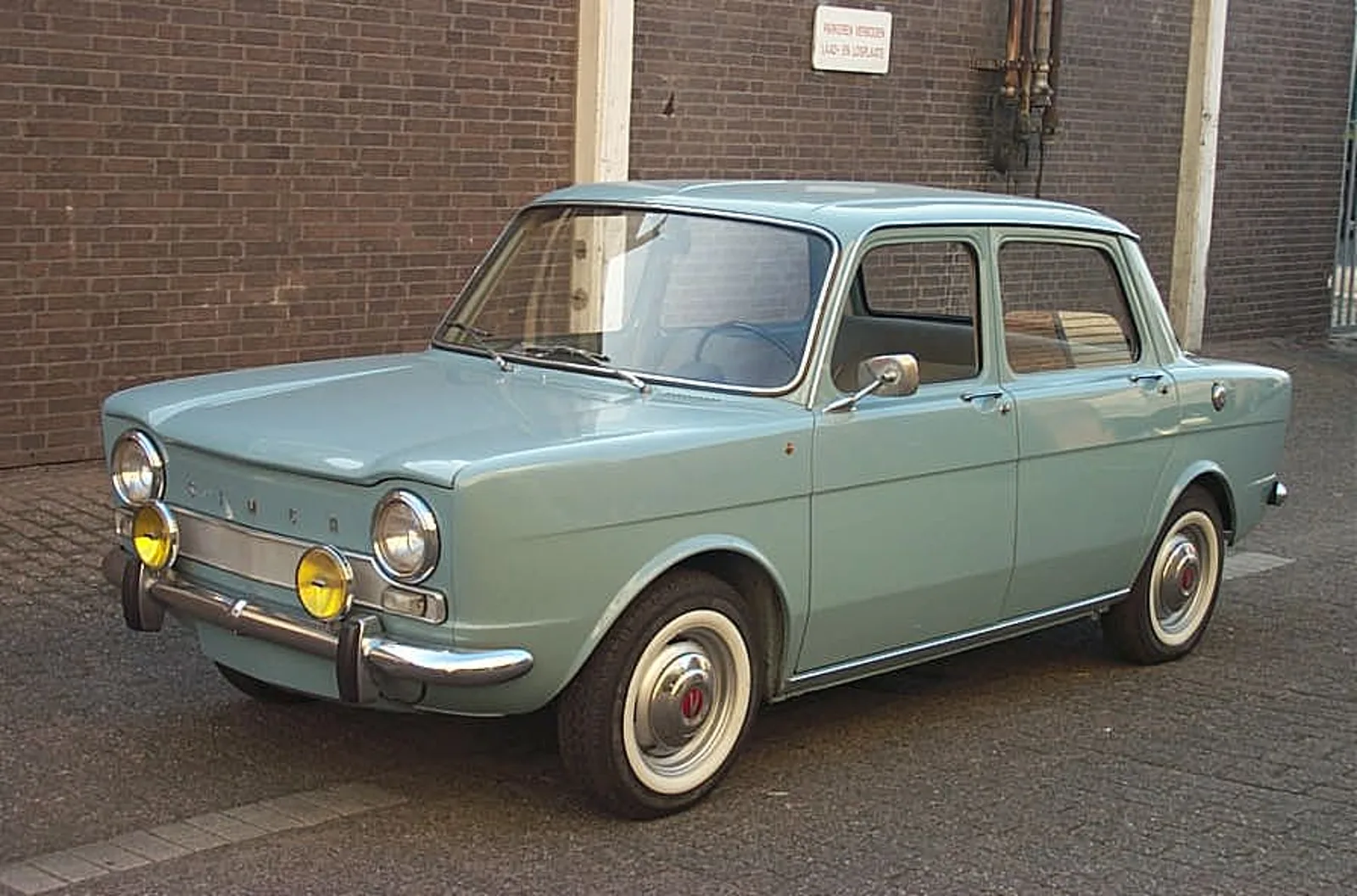
Launched in 1961 with Fiat roots and a rear-mounted engine, the Simca 1000 sold almost two million cars before production ended in 1978.
Developed with Fiat involvement, the Simca 1000 was a small car with its engine at the back, first built in 1961. Simca kept it on sale until 1978 and sold almost two million, with Rallye and Abarth versions adding a sporting edge.
The Simca 1000, or Simca Mille as it was known in French, was a small, boxy, rear-engined four-door saloon built by the French maker Simca from 1961 to 1978. Its origins lay in Italy as much as France, because the design was developed through close links with Fiat. It became one of the best-selling small cars in France, and it sold almost two million cars in 17 years.
Where did the Simca 1000 come from?
The origins of the Simca 1000 lie in Turin rather than Paris, and in French the car was known as the Simca Mille. Pigozzi, Simca's president, was a Turin native whose friendship with Agnelli dated from 1922 until the founder died in 1945. Fiat remained Simca's dominant shareholder until 1963, and Pigozzi visited the Fiat operation regularly. That closeness meant Simca had early access to the thinking inside Fiat's development department, which was still headed by the designer-engineer Dante Giacosa.
Fiat's own plans shaped the car. Its Project 122 was a more radically differentiated four-door successor to the Fiat 600, and Pigozzi persuaded Fiat's directors to let Simca develop one of six boxy clay models from that project as its new small car.
The styling was handled by Mario Revelli de Beaumont, the head of Simca's styling department. He had transferred from General Motors in 1955, and he split his time between Fiat's Industrial Design Centre in Turin and Simca's Styling Centre at Poissy.
Felice Mario Boano, also at Fiat, worked with Revelli de Beaumont from 1959 to 1961 to bring the car to production readiness. The basic architecture and boxy shape had been right from the start, and the 1961 car is recognisably the model Pigozzi had chosen.
A small rear-engined Simca with Fiat roots that sold nearly two million cars and ended with a 103 PS rally variant.
How did the 1000 launch and sell?
Production began on 27 July 1961, and the car was unveiled at the Paris Motor Show on 10 October 1961. Simca presented it with a high-profile publicity campaign, and Pigozzi placed great stress on the car as a landmark for an increasingly independent Simca.
The Fiat collaboration was less visible at the launch, and Simca presented the car as its own achievement. Pigozzi's marketing emphasised the new Development Department at Poissy, which was a significant step for a company that had depended on its Italian partner. The 1000 was the product of close work with Simca's majority shareholder, and that link was not the centrepiece of the marketing.
The launch was also helped by an unusual move. Simca had bought a Paris taxi business in 1958, and in November 1961 it replaced 50 of that company's Simca Ariane taxis with 50 of the much smaller 1000s. Pictures of the little taxis turned up in the press, but the change was not permanent.
The 1000 sold strongly from its first full year. In 1962 Simca produced 154,282 cars, which was impressive because the company had no recent experience of selling small cars. Most buyers had to be lured from rival makers, which made the figure more remarkable still.
What was the rear-engined layout like?
The 1000 used the rear-engined layout, a first for Simca, although leading makers in France and Germany had used it on mainstream small cars for more than a decade. The fuel tank sat behind the rear passenger seat, which gave the car a weight distribution of 35/65 front to rear.
That split gave the car a light and nimble front end, along with a responsive oversteer on curvy roads. The interior was considered surprisingly spacious for the class and had room for four, although the luggage space under the bonnet was limited. High-specification versions offered in the British market came with a walnut dashboard, which set them apart from the plainer French cars.
Simca stowed the spare wheel vertically in the front luggage compartment, just behind the front bumper. Unlike the Renault Dauphine and Renault 8, the spare did not lie flat, which reduced the luggage space further.
The driver had an excellent view out of the car. The speedometer pod was basic, but the glass covering it was angled to minimise reflections, which made it easier to read.
How did the 1000's engine develop?
The Poissy engine was a new water-cooled inline-four of 944 cc at launch. In 1963 the 900 arrived as a cheaper variant with the same 944 cc unit, producing 36 PS (26 kW), and the 1000 gained a few extra horsepower over it.
In 1966 only the 900C remained, with the more powerful version of the Type 315 engine. In October 1968 the low-cost Simca 4 CV, also sold in France as the Sim'4, appeared with a 777 cc engine producing 31 PS (23 kW), and it became a popular basis for Rallye replicas.
The 1000 engine was updated at the same time as the 4 CV and renamed the type 349. For 1969 an 1118 cc engine from the larger Simca 1100 was added at the top of the range, and that car was marketed in the US as the Simca 1118. The engine grew again to 1294 cc in 1971, and that unit was fitted to the 1000 in 1972.
A three-speed semiautomatic transmission developed by Ferodo could be fitted in some versions, alongside the standard manual gearbox.
Which later engines did the 1000 use?
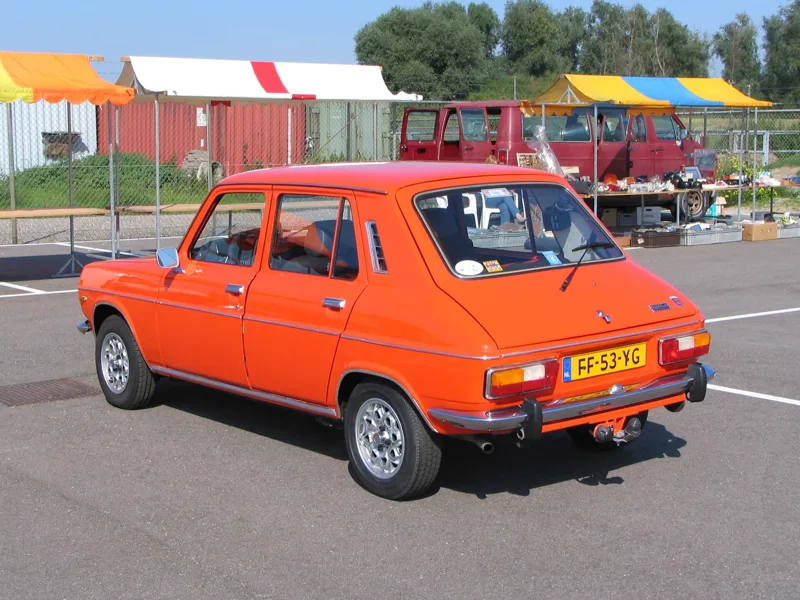
The car received a light facelift at the 1968 Paris Motor Show, for the 1969 model year. It brought new hubcaps, redesigned bumpers, bigger headlamps and square taillights.
In 1977 the model was revised for the last time and given the names 1005 and 1006, depending on specification, to match the newer Simca 1307 and its derivatives. The 1005 and 1006 were identified by their rectangular headlights.
The Spanish 1000 GT, introduced in April 1970, made 61 PS (45 kW) from a milder version of the 1204 cc engine used in the 1200 Coupe. The Spanish 1000 Rallye GT followed in 1971 with twin carburettors and 74 PS (54 kW) SAE.
How did the Rallye and Abarth models compete?
The Rallye name carried on into a sporting Spanish model that wore the 1000 Rallye GT badge, and the Rallye line grew from there. In the model's early years the Italian tuner Abarth offered modified versions of the 1000, and Simca later started its own Rallye version, and the line grew in steps. That helped boost the car's popularity in the motorsport community, and after the first Rallye came the Rallye 1, the Rallye 2 and the Rallye 3, each one a step on from the last.
The Simca-Abarth 1150 used a 1137 cc engine producing 55 PS (40 kW), and the 1150 S made 58 PS (43 kW). The 1150 SS produced 65 PS (48 kW), and an option gave it a six-speed gearbox. These cars carried disc brakes.
The swan song of the Simca 1000 in this series was the Rallye 3, which made 103 PS (76 kW). Only 1,000 were produced in its final year, 1978, before production ended.
Where else was the 1000 built?
In Spain the 1000 was built by Barreiros Diesel from late 1965, and that company later changed its name to Chrysler Espana. Early cars carried a chrome Barreiros script, and the Spanish range included the low-specification 900 with 844 cc.
Cars with engines below 850 cc received a sizable tax break in Spain, which made the 900 an attractive choice there. Spanish production ended in May 1977, and the Spanish-built Rallye arrived only in 1976. The Spanish 900 Special of 1973 used twin carburettors and produced 43 PS (32 kW), while the 1000 Rallye of 1976 used a single-carburettor 1294 cc engine with 63 PS (46 kW) and lacked disc brakes on all four wheels.
Spain also had its own 1000 GT, and the Spanish models always differed in equipment from the French cars. Chrysler Espana took over the Barreiros business in 1970, which ended the Barreiros name on the cars.
Spanish-built CKD kits went to Colombia as well. Chrysler Colmotores assembled the car there from 1969 to 1977, and it too found work as a taxi.
How well did the 1000 sell?
The 1000 became a popular car in France, and to some extent in export markets. Annual sales in France stayed above 100,000 from the early 1960s until 1974, which put the car well up the rankings for most of its life.
Its main French rivals were the Renault Dauphine, which sold 266,767 examples in 1962, and the Citroen Ami, which managed 85,358 units in the same year. The 1000 finished the year well ahead of the Ami and within reach of the Dauphine.
South Africa received the car by June 1963, selling it alongside Chrysler, Dodge and Plymouth models. In the United States the 1000 sedan went on sale for the 1963 model year, and the coupe followed in 1965.
In 17 years of production almost two million Simca 1000s were sold. That total made it one of the most successful small cars Simca ever built.
Cultural legacy
The Spanish pop-rock band Los Inhumanos recorded a song about the car's cramped interior, which was included on the 1988 album 30 hombres solos. The song joked that intimacy in a Simca 1000 was almost impossible because of the limited space.
The car's compact dimensions and boxy shape made it a familiar sight on Paris streets, and the taxi trial helped cement that image in the public mind.
Simca 1000 specification by variant
| Variant | Years | Engine | Power |
|---|---|---|---|
| Simca 1000 (launch) | 1961 to 1968 | 944 cc inline-four | Type 315 engine |
| Simca 900 | 1963 onward | 944 cc inline-four | 36 PS (26 kW) |
| Sim'4 (4 CV) | 1968 onward | 777 cc | 31 PS (23 kW) |
| Simca 1118 (US name) | 1969 onward | 1118 cc | Engine from the Simca 1100 |
| Simca-Abarth 1150 SS | Mid-1960s | 1137 cc | 65 PS (48 kW) |
| Simca 1000 Rallye 3 | To 1978 | Rallye engine | 103 PS (76 kW) |