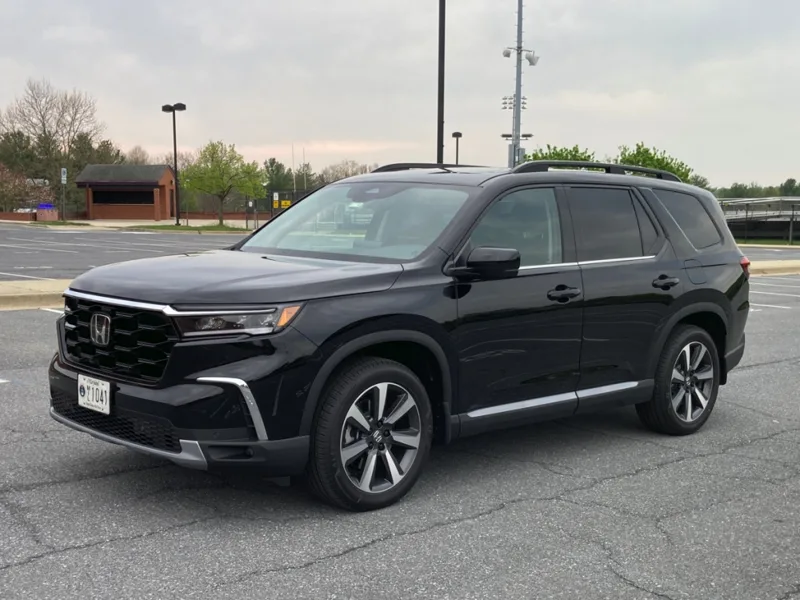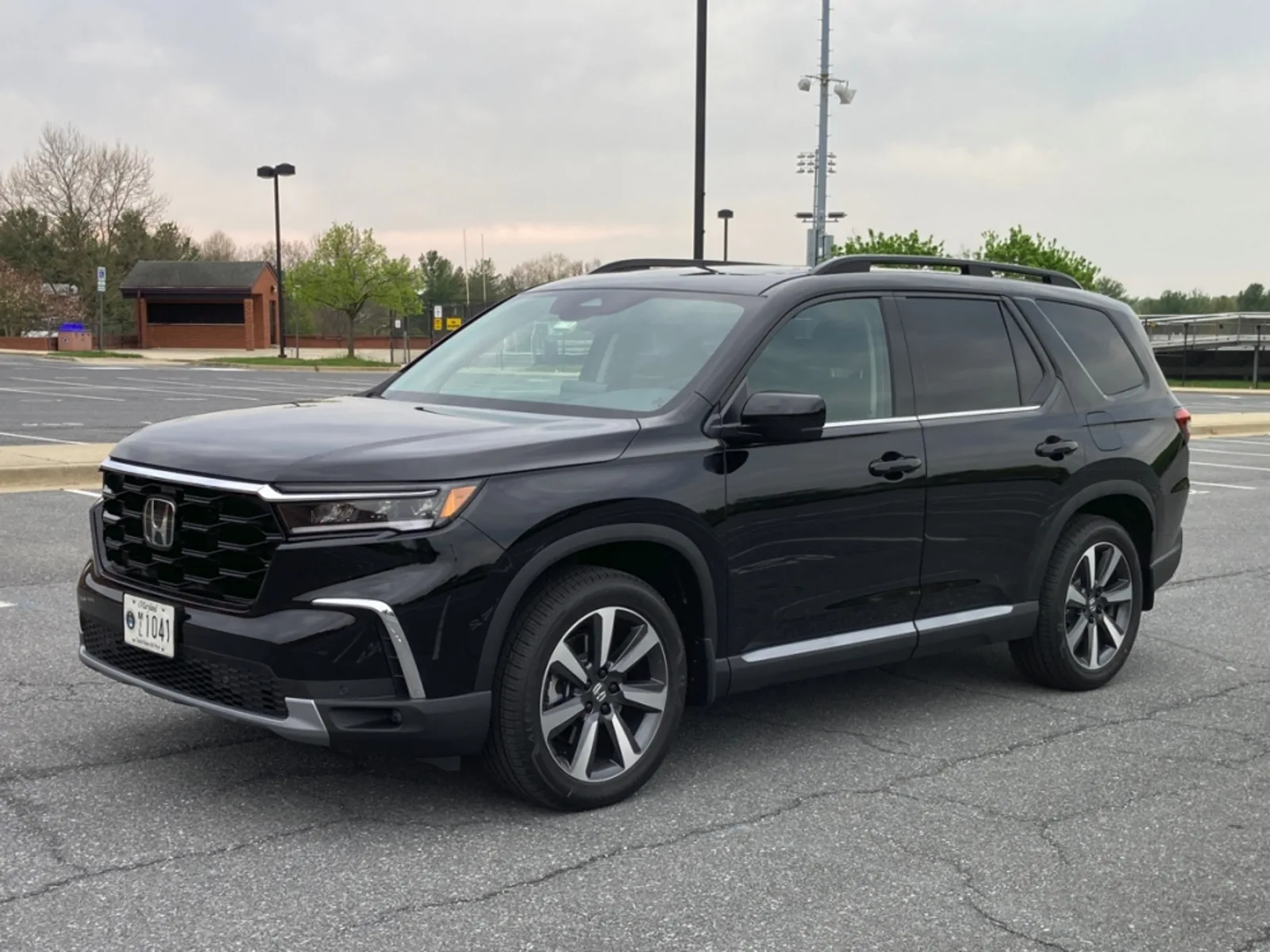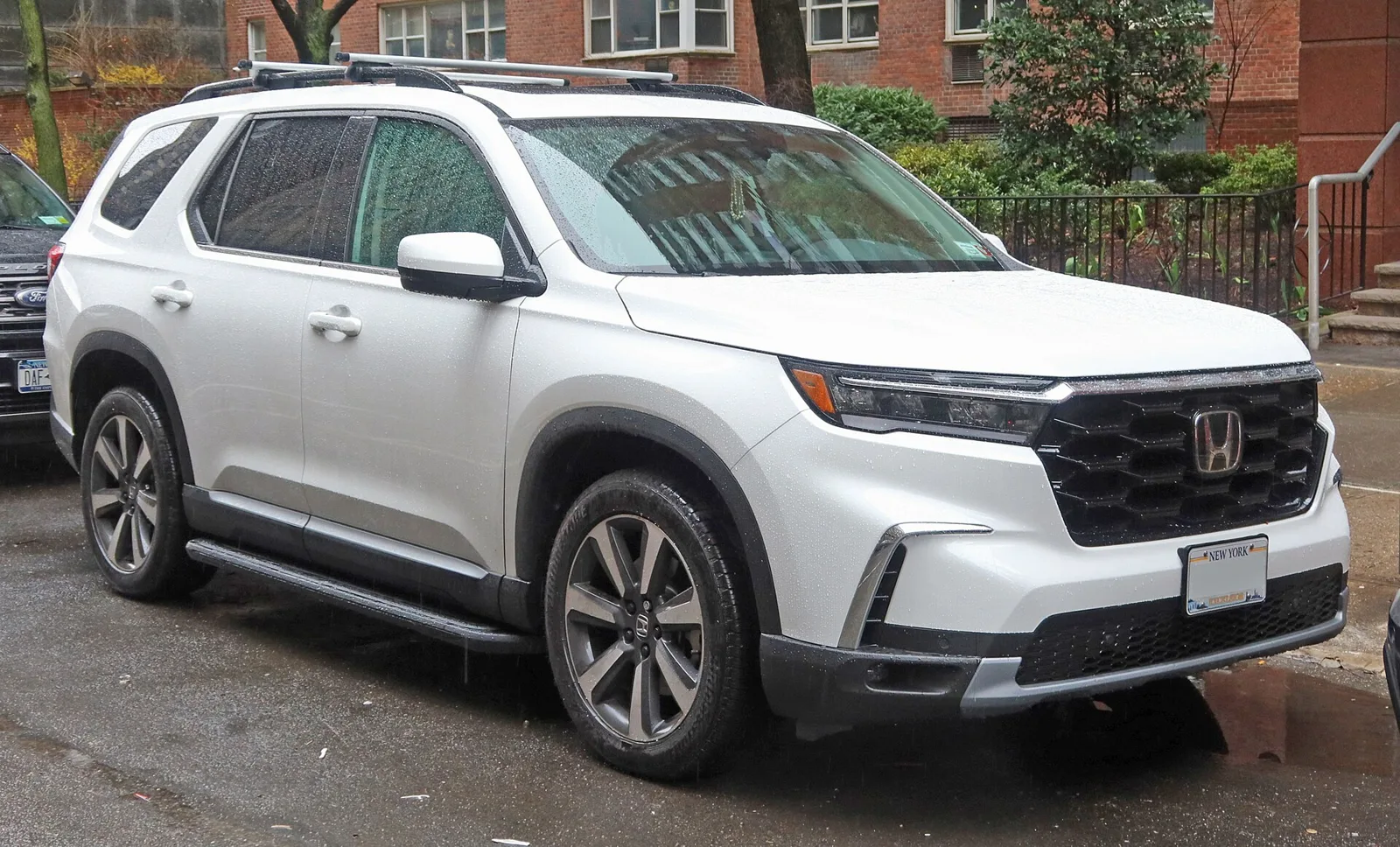
From a unibody Accord-family platform in 2002 to a 2026 facelift, the Pilot grew into Honda's largest SUV with eight seats and a V6 at its core.
The Honda Pilot is a mid-size three-row crossover built by Honda since 2002 for the 2003 model year. It shares its platform with the Acura MDX and the Odyssey, and it has moved through four generations, with a 3.5 L V6 in every version and eight seats as standard.
The Honda Pilot is a mid-size crossover SUV with three rows of seating, built by Honda since the 2003 model year. It is the largest SUV Honda makes for the North American market, and it shares its underpinnings with the Acura MDX and the Odyssey minivan. Four generations have followed the original, most recently a 2026 facelift.
Where did the Pilot fit in Honda's range?
Before the Pilot arrived, Honda sold the compact CR-V and the midsize MDX, along with the Passport, which was a rebadged Isuzu Rodeo, the Crossroad, which was a rebadged Land Rover Discovery, and the Acura SLX, a rebadged Isuzu Trooper. Those truck-based models used body-on-frame designs, while the Pilot used a unibody layout closer to the MDX.
The Pilot became Honda's largest SUV, although the 2010 Crosstour later outran it in length. Honda also sold a first-generation Acura MDX in Japan and Australia for several years, and the second-generation Pilot found buyers in Russia, Ukraine, South Korea, Latin America and the Philippines.
Honda's three-row SUV grew from a unibody crossover into an eight-seat family vehicle with four generations behind it.
How did the first-generation Pilot ride and handle?
The first-generation Pilot was unveiled in December 2001 and went on sale on June 3, 2002 as a 2003 model. Its unibody construction and independent suspension were designed to handle like a car, and integrated perimeter frame rails gave it the ability to tow and cope with light off-road use.
Front struts with coil springs were combined with a multilink rear suspension, which kept the rear load floor flat. Honda's VTM-4 four-wheel drive was fitted to the early cars. It sent most power to the front wheels in normal driving and could push up to 50 percent to the rear under acceleration or wheel slip.
- VTM-4 lock button: locked the rear differential and sent 25 percent to each rear wheel
- VTM-4 lock: worked only in first, second and reverse, and disengaged above 29 km/h (18 mph)
- Towing rating: 2,041 kg (4,500 lb) for a boat, or 1,588 kg (3,500 lb) for a trailer with the dealer towing package
- Seating: eight passengers in three rows, with the third row best for small children
What engines did the Pilot use?
The 2003 and 2004 models used the J35A4, an all-aluminium 3.5 L SOHC V6 with VTEC, producing 240 hp (179 kW) and 328 N m (242 lb-ft) of torque. For 2005 the J35A6 added drive-by-wire throttle and produced 255 hp (190 kW) with 339 N m (250 lb-ft). The fuel tank was also redesigned, extending the driving range by more than 64 km (40 miles).
For 2006 the engines became the J35Z1 for front-wheel drive and the J35A9 for four-wheel drive. Both were rated 244 hp (182 kW) with 325 N m (240 lb-ft) of torque, which was lower on paper because Honda had moved to the updated SAE net power standard. Front-wheel drive versions gained Variable Cylinder Management, which could shut down up to three cylinders at light load.
What changed in the second generation?
A prototype of the bigger second generation was shown in January 2008 at the North American International Auto Show, and production cars went on sale on May 22, 2008. It was assembled at Honda Manufacturing of Alabama in Lincoln, Alabama, and was offered in LX, EX, EX-L, Touring and, for 2015, SE trims.
All second-generation Pilots used the J35Z4 3.5-litre V6, with 186 kW (250 hp; 253 PS) and 343 N m (253 lb-ft) of torque. Both drivetrains used five-speed automatics. The wheelbase was 2,774 mm (109.2 in), the length 4,849 mm (190.9 in) and the width 1,994 mm (78.5 in). The truck-like styling drew on the full-size Chevrolet Tahoe and GMC Yukon, and the car competed with the Toyota 4Runner.
- 2011: voice-activated navigation extended to EX-L, rear entertainment standard on Touring
- 2012: redesigned front fascia, new alloy wheels and i-MID with integrated backup camera on EX-L
- 2013: standard rearview backup camera on LX and EX, 8-inch LCD screen, Bluetooth and tri-zone climate control
- 2015: SE special edition with power moonroof, satellite radio and LED headlights on Touring
How did the third generation shrink and sharpen?
The third-generation Pilot debuted at the Chicago Auto Show in February 2015, with production beginning in May and sales starting on June 18, 2015. The body was sleeker and 10 percent lower in drag area, and the car was about 140 kg (300 lb) lighter despite a more spacious interior modelled on the Odyssey.
The revised 3.5 L V6 had direct injection and produced 209 kW (280 hp; 284 PS). Front-wheel drive models were fitted with a six-speed automatic on the LX, EX and EX-L, and a ZF nine-speed on the Touring and Elite. Fuel economy for front-wheel drive six-speed models was 12 L/100 km (19 mpg-US) city and 8.7 L/100 km (27 mpg-US) highway. Ultra-high-strength steel made up 21.3 percent of the body.
Which safety features did the Pilot gain?
Later third-generation cars gained LaneWatch, a passenger-side camera, along with Blind Spot Information and a rear Cross Traffic Monitor. Honda Sensing packages added forward collision warning with collision mitigation braking, lane departure warning, road departure mitigation and adaptive cruise control. A tri-angle backup camera became standard, with dynamic guidelines as an option.
From 2019, Honda Sensing became standard on every trim. The Insurance Institute for Highway Safety reported that the Pilot's driver death rate was 2 deaths per million registered vehicles, which placed the model among the ten lowest in its report. The 2023 Pilot later earned Top Safety Pick+.
How did the fourth generation and the 2026 facelift change it?
The fourth-generation Pilot made its debut on November 7, 2022 and went on sale on December 12, 2022 as a 2023 model. It used a DOHC 3.5-litre J35Y8 V6 rated 285 hp (213 kW; 289 PS), with 355 N m (262 lb-ft) of peak torque, paired with a ten-speed automatic that replaced the ZF nine-speed.
The 2026 refresh was unveiled on November 18, 2025. It brought a redesigned front fascia with a larger grille, a 10.2-inch digital instrument cluster that was 43 percent larger than before, and a 12.3-inch touchscreen that was 37 percent larger. Wireless Android Auto and Apple CarPlay were added, along with extra insulation to cut engine, road and wind noise.
What trims and special editions are available?
- 2019: hands-free tailgate and new steering wheel from the Odyssey
- 2020: Black Edition trim added to the lineup
- 2021: 9-speed transmission standard on all trims, and a Special Edition between EX-L and Touring
- 2022: entry-level Sport trim and TrailSport trim, with a 15.2 mm (0.6 in) lift
- 2025: Black Edition returned with 20-inch alloy wheels, red trim and LED ambient lighting
- 2026: TrailSport gained a panoramic moonroof, brown leather and a 360-degree camera
How much of the third-generation Pilot was high-strength steel?
The third-generation Pilot mixed steel grades according to where strength and cost mattered most. Ultra-high-strength steels of 980, 1,300 and 1,500 MPa made up 21.3 percent of the body, while aluminium or magnesium accounted for 5 percent of the structure.
The remaining 34.5 percent was 270 MPa mild steel, placed in areas where repairs would cost less. The lighter structure helped the car lose about 140 kg (300 lb) against its predecessor, and extra insulation reduced engine, road and wind noise.
How did the Pilot's cabin technology change over time?
Early Pilots offered a DVD entertainment system or navigation, but not both on the same car. Later models added a backup camera, an 8-inch LCD screen, a 4G LTE hotspot and CabinTalk, and Honda Sensing became standard across the range from 2019.
The 2019 refresh brought a new gauge cluster similar to the Odyssey, the HondaLink software and a hands-free tailgate. The 2026 facelift went further, adding a larger digital cluster and touchscreen, plus wireless Apple CarPlay and Android Auto.
How did the Pilot's engine and gearbox evolve across generations?
The Pilot's V6 has been the constant. The first generation used a 3.5 L V6 with VTEC rated at 240 hp (179 kW), and by the third generation the revised V6 used direct injection, lifting output to 280 hp.
Transmissions followed a similar path. The early models used a five-speed automatic, the third generation used a six-speed on the base trims and a nine-speed on the upper ones, and the fourth generation moved to a ten-speed automatic.
How did the Pilot compare with its Honda relatives?
The Pilot sits alongside two relatives in the Honda line-up, its MDX-based cousin and the Odyssey minivan. Anyone who has driven either will find its dimensions and layout familiar.
Honda positioned the Pilot as its largest SUV, with eight seats in three rows as standard. Stadium-style seating and a flat load floor when the rear seats fold made it a practical choice for larger families, while the Odyssey remained the more van-like option of the group.
Specifications at a glance
| Specification | Detail |
|---|---|
| First generation launch | Released April 2002 as a 2003 model |
| Second generation wheelbase | 2,774 mm (109.2 in) |
| Second generation length | 4,849 mm (190.9 in) |
| Third generation output | 209 kW (280 hp; 284 PS) |
| Fourth generation output | 213 kW (285 hp; 289 PS), 355 N m (262 lb-ft) |
| Towing (2003 to 2005 era) | 2,041 kg (4,500 lb) boat; 1,588 kg (3,500 lb) trailer |
| Seating | Eight in three rows as standard |