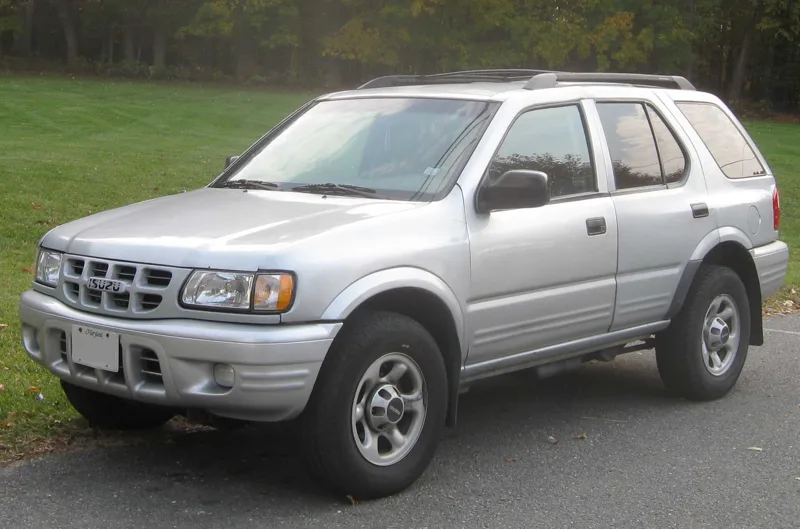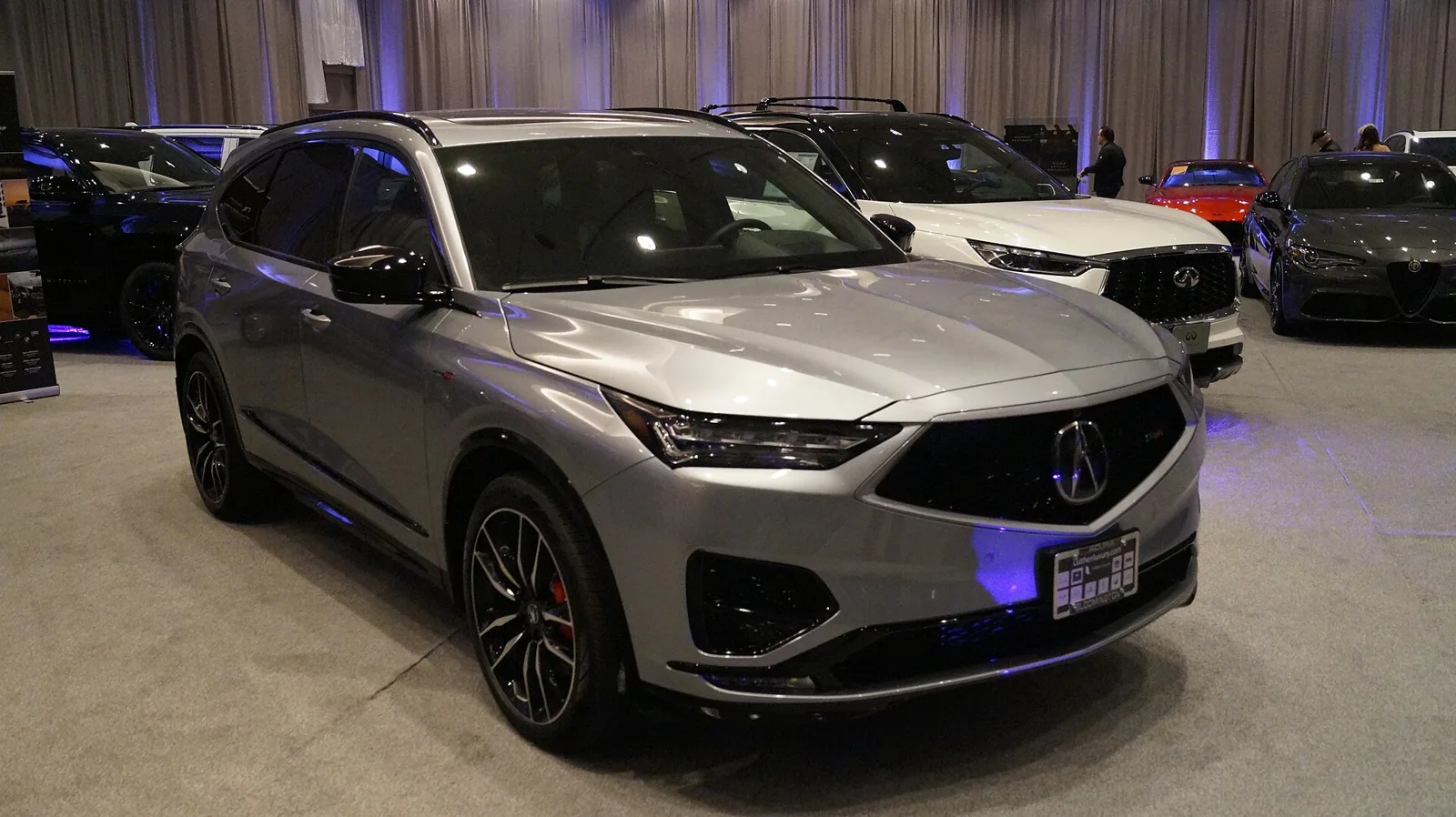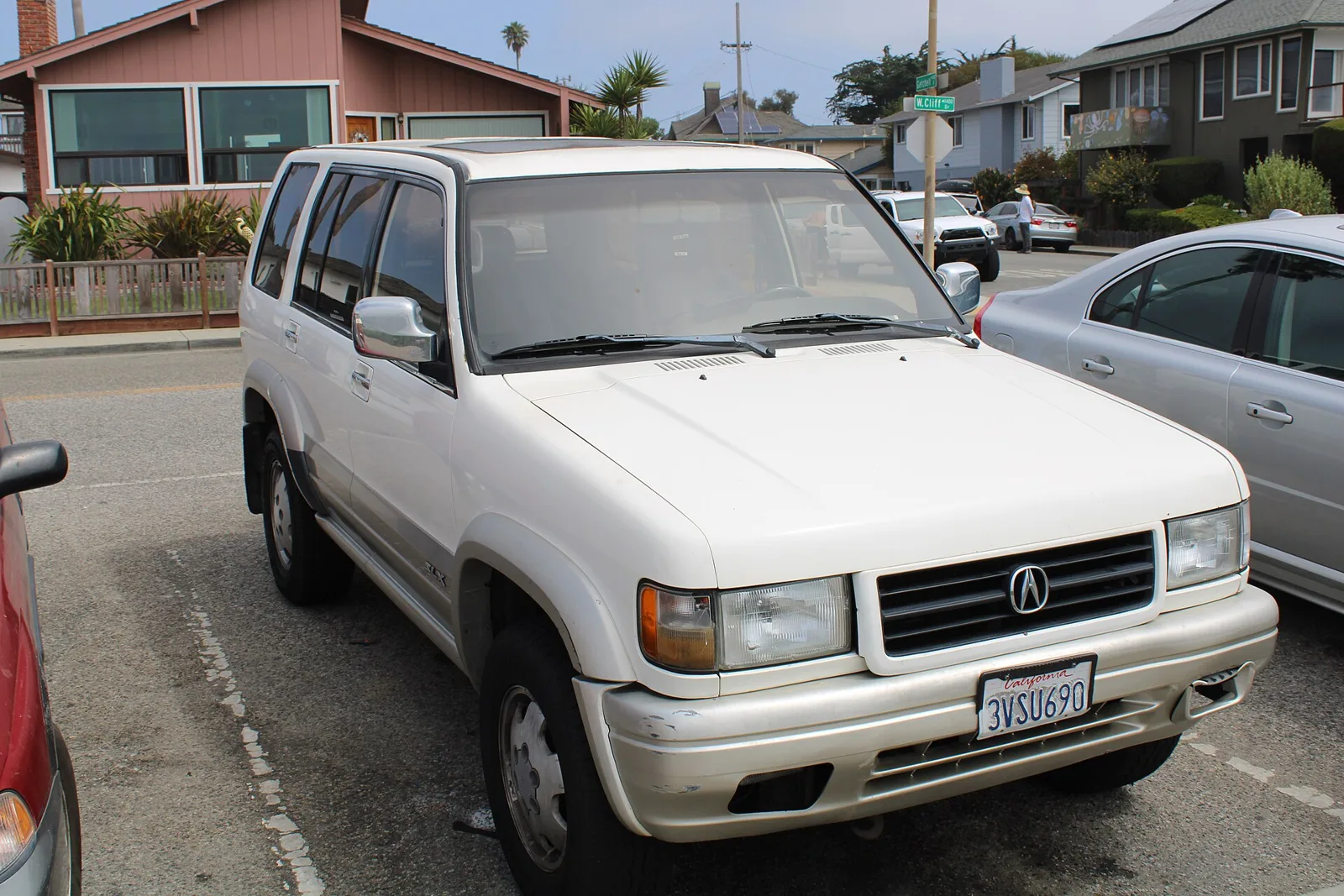
A rebadged Isuzu Trooper sold by Acura from 1995 to 1999, part of a two-generation SUV that Isuzu built for more than two decades.
The Acura SLX was a lightly upgraded, rebadged Isuzu Trooper sold by Acura, the luxury division of Honda, in the United States from 1995 to 1999. It was built on the Trooper's platform and replaced by the Acura MDX in 2001.
The Acura SLX was Honda's luxury badge on an Isuzu sport utility, sold only in the United States. Its real story belongs to the Trooper family, which Isuzu built for more than two decades in several markets under a range of names.
Where did the Trooper come from?
Isuzu built and sold the Trooper, a mid-size SUV, from September 1981 until September 2002. The first generation covered the years to 1991, and the UBS series that followed ran until 2002 with a refresh in 1998.
Early examples shared their underpinnings with the Isuzu Faster and the Chevrolet LUV pickup. Japanese buyers knew the vehicle as the Isuzu Bighorn, while export markets mostly called it the Trooper.
American tax rules shaped the first two-door. A 25% Chicken Tax applied to two-door trucks, so Isuzu sold that version under the Trooper II name and kept the name when a four-door joined the range.
A rebadged Isuzu that Honda's luxury division sold for four model years, then lost to a rollover row and a court case.
What did the first generation look like?
The first Trooper launched in 1981 in two body styles, a three-door wagon and a soft-top, and both used independent front suspension. Few buyers chose the soft-top, which left the range quickly.
A five-door body arrived in 1983, and rectangular headlights came in 1987 together with an LS trim for the five-door. The vehicle weighed roughly 3,700 lb (1,678 kg) when empty, which made its early engines feel weak.
For a single year, 1989, a 90-inch wheelbase two-door reached the US as the Trooper RS. Those cars ran a 2.6-litre fuel-injected inline four, 4.77:1 differential gears and 15x7-inch aluminium snowflake wheels, with a choice of automatic or manual gearbox.
Other markets saw different takes on the design. Central American cars could be fitted with removable roofs and extra ground clearance, while Venezuelan cars were built locally and sold as the Caribe 442 to satisfy import limits.
Which engines did the first generation use?
Launch engines were a 1.95-litre petrol unit and a 2.2-litre diesel making 73 PS (54 kW). Both struggled for pace in a vehicle of that weight, and Isuzu spent the decade working on the range.
A 2.3-litre petrol engine, the 4ZD1, arrived in 1983 with 97 PS (71 kW; 96 hp). Its updates included a Kevlar timing belt in place of a chain and a bigger two-barrel carburettor. The turbocharged C223T diesel, good for 87 PS (64 kW), was offered in the US for a single model year, 1986.
By 1988 the 4ZD1 had climbed to 110 hp, and the US market gained a fuel-injected 2.6-litre 4ZE1 rated at 120 hp (89 kW). A General Motors 2.8-litre pushrod V6 became optional in 1989, and turbocharged 2.8-litre engines started at 95 PS (70 kW) before intercooling lifted them to 115 PS (85 kW).
What changed with the second generation?
Isuzu overhauled the Trooper at the end of 1991, ready for the 1992 model year, making it bigger, stronger and plusher. The long-wheelbase five-door came first, with a three-door following in March 1992, and the heavier cars weighed 4,155 lb (1,885 kg).
Petrol buyers could choose a 3.2-litre SOHC engine with 177 PS (130 kW; 175 hp), or a DOHC version of the same capacity with 193 PS (142 kW; 190 hp). From 1996 a SOHC 3.2-litre with that 193 PS output replaced the DOHC in some export markets.
The UBS range also had a 3.1-litre turbodiesel inline four, the 4JG2. Its output was 112 hp (84 kW; 114 PS), reached at 3,600 rpm, and torque peaked at 192 lb ft (260 N m) by 2,000 rpm, which suited owners who towed. After 1998 a 3.0-litre 4JX1 diesel replaced it, and a four-speed automatic joined the five-speed manual.
The 1998 Australasian and American-specification Troopers received the 3.5-litre DOHC engine from the Rodeo, with 160 kW (215 hp; 218 PS). That year also brought a facelift, with a new grille, bumper, headlamps and front wings, plus a body-coloured cover for the spare.
How was the second generation driven and loaded?
Most second-generation cars used part-time four-wheel drive, which meant stopping the vehicle before the front axle could be engaged or released. From the 1996 model year some Troopers gained a shift-on-the-fly system that avoided that step.
The 1998 update also introduced a Borg-Warner torque-on-demand all-wheel drive system. Underneath, a torsion-bar front suspension sat beside a multilink rear with coil springs, tied into a solid rear axle.
Buyers chose from a five-speed manual, the Aisin AR5 gearbox and the 4L30E, an electronically controlled four-speed automatic. That automatic offered a power mode for sharper shifts and a winter setting that allowed third-gear starts, and the 2000 to 2002 cars added a hill-descent aid called Grade Logic.
Customers in the US were offered five seats, while a seven-seat layout was sold elsewhere. A rear limited-slip differential could be specified on any model. The LS and S versions provided 117.8 cu ft (3,340 L) of load space, against 112.3 cu ft (3,180 L) for the Limited.
How did the Acura SLX come about?
In the early nineties General Motors, Isuzu and Honda built a working relationship that spread the Trooper across several badges. In Japan it became the Honda Horizon from 1994 to 1999, and in the United States it became the Acura SLX from 1996 to 1999.
Acura, the luxury division of Honda, sold the SLX from 1995 to 1999, although the models carried 1996 to 1999 year labels. It was a lightly upgraded, rebadged Trooper, and the Acura MDX took over its place in 2001.
The SLX dropped some Trooper options, notably the manual gearbox and a few engines. Its 1996 and 1997 cars came only with a 3.2-litre V6 in SOHC or DOHC form, and the 1998 model moved to a new 3.5-litre DOHC V6 alongside a restyled nose.
Autotrader listed the SLX's base entry price at 36,300 dollars and gave it a 3-star safety rating for the driver and front passenger. Sales remained weak, and the car was dropped after the 1999 season.
Why did the rollover controversy matter?
The second generation came under fire in the US when Consumer Reports labelled the 1995 to 1997 models Not Acceptable, on the grounds that they tended to roll over during its tests. Isuzu argued that the verdict damaged sales.
Consumers Union, the magazine's publisher, petitioned for a federal look. The National Highway Traffic Safety Administration tested the vehicle itself and found nothing that would justify a recall.
Isuzu went to court and sought $242 million from Consumers Union, claiming the magazine had turned the steering wheel further than any driver could in a sudden emergency. The judge, Richard Paez, required clear and convincing evidence of wrongdoing, because Isuzu had mounted a public campaign against the report.
The jury found that eight of the 17 statements Isuzu disputed were false, and that one of them showed reckless disregard for the truth. Isuzu won no damages, and the court ordered it to cover Consumers Union's defence costs, though not attorney fees. Isuzu put the total cost of the dispute at $244 million.
Which other brands sold the Trooper?
In Indonesia a local plant, PT Garmak Motors, assembled the car as the Chevrolet Trooper, and a two-wheel-drive Chevrolet Stallion followed around 1987. The Chevrolet Trooper name also appeared in South America, though not in Venezuela.
Australia and New Zealand bought the Trooper as the Holden Jackaroo, a name borrowed from the local term for a young station hand. Holden used Monterey for its top V6 trim, and the sporting HSV Jackaroo range included 79 examples of the first model and 234 of the Jackaroo SE.
Subaru's Bighorn went on sale in November 1988 with an Irmscher finish and Isuzu's 2.8-litre turbodiesel, and it stopped being sold in February 1992. SsangYong Motors built its Korando Family under licence and eventually launched the New Korando in July 1996.
The Honda Horizon was sold in Japan from 1994 to 1999 with either a 3.2-litre V6 or a 3.1-litre turbodiesel. A direct-injection 3.0-litre rated 160 PS (118 kW) arrived on March 19, 1998. In Europe the Opel Monterey ran from 1992 to 1999, and the Vauxhall Monterey was sold in Britain from 1994 to 1998.
How did the Trooper perform in motorsport?
The Jackaroo claimed the Marathon class at the 1989 Australian Safari, with Peter Lockhart at the wheel. A Trooper won a class at the 1992 Australian Safari, and in 1993 two Troopers finished first and second in their class there.
In 1994 a Trooper took the Marathon class at the Paris-Dakar Rally and finished 12th overall. Another Trooper won its class at the Photographs Rally that same year, and the 1998 Playstation Rally brought Holden Jackaroos first and second places.
From 1995 to 1997 the Holden Jackaroo acted as safety car at the Bathurst 1000, which surprised many fans given its off-road roots. Its high seating position and steady handling made it useful for controlling the pace under caution.
Bruce Garland won the Australian Safari in a Jackaroo in 1996, 1999, 2000 and 2001, and he shared the 2002 win with Harry Suzuki.
What was the Holden Jack8 concept?
The 2001 Holden Jack8 reimagined the Jackaroo 4x4 to revive interest in an ageing model that had reached its twentieth year in Australia. It was first shown at Melbourne's National 4x4 Show with its roof removed, extended front doors and a heavily reworked tail.
The styling borrowed from V8 desert racers, lifted 50mm on its body, with stiffer suspension and a Gen III V8. It was a running, driveable car and was even registered in Victoria, though it did little to lift Jackaroo sales.
The Jackaroo ended in 2003 and was succeeded by the Commodore-based AWD Adventra. The Jack8 is now kept in the Holden Heritage Collection as a reminder of the brand's design ambitions.
How did the Trooper's story end?
In 2002 the Trooper left the US market, making way for the smaller Axiom and the larger Ascender, which was a rebadged GMC Envoy. In Japan the final Bighorn rolled out in September 2002, as Isuzu stopped building its own passenger cars.
Europe kept the Trooper until 2003. In the Philippines the Skyroof Edition, which used a 16-valve 3.0-litre 4JX1-TC rated 159 PS (117 kW; 157 hp), was sold from 2002 to 2005 before Isuzu Alterra replaced it.
Acura SLX specifications at a glance
| Specification | Detail |
|---|---|
| Body | Mid-size SUV, three-door or five-door |
| Production | September 1981 to September 2002 |
| First generation | 1981 to 1991; 1.95-litre petrol and 73 PS (54 kW) diesel at first |
| Second generation | 1991 to 2002 (UBS); 4,155 lb (1,885 kg) |
| Second-generation petrol | 3.2-litre SOHC 177 PS (130 kW; 175 hp); DOHC 193 PS (142 kW; 190 hp) |
| Second-generation diesel | 3.1-litre 4JG2 turbodiesel, 114 PS (84 kW; 112 hp) |
| Acura SLX | 1995 to 1999 sales; 1996 to 1999 models; 36,300 dollars base |
| Cargo | 117.8 cu ft (3,340 L) LS and S; 112.3 cu ft (3,180 L) Limited |