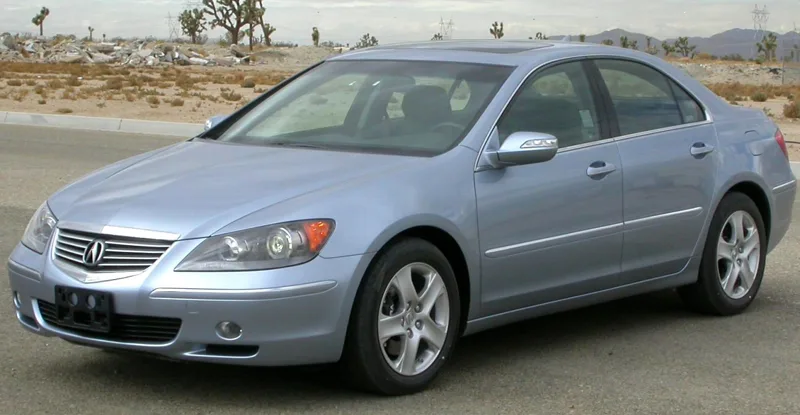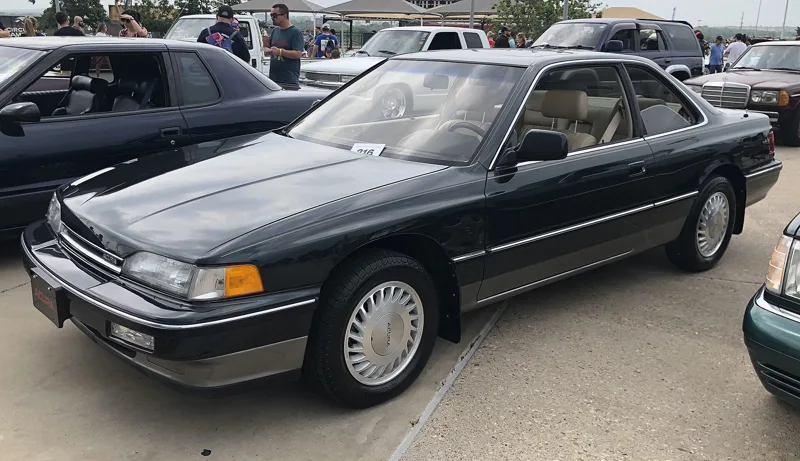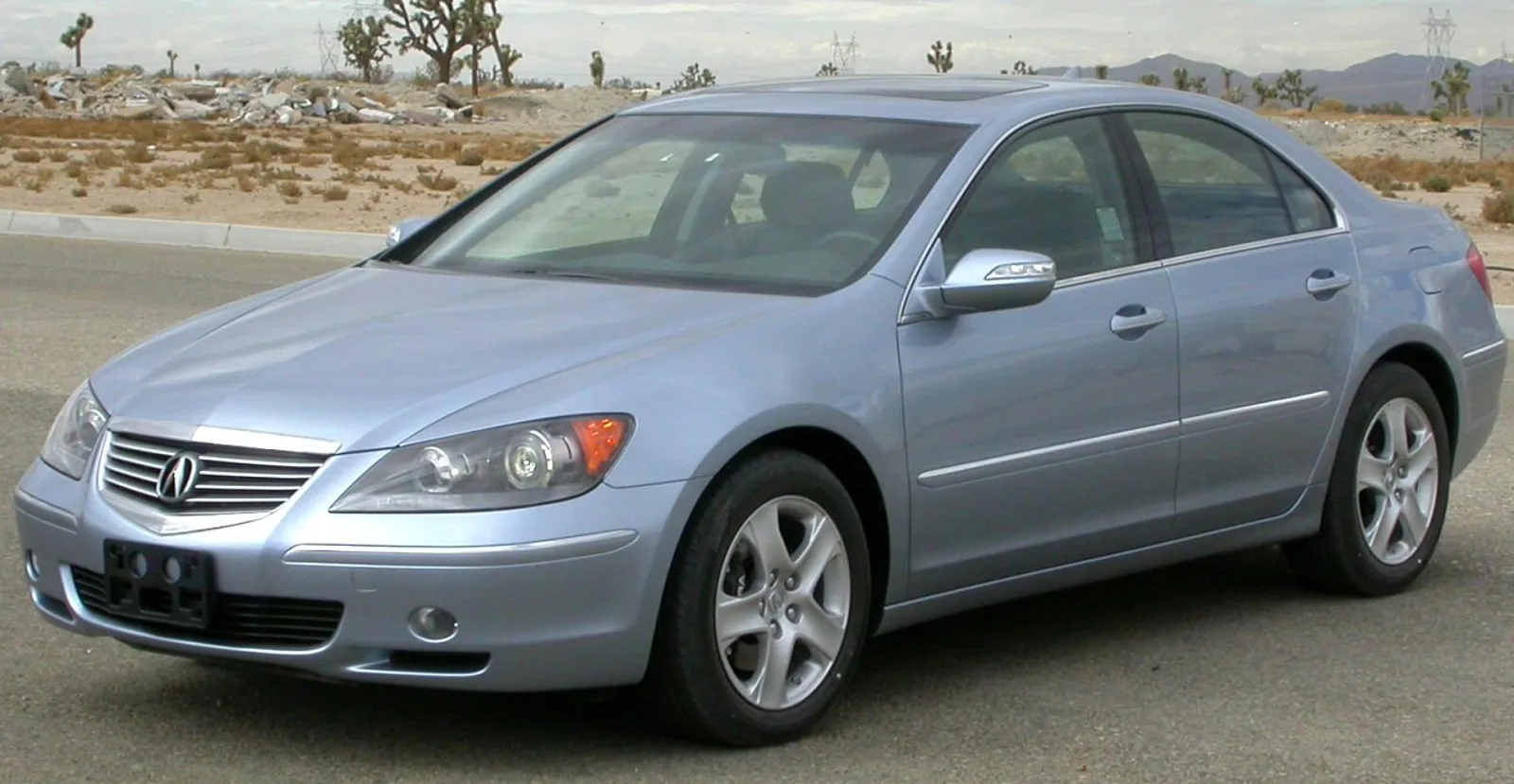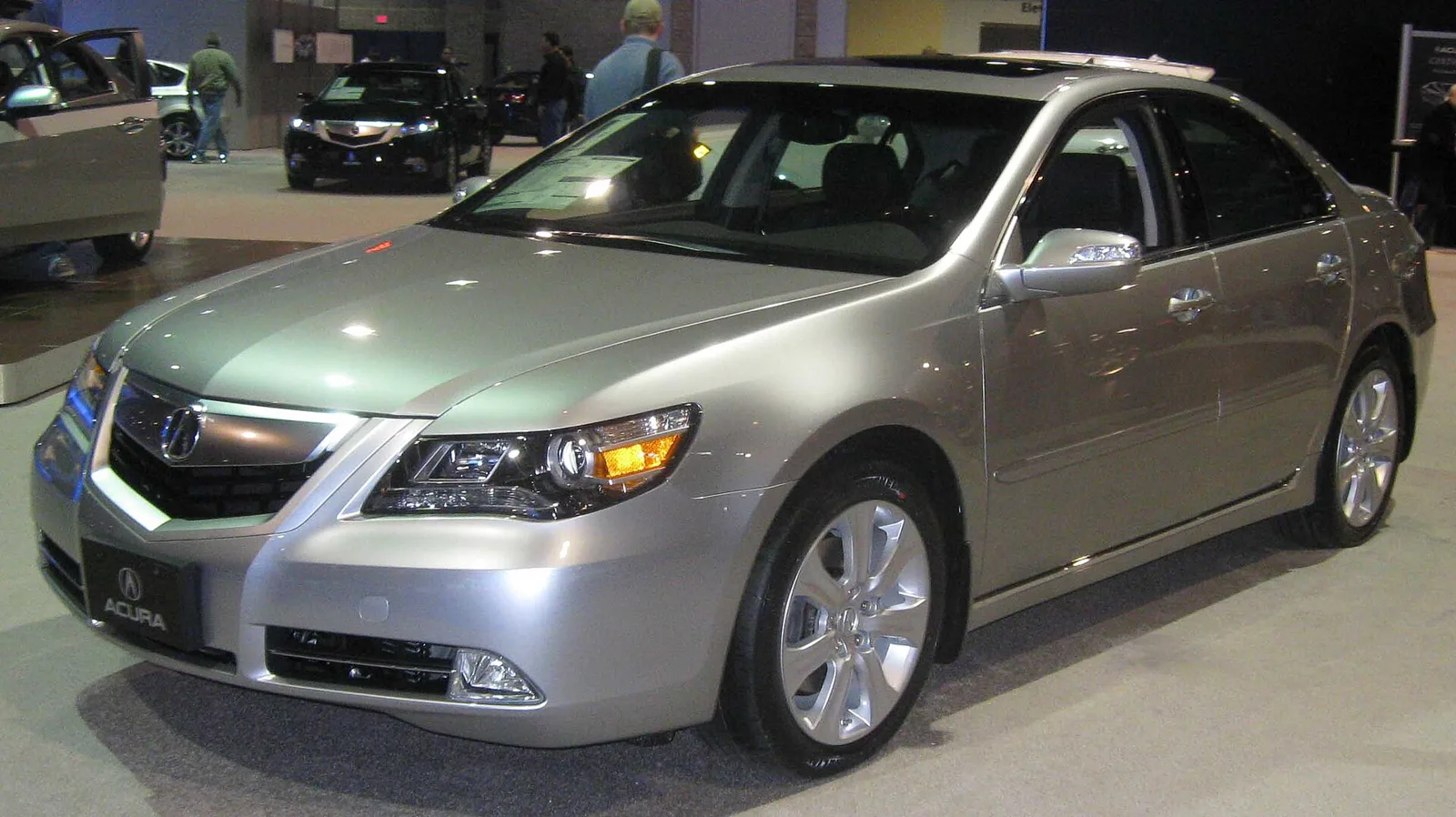
Two generations of a rebadged Honda Legend, a torque-vectoring all-wheel drive system that won praise, and a flagship that never quite found its audience before the RLX replaced it.
Sold from 1996 to 2012 in two generations, the Acura RL was a flagship luxury saloon built on the Honda Legend. Its second generation added SH-AWD torque-vectoring all-wheel drive, and the successor RLX took over in the 2014 model year. The second-generation engine made 300 hp (224 kW).
The Acura RL was a mid-size luxury car that Acura sold for the 1996 to 2012 model years over two generations. It was the flagship of the marque, built on the Japanese Honda Legend, and it was replaced in 2013 by the Acura RLX. Its signature was Super Handling All Wheel Drive, a system that could push torque side to side as well as front to rear.
What was the Acura RL?
The RL succeeded the Acura Legend. All of the Legend, RL and RLX models were adapted from the Japanese domestic market Honda Legend, which made the RL a close relative of the Honda range rather than a clean-sheet design.
The name stood for Refined Luxury. The first generation was a rebadged third-generation Honda Legend, introduced in North America in 1996, and the second was a rebadged fourth-generation Legend that arrived in September 2004 as a 2005 model.
The second generation then received a substantial mid-cycle revision for 2009 and a further update for 2011. The third generation debuted as the RLX for the 2014 model year, so the RL line ended with the 2012 cars.
A rebadged Honda Legend that gave Acura its first all-wheel drive system with real torque vectoring, and never quite found its buyers.
How did the first-generation Acura RL start life?
In 1996 Acura introduced the 3.5RL, internally called KA9, to replace the Legend. Acura had dropped the Legend name after market research showed that buyers talked about its products by their model names, such as Legend and Integra, rather than by the Acura brand.
Its longitudinal V6 was mounted in line with the car's axis rather than across it. That gave a smaller turning circle and an easy in-town manner, while also producing a 56/44 front to rear weight distribution for the 1996 model year.
The engine used forged internals, and its connecting rods were made by a process called block forging. A balance shaft reduced noise and vibration, and a four-speed automatic with Gradelogic was standard on every trim.
Suspension was a double wishbone at the front and a multilink arrangement at the rear, with coil springs and progressive shock absorbers. Some bushings were liquid filled to reduce harshness over bumps, and the steering was speed-sensitive rack and pinion. A powered moonroof was standard, and some cars had traction control.
What changed in the 1999 facelift?
The 1999 model year brought a front and rear facelift with integrated foglights, revised bumpers, a new hood, headlights, taillights, trunk and fenders. Driver and front passenger side airbags were added, and the suspension and chassis were stiffened.
Aerodynamics improved as the drag coefficient fell to 0.32 from 0.34, and the lift coefficient dropped to 0.102 from 0.155. HID low beam headlights became standard, and the steering wheel gained a floating horn switch instead of the two horn buttons of earlier cars.
The 2000 model year added a larger navigation screen and DVD map databases, and the emissions systems were revised to earn LEV status. The traction control system gave way to VSA, an electronic stability programme that used the anti-lock brakes and traction control together to limit under and oversteer.
What did the 2002 and 2004 updates bring?
The 2002 model year gave the 3.5RL painted lower trim, mudflaps, redesigned 7-spoke alloys and a sportier suspension with larger solid sway bars. The revised engine produced 225 hp (168 kW) and 231 lb ft (313 N m) of torque, aided by a new variable muffler.
OnStar became standard in 2002, and the car's OE tyres changed to 225/55R16 Michelin Pilot HX MXM4 units. The ABS was revised to run four channels at all times, and a new dual-diaphragm master cylinder gave more braking with less pedal force.
For 2004 the 3.5RL offered a revised navigation system and integrated satellite radio as standard in the continental United States. That made it the first production saloon with satellite radio as standard equipment, and the gauges and steering wheel were also changed.
The 1996 to 2004 engine, internally called the C35A, was the last V6 in the Acura line without Honda's VTEC variable valve timing. It was also the last Acura to use a numeric displacement name, with the 3.5 figure on the car.
What was the second-generation RL?
The second generation, known internally as KB1, appeared as a prototype at the 2004 New York International Auto Show and went on sale in late 2004 as a 2005 model. The big change was the all-wheel drive system that Acura marketed as Super Handling All Wheel Drive, or SH-AWD.
SH-AWD combined active differentials with traction control and could vary the power distribution from side to side at the rear, not just front to rear. It could direct up to 70 percent of available torque to the rear wheels, and as much as 100 percent of that rear torque could go to one wheel.
A planetary gear set let the rear wheels overdrive by up to five percent relative to the fronts, so torque sent to the outside rear wheel could push the car around a bend and reduce understeer. The idea was often compared to a rower pulling harder on the outer oar to turn a boat.
The 2005 car's 3.5 litre J-series V6 used SOHC VTEC and produced 300 hp (224 kW), later revised to 290 hp (216 kW) when the SAE testing procedure changed. It used drive-by-wire throttle control and a five-speed sequential sport automatic with paddle shifters on the steering wheel.
How was the 2005 RL equipped?
The 2005 RL used aluminium four-piston front brake calipers over 12.6-inch cast-iron ventilated rotors, the first use of that caliper type on an RL. At the rear, 12.2-inch discs were gripped by one-piston aluminium calipers, and the wheels were 17-inch five-spoke alloys with Michelin Pilot HX MXM4 245/50R17 tyres.
Keyless entry allowed the driver to lock and unlock the car by touching the door handle, and a keyless start system used a non-removable switch in the steering column. The 260 watt Bose DVD-Audio 5.1 system had ten speakers and several Bose technologies, including Active Noise Cancellation with two cabin microphones.
Voice recognition covered over 560 commands for the navigation, phone, audio and climate controls. The Alpine DVD navigation unit had an 8-inch LCD screen and a multi-use interface dial, and the driver could change destinations while moving.
The Active Front Lighting System swivelled the high intensity discharge headlamps by up to twenty degrees with the steering. LEDs replaced incandescent bulbs in the tail and brake lights, and the 2005 RL was the first Honda vehicle with the Advanced Compatibility Engineering body structure, which later spread across the Honda and Acura range.
What did the 2006 and 2007 cars add?
For 2006 the RL gained a Technology Package with adaptive cruise control, the Collision Mitigation Braking System and Michelin PAX run-flat tyres. The PAX wheels were 460 mm (18 in) equivalent with 245/45R18 tyres, and the mud guards that had been standard were removed.
By 2007 the range had three trim levels: a base model, the Technology Package and the Technology Package with CMBS and PAX. The base car lost navigation and the Adaptive Front Lighting System, and it used faux wood trim where the others kept genuine wood.
The A-Spec package was a dealer-installed kit available for 2005 to 2008. It included lowering springs of about 0.75 inch, re-valved dampers, 18-inch alloy wheels and aero body parts, and it was first announced at the late 2004 SEMA show in Las Vegas.
What changed in the 2009 mid-model change?
The 2009 mid-model change, designated KB2 in the VIN, was released on 1 July 2008 after its February introduction at the Chicago Auto Show. Acura called it the most extensive Acura mid-model change ever, and it raised the engine from 3.5 to 3.7 litres with 300 hp (224 kW).
The 3.7 litre V6 was a variant of the engine shared with the MDX, and it was the first SOHC Honda V6 to use VTEC on both intake and exhaust. Emissions were reduced to meet EPA Tier 2 Bin 5 and California ULEV-2 standards, and the SH-AWD was tuned for earlier intervention with a greater rear bias.
Suspension was upgraded with higher-rate springs, larger anti-sway bars and stiffer bushings. The front anti-sway bar became a hollow 30mm unit, and the rear bar grew to 19mm. Standard 18 x 8-inch seven-spoke wheels with 245/45-18 tyres replaced the earlier 17-inch five-spoke wheels.
Inside, the front seats were revised for comfort, with a power passenger seat and active head restraints. Six levels of cooling ventilation were added to the existing heated seats, and the shifter moved fore and aft in a straight line, with simulated wood on the wheel and shifter.
The 2009 car was also quieter, with Active Sound Control that linked noise cancellation to throttle position and engine speed. Its voice recognition grew to over 700 commands from 560, and the infotainment system gained XM traffic and weather reports as well as a USB port for media devices.
The mid-model change grew the car slightly, with the body 2.2 inches (56 mm) longer. Curb weights rose across the range compared with the 2006 cars. The controversial 'Power Plenum' grille came with the update, and critics disliked its chrome bar.
What did the 2011 update change?
The 2011 model year brought the six-speed automatic that had first appeared on the 2010 Acura ZDX, replacing the five-speed the press had long criticised as outdated. The new gearbox improved EPA ratings to 17 mpg-US city, 24 mpg-US highway and 20 mpg-US combined.
Acura said the change cut the 0-60 mph time by 0.5 seconds to 6.0 seconds. The RL's exterior also received a toned-down version of the power plenum grille, and the interior gained a new colour, Sea Coast, with dark burlwood trim.
The new 18 x 8-inch 15-spoke wheels carried a polypropylene Helmholtz resonator around the inner rim. The resonators suppressed frequencies between 100 and 500 hertz, which cut road noise by 1.3 dB, or 15 percent when combined with extra floorboard insulation.
How did critics and safety testers rate the RL?
Critics praised the second-generation RL for its engineering. It appeared on Car and Driver's Ten Best list for 2005, won a CNET Editor's Choice award as a top tech car, and Popular Science named SH-AWD one of the best automotive innovations of 2004.
In October 2010 Consumer Reports named the RL the most reliable new car among luxury sedans. In a comparison of 2006 and 2007 mid-luxury sedans with all-wheel drive, the RL compared favourably with a Mercedes-Benz E300 4MATIC and a BMW 528xi.
Safety ratings were also strong. From 2005 to 2008 the RL ranked number one in the Informed for LIFE vehicle risk index, with a safety score of 46.4. The 2009 and 2010 models earned NHTSA five-star crash ratings, and the 2009 car received an IIHS Top Safety Pick, which it lost in 2010 after a Marginal roof strength rating.
Some of its safety features were unusual at the time. The CMBS radar could detect objects up to 330 feet ahead, and the adaptive cruise control offered following distances of 2.0, 1.5 or 1.0 seconds. The PAX run-flat system could run for up to 125 miles (201 km) at 50 mph (80 km/h) after a puncture.
Why did RL sales disappoint?
The critical praise did not translate into sales. Only 2,043 cars were sold in the US in 2009, a 55 percent fall from 2008, and in the first six months of 2010 Acura sold just 872 RLs against 5,650 Lexus LS and 6,602 Infiniti M sedans.
Enthusiasts and dealers said the RL lacked the full-size dimensions of its rivals, and the back seat was regarded as tight for a car of its size. It also lacked a V8 option and the rear-drive balance that buyers expected from its larger German competitors.
The 2009 refresh and the 2011 update did not keep the car competitive in acceleration or economy. The infotainment system used an outdated DVD navigation unit with poor graphics, while BMW and Mercedes-Benz had moved to newer iDrive and COMAND systems.
The price was also a problem. Some suggested that the RL's initial pricing was out of its bracket, and the cheaper TL shared most of the RL's core features. The 2009 TL SH-AWD with the Technology package offered a similar SH-AWD system for CAD 44,900, which made the RL look superfluous in Acura's own showrooms.
Late in its life the RL also faced the Hyundai Genesis, which was refined, rear-drive and offered an optional V8 at a competitive price. Only 379 RLs were sold in North America in 2012, which marked the end of the line.
Did the Acura RL have recalls?
There were two recalls on the second-generation RL, both based on defects in parts shared with Honda vehicles. In December 2007 certain 2005 to 2008 RLs were recalled because the power steering hose could crack and leak oil onto a hot catalytic converter.
In December 2010 certain 2005 to 2007 RLs were recalled over a brake master cylinder seal that could leak if the wrong brake fluid was used. The same recall covered 2005 to 2007 Honda Odyssey models, and affected vehicles were repaired at no charge.
What replaced the Acura RL?
In April 2012 Honda introduced the Acura RLX concept, and the production model debuted at the Los Angeles Auto Show. The first RLX was front-wheel drive, but a later all-wheel drive version used a 377 hp hybrid engine mated to a seven-speed dual-clutch transmission.
The RLX ended the RL name, and the flagship role passed to a model that carried the new hybrid and dual-clutch technology. The RL was then remembered as the car that introduced SH-AWD to the Acura range.
What are the Acura RL specifications?
| Specification | Detail |
|---|---|
| Model years | 1996 to 2012, two generations |
| First-generation engine | 3.5 litre V6, C35A, no VTEC |
| 2002 output | 225 hp (168 kW); 231 lb ft (313 N m) |
| 1999 drag coefficient | 0.32, down from 0.34 |
| 2005 engine | 3.5 litre J-series V6, 300 hp (224 kW), later 290 hp (216 kW) |
| 2005 drag coefficient | 0.29 |
| SH-AWD rear torque | Up to 70 percent to the rear, up to 100 percent to one rear wheel |
| 2009 engine | 3.7 litre V6, 300 hp (224 kW) |
| 2009 curb weight | Higher than on the 2006 cars |
| 2011 gearbox | Six-speed automatic, 6.0 seconds to 60 mph |
| 2011 economy | 17 mpg-US city, 24 mpg-US highway, 20 mpg-US combined |
| US sales, 2009 | 2,043 cars |