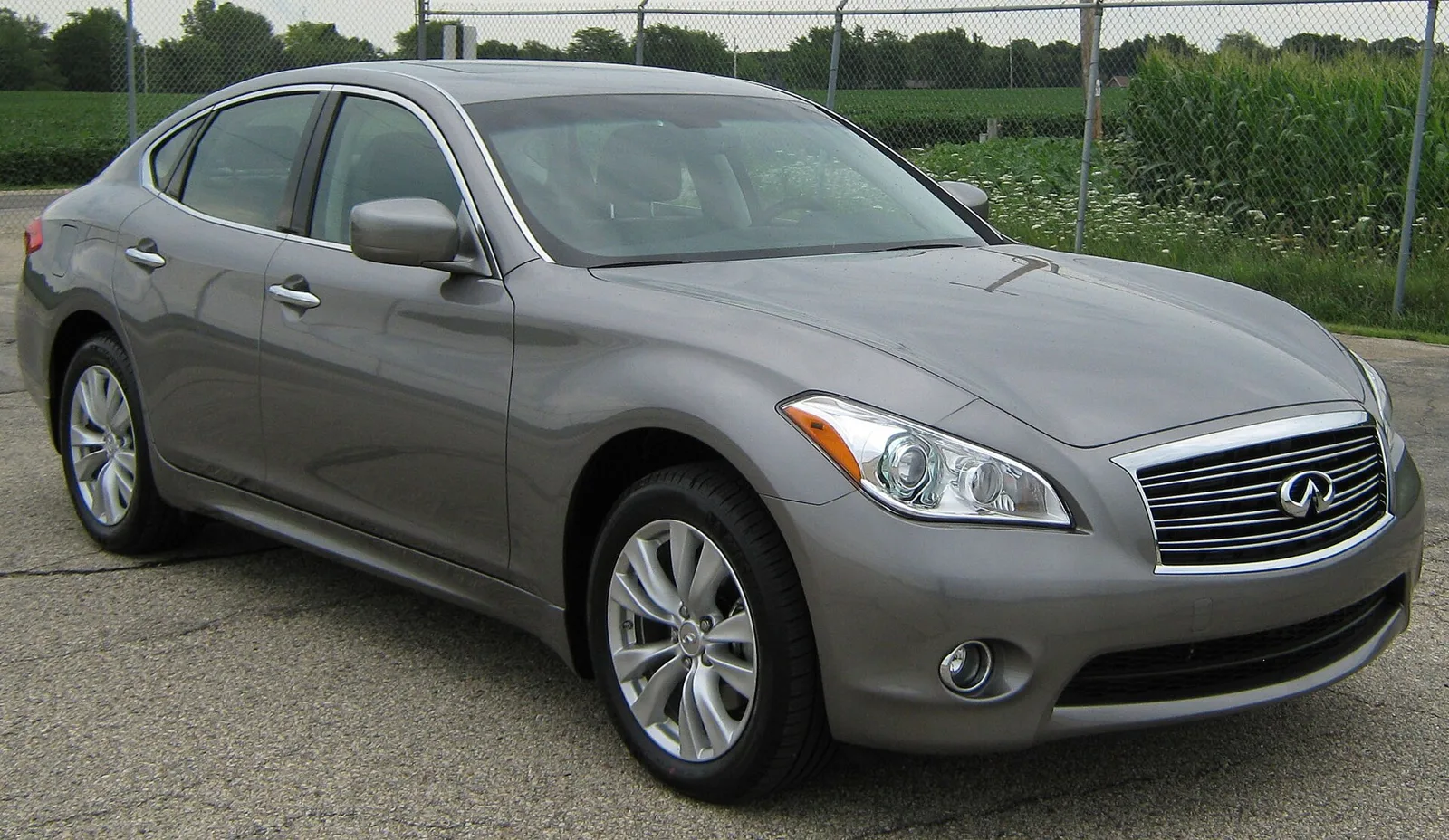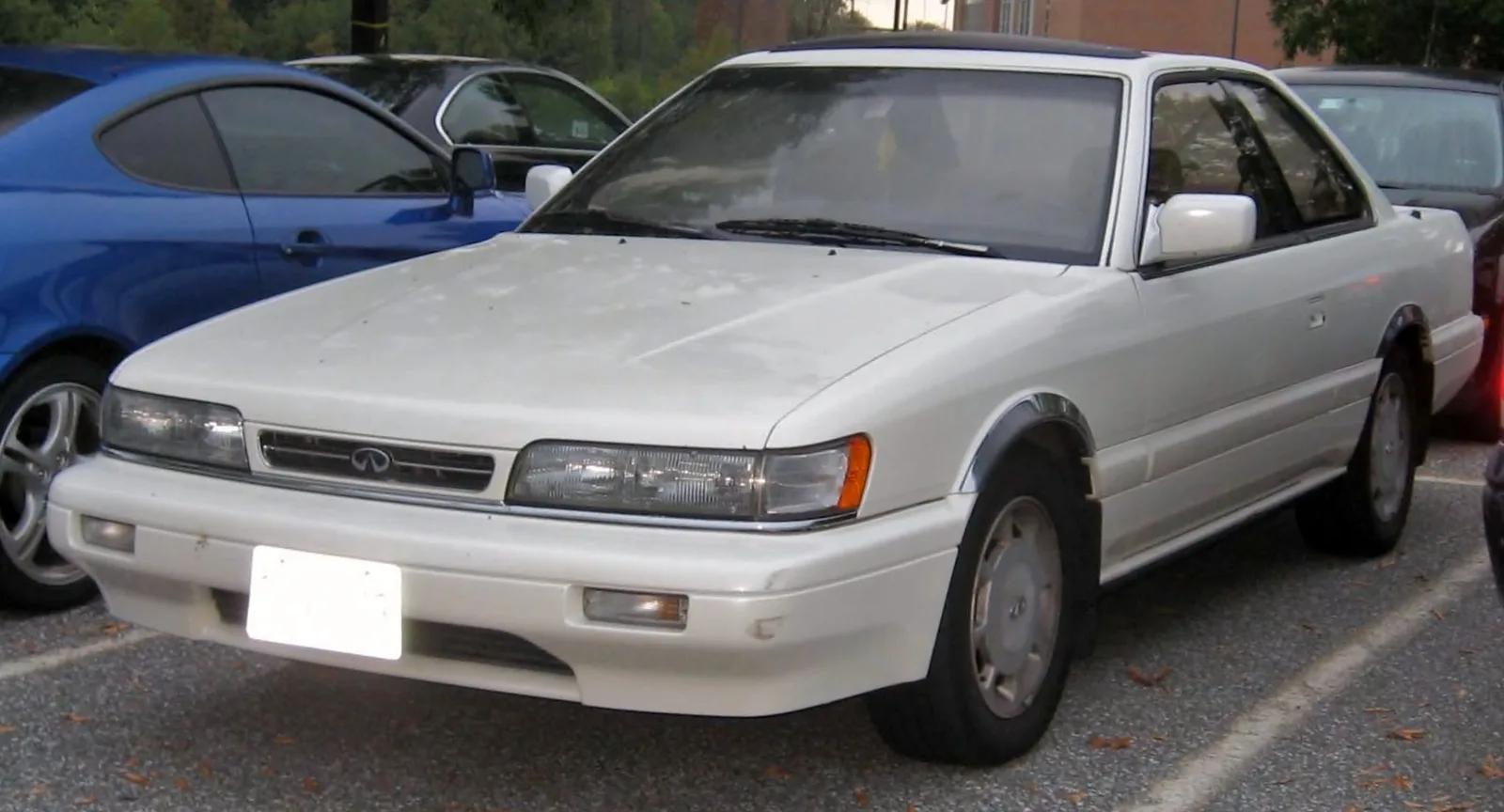
From a rebadged Japanese Leopard in 1989 to a 2010 V8, a diesel and a hybrid, the Infiniti M carried the executive line until it was renamed the Q70.
The Infiniti M was a mid-size luxury executive car from Nissan's Infiniti division, built from 1989 as a rebadged Japanese Leopard. It later used V8, hybrid and diesel engines and was marketed as the Q70 from 2013 until its discontinuation after 2019.
The Infiniti M was a line of mid-size luxury executive cars from Nissan's Infiniti division. It began in 1989 as the M30, a rebadged Japanese Leopard, and from 2013 it was marketed as the Infiniti Q70.
This profile follows the M through its first generation, the M45 and M35 years, the Y51 redesign of 2010, the hybrid and diesel versions and the 2019 end of the Q70.
Where did the Infiniti M begin?
The first M was the M30, a two-door coupe and convertible based on the Japanese market Nissan Leopard, with chassis code F31. It arrived in 1989, ahead of the 1990 model year, as a cheaper option than the Infiniti Q45.
The M30 was meant to compete with the Acura Legend coupe, and to a lesser extent with the Lexus ES 250. It also undercut the Lexus LS400 on price, although the ES 250 was offered only as a four-door sedan.
A Japanese Leopard in American clothes that grew into a V8, hybrid and diesel executive car before its renaming.
Why did the M30 look dated?
The M30 was built on a platform originally designed for the Japanese market, rather than being a new car for America. Few changes were made to the exterior when the Leopard came to the United States, while the interior was revised to suit American tastes.
Its angular design and on-road performance were seen as outdated, particularly after a redesigned Acura Legend coupe arrived in 1991. The interior was also criticised for its ergonomics and lack of room.
The Japanese Leopard had received a new dashboard in its 1988 facelift, but the cost of a left-hand-drive version was too high. The M30 instead borrowed the left-hand-drive layout of the R31 Skyline's rectilinear dashboard, which had debuted in 1985.
How did the M30 price compare?
The M30 made up for these weaknesses with a lower price. It cost $23,500 with no factory options, compared with $27,325 for the 1990 Acura Legend coupe and $24,650 for the 1990 BMW 325i, both before options.
Dealers offered an in-car cellular telephone and a CD player as optional accessories, among other items.
What was standard on the M30?
Standard equipment included a driver's airbag, anti-lock brakes, leather upholstery and Nissan's Sonar Suspension II. The suspension used a sonar sensor under the front bumper to read the road ahead and change damping in real time.
A centre console switch let the driver choose between Comfort, which was soft, and Sport, which was firm. All M30s used MacPherson struts at the front and a semi-trailing arm rear with coil springs.
How did the convertible come about?
A convertible was introduced for the 1991 model year. All convertibles began life as coupes, which were shipped to California and converted by American Sunroof Corporation.
The electric canvas top had fully automatic push-button operation. Unlike the coupe, the convertible had manual climate controls, and it had a Bose Active Sound audio system. Japan never received it officially, so the convertible was built for the American market alone.
What changed through the M30's life?
For 1991 the cable-type speedometer became electric, and the instrument cluster typeface was changed to match the Q45. An illuminated entry feature lit the door keyholes and the dome light when the outer handle was pulled.
For 1992 a central locking switch was added next to the Sonar Suspension II selector. The intake plenum cover displayed the Infiniti logo instead of the Nissan logo and the V6 3000 script used on earlier cars.
How powerful was the M30?
The M30 used Nissan's VG30E V6, producing 162 hp (121 kW; 164 PS) at 6000 rpm and 180 lb-ft (244 N-m) at 3500 rpm. It was offered only with the single-overhead-cam version of that engine, and every car had a Jatco four-speed automatic.
The coupe weighed 3,302 lb (1,498 kg) and the convertible 3,523 lb (1,598 kg). Both were generally seen as overweight and underpowered, with quoted 0-60 times of 9.4 and 9.7 seconds.
Infiniti marketed the car as a luxury sports coupe, but its modest power, comfort-oriented ride and lack of a manual gearbox held back its sporting image.
What replaced the M30?
Production ended after the 1992 model year, with roughly 17,000 cars built. Its successor in the Infiniti line was the J30 sedan.
What was the second-generation M45?
The M45 was designed in 2000 at the Nissan Technical Center in Atsugi, Japan, and was manufactured in Tochigi. It was based on the eleventh-generation Y34 Nissan Gloria, but unlike the Japanese models it had a V8.
The M45 used Nissan's VK45DE V8, which made 340 hp (254 kW), along with 333 lb-ft (451 N-m). That engine was shared with the Q45 flagship, and the M45 broadened Nissan's use of the 4.5-litre V8 so the development cost could be spread further.
The Y34 M45 had a different instrument panel, similar to the one in the F50 Q45, and a different rear multi-link suspension. The front suspension carried over from the Y33 Q45, with a cast aluminium lower A-arm in place of a stamped steel one.
How did the third-generation M arrive?
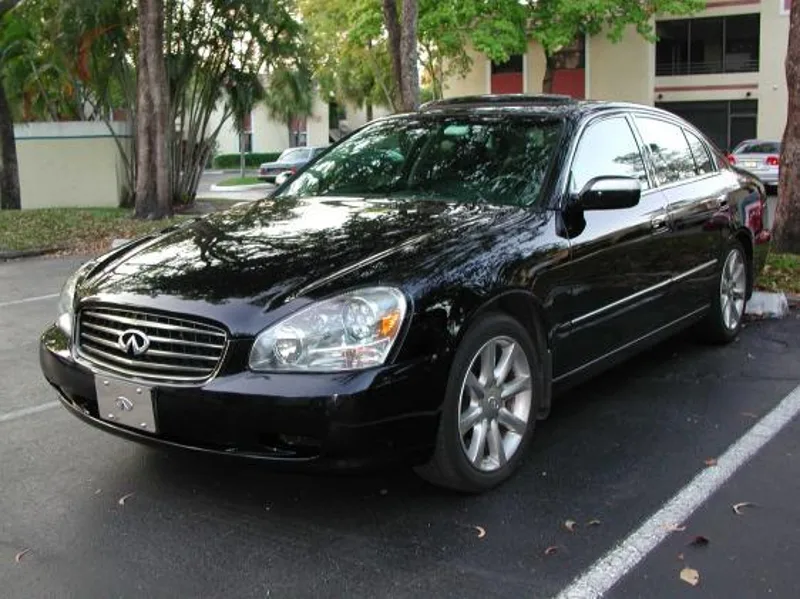
Infiniti released a redesigned M for the 2006 model year, launched in February 2005 and marketed in Japan as the Nissan Fuga. The chassis was a stiffer take on Nissan's FM platform, the same architecture under the G35, the 350Z and the FX.
The M was 177 mm (7.0 in) shorter than the last Q45, which measured 5,069 mm (199.6 in). It still offered more interior space, a rear multi-link suspension, front double wishbones and a wheelbase 30 mm (1.2 in) longer.
All-wheel-drive models were marketed as the M35x and M45x. They used the ATTESA-ETS system to send all power to the rear wheels until slip was detected, and the M45 became Infiniti's flagship once the Q45 left the export line after the 2006 model year.
How did the M35 and M45 perform?
The M35 used a 280 hp (209 kW) 3.5 L VQ-series V6, while the M45 used the Q45's 335 hp (250 kW) 4.5 L V8. Reviewers praised the driving involvement and handling of both cars against the GS and the E-Class.
Consumer Reports picked the M35x as its top luxury car for 2006, displacing the 2005 Lexus LS 430. Inside, it ranked near the head of its class in every dimension.
Why did the M struggle in sales?
The M never gained a significant share of the mid-luxury market. The G37 sedan and coupe, competing in the entry-level sport luxury category, accounted for half of the marque's sales by 2009.
Of the 81,000 Infiniti cars sold that year, only 10,000 were M models. The 2009 update also left the M35 and M45 in an awkward spot, because the G37 was fitted with a more powerful VQ37VHR engine.
What changed for 2008 and 2009?
For 2008 the M received a facelift, with optional all-wheel drive on the M45x, revised front and rear fascias and revised tail lights. The gauges were redesigned with blue highlights instead of orange, and an S type version was offered on the M45 and M45x.
For 2009 the M35 received a new V6 producing 303 hp (226 kW), with 262 lb-ft (355 N-m) of torque, along with a 7-speed automatic. The M35x, M45 and M45x kept the five-speed automatic.
What was the Y51 generation?
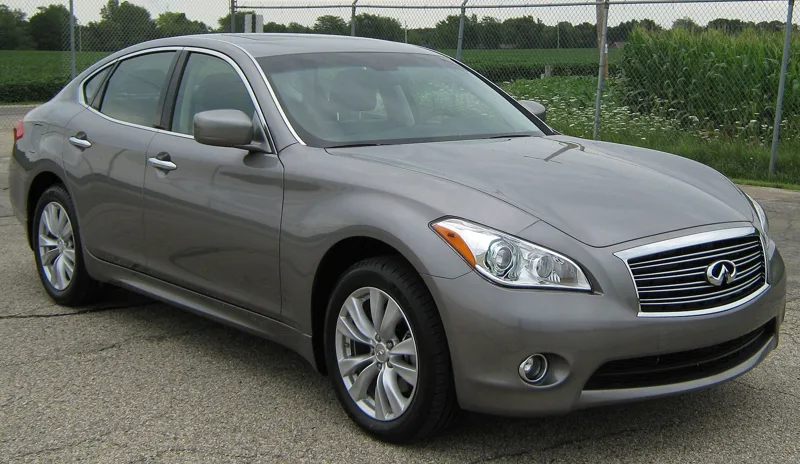
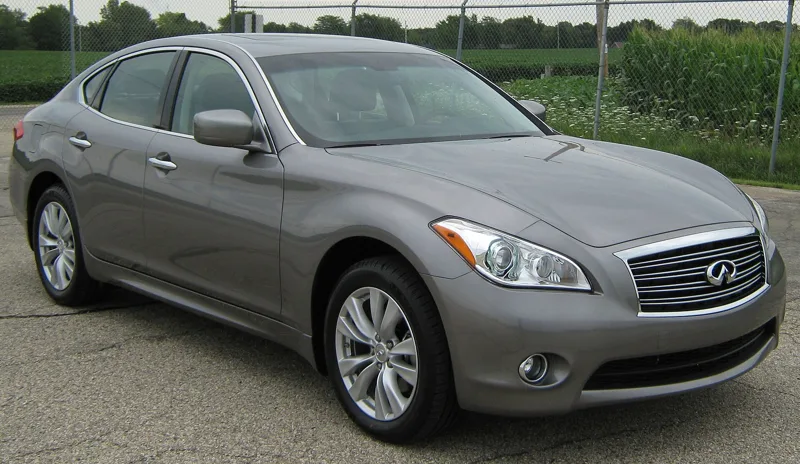
The Y51 was designed by Hideo Komuro between 2006 and 2008, under the supervision of Shiro Nakamura. The body became smoother and rounder, evoking the coke-bottle shapes of the 1960s and 1970s.
The 2011 Infiniti M debuted at the 59th Pebble Beach Concours d'Elegance. A media event in Beverly Hills, California in December 2009 coincided with the Los Angeles Auto Show, and the production car went on sale globally in spring 2010.
The US launch date was 1 March 2010, and the car was shown in Europe at the 2010 Geneva Motor Show.
What engines and features did the Y51 get?
The VK56VD V8 in the M56 was competitive with the BMW 550i and Mercedes-Benz E550. It was not shared with the Japanese Fuga, which received a hybrid as its performance option instead.
A driving mode selector offered Standard, Sport, Eco and Snow settings, and the M included a noise-cancelling system branded Active Noise Control. Kayaba, rather than Hitachi, now supplied double-piston shock absorbers.
Safety technology included Lane Departure Prevention, which used a camera above the rearview mirror and could lightly brake to ease the car back into its lane. The Blind Spot Intervention System provided a visual warning and could apply opposite-side brakes to guide the car away from an obstacle.
How safe was the third-generation M?
The third-generation car won an IIHS Top Safety Pick, scoring Good in all four of the institute's crash tests. Stability control was standard, which helped the car avoid accidents in the first place.
What was the M35h hybrid?
In Japan the hybrid was badged as the Nissan Fuga Hybrid and sat at the top of the performance range. It introduced Nissan's first in-house electric hybrid technology, and the carmaker claimed it doubled the fuel economy of its gasoline version.
The hybrid used a 3.5 L V6 with 302 hp (225 kW) and 258 lb-ft (350 N-m) of torque, plus one electric motor and two clutches. Together the two sources produced 360 hp (268 kW; 365 PS) at 6500 rpm, with about 391 lb-ft (530 N-m) of torque, peaking at 2000 rpm.
The lithium-ion battery was expected to last 10 years. It was installed upright behind the rear seats, which reduced luggage space and fixed the rear seats in place, and all-wheel drive was not offered. The battery placement gave the hybrid a 51/49 front to rear weight distribution.
How fast was the M35h?
On 23 August 2011 the M35h set a Guinness record for the fastest accelerating production full hybrid. CAR magazine journalist Tim Pollard drove the car down the quarter-mile at Santa Pod Raceway in 13.896 seconds.
The M35h averaged 13.9031 seconds across all runs, passing 100 mph (160 km/h). Its official 0-100 km/h time was 5.5 seconds.
Reviewers placed the 2012 M35h among the best executed hybrid performance luxury cars, alongside the Porsche Panamera S Hybrid, which also arrived in 2011.
What was the M30d diesel?
The diesel was first shown at the 2010 Geneva Motor Show, and European sales began in September 2010.
The V9X diesel made 240 hp (179 kW), and its 406 lb-ft (550 N-m) of torque arrived at 2,500 rpm. In western Europe it was offered as a performance option in place of the M56 V8, and it was never sold in the US or Canada.
How did the Infiniti M end?
Nissan announced in 2019 that the Q70, Q70L, Q30 and QX30 would end after model year 2019. Weak sales, and a move by buyers in the United States, Canada and Mexico toward crossovers and SUVs, were the main reasons.
Nissan also planned to withdraw the Infiniti brand from several markets by the end of 2020, after leaving South Africa in 2017 because of losses and poor sales.
What awards did the M win?
The Y51 won the 2010 Ward's Auto Interior of the Year award. In 2011 the car was named among the Popular Mechanics Top 10 Cars of 2011 as the Top Luxury Pick, and it also received an IIHS Top Safety Pick.
The M35h's Guinness record was certified by the 2013 edition of the Guinness Book of Records.
What are the Infiniti M specifications?
| Item | Detail |
|---|---|
| First model | M30, 1989, 1990 model year |
| M30 engine | VG30E V6, 162 hp (121 kW; 164 PS) at 6000 rpm |
| M30 coupe weight | 3,302 lb (1,498 kg) |
| M45 engine | VK45DE V8, 340 hp (254 kW) |
| M35 engine (2009) | V6, 303 hp (226 kW), 7-speed automatic |
| M35h output | 360 hp (268 kW; 365 PS) combined |
| M35h battery | Lithium-ion, expected life of 10 years |
| M30d engine | V9X diesel, 240 hp (179 kW) |
| Y51 US launch | 1 March 2010 |
| Q70 name | From 2013 (model year 2014) |