Ken Tyrrell's team won titles with Jackie Stewart, struggled through the turbo years and ended as Tyrrell in 1998.
Tyrrell Racing was a British auto racing team and Formula One constructor founded by Ken Tyrrell. It won three drivers' championships with Jackie Stewart and one constructors' title in 1971. The team competed until 1998, and its descendants include the Mercedes team.
Tyrrell Racing was a British team that began as a privateer operation in 1958 and became a Formula One constructor in its own right. Ken Tyrrell ran it with Jackie Stewart at the peak of its success, and the team took three drivers' championships and one constructors' title between 1969 and 1973. Its later years brought fewer results, a sale in 1997 and a final race in 1998.
Where did Tyrrell Racing begin?
The team's first outing came in 1958, with Formula Three machinery run for Ken Tyrrell and promising local names. Ken gave up his own driving in 1959 and moved into junior single-seater operations. His workshop was a woodshed owned by the family business, Tyrrell Brothers, which gave the operation its modest beginnings.
Through the 1960s the team climbed the lower formulae, giving John Surtees and Jacky Ickx their first single-seater runs. Its most important partnership was with Jackie Stewart, who first signed with Tyrrell in 1963. That relationship would define the team's rise to Formula One.
Tyrrell ran BRM's Formula Two operation in 1965, 1966 and 1967, a period when Stewart was contracted to BRM's Formula One squad. After that, the team agreed to run Formula Two cars made by the French firm Matra.
The first world championship entry came at the 1966 German Grand Prix, when Ickx and Hubert Hahne drove Matra MS5 cars. Hahne finished 9th as the best of the Formula Two cars. A year later Ickx qualified 3rd-fastest at the 1967 German Grand Prix, but the Formula Two cars started at the back of the grid, and he retired with broken suspension after running as high as fifth.
A woodshed privateer that won titles with Jackie Stewart and left a six-wheeler in Formula One history.
How did Matra and Tyrrell win the 1969 title?
Tyrrell reached Formula One in 1968 through a joint venture with the French maker Matra, known as Matra International. Elf and Ford helped fund the move. Stewart won three Grands Prix in the Matra MS10 that year, and the car's most unusual feature was a set of structural fuel tanks built into the chassis.
The tanks made the chassis about 15 kg lighter and stronger than rivals' designs, but the FIA judged the idea unsafe and banned it for 1970. Rubber bag-tanks replaced them.
For 1969 the Matra works team decided not to race in Formula One and gave its effort to Tyrrell's Matra International team. A new car, the MS80, was built around the Cosworth DFV engine even though it would be eligible for only one season. Stewart won the 1969 drivers' title in it.
That title was a notable achievement on two counts. It was the first championship won by a French-built car, and it also went to a privateer's entry. Both had made their Formula One debut only a year earlier, which made the result especially striking.
How did Tyrrell win the 1971 championships?
For 1970 Matra merged with Simca, and the partnership changed direction. Matra asked Tyrrell to use its V12 engine instead of the Cosworth. Stewart tested the V12 and found it inferior, and Elf's sponsorship agreement with Renault made it hard for Tyrrell to back a Simca partner. The team bought a March 701 as an interim car.
The team was renamed Tyrrell Racing Organisation at the start of 1970. It kept its traditional French blue colours through most of its existence. At the woodshed in Ockham, Surrey, Derek Gardner began developing the team's first in-house car, while the team ran March-Fords through the year with mixed results.
The privateer team had already been successful in its own right. Across its Matra and March years it won 10 races in total, which made it the top privateer outfit the sport has known. Its one World Drivers' Championship came in 1969 with the Matra MS80.
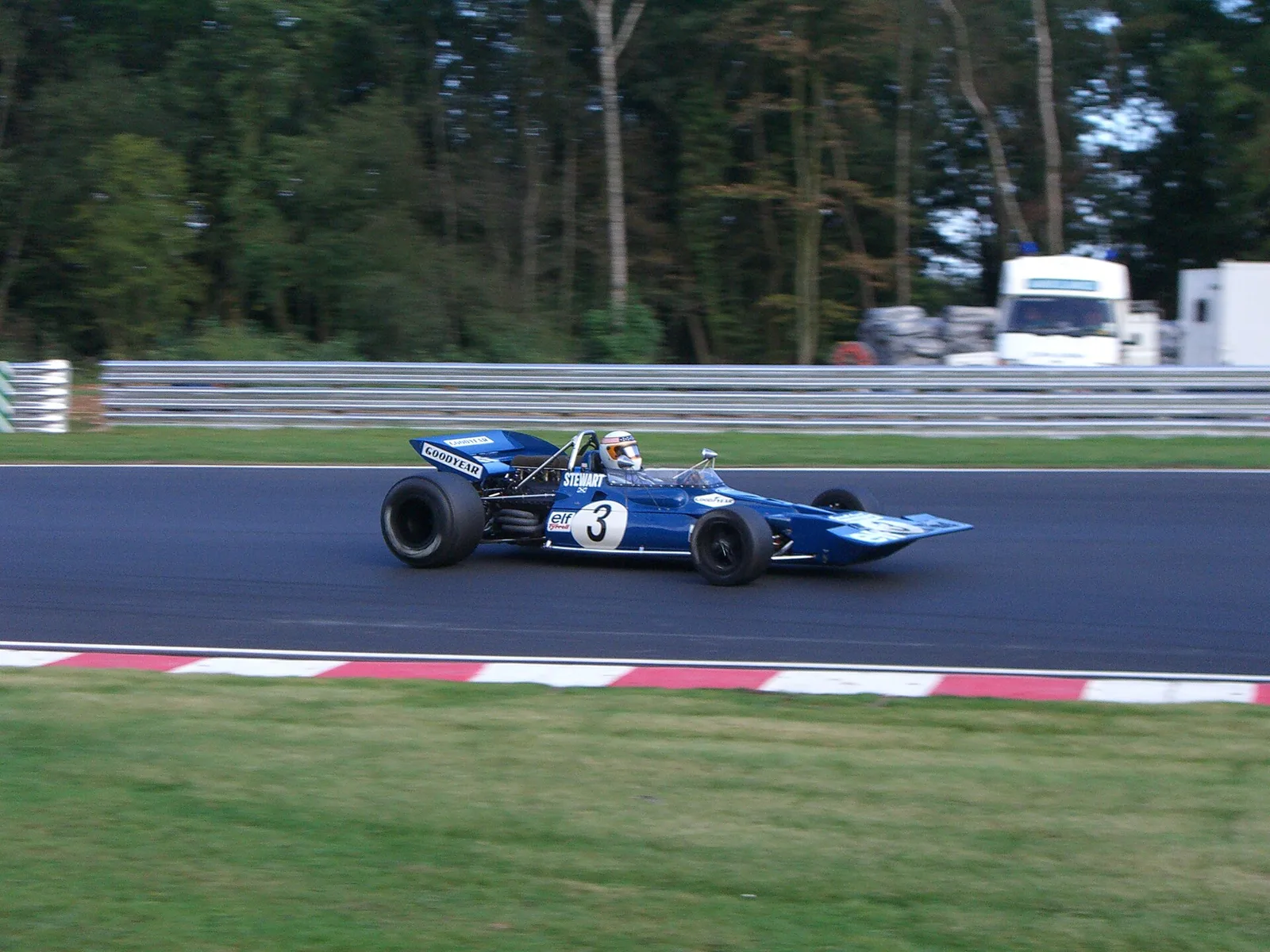
The Tyrrell 001 appeared at the end of 1970, and Stewart took pole position at the Canadian Grand Prix with it. Mechanical failures struck in all three of its race starts that season. The near-identical Tyrrell 003 then delivered both titles in 1971, with Stewart and Francois Cevert at the wheel.
Stewart's 1972 season was hampered by a stomach ulcer, though he was fit again in 1973. That year he and Cevert placed first and fourth in the standings. Cevert died in practice for the United States Grand Prix at Watkins Glen, and Stewart confirmed his retirement at season's end.
What was the Tyrrell P34 six-wheeler?
The P34 was the first six-wheeler to succeed in Formula One, with two small front wheels on each side replacing the conventional pair, which made the car stand out on any grid. Derek Gardner designed it, and it gave the team one of its most memorable results.
Scheckter won the 1976 Swedish Grand Prix in the P34, and Tyrrell finished one-two. The design was then abandoned because Goodyear refused to develop the small tyres it needed. The tyre maker was busy with its rivals in Formula One, and the P34 never returned.
The car is still remembered as one of the most unusual race cars ever built. Several other teams tried six-wheel designs in the years that followed, among them March and Williams, but none achieved the same success as the Tyrrell.
Without Stewart and Cevert, Tyrrell were never again a serious championship contender, although the team kept winning races through the decade.
Why was Tyrrell excluded from the 1984 championship?
Tyrrell was excluded from the 1984 championship after a dispute over water injection and ballast. The team was the only naturally aspirated engine user that season, which gave it a particular interest in any advantage it could find over turbocharged rivals.
The problem came to light when lead shot was seen escaping from the top of one car in the closing stages of several races. The team had been running underweight during the race and topping up its water injection tank late on. The water was mixed with 140 lb of lead shot, and it was pumped in under pressure, so some of the shot escaped through the tank vent.
Brundle had finished second for Tyrrell at Detroit, and afterwards the top cars were impounded. Officials alleged that the water contained 27.5 per cent aromatics and so acted as an extra fuel source. Later analysis showed the fuel content was below 1 per cent and within the rules, but the charges were amended on appeal.
The international judging panel upheld the decision. Tyrrell were excluded from the championship, lost all of their 1984 points and were barred from the final three races of the year. The exclusion removed the only naturally aspirated team from the grid and changed the regulations for the years that followed.
What was Tyrrell's last Grand Prix win?
Michele Alboreto won the 1983 Detroit Grand Prix in a Tyrrell 011, and that victory was the final win for the Cosworth DFV engine. It also marked the end of the team's Grand Prix winning. The result marked the end of an era for the team and for the engine that had powered so many of its cars.
Tyrrell had been the last team to race the Cosworth DFV after the turbo era began in 1977. Without the funding to switch to turbo engines, the team struggled through the 1980s, but it kept racing and fought to stay in the championship.
After the 1984 penalties, the team adopted a turbo Renault engine in the middle of 1985. Turbo engines became mandatory for 1986, and naturally aspirated engines returned in 1987. That year the team also took the Colin Chapman Trophy, which went to naturally aspirated constructors, a reward for persistence in hard circumstances.
Stefan Bellof, who had been among those hit by the scheme, died in a 1985 sports car race at Spa.
Tyrrell at a glance
| Period | Main cars or engines | Notable drivers | Highlights |
|---|---|---|---|
| 1968-1969 | Matra MS10 and MS80, Cosworth DFV | Jackie Stewart | Three Grands Prix in 1968; drivers' title in 1969 |
| 1970-1973 | March 701, Tyrrell 001 and 003 | Jackie Stewart, Francois Cevert | Drivers' and constructors' championships in 1971; first and fourth in 1973 |
| 1976-1979 | P34 six-wheeler, Tyrrell 009 | Jody Scheckter, Patrick Depailler, Jarier and Pironi | 1-2 finish at the 1976 Swedish Grand Prix |
| 1983-1986 | Tyrrell 011, turbo Renault engine | Michele Alboreto, Martin Brundle | Last Cosworth DFV win at Detroit in 1983; excluded in 1984 |
| 1990-1991 | Tyrrell 019, Honda engines | Jean Alesi, Stefano Modena | Two second places in 1990; second at the 1991 Canadian Grand Prix |
| 1997-1998 | Tyrrell 026 | Mika Salo, Ricardo Rosset, Tora Takagi | Last points at the 1997 Monaco Grand Prix; final race in 1998 |
How did Tyrrell fade in the 1990s?
There was a brief revival in the early 1990s. Harvey Postlethwaite designed the anhedral high-nose Tyrrell 019 for 1990, and Jean Alesi finished second twice, at Phoenix and Monaco, for the team. Alesi had led 30 laps of the Phoenix race before the result slipped away.
Alesi left for Ferrari after 1990. Honda engines and Braun sponsorship helped the team in 1991, and Stefano Modena earned a front row start at Monaco alongside Ayrton Senna. Modena also finished second at the 1991 Canadian Grand Prix, one of the last high points of that period.
The team then slipped back from midfield. Mika Salo scored Tyrrell's last Formula One points at the 1997 Monaco Grand Prix, and the team's form faded while Ken's ill health made the situation harder.
The sale to Craig Pollock came after the 1997 season. Pollock was also building British American Racing, which was backed by British American Tobacco. Ken left just before the 1998 season after a dispute with Pollock over choosing Ricardo Rosset for sponsorship money rather than Jos Verstappen.
The final race came at the 1998 Japanese Grand Prix. Rosset failed to qualify, and his team-mate Takagi's race ended on lap 28, when a clash with Esteban Tuero's Minardi forced him out. That retirement ended the Tyrrell name in Formula One.
What became of the Tyrrell name?
The team's legacy passed to others. The lineage runs through a chain of ownership changes involving BAR, Honda and Brawn GP, and its descendants include the Brawn team that won the 2009 titles and today's Mercedes team. Those descendants had won 142 Grands Prix by the 2026 Singapore Grand Prix.
The wider group of descendant teams also holds a significant number of championships. Brawn won the 2009 drivers' and constructors' titles, and Mercedes took the rest, giving the family 8 drivers' championships and 9 constructors' championships by the same point.
Bob Tyrrell kept the family's name alive as a business, managing the trademarks through Tyrrell Promotions Limited. The licensed products ranged from model cars and artwork to games and sim-racing content. In 2023 the brand and its rights went to a new private owner.
That owner intends to revive the name as a historic team, and Team Tyrrell has been confirmed for the 2026 Monaco Historic, which puts the name back on track.