Twin-turbo V8 prototypes from 1990, a split between European and Japanese versions, and a final outing at Suzuka in 1993.
The Nissan R90C was a Group C sports prototype platform built by Nissan Motors in 1990. It raced in the World Sportscar Championship in Europe and the All Japan Sports Prototype Championship, with cars based on the platform competing until 1993 and winning three JSPC championships along the way.
Nissan's R90C was a Group C racer that carried the company's effort in two championships during 1990. Its twin-turbocharged V8 came from the earlier R89C, while two chassis versions, the R90CK and the R90CP, served different race programmes. The platform's final appearance came at Suzuka in 1993, after the European chapter had already closed.
What was the R90C?
The R90C was a Group C racing car platform that Nissan Motors built in 1990 for two championships. The World Sportscar Championship in Europe was one target, and the All Japan Sports Prototype Championship in Japan was the other. Cars based on the platform raced until 1993.
The R90C followed the R89C closely. Most of the chassis construction and the mechanical layout carried over, and the VRH35Z 3.5-litre twin-turbo V8 that debuted in the R89C stayed as well. Although the mechanicals were similar, the cars were nearly all new builds. Lola Cars International, the chassis builder, named them T90/10, succeeding the T89/10.
Nissan judged the R89C a compromise and developed two different machines to fill the gap. One was the R90CK, the other the R90CP, and the pair gave Nissan a choice between downforce and top speed.
Two chassis versions, one twin-turbo V8 and three Japanese titles from a car that was built for Europe and Japan alike.
How did the R90CK and R90CP differ?
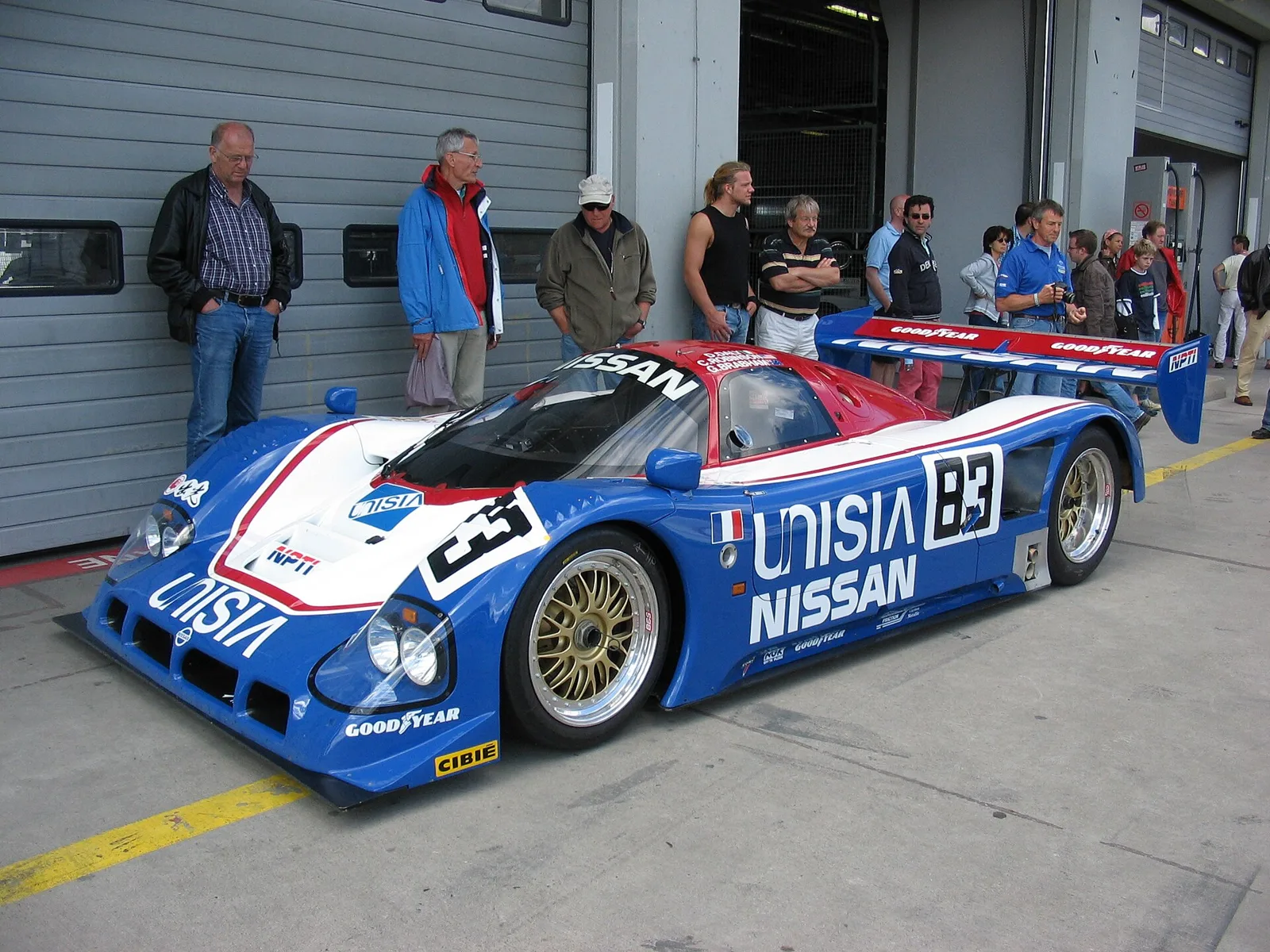
The R90CK was built by Nissan Motorsports Europe as an evolution of the R89C, with a low nose and deep channels. The R90CP, built at Nismo's headquarters in Japan, was a lower downforce car for high speed. Both shared the same cockpit, but their bodywork differed in almost every other way.
The R90CK kept many stylistic elements of the R89C. Its nose was low and slanted, with two deep channels on either side leading to radiator inlets at the sides of the cockpit. Small slatted inlets on the leading edge fed the brake cooling ducts, and the rear wing sat high on exposed struts for downforce.
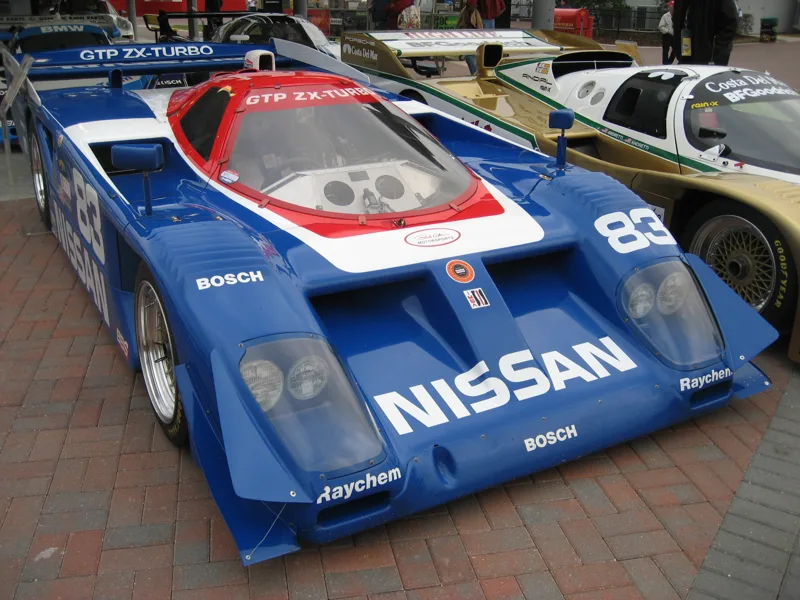
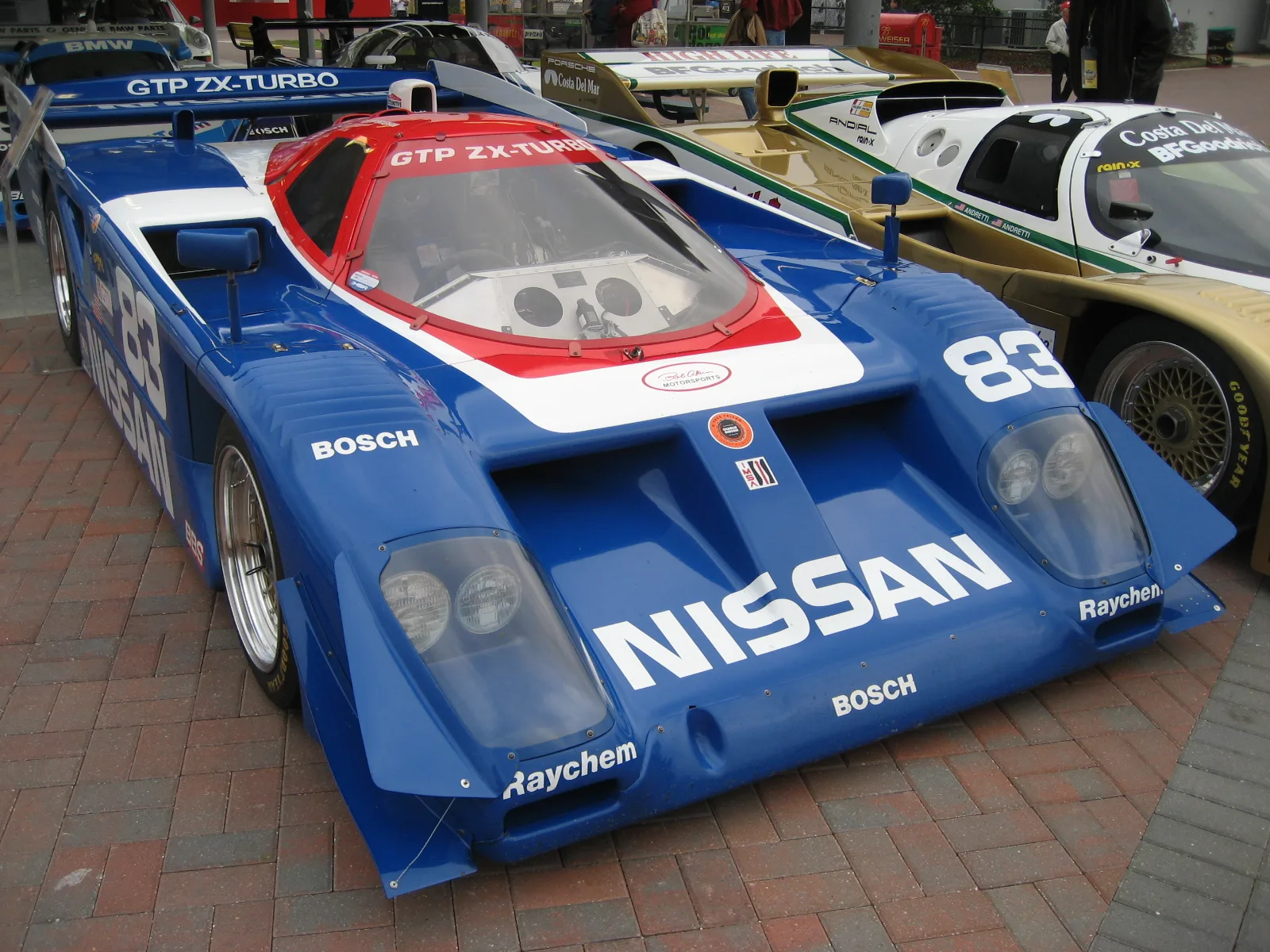
The R90CP had a higher nose, with the narrow channels removed and replaced by large ducts inside the front fenders. Its headlights stood vertically, and its mirrors were built into the fender bodywork. The rear wing sat much lower, joined to the rear wheel fender in a style similar to the Nissan GTP ZX-Turbo sold in North America.
The turbo inlet of the R90CP sat on the front edge of the rear fender, rather than on top of the engine cover as on the R90CK. The R90CP's bodywork therefore differed from its sibling in several places, even though the cockpits were identical.
How was the R90CK developed?
The R90CK was developed with Ray Mallock Limited, and the cars were prepared and run from the RML workshop in 1990 before being shipped to the United States for the 1991 24 Hours of Daytona. The programme was closely tied to the tyre supplier Dunlop, which booked a week-long test session as part of the pre-season work.
Part of that testing took place at the Phillip Island Grand Prix Circuit in Australia, a 4.448 km (2.764 mi) track about 90 km from the Melbourne home of Howard Marsden, Nissan Europe's British-born Australian team manager. Marsden argued that Australian summer conditions at Phillip Island matched what the team would meet in Europe, and that the flowing layout resembled traditional European and British circuits.
Reports at the time said the cars were lapping the circuit in the 1:18s.
How did the World Sportscar Championship season go in 1990?
Nissan's WSC effort began late, because the new R90CKs were not ready for the Suzuka opener. Once they were completed, the team ran the cars towards the front and took a podium at Spa-Francorchamps and a second place at Montreal, before finishing third in the teams championship, four points behind Jaguar.
The first rounds were mixed. At Monza one car ran out of fuel and the second finished seventh. At Silverstone suspension and fuel problems eliminated both cars in the final laps. Spa-Francorchamps brought the first real reward, with both cars finishing and the Acheson and Bailey car taking third, a gap of two minutes to the winning Mercedes-Benz.
For Dijon the drivers were swapped around, and Bailey with Blundell finished on the podium. At Donington Park both cars finished in the top six, and Acheson and Brancatelli took fourth after both Jaguars were disqualified.
The race at Montreal was stopped early because of dangerous conditions. Bailey and Blundell were six seconds behind the leading Mercedes-Benz when the red flag came out, and the second Nissan finished fifth. At Mexico City Bailey and Blundell took second again, two laps behind the winner, while Acheson and Brancatelli finished fourth.
| Round | Best Nissan result | Notes |
|---|---|---|
| Monza | Seventh (second car) | First car ran out of fuel |
| Spa-Francorchamps | Third | Acheson and Bailey, two minutes behind the winning Mercedes-Benz |
| Dijon | Podium | Bailey and Blundell |
| Donington Park | Fourth | Acheson and Brancatelli after the Jaguar disqualifications |
| Montreal | Second | Bailey and Blundell, race stopped early |
| Mexico City | Second | Bailey and Blundell, two laps behind |
Bailey was the highest-ranking Nissan driver in the drivers championship, in ninth place. Nissan then left the World Sportscar Championship, which was abandoned after 1992.
What did the JSPC seasons bring?
Nissan took the R90CP into the JSPC in 1990, with Hasemi, Suzuki, Hoshino and Olofsson sharing the cars. The debut at the 500 km of Fuji brought second and fourth places behind Toyota's new 90C-V. A third Fuji race then delivered Nissan's first win, when Hasemi and Olofsson beat a Porsche 962C by two laps.
Hoshino and Suzuki took the next win at the 1000 km Suzuka, and Hasemi and Olofsson won again at Sugo. Toyota took the final Fuji race by just over a minute, but Nissan won the manufacturers championship, and all four Nissan drivers tied for the drivers title.
For 1991 Nissan upgraded its cars to R91CP specification and sold some older machines to privateers. Nova Engineering used the Yatabe wind tunnel at the Japan Automobile Research Institute to take its R90C to R91CK specification, while Team Le Mans bought an R90CP and modified it into the R91VP.
The opening Fuji round went to the factory team, with Nova second and Team Le Mans fourth. Toyota's new 91C-V debuted at the second Fuji round, but Nissan took the top two places, a lap clear of it. Toyota won the third Fuji race, with Nissan second, ten seconds back.
Nissan beat Toyota at the 1000 km Fuji by a minute, although three of its cars failed to finish. Jaguar won the final round of the year, with Toyota second and Nissan third and fourth. Nissan still won the points championship by three points, and Kazuyoshi Hoshino and Toshio Suzuki took the drivers title by just two points over Toyota's leading pair.
The 1992 season was the last for the JSPC. Nissan upgraded the R91CPs to R92CP specification, and the championship was split into two classes. The older Nissans and the R92CPs ran in C1, while cars meeting the 1992 World Sportscar 3.5-litre engine rules ran in class C.
Nissan won the R92CP's debut at Suzuka, with Jeff Krosnoff and Masahiko Kageyama replacing Olofsson in the winning car. At Sugo the margin over Toyota was just three seconds. At the second 1000 km Fuji a Toyota TS010 easily beat the second-placed R92CP, and a second TS010 joined the final round at Mine, where Nissan finished second and third behind it. Nissan still won the C1 championship, and Kazuyoshi Hoshino took the solo drivers title.
How did the R90C perform at Le Mans?
At the 1990 24 Hours of Le Mans, Nissan entered several R90Cs and R89Cs across its own teams and privateers, but only three cars finished. The best was the lone R90CP of Masahiro Hasemi, Kazuyoshi Hoshino and Toshio Suzuki, which finished fifth, 11 laps behind the winning Jaguar.
The American NPTI R90CK finished 17th, while Courage Competition's older R89C was 22nd. The R90CK was notable for the highest straight-line speed on the Mulsanne Straight after the chicanes were installed. Mark Blundell reached 366 km/h (226.9 mph) on his pole position lap.
That qualifying engine was normally capable of up to 1000 bhp, but a jammed wastegate pushed its output well over 1100 bhp. Bob Earl set the fastest race lap, 3:40.030 in the NPTI car, and the trap speed set in qualifying still stands today.
Nissan did not return to Le Mans with prototypes until the R391 arrived in 1999.
What happened at Daytona?
Nissan made a notable showing at the 24 Hours of Daytona, where the R90C was judged better suited than the GTP ZX-Turbo that ran in the IMSA GT Championship. In 1991, Bob Earl, Derek Daly, Chip Robinson and Geoff Brabham finished second overall in an R90CK.
Three R90CKs were entered in 1991 by NPTI in an invitational class for Group C cars. Two of them failed to finish, but the car of Earl, Daly, Robinson and Brabham finished first in class, 18 laps behind the winning Joest Racing Porsche 962C.
Nissan returned in 1992 with more cars. Two R90CKs were modified to run in the IMSA GTP class, the factory team brought an R91CP from Japan for the invitational class, and Nova Engineering ran its R91CK. The R90CKs suffered, but the R91CP won by nine laps.
How did the R90C platform end?
The platform's final appearance came at the 1993 1000 km Suzuka, part of the new All Japan GT Championship that replaced the JSPC. Team Le Mans fielded a former factory R92CP, while Nova Engineering fielded its R91CK. The two cars took victory, with Team Le Mans ahead of Nova, and the only other prototype in the race was the Spice-Acura.
Why did Nissan leave sports car racing?
Nissan withdrew from the World Sportscar Championship after the 1990 season to concentrate on the JSPC and its IMSA GT Championship effort in North America. The company then stayed away from sports car racing until 1997, and the R90C's Japanese chapter ran on until 1993.
After the 1990 season the WSC cars competed in only one further event. Nova Engineering's R91CK ran in an invitational class at the 1992 1000 km of Suzuka and finished fourth.