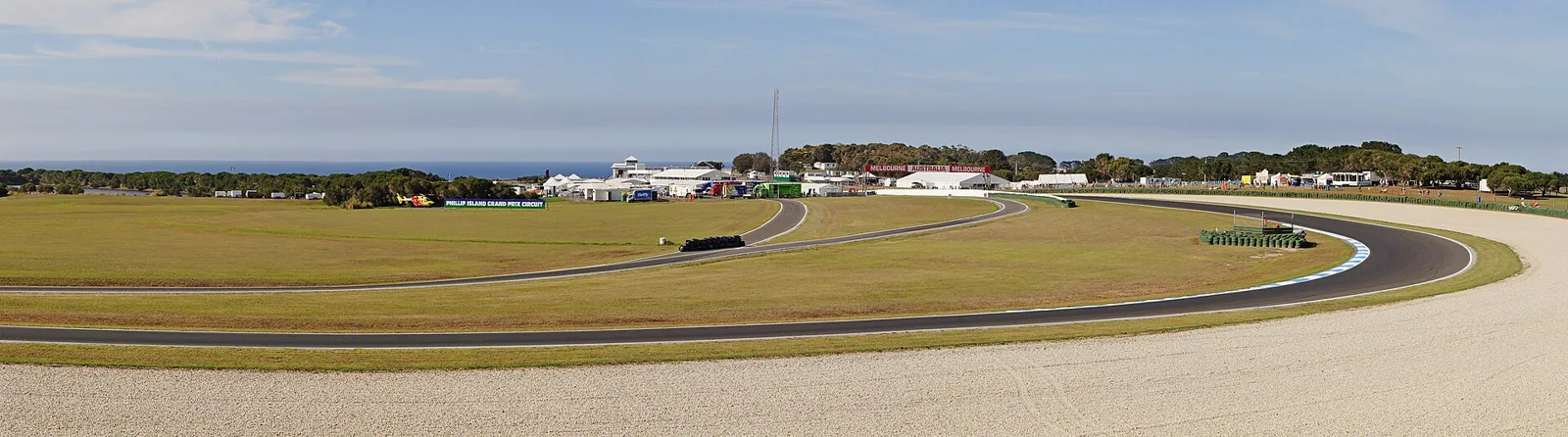
A Victorian coastal track that began as a 1928 road race, was rebuilt in the 1950s, closed and revived, and now hosts the Australian motorcycle Grand Prix and Superbike racing.
The Phillip Island Grand Prix Circuit is a 4.448 km (2.764 mi) motor racing circuit on Phillip Island, Victoria, first used in 1952. It is one of two Australian tracks holding a FIM Category A licence, which allows the highest level of motorcycle racing. The circuit also hosts the Australian motorcycle Grand Prix and the Superbike World Championship.
The Phillip Island Grand Prix Circuit sits near Ventnor on Phillip Island in Victoria, and its story runs from a 1928 road race to the modern motorcycle Grand Prix. The track has been rebuilt, closed and revived several times, and it is now one of two Australian circuits licensed to host MotoGP.
How did racing begin on Phillip Island?
Racing began in 1928 with the 100 Miles Road Race, run on closed public roads in a high-speed rectangle with four similar right-hand corners. The event later became known as the first Australian Grand Prix, and the road circuit hosted the Australian Grand Prix through to 1935.
Car and motorcycle courses used different lengths. The car course measured about 6 mi (9.7 km) per lap, while the motorcycle circuit was about 10 mi (16 km) long. The island also hosted other events, including the 1934 Phillip Island 100, the 1934 Winter 100 and the 1935 Centenary 300.
The final use of the rectangular course came on 6 May 1935, when the Jubilee Day Races were run. The island's road racing then moved onto a new layout, and the last car event on it was held on Cup Day in 1938.
A 1928 road race on closed public roads, rebuilt in 1952 on a coastal site with grades of up to 57 metres.
What were the road circuit layouts like?
The original road circuit ran about 6 mi (9.7 km) per lap for cars and about 10 mi (16 km) for motorcycles. A new 3.312 mi (5.330 km) triangular circuit, which used the pit straight from the old course, was first used for the Australian Race Drivers' Cup on 5 November 1935.
The triangular layout hosted car racing until Cup Day in 1938, and the final motorcycle race meeting on the island was held on 30 January 1940.
Why was a new circuit built in 1952?
Six local businessmen decided in 1951 to build a new track, about 2 km (1.2 mi) from the original circuit, and it opened in 1952. The land sat on the coast, and its steep grades, with the highest point 57 metres above the surrounding ground, caused cost overruns and delays before the track could open.
The Phillip Island Auto Racing Club hoped to create Australia's first international grand prix circuit. It asked for 7000 subscriptions at 10 pounds each to fund development. An Alfa was used to measure the three-mile distance needed for international certification as an International Circuit.
| Year | Milestone |
|---|---|
| 1928 | 100 Miles Road Race, the first Australian Grand Prix |
| 1935 | Triangular 3.312 mi (5.330 km) circuit first used |
| 1952 | Current circuit opened near Ventnor |
| 1960 | Inaugural Armstrong 500 production car race |
| 1962 | Damage from the Armstrong 500 leads to closure |
| 1967 | Circuit reopens with a newly laid surface on 22 October |
| 1988 | Refurbished circuit reopens on 4 December |
| 1989 | First World Championship motorcycle round in Australia |
| 1990 | First Superbike World Championship round on the island |
| 2014 | Jamie Whincup wins a sixth ATCC and V8 Supercars title |
Before the Armstrong 500, the new track staged numerous trophy races. In 1957 these included the Australian Motorsport Magazine Trophy Race, and the Formula Libre race and the Phillip Island Trophy race both followed in 1958.
What happened at the Armstrong 500 in 1960 and 1962?
The inaugural Armstrong 500 production car race took place in 1960 and was won by Frank Coad and John Roxburgh in a Vauxhall Cresta. They completed the race in 8 hours 15 minutes. The race was run as a long-distance endurance event for production cars.
Extensive damage in the 1962 running left the owners unable to finance repairs. The circuit was closed, and the race moved to the Mount Panorama Circuit at Bathurst in New South Wales, where it eventually became the Bathurst 1000.
How did the circuit survive its lean years?
Len Lukey, a businessman and former Australian Drivers' Champion, bought the circuit in 1964 with a view to redevelopment, and a corner is now named after him. The track came back into use in October 1967, with a freshly laid surface and a Grand Re-Opening Meeting on 22 October.
The Phillip Island 500, an endurance event, was held between 1971 and 1977 as a round of the Australian Manufacturers' Championship. The same circuit also counted towards the Australian Touring Car Championship in 1976 and 1977. Its demanding ground took a toll, and the track gradually lost its condition through the 1970s.
The circuit closed in 1978 and was used only for historic rallies and cub sprints from 1979 to 1982. A problem with the Phillip Island Bridge made matters worse, because it reportedly could not carry the heavy vehicles needed for a hot-mix resurfacing. The track was laid with a cold mix that broke up under racing loads, and the bridge was not rebuilt until the mid-1980s.
Placetac Pty Ltd bought the circuit in 1985 to bring racing back. After refurbishment at 4.448 km (2.764 mi), the circuit welcomed motorcycles again on 4 December 1988, for the closing round of that year's Swann Insurance International Series.
When did motorcycle racing arrive at the circuit?
The Australian motorcycle Grand Prix joined the FIM Road Racing World Championship calendar in 1989, when the race was held on 9 April at Phillip Island. It was the first World Championship round held in Australia, and Wayne Gardner won the 500 cc race in front of a large crowd.
The 1989 race was a close contest in the 500 cc division. Gardner beat local rival Kevin Magee, with Wayne Rainey and Christian Sarron also in the mix. Gardner went on to win again in 1990, before the race moved to Eastern Creek in Sydney for 1991.
Who won the motorcycle Grand Prix in later years?
The race returned permanently to Phillip Island from 1997. Michael Doohan won the Grand Prix in 1998, and the first corner of the circuit is named after him. Troy Corser won the Superbike World Championship on a Ducati at the October 1996 race on the island.
Casey Stoner won the Australian Motorcycle Grand Prix six times in a row, and his 2012 win was his last Grand Prix victory of his career. The third corner was named after him before that race. The contract for the Grand Prix has been prolonged until 2026, and tobacco advertising has been banned since 2007.
Organisers have long treated the Grand Prix as a promotional event rather than a source of profit.
When did the Superbike World Championship come to Phillip Island?
In 1990 the island replaced Sydney's Oran Park Raceway as the Australian venue for the Superbike World Championship, staging its first round there. The round is still held every year at the island.
Local riders Peter Goddard on a Yamaha FZR750 and Rob Phillis on a Kawasaki ZXR750 won the two races in that first round, which was Round 12 of the season. Goddard had also secured pole position.
How did touring cars and V8 Supercars use the track?
The Australian Touring Car Championship returned to the circuit in 1990 as a sprint round, its first visit since 1977. Dick Johnson won the round in his Ford Sierra RS500, which turned out to be his final round victory of his career.
The sprint format ran every year from 1993 to 2004. From 2005 to 2007 the Grand Finale decided the V8 Supercars champion at the island, and the 2006 finale was controversial. From 2008 to 2011 the venue ran a 500 km race known for sponsorship reasons as the L&H 500.
The Phillip Island 500 later replaced Sandown's race as the annual V8 Supercar 500 km event. Since then the island has hosted a sprint round of the championship known as the Phillip Island Super Sprint. In 2014 Jamie Whincup became the first driver to win a sixth ATCC and V8 Supercars title.
Who owns the circuit and what is planned?
The Linfox corporation bought the circuit and surrounding land in 2004. By then the track had been back in use since 1988 for motorcycles and, from 1990, for touring cars and Superbikes. The plan was to complement the track with an 18-hole golf course designed by Greg Norman and a 5-star hotel, along with other facilities.
A multimillion-dollar redevelopment followed in late 2006, carried out by the Linfox Group. It included the construction of a new karting circuit.
What are the circuit's lap records?
Simon Wills set a longstanding outright lap record in the Formula Holden category in 2000. Testing times are kept apart from official records, which are set at race meetings.
Early 1990s pre-season testing brought World Sportscar teams and Japanese Formula 3000 teams to the island. Neil Crompton reported in 1990 that a Nissan R90C driven by Julian Bailey and Mark Blundell lapped in around 1:18, while the Formula Holdens with 3.8 litre V6 engines were about 10 seconds per lap slower.
In October 2018 Mathew Radisich drove his 2011 ex-Conquest Racing IndyCar during an unofficial practice day. Recorded Cosworth data showed a lap of 1:17.005, but because it came from a practice day rather than a meeting, it cannot be entered as an official record.
What events run at Phillip Island today?
The calendar starts in February with the Superbike World Championship, the Supersport World Championship and the Australian Superbike Championship. March brings GT World Challenge Australia and the Phillip Island Classic, while the Australian Prototype Series runs in August. Across the year the calendar therefore spans motorcycle, sports car and touring car racing.
October is the motorcycle Grand Prix month, with the Australian Superbike Championship also on the schedule, and November closes the year with Island Magic. Many former events, including the Armstrong 500 and the Australian Tourist Trophy, are no longer on the calendar.
Former events on the island's list are broad. They include the S5000 Australian Drivers' Championship from 2021 to 2023, the Porsche Carrera Cup Australia Championship, the Australian Production Car Series and the Australian Super Touring Championship from 1993 to 1998. The FIM Endurance World Championship and the Sidecar World Championship also visited the circuit.