A twin-turbo, four-wheel-drive coupe from 1989 that won races at home and abroad, and that returned decades later as an electric conversion.
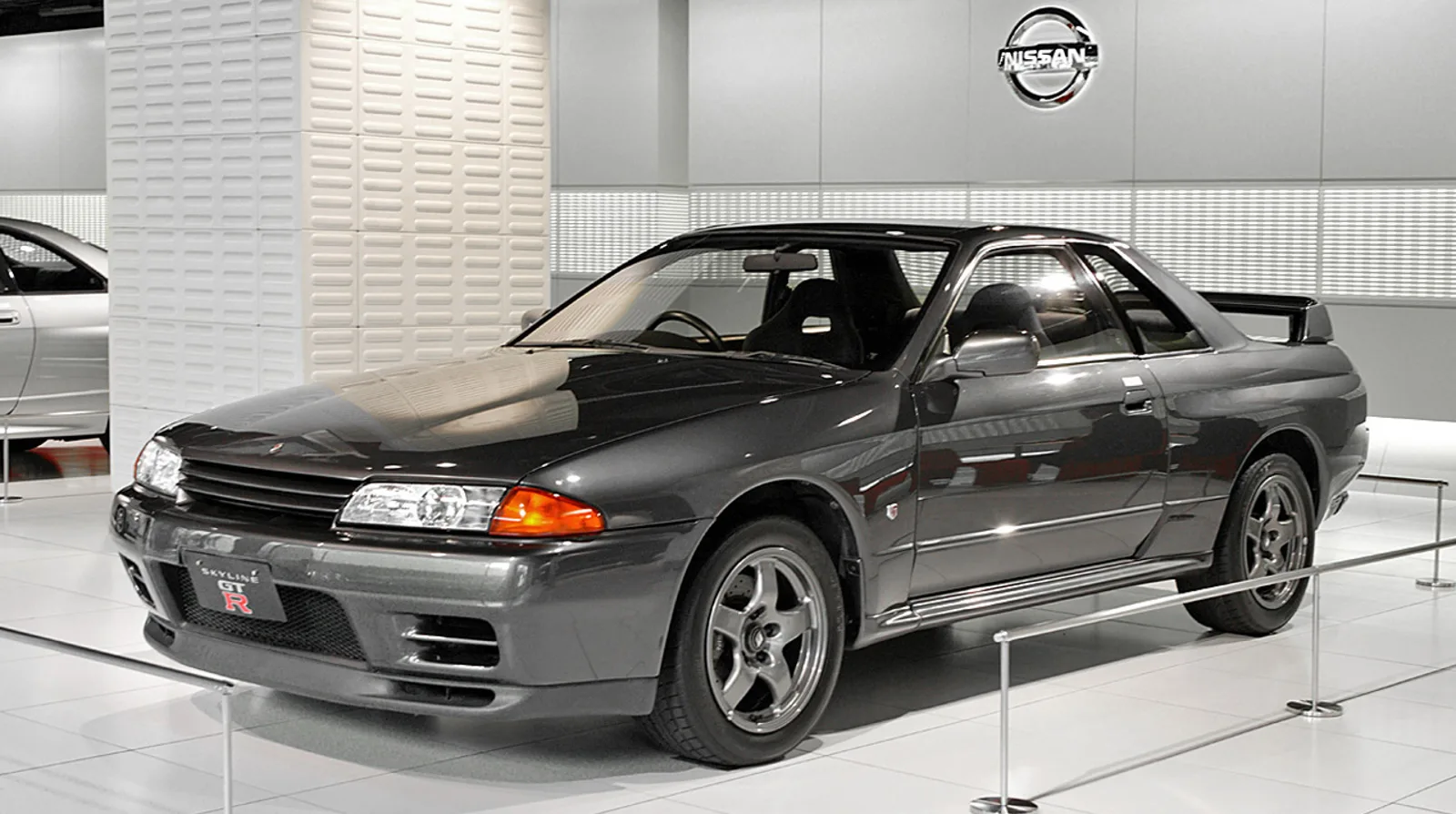
The Nissan Skyline GT-R BNR32 was a two-door sports coupe built on the eighth-generation Skyline. Sold from August 1989, it carried a 2,568 cc twin-turbo engine and four-wheel drive. Nissan built 43,934 of them in total before production ended in 1994.
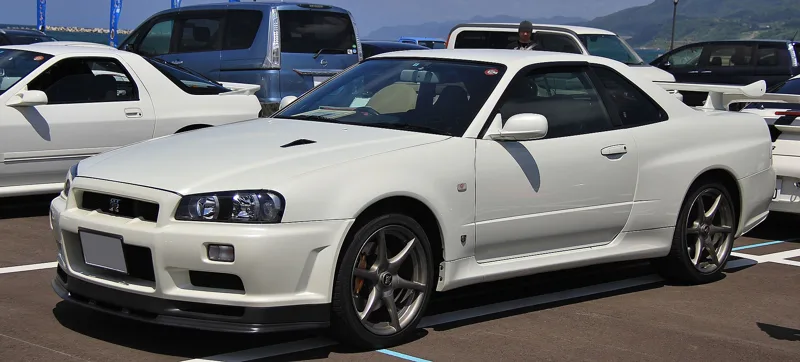
The Nissan Skyline GT-R BNR32 brought the GT-R name back in 1989, sixteen years after the previous GT-R had left production. The car started life as a two-door coupe from the eighth-generation Skyline range, and it added a twin-turbo engine, four-wheel drive and four-wheel steering. More than 30 years after production ended, its racing career still keeps it in the minds of enthusiasts.
Fans often shorten the name to R32 or 32R. In Japan the car is likened to Godzilla, the monster that represents the country's films, and that comparison shows how strongly the car is remembered.
Where did the R32 GT-R come from?
Nissan unveiled the eighth-generation Skyline, R32 type, on 22 May 1989. That four-wheel-drive GT-R reached showrooms on 21 August, and it had been developed under the provisional name GT-X. It was the first GT-R since the KPGC110 of 1973 went out of production.
The car capped off the 901 campaign, the programme Nissan was pursuing at the time, and it gathered the latest devices of the period. Earlier plans had been dropped along the way. When the R31 Skyline was on sale, Nissan had considered bringing back the GT-R as a two-door coupe, but that coupe used the RB20DET engine from the four-door sedan, and journalists had been harsh about that engine. The chief development engineer, Shurei Ito, withdrew the plan.
Following the Plaza Accord, Nissan's financial performance declined, and the team judged that a call to revive the GT-R at that moment would not be accepted. Development therefore went ahead under the provisional name GT-X.
The first prototype shared its floor pan with the ordinary Skyline. Because the project was highly secret, a test car with widened fenders was built on the C32 type Laurel instead of the R31 Skyline, according to the testimony of developer Tsutomu Nagashima.
A twin-turbo, four-wheel-drive coupe that brought the GT-R name back in 1989 and then won race after race.
Why did the RB26DETT engine matter?
The RB26DETT was a 2,568 cc twin-turbo engine developed specifically for this car, and it produced 280 PS (206 kW; 276 hp) in Japanese-market form. Its strength far exceeded that of an ordinary road engine, because it had been developed with racing in mind from the outset.
The engine followed the same philosophy as the S20 unit before it, with motorsport as the purpose. That gave it strength far beyond typical road car engines. The trade-off was weight, because the strength came from a cast iron block, and the front-heavy balance of 59.4:40.6 made the car heavier still at the nose.
The chassis was just as ambitious. The ATTESA E-TS system controlled a torque-split four-wheel-drive system electronically, SUPER HICAS provided four-wheel steering, and a mechanical limited-slip differential sharpened cornering. Tyres were 225/50R16 92V, and the suspension was tuned specially for them.
Those choices had a cost. The stock brakes could not cope with hard driving, and understeer lingered. Early N1 racing was troubled by strong understeer, and brake fade caused retirements. As a countermeasure, the V-spec later used larger Brembo brake calipers.
Why was the car rated at 280 PS?
Nissan had planned to sell the GT-R with the Fairlady Z and the Infiniti Q45 as the first trio of Japanese cars rated at 300 PS. Horsepower regulations of the time capped all three at 280 PS for Japanese buyers, while export Fairlady Zs and Q45s stayed at the full 300 PS.
The Fairlady Z and Q45 sold abroad kept the full 300 PS (221 kW; 296 hp). The lower Japanese figure came from the horsepower regulation of the time.
What set the Australian cars apart?
About 100 cars were assembled from kits at Nissan Motor Australia's Clayton plant, and only Australian buyers received them. The power matched the Japanese car, but several small changes set Australian cars apart. Each car carries a 17-digit VIN that begins with 6F4, a sign that Nissan Motor Australia built it.
The speedometer read on a 260 km scale, the antenna was mounted at the front centre of the roof, and a high-mounted stop lamp was added. Each change was small, but together they marked the Australian cars out from the Japanese ones.
The overseas nickname came from the Australian touring car scene. The GT-R's impact there was such that it lapped rival manufacturers, and the name Godzilla followed it from that moment.
Which grades did the R32 GT-R come in?
The line-up started with the standard GT-R, and the range grew into the NISMO, V-spec, V-spec II and N1 versions. Kerb weight ran from 1,430 kg (3,153 lb) on early cars to 1,480 kg (3,263 lb) on mid and late cars, while the NISMO was lighter still.
The standard GT-R was offered from the first day of sales. Its weight rose with the mid-period update, from 1,430 kg to 1,480 kg.
The GT-R NISMO existed to homologate the Group A racing car. It was limited to 500 units, and 560 were made in total once race-based machines were counted. Nissan Motorsports International's Omori Factory tuned it. The turbocharger changed from ceramic to metal. Stripped out were ABS, the intercooler grille, the rear wiper, the audio system and the air conditioning, which brought the car down to 1,400 kg (3,086 lb). A bonnet moulding and an extra front bumper opening, known as the Nismo duct, helped the cooling.
The V-spec arrived in February 1993 with the late-type facelift and commemorated a third straight JTC win. Its brakes grew to 324 mm front rotors and 300 mm rear, and Brembo calipers were fitted, a first for a Japanese car. Tyres were 225/50R17 on BBS wheels. The V-spec II followed in February 1994 with 245/45R17 tyres.
The N1 went on sale on 19 July 1991 for Japan Automobile Federation N1 rules and the N1 endurance race, now Super Taikyu. It dropped the comfort equipment and ABS, and its RB26 engine had a thicker block and was built for durability at higher output. Later N1 versions followed the V-spec and V-spec II.
What colours could buyers choose?
Eight body colours were offered, led by the image colour Gun Grey Metallic, code KH2. Other choices included Jet Silver Metallic, Red Pearl Metallic, Crystal White, Dark Blue Pearl and Greyish Blue Pearl.
Dark Green Metallic, code DH0, appeared in the pre-launch sales catalogue and even had prototypes built, but the GT-R never received it. Later, the GTS grade adopted that colour from the middle of production onward.
In August 1991 Spark Silver Metallic joined the palette, alongside Crystal White and Greyish Blue Pearl, and Jet Silver Metallic was dropped.
How did the GT-R dominate the JTC?
The GT-R made its race debut in round one of the JTC in 1990, and it won all six rounds that season. Its record in the series stayed unbeaten until the JTC ended in 1993, a run of 29 consecutive wins.
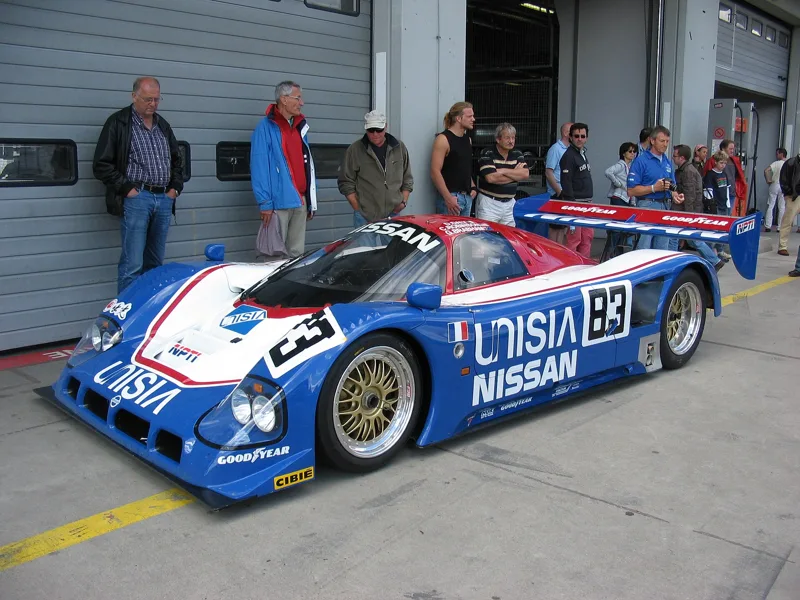
In the first race, the Calsonic Skyline driven by Kazuyoshi Hoshino and Toshio Suzuki took pole and the win at the West Japan Circuit. Qualifying saw the course record come down by almost two seconds, and by a quarter distance the car had already lapped every rival.
The number of GT-Rs gradually increased. In 1993, the final season, seven took part, and Group A Class 1 had effectively turned into a one-make contest for the car.
The series titles followed the GT-R's own drivers. Hoshino took the 1990 title with five wins, Masahiro Hasemi won the 1991 title with three and the 1992 title with two, and Masahiko Kageyama took the 1993 title with four.
The All Japan Touring Car Championship (JTCC) was set to run under FIA Class 2 touring car rules, covering four-door sedans with engines of up to 2.0 L, so from 1993 the racing shifted to the All Japan GT Championship (JGTC).
How did the car fare outside Japan?
The GT-R raced abroad with similar success, most clearly in Australia and at the 24 Hours of Spa-Francorchamps. The Australian titles went to Jim Richards and Mark Skaife in 1990, 1991 and 1992, and the Spa overall win came in 1991.
Results in Australia were so dominant that the 1993 rules introduced Class 2 Super Touring, which outlawed turbocharged and all-wheel-drive machinery. The top class then went to 5.0 L V8 Australian cars, effectively a contest between Ford Australia and Holden. Richards and Skaife also won the Bathurst 1000 km in consecutive years.
At Spa the GT-R took all the Group N podium places in 1990. In 1991 Keith Odor, Takayuki Kinoshita and Dirk Schuys placed sixth overall and took the Group N class, while the ZEXEL Skyline, a factory entry from Nissan, finished more than 20 laps clear to win overall. In 1992 the ZEXEL Skyline carried a 90 kg handicap, fought the BMW M3 cars and led early, but engine trouble dropped it back, and a petrol fire during a pit stop ended its race.
In November 1990 Masahiro Hasemi's Castrol Skyline took pole and then won the gear race held as part of the Macau Grand Prix, which was for Group A machines.
Those results prompted the ACO, organiser of the 24 Hours of Le Mans, to move to ban four-wheel drive outright. The GT-R's only World Rally Championship outing came on the Tour de Corse in 1990, with Hiroshi Nishiyama and Masahiro Nagayama in the Gr.N class, and it produced no results.
What did the R32EV change?
Nissan announced its R32EV conversion project on 28 March 2023 and first showed the car at the Tokyo Auto Salon 2025 on 10 January 2025. The electric version uses two motors for four-wheel drive, with a lithium-ion battery placed where the rear seats had been.
Ryozo Hirakou led the project. His earlier work covered battery-electric drivetrains, e-POWER series hybrids and the e-4ORCE electric four-wheel-drive system. His reasoning was that in 30 years the original would be hard to drive and maintain, and that modern electric and digital technology could let future generations experience it.
The battery is the same lithium-ion unit used in the Leaf NISMO RC02. A charging port now occupies the old fuel-filler spot, and putting the original drivetrain back is also possible.
The electric conversion added 300 kg (661 lb), so the car received the Ohlins sports suspension kit and the stronger genuine brakes of the R35 GT-R. The wheels grew from 16 inches to 18 inches while keeping the original design almost unchanged, and the tyres are 245/40R18.
Output and torque-to-weight figures matched the original, and the way the car accelerated, slowed and split torque front to rear barely changed. Test driver Hiroyoshi Kato collected the original driving data at the Tochigi test course to reproduce the handling faithfully.
Inside, the seats are Recaro units in the original colours and covering, and paddle shifters give a simulated gearchange without a gearbox. The floor selector follows the PRND pattern of automatic cars, but it has a grip shape copied from a manual shift. The centre panel uses a liquid crystal display, with the displays kept close to the original.
A dedicated sound system reproduces the original engine note, including idling, blipping and gear-change sounds. The sound is played only inside the cabin, and the driver switches it on with a satellite switch left of the instrument panel. The seats vibrate with the sound, so the feel while driving stays close to the original.
Age had taken its toll on the seats, steering wheel and gear knob, and analogue meters were difficult to find, so the interior was partly changed. Nissan also captured the car in 3D, from the cabin to the engine bay.
Specifications at a glance
| Specification | Detail |
|---|---|
| Engine | 2,568 cc (156.7 cu in) RB26DETT twin-turbo |
| Output in Japan | 280 PS (206 kW; 276 hp) |
| Torque | 36 kgf-m |
| Drive | ATTESA E-TS four-wheel drive, SUPER HICAS four-wheel steering |
| Front to rear weight split | 59.4:40.6 |
| Kerb weight, early type | 1,430 kg (3,153 lb) |
| Kerb weight, mid and late types | 1,480 kg (3,263 lb) |
| Standard tyres | 225/50R16 92V |
| NISMO kerb weight | 1,400 kg (3,086 lb) |
| Total production | 43,934 cars |
| Last standard car off the line | 7 November 1994 |
| Sales ended | December 1994 |
How did production end?
The model's total output was 43,934 cars. The final standard car rolled off the line on 7 November 1994, and after that only stock could be supplied. Sales finally ended in December 1994, which closed the run of the R32 GT-R.
The first facelift came in August 1991. It added side-impact reinforcement and steering pads designed to absorb impact, which raised the weight by 50 kg (110 lb). The headlamps grew from H3C to H1, and the crankshaft and cylinder block were strengthened.
The late type arrived in February 1993 with a pull-type clutch in place of the push type, and the transmission synchromesh was improved. From model year 1994 the rear differential cover was the Laurel's type.
Why do fans still talk about the R32?
The car's racing record, its Godzilla nickname and its long afterlife keep it in conversation. Fans still hold it in high regard more than 30 years after production ended, and many shorten its name to R32 or 32R.
The R32EV drew a divided reaction when it was announced. Older fans rated the original engine very highly, so removing it was hard for many to accept. Some inside Nissan also pushed back, but Hirakou said he had expected that and chose to go ahead.
His aim, in his account, was to pass the appeal of the car on to future generations. He chose to combine the car with modern technology rather than simply copying it, so the result is a more modern and futuristic approach.