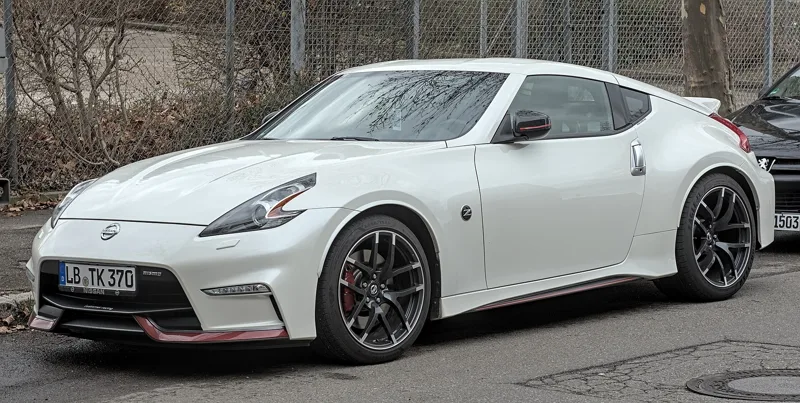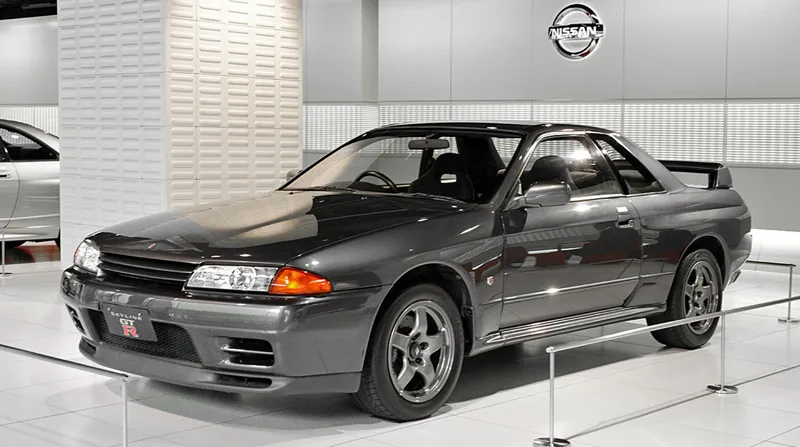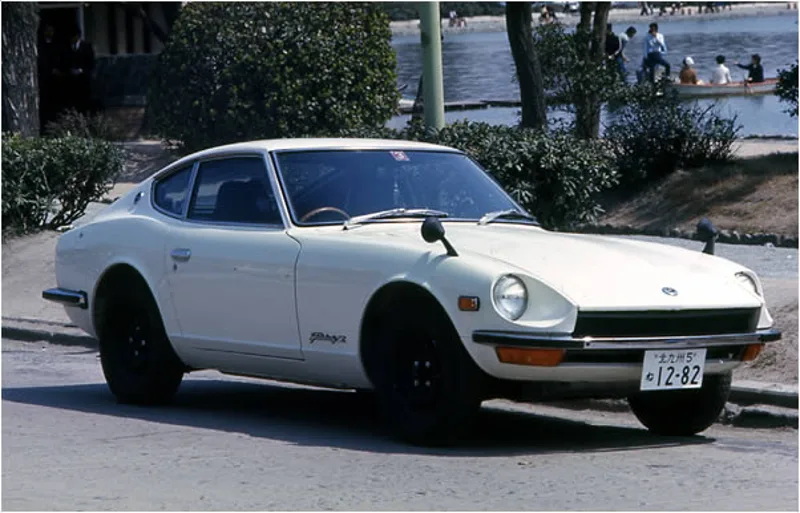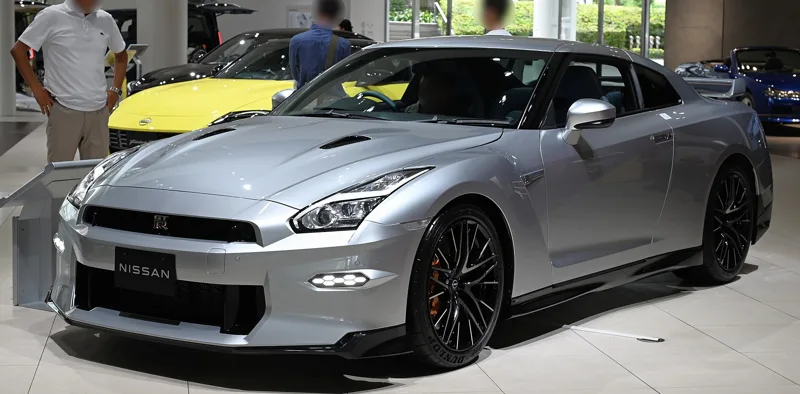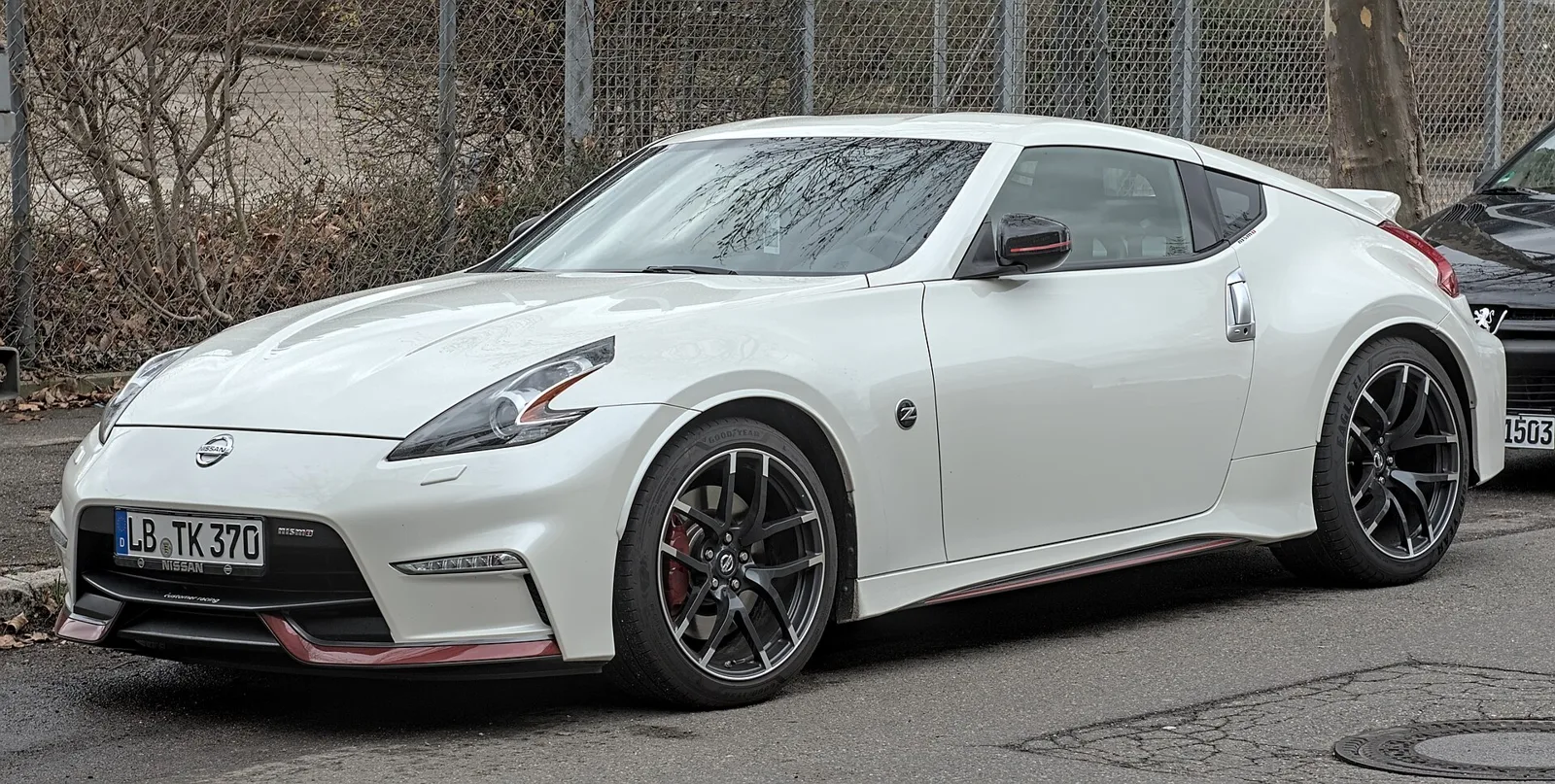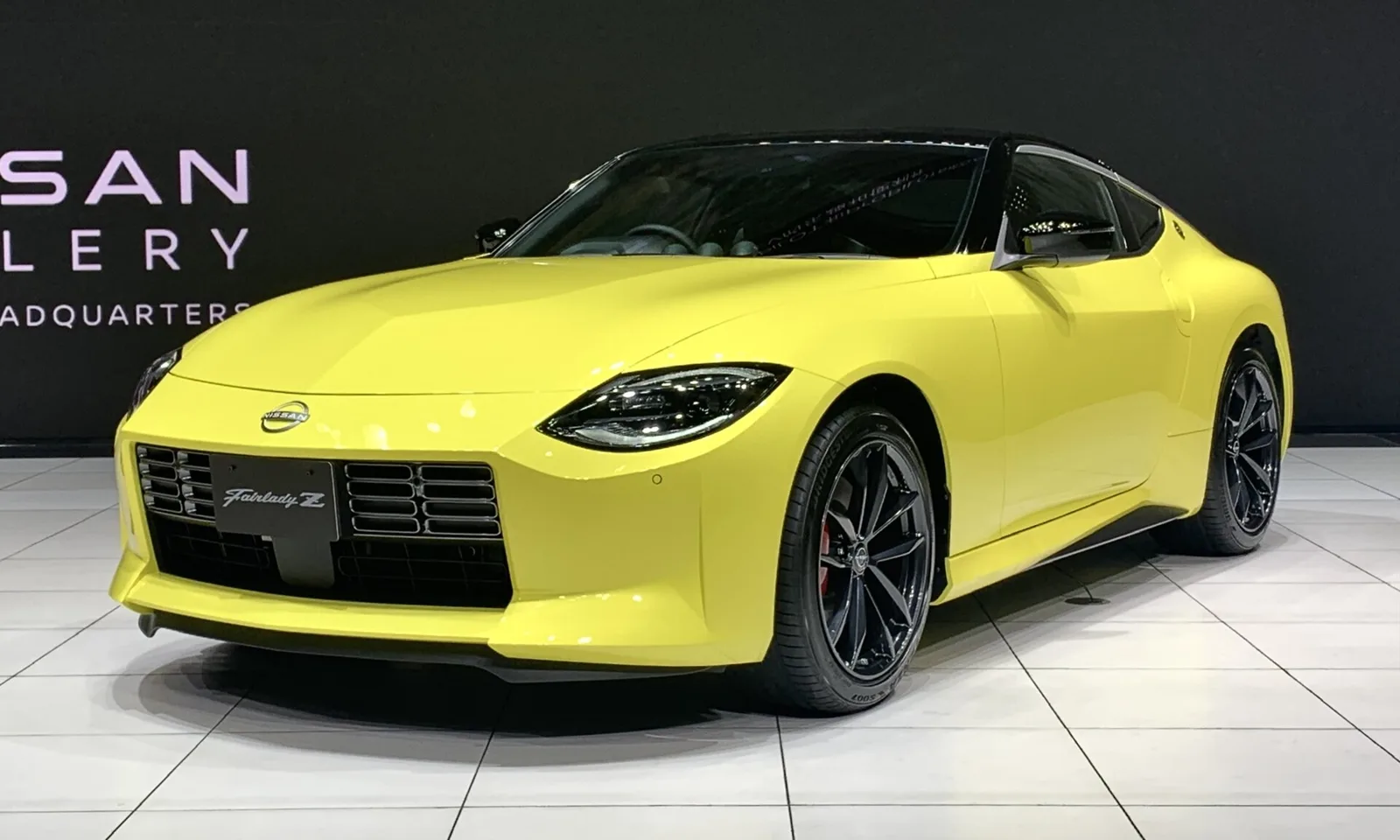
The RZ34 Z dropped the numbered naming of its predecessors, borrowed the VR30DDTT from the Skyline and returned to 240Z-inspired styling.
The RZ34 Nissan Z arrived in 2022 with a twin-turbo 3.0-litre V6 rated at 400 hp, borrowed from the Red Sport 400 family. The Z Nismo raises that output to 420 hp.
The Nissan Z is the seventh generation of Nissan's Z-car sports car line, known as the Fairlady Z in Japan and Indonesia. It succeeded the 370Z on a modified version of that car's platform, and it dropped the numerical naming that earlier generations carried. Its retro styling, twin-turbo V6 and manual gearbox placed it firmly in the line's tradition.
How did the Nissan Z come about?
In 2018, Alfonso Albaisa, Nissan's senior vice president for global design, hinted that a direct successor to the 370Z was in development. He confirmed the plan to the Australian magazine WhichCar, and the project moved forward from there.
Nissan filed a trademark for a new version of the Z-car logo on March 19, 2020. On May 28, 2020, a video on Nissan's YouTube channel showed the updated lineup as part of the company's global restructuring plan, Nissan Next. It confirmed retro styling, with the overall shape and circular running lights referencing the 240Z.
Nissan revealed the prototype as the Nissan Z Proto Concept on September 15, 2020. The prototype was 4,382 mm (172.5 in) long, which was 142 mm (5.6 in) longer than the 370Z, and it shared the same width. In August 2021 Nissan unveiled the price, specification and details of the production car in New York City.
The production unveiling took place on August 17, 2021, and the car was presented by Cody Walker, brother of the late Paul Walker. The production model came in two trims, Z Sport and Z Performance, which were called Fairlady Z Version S and Version ST in Japan.
A 400 hp twin-turbo V6 in a body that borrows its emblem, grille and tail from earlier Z-cars.
What engine and drivetrain does the Nissan Z use?
The Z uses the VR30DDTT, a 3.0-litre twin-turbocharged V6 with direct injection and variable valve timing. It is the same engine used in the Infiniti Red Sport 400 and the Nissan Skyline 400R V37 in Japan. Output for the base Sport is 298 kW (400 hp; 405 PS) at 6,400 rpm, with 475 N m (350 lb ft; 48 kg m) of torque between 1,600 and 5,600 rpm.
The engine runs up to 14.7 psi (101 kPa) of boost and has a redline of 6,800 rpm. A six-speed manual carries on the tradition of earlier Z-cars, while the optional gearbox is a nine-speed automatic. That automatic is a Mercedes-Benz 9G-Tronic unit built under licence by Jatco and branded JR913E.
Manual models get a carbon-fibre driveshaft, an EXEDY performance clutch and rev-matching on downshifts. Automatic models get launch control and aluminium paddle shifters, and the Performance trim adds SynchroRev Match to its manual.
How does the Nissan Z handle and stop?
The chassis is built on the same Nissan FM platform as the previous two generations. The front uses double-wishbone aluminium suspension with an increased caster angle, which improves straight-line tracking and high-speed stability, and a front strut tower brace stiffens the structure. A rear multilink suspension completes the layout.
The car runs wider tyres than the 370Z, larger monotube shocks and extra body rigidity to improve cornering. Standard brakes use 12.6-inch front rotors with fixed two-piston calipers and 12.1-inch rear rotors with single-piston calipers. The base car rides on 18-inch aluminium alloys with Yokohama Advan tyres.
The Performance trim adds a mechanical clutch-type limited-slip differential, 14.0-inch front and 13.8-inch rear rotors with red floating aluminium calipers, and 19-inch Rays forged alloys wearing Bridgestone Potenza S007 tyres. Front and rear spoilers add downforce.
How does the Nissan Z look?
The exterior is inspired by earlier Z-cars. The taillights resemble those of the Z32 300ZX, and the car uses the S30 Fairlady Z emblem. The distinctive headlights of the Z34 gave way to a rounded LED design, and the front mask has a sharp, large grille similar to the S30 and Z33.
Nissan's chief product specialist, Hiroshi Tamura, told CarExpert that around 80 percent of the body was changed, while carry-over parts kept the cost down. The hood, doors and hatchback are aluminium to save weight, and the Sport manual weighs 1,581 kg (3,486 lb) against 1,610 kg (3,549 lb) for the automatic.
Nissan offered three single-tone paints, Black Diamond Pearl, Gun Metallic and Rosewood Metallic. It also offered six two-tone schemes that pair a Super Black roof with colours such as Ikazuchi Yellow TriCoat and Passion Red TriCoat. Dual body-coloured mirrors with integrated LED turn signals complete the look.
What does the Nissan Z interior offer?
The cabin was designed with help from Nismo and from Tsugio Matsuda, a Super GT GT500 driver. It has a customisable 12.3-inch TFT instrument display, a programmable shift indicator and three analogue gauges on top of the dash that show boost, turbocharger speed and battery voltage.
The seats are manually adjustable sport buckets similar to those in the GT-R. The driver's seat adjusts eight ways and the passenger seat four ways. An 8.0-inch touchscreen with navigation and NissanConnect services is standard, along with a six-speaker Bose system with active noise cancellation.
Safety kit as standard covers a lane warning, pedestrian-aware emergency braking and adaptive cruise, and the phone links are Apple CarPlay and Android Auto.
How does the Performance trim differ from the Sport?
The Performance, known as Fairlady Z Version ST in Japan, uses the same VR30DDTT and the same six-speed manual and nine-speed automatic. It keeps all the Sport equipment and adds the suspension, brake and wheel upgrades described above.
Interior upgrades on the Performance include heated four-way power leather seats, a 9.0-inch touchscreen with navigation, NissanConnect services and an eight-speaker Bose audio system. The manual weighs 1,604 kg (3,536 lb), and the automatic 1,634 kg (3,602 lb).
What makes the Z Nismo different?
The Z Nismo was revealed on August 1, 2023 for the 2024 model year, with major changes to both looks and mechanics. Its VR30DDTT received a redesigned wastegate, enhanced ignition timing and upgraded engine and oil cooling, inspired by the GT-R Nismo. Output rose to 420 hp (313 kW; 426 PS) at 6,400 rpm, with 384 lb ft (521 N m; 53 kg m) of torque from 2,000 to 5,200 rpm.
The car initially came with the nine-speed automatic, which had Nismo-tuned clutch packs and engine management software for downshifts twice as fast. A six-speed manual was announced for the 2026 model year, and a new Sport+ driving mode gives quick downshifts without the paddles. Curb weight rose to 1,680 kg (3,704 lb).
Chassis upgrades include extra bracing that increases torsional rigidity by 2.5 percent over the Performance, a steel driveshaft in place of the carbon-fibre unit, stiffer bushings and larger dampers. The brakes use four-piston calipers and 15.0-inch front rotors with 13.8-inch rears. The Nismo wears wider gloss-black wheels with Dunlop SP Sport MAXX GT600 tyres and a three-piece rear spoiler, and its cabin has red and black trim with Recaro bucket seats.
How fast is the Nissan Z?
Top speed is capped at 249 km/h (155 mph). In Hagerty's drag test, an automatic Z Performance reached 97 km/h (60 mph) in 4.0 seconds and crossed the 402-metre line in 12.3 seconds at 187 km/h (116 mph).
The manual Performance reached 97 km/h (60 mph) in 4.3 seconds, then took 12.8 seconds to cover 402 metres, ending at 180 km/h (112 mph).
Where is the Nissan Z sold and what does it cost?
Nissan did not offer the Z in Europe, including the United Kingdom, Ireland, Turkiye and Ukraine, because of strict emissions and noise rules. It is sold in Japan, North America, Australia, New Zealand, Southeast Asia, the GCC countries of the Middle East and Latin America.
Japanese pricing for the S was announced in April 2022 at 5,241,500 yen (US$41,081 at the time), and the ST started at 6,462,500 yen (US$50,650). In the United States the Sport started at US$41,015 and the Performance at US$51,015. Production began in April 2022, with deliveries starting in late 2022 after supply delays.
US sales were 263 in fiscal 2022 and 1,771 in fiscal 2023, for a total of 2,034 cars sold in the United States as of December 31, 2023.
Which special editions were built?
Nissan announced a launch edition, the Z Proto Spec Edition, before the production car went on sale. It was limited to 240 units and shared the look of the Z Proto concept, with a black and yellow exterior, bronze wheels with yellow brake calipers, black seats with yellow stitching and a yellow shift knob.
Pricing for the Z Proto Spec started at 6,966,300 yen (US$54,599) in Japan and at US$54,015 in the United States. At the 2022 Tokyo Auto Salon, Nissan also unveiled a one-off prototype, the Fairlady Z Customized Proto, with an orange body, a split front grille and black eight-spoke wheels. Nissan described it as a way to gauge interest in future accessories, and it had no technical changes from the production car.
How has the Z performed in motorsport?
The Z GT500 was unveiled at Fuji Speedway in December 2021 and entered the 2022 Super GT season, the first time Nissan had raced a Z in that series in 15 years. It replaced the GT-R GT500, which had run for 13 seasons. Its debut at the Okayama GT 300km brought a podium for Team Nismo's No. 23 car, driven by Tsugio Matsuda.
The Z GT500 scored its first win at Suzuka with NDDP Racing, driven by Katsumasa Chiyo and Mitsunori Takaboshi. The No. 12 Calsonic Impul Z, driven by Kazuki Hiramine and Bertrand Baguette, was crowned champion for 2022, while NDDP Racing finished second in the standings.
In June 2022 Nissan entered two Z Racing Concept cars at the 24 Hours of Fuji in the Super Taikyu Series, both of which finished. One ran a carbon-neutral fuel compatible engine, and the other a conventional engine. The Z Nismo GT4 followed on September 28, 2022, as the successor to the Z33 and Z34 cars in SRO's GT4 European series.
What changed with the 2026 facelift?
The facelifted car made its debut at the 2026 Tokyo Auto Salon on January 9, 2026. A fresh Z emblem on the bonnet takes the place of the Nissan logo, and a new front bumper design takes its cues from the S30.
For the US market, the facelift was announced in March 2026 for the 2027 model year. The Z Nismo gained a manual option and front brakes borrowed from the R35 GT-R, while the standard Z got a new front fascia similar to the Heritage edition sold for the 2025 model year.
What are the Nissan Z specifications?
| Specification | Detail |
|---|---|
| Model code | RZ34, seventh-generation Z-car |
| Engine | VR30DDTT 3.0-litre twin-turbo V6 |
| Sport and Performance output | 298 kW (400 hp; 405 PS) at 6,400 rpm |
| Sport and Performance torque | 475 N m (350 lb ft; 48 kg m) from 1,600 to 5,600 rpm |
| Z Nismo output | 420 hp (313 kW; 426 PS) at 6,400 rpm |
| Z Nismo torque | 384 lb ft (521 N m; 53 kg m) from 2,000 to 5,200 rpm |
| Transmissions | 6-speed manual; 9-speed automatic (Mercedes-Benz 9G-Tronic, JR913E) |
| Top speed | 249 km/h (155 mph), limited |
| Sport curb weight | 1,581 kg (3,486 lb) manual; 1,610 kg (3,549 lb) automatic |
| Performance curb weight | 1,604 kg (3,536 lb) manual; 1,634 kg (3,602 lb) automatic |
| Z Nismo curb weight | 1,680 kg (3,704 lb) |
| Front brake rotors | 12.6 in (Sport); 14.0 in (Performance); 15.0 in (Nismo) |
| Wheels | 18-inch alloys (Sport); 19-inch Rays forged (Performance) |
| Hagerty automatic, 0-60 mph | 4.0 seconds; 402 metres in 12.3 seconds, 116 mph at the line |
| Hagerty manual, 0-60 mph | 4.3 seconds; 402 metres in 12.8 seconds, 112 mph at the line |