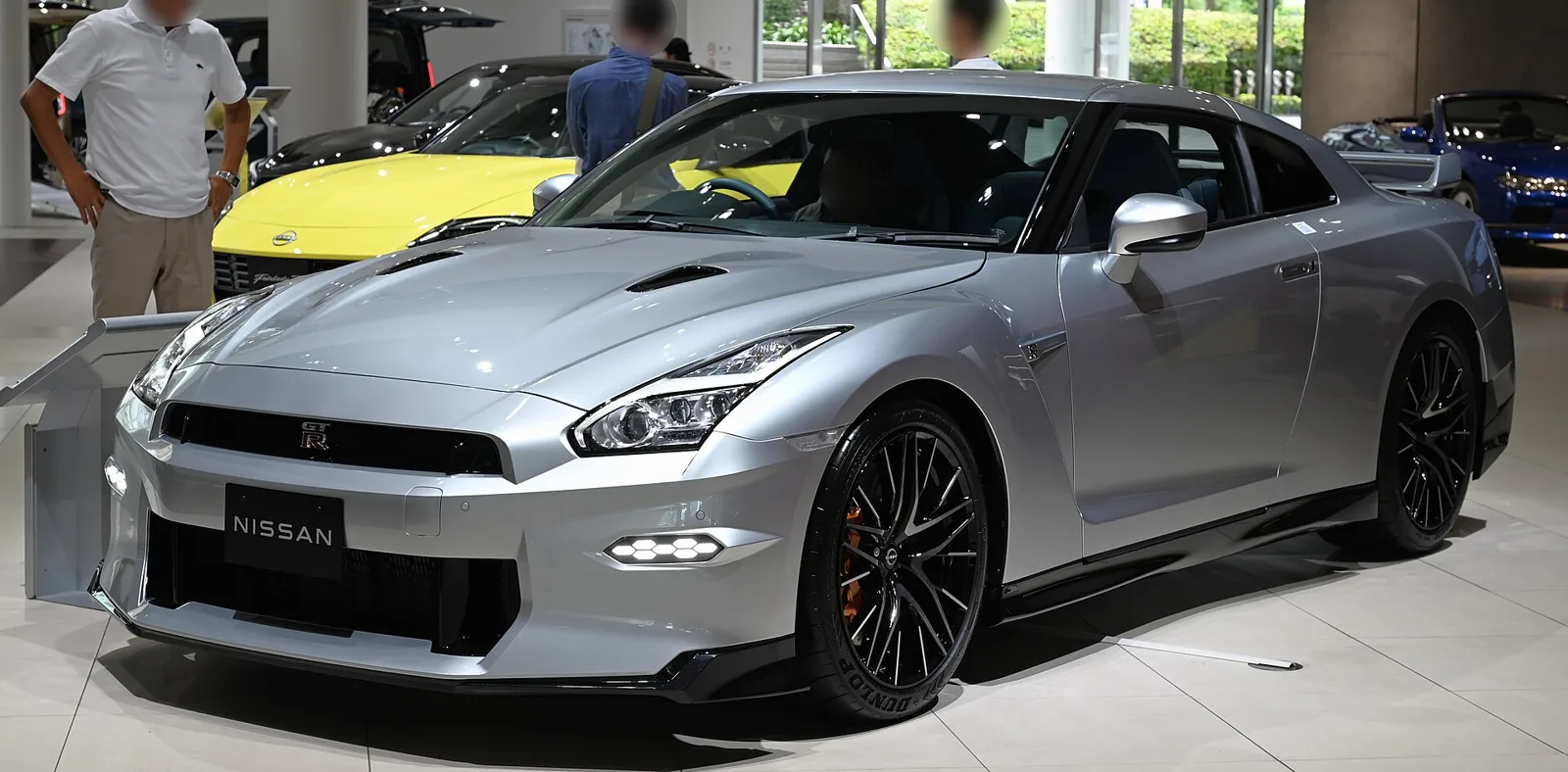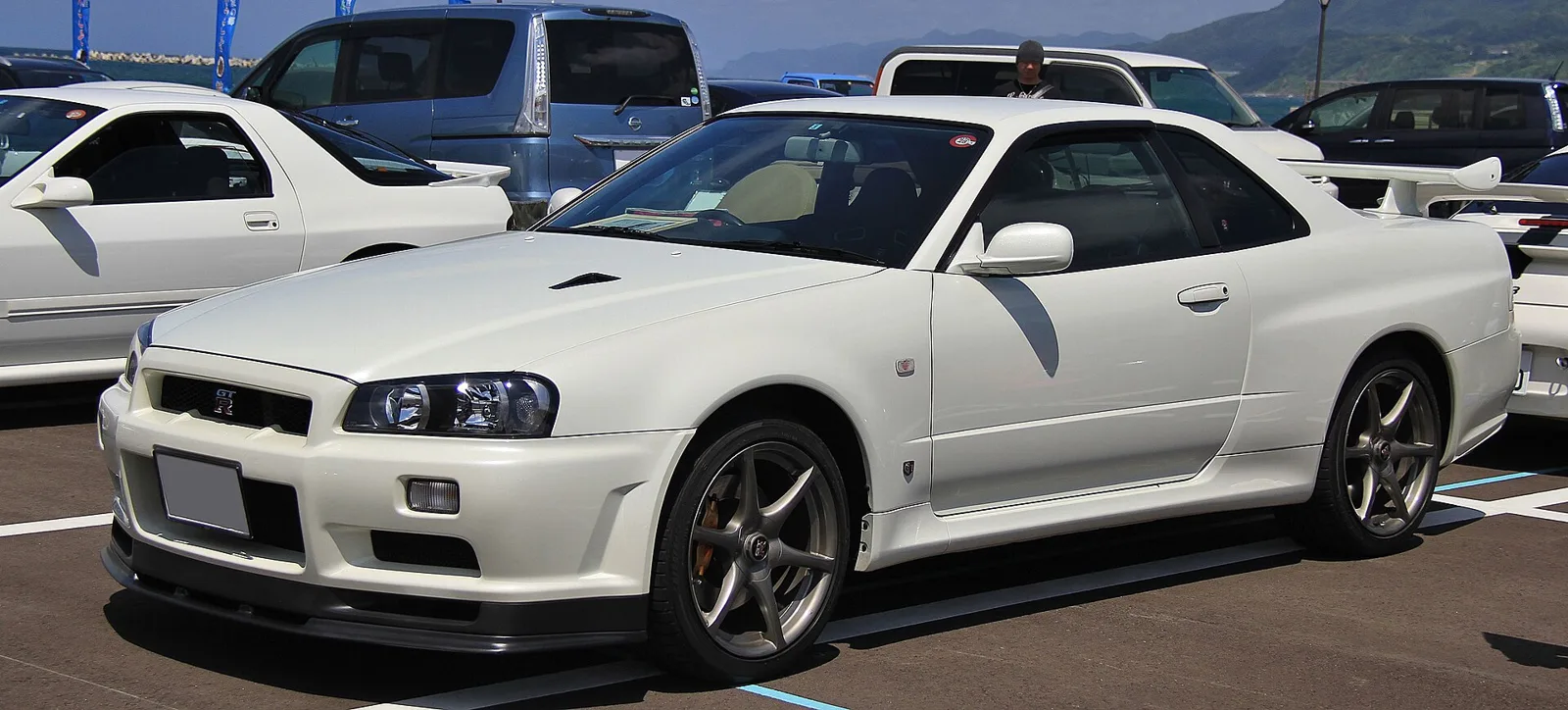
A touring-car winner in 1969, a 16-year gap, a Group A champion in 1989 and then a car that left the Skyline name behind.
The Skyline GT-R began in 1969 as a Japanese touring-car winner, paused after 1973, and returned in 1989 as the all-wheel-drive R32 built to dominate Group A. Skyline GT-R production ended in August 2002, and the separate R35 GT-R ran from 2007 to 2025.
The first Skyline GT-R won 33 times in a year and a half of racing, and was chasing a 50th consecutive victory when a Mazda Savanna RX-3 ended the run. That car, nicknamed Hakosuka, started a story in which the GT-R vanished for 16 years, came back as a Group A champion and finally left the Skyline range altogether.
Where did the Skyline GT-R name come from?
From Prince, a car company that merged with Nissan-Datsun in 1966. Prince launched the original Skyline in April 1957 with a 1.5-litre engine, and in 1964 it built a Skyline GT with a 2.0-litre G7 inline-six borrowed from the Gloria sedan. Two road versions followed: the S54A with a single carburettor and 78 kW (106 PS; 105 hp), and the S54B with three carburettors and 92 kW (125 PS; 123 hp). Production totalled 100 units.
Fitting a six into the Skyline required a 200 mm (8 in) extension to the wheelbase ahead of the cowl. The racing version entered the second Japanese Grand Touring race on 3 May 1964, where Skyline GTs finished second to sixth against the Porsche 904. The earlier Prince Skyline Sport coupe and convertible had already pointed the way as the first sports-oriented Skyline.
GT-R means Gran Turismo-Racing, and the sibling GT-B means Gran Turismo-Berlinetta. The Japanese borrowed Italian naming conventions at a time when most Japanese cars used Western abbreviations, hoping to enhance sales.
The R32 earned the Godzilla nickname from Wheels magazine in July 1989.
What was the Hakosuka?
It was the first car to wear the Skyline GT-R name. Internally the PGC10, it was introduced on 4 February 1969 as a four-door sedan. The shape had been seen in public at the Tokyo Motor Show of October 1968, badged Skyline 2000GT. Nissan advertised it alongside the R380 racing car to underline the Skyline's competition heritage.
Under the bonnet was the 2.0 L S20, a double-overhead-cam inline-six. It delivered 119 kW (162 PS; 160 hp) when it reached 7,000 rpm, and a torque peak of 176 N.m (130 lb.ft) came lower, at 5,600 rpm. Power reached the rear wheels through a five-speed manual and a limited-slip differential. The suspension was semi-trailing arm, with disc brakes at the front and drums at the rear. Inside, racing bucket seats, a three-spoke steering wheel, wood inserts and aluminium pedals made for a basic cabin.
In October 1970 a two-door coupe, the KPGC10, joined the line. The popular name for both cars blends hako, the Japanese word for box, with suka, the spoken short form of Skyline. Production came to 832 PGC10s and 1,197 KPGC10s.
On the track the four-door PGC10 scored 33 victories in the year and a half it raced, until a Mazda Savanna RX-3 stopped its attempt at a 50th consecutive win. By the time the car was discontinued in 1972 it had taken 1,000 victories.
What happened to the second-generation GT-R?
It was gone almost before it arrived. The KPGC110 was introduced in 1973, after a showing at the 1972 Tokyo Motor Show, with a 1,989 cc S20 inline-six, a five-speed manual, disc brakes at all four corners and semi-trailing ring arm suspension. Nissan added some minor aerodynamic parts.
It is known as the Kenmeri, after an advertisement showing a young couple, Ken and Mary, in the Hokkaido countryside, which inspired a hit song by Buzz. Only 197 were built. The S20 engine from the first generation could not meet increasingly strict emissions laws, so the car was dropped, and for the next decade the GT-R went without a successor. The KPGC110 never competed in a major race despite being developed purely as a race car, and the sole survivor now sits in Nissan's historic storage at Zama.
Why did Nissan bring the GT-R back in 1989?
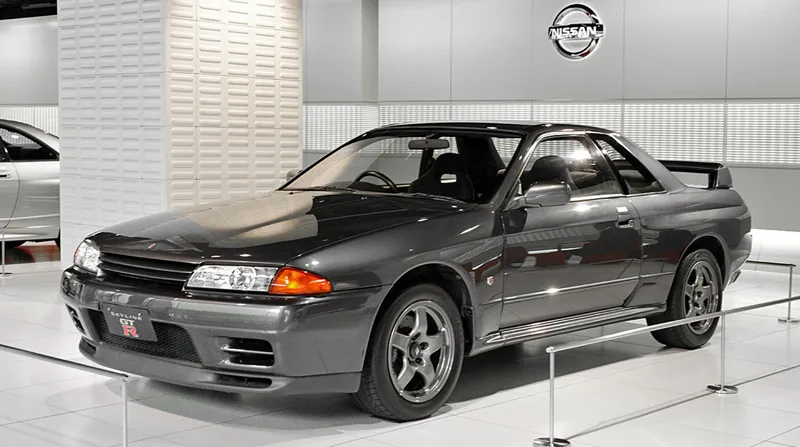
To win in Group A racing. Nissan was competing with the Skyline GTS-R and wanted a more competitive replacement, so the new E-BNR32, the R32, was designed to dominate the class. The GT-R nameplate came back after a 16-year break.
The engineering story is a lesson in how rules shape a car. Nissan Kohki first tested a twin-turbo 2.4 L engine making 233 kW (317 PS; 312 hp) in a rear-drive car. But Group A multiplies a turbocharged engine's displacement by 1.7, which put the car in the 4,000 cc class and forced it onto 10-inch-wide tyres. The classes work like rungs on a ladder, each with its own tyre width, so Nissan answered with traction: it chose all-wheel drive and developed the ATTESA E-TS system for the job.
That solved grip but added 100 kg (220 lb), a disadvantage against the other 4,000 cc cars. So Nissan raised the displacement to 2,600 cc, which moved the car into the 4,500 cc class, where weights were near equal and 11-inch tyres were allowed. New blocks and heads followed, and the result was a race engine making 441 kW (600 PS; 592 hp). Later REINIK units were rated between 373 and 485 kW (507 and 659 PS; 500 and 650 hp), depending on track conditions.
What made the R32 GT-R special?
The R32 turned that race car into a road car. The 2,568 cc RB26DETT engine produced 206 kW (280 PS; 276 hp) at 6,800 rpm, and 260 lb.ft (353 N.m) of torque at 4,400 rpm, moving a car that weighed 1,430 kg (3,150 lb). Production started on 21 August 1989, and the Group A campaign began in 1990.
Results arrived quickly. Group A R32s won the Japanese Touring Car Championship four years in a row, and in Australia Jim Richards took the touring car title in 1991 and Mark Skaife in 1992 until a rule change shut the GT-R out in 1993. The Australian magazine Wheels, impressed by the technology and performance, nicknamed the car Godzilla in July 1989.
The special R32 models
Nissan used limited editions to homologate racing changes and to celebrate success.
| Model | Introduced | Notes |
|---|---|---|
| Nismo (RA) | 22 February 1990 | 560 built; no ABS; aluminium bonnet; 1,400 kg (3,086 lb) |
| N1 (ZN) | 19 July 1991 | 245 built; no air conditioning or sound system; Crystal White |
| V-Spec | 3 February 1993 | Brembo brakes; retuned ATTESA E-TS; 17-inch BBS wheels; 1,396 built |
| V-Spec II | 14 February 1994 | Wider 245/45R17 tyres; 1,306 built |
The Nismo model carried a premium of 235,500 yen over the standard car and existed to meet the Group A rule of 500 production units; Nissan built 60 more to turn into race cars. It dropped ABS, which Group A did not allow, and the rear wiper, and used larger T04B turbochargers whose steel wheels were more reliable than the faster-spooling ceramic ones. Every Nismo came in Gun Grey Metallic.
The N1 was made for home-market N1 racing, with a modified engine and lightweight headlights, and every one was delivered in a thin coat of Crystal White. The plain V-Spec and V-Spec II weighed 1,480 kg (3,263 lb), 50 kg (110 lb) more than the standard car.
What did the R34 add to the legend?
It gave Wheels another headline. The magazine called the R34 GT-R Godzilla Returns and judged it the finest-handling car its writers had ever driven. Other publications recorded 12.2 seconds for the quarter mile (402 metres) from rest, and 4.4 seconds from 0 to 100 km/h (62 mph).
By then the GT-R was the flagship of Nissan performance, carrying advanced technology such as ATTESA E-TS all-wheel drive and Super-HICAS four-wheel steering. The last Skyline GT-R left the line in August 2002. The car was never built outside Japan. Export began in 1991 to Hong Kong, Singapore, Australia and New Zealand, and the UK followed in 1997 under the Single Vehicle Approval scheme.
Why are Skyline GT-Rs so widely imported?
Because the car became a pop-culture star that most of the world could not buy new. As a grey import it has built a following in the US and Canada, in Ireland and South Africa, and in New Zealand, Australia and the UK. The Fast and the Furious, Initial D, Wangan Midnight, Need for Speed, Forza and Gran Turismo all helped, and the car is popular today in import drag racing, circuit track days, time attack and tuning-magazine events.
The rear-drive layout helped. The Skyline stayed popular through the 1990s partly because it kept rear-wheel drive while most rivals chased front-wheel drive, and part-time all-wheel drive only appeared with the R32. In 2019 Nismo announced a restart of spare-parts manufacturing covering every generation of Skyline GT-R, from body panels to engines.
How did the R35 GT-R come about?
Through a CEO's demand for a halo car. In 2000 Carlos Ghosn requested the revival of the GT-R as part of the Nissan Revival Plan, believing a showpiece would lift enthusiasm for the struggling brand. He wanted a high-performance car able to take on Porsche, Lamborghini and Ferrari at a comparatively affordable price, and he insisted on keeping the four round taillights as the GT-R's signature.
Designers from Japan, the US and Europe produced many sketches, and 50 reached design director Shiro Nakamura. A concept appeared without warning at the 2001 Tokyo Motor Show, and a revised GT-R Proto followed in 2005. Officials said the production car would be 80 to 90 percent based on the Proto.
The mechanical side fell to Kazutoshi Mizuno, known as Mr. GT-R and chief engineer of the R34. He first refused, saying the old FM platform could not underpin a world-class car. In April 2003 he built an Infiniti G35-based prototype on an advanced version called the Premium Midship, or PM, platform, and was given full authority. Lotus Engineering refined the chassis rigidity and suspension geometry. Development began formally in January 2004.
Mizuno's goals were ambitious: a comfortable conversation at 300 km/h (186.5 mph), a power-to-weight ratio under 4 kg (9 lb) per horsepower and a Nurburgring lap under eight minutes. A straight-six was planned at first, but the team chose a shorter V6 for better weight distribution, and Naoki Nakada led the brand-new VR38DETT, a twin-turbo V6 evolved from the VQ engine. Brembo brakes and Bilstein suspension were conceived by Mizuno himself.
Aerodynamics were set by Yoshitaka Suzuka, who had developed Nissan's Le Mans prototypes. The target was a drag coefficient of Cd=0.28 or lower together with front and rear downforce, and active aerodynamics were rejected over cost. A first wind tunnel result of Cd=0.32 improved after the chassis frame rails were lowered to smooth the airflow beneath the car. More than 2000 wind tunnel runs later, the final figure was Cd=0.27.
What was the R35 GT-R like, and how did it end?
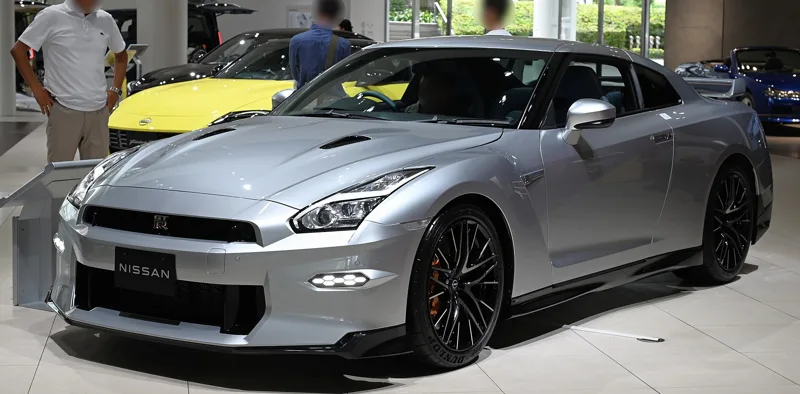
It was a clean break with the past. The R35 was built from 2007 to 2025 on the PM platform at Nissan's Tochigi plant, with a front-mid engine driving all four wheels through a rear-mounted transaxle and the ATTESA E-TS Pro system. Among the first production cars to offer launch control and a dual-clutch transmission, and its body used steel, aluminium and carbon fibre. HICAS was omitted because engineers judged it incompatible with the advanced all-wheel drive.
The production car was unveiled at the 2007 Tokyo Motor Show, and in September 2007 the team recorded 7:38.54 around the Nurburgring Nordschleife in damp conditions. Nissan said the car would have gone quicker in ideal conditions. Unlike its predecessors, it was offered worldwide, and its racing versions took titles in the FIA GT1 World Championship, in Super GT and in GT3 series.
The end came market by market. Australian sales stopped in 2021 because of new side impact rules, European markets were suspended over noise regulations and North American sales followed in 2024. Sales in Japan and elsewhere continued until late August 2025, closing production after 18 years and around 48,000 units.