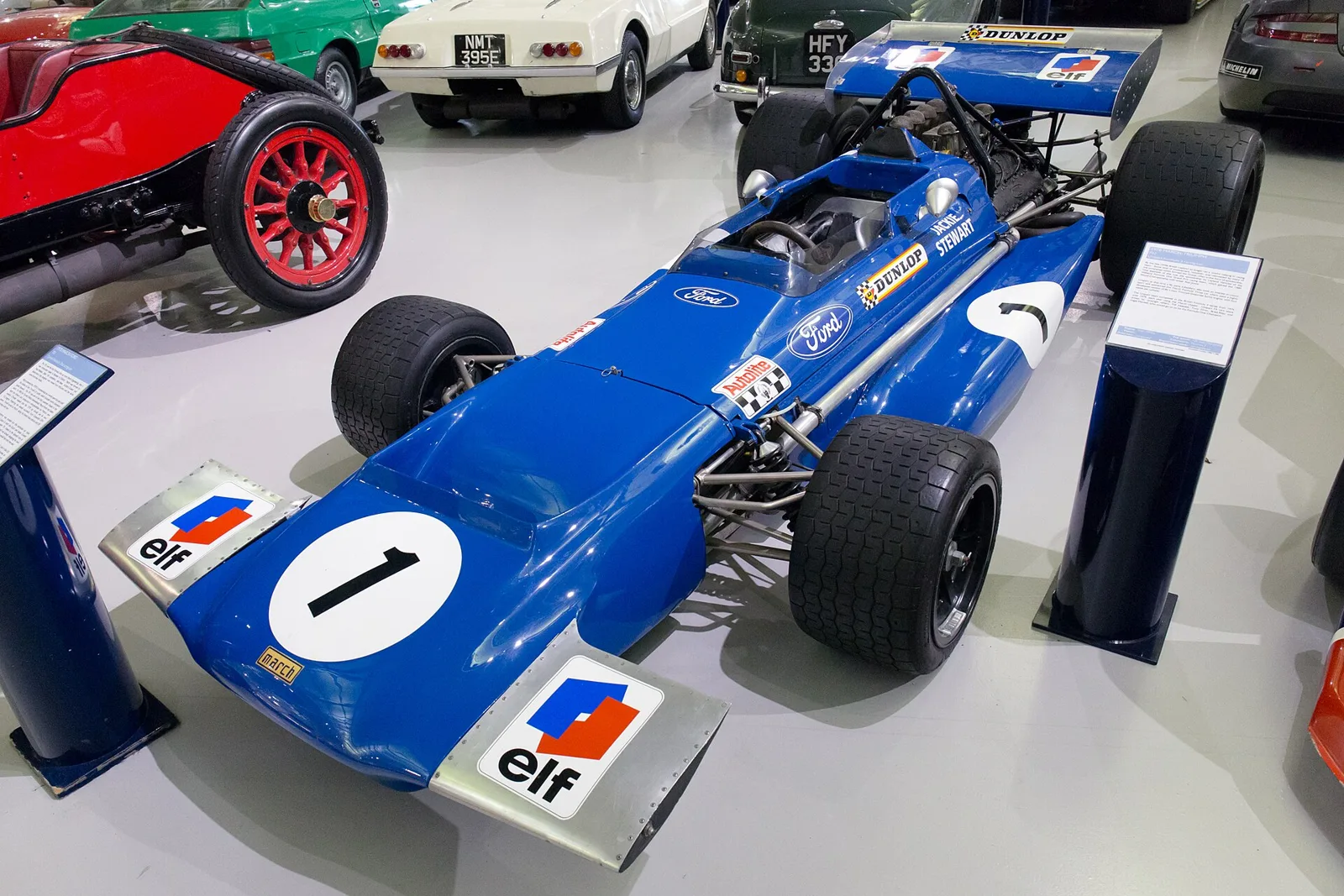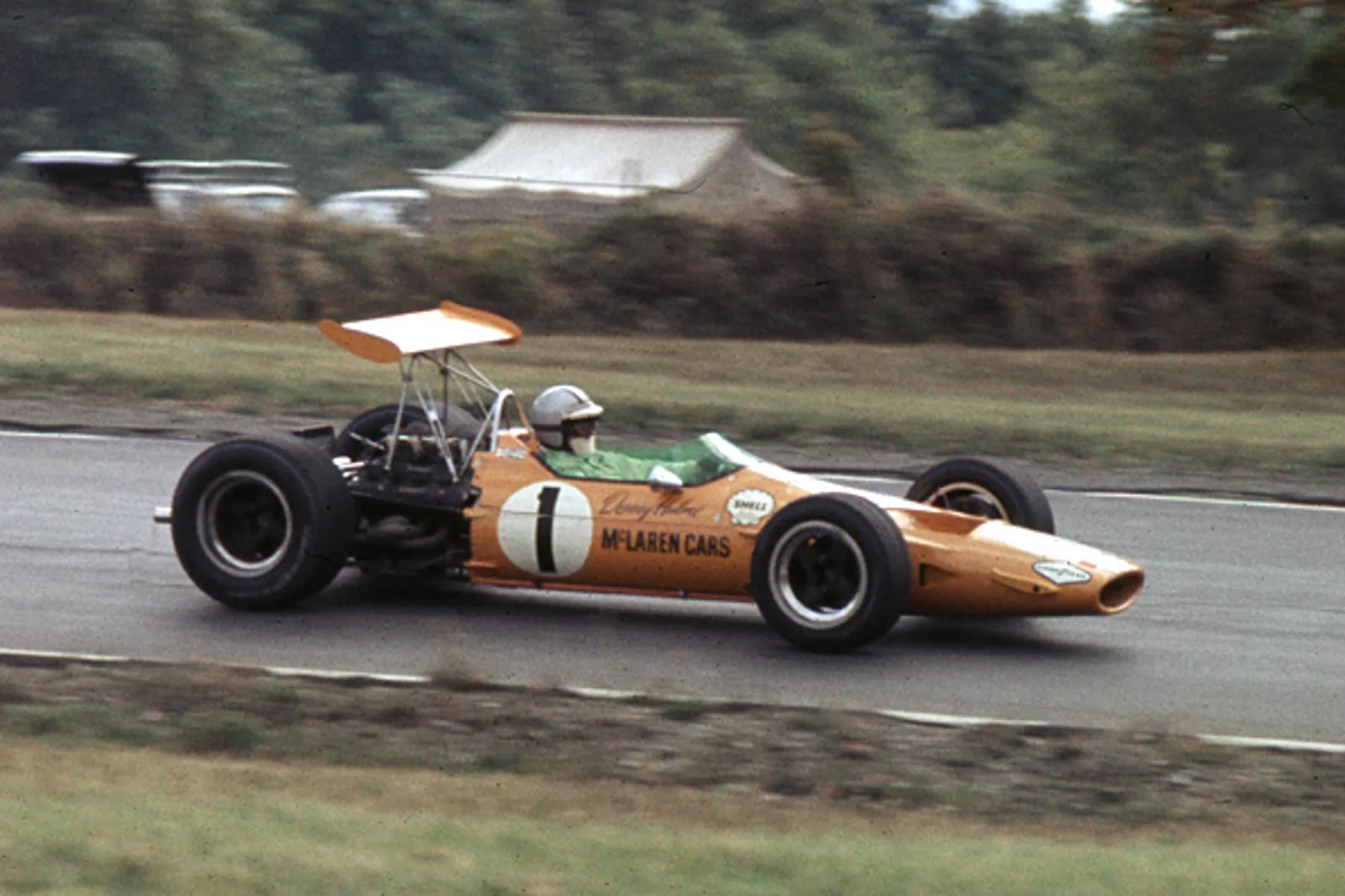
Designed by Robin Herd and Gordon Coppuck, the M7A brought the Cosworth DFV to McLaren and won the 1968 Belgian Grand Prix.
The McLaren M7A was designed by Robin Herd and Gordon Coppuck and raced from 1968 to 1971. It was the first McLaren to use the Cosworth DFV engine, and it won the 1968 Belgian Grand Prix on its way to a second-place finish in the constructors' championship.
The McLaren M7A was a Formula One car built by McLaren for the 1968 to 1971 seasons. It was the team's first car to use the Cosworth DFV V8, an engine McLaren went on to use until 1983. The M7A scored the team's first world championship win at the 1968 Belgian Grand Prix and helped it finish second in the constructors' table that year.
Why did McLaren need a new car in 1968?
Bruce McLaren had founded his racing company in 1963, after a spell as a factory driver for the Cooper team. From 1966 the team had been building and racing its own Formula One cars, and the early results had been poor. Bruce McLaren's team had struggled in its first two seasons, scoring just six points across 1966 and 1967 with a best finish of fourth. Engine supply was the core problem, as the Ford and Serenissima V8s of 1966 lacked power and the BRM V12 of 1967 arrived only in mid-season.
The Cosworth DFV changed the picture. The engine debuted in 1967 with Lotus, which had exclusive use of it that year and won its first race with it. In 1968 the DFV was offered to any manufacturer, and McLaren bought five engines at 7,500 pounds sterling each.
The designer Robin Herd had joined the team in 1965 after working as an aerospace engineer at the National Gas Turbine Establishment, where he had been involved in the Concorde project. He began the M7A late in 1967 but left for Cosworth before the car was finished. His assistant, Gordon Coppuck, another former NGTE engineer, completed the work with Bruce McLaren.
A DFV-powered car that brought McLaren its first world championship win in Belgium.
How was the M7A built?
The M7A was an open-topped monocoque, or bathtub chassis, made from aluminium alloy panels that were glued and riveted to three steel bulkheads. The engine was a stressed member bolted to the rearmost bulkhead, and the gearbox sat behind it. At the back, lateral top links, twin radius arms and reversed wishbones connected the gearbox and rear bulkhead to the wheels.
Glass-reinforced plastic covered the nose and cockpit, which kept the shape simple and light, and magnesium alloy was used for the dash panel, the battery cover and many smaller panels. The wheelbase of the second and third chassis was 96.5 inches, and the car weighed 1,140 pounds (520 kg), with a front track of 58 inches (1,500 mm) and a rear track of 57 inches (1,400 mm).
Fuel was stored in tanks running down the sides of the chassis, with a total capacity of 40 imperial gallons (180 L). Bruce McLaren's car began with outboard pannier tanks at the first two world championship races, an idea that came from his belief that sports-car handling benefited from better fuel weight distribution. According to the McLaren mechanic Tyler Alexander, the idea was developed in discussion with Lotus boss Colin Chapman. Those tanks were removed after the car was damaged at Monaco in 1968.
The brakes were a Lockheed system with four-piston calipers and ventilated discs. The prototype car had started with solid discs and Girling calipers while the new system was awaited, and ventilated discs were chosen partly because Lotus had suffered cracking with its own designs.
Wings became a feature of Formula One in 1968, and the governing body, the CSI, regulated their use. Lotus had begun the first wing experiments at Monaco, and Ferrari and Brabham had debuted full-height wings at Belgium. McLaren had experimented with wings on its 1965 development car but left them off the racer. In 1968 the team tried a rear wing mounted above the engine for the French Grand Prix, but it was far less effective than Lotus's version, which was fixed to the unsprung suspension.
What was the Cosworth DFV like?
The DFV was a 90-degree V8 with an aluminium block and iron cylinder liners. It had four valves per cylinder, operated by double overhead camshafts, and peak power of 410 bhp (306 kW) at 9,000 rpm. It drove the rear wheels through a Hewland DG300 gearbox.
Liquid cooling came from a radiator in the nose, with ducts venting the hot air through the upper bodywork, while the oil was managed by a cooler perched on top of the gearbox.
The engine's development was funded by Ford and designed and built by Cosworth. Its early reputation was built on that funding and on the team's willingness to adopt it quickly. Its success was immediate, and McLaren relied on it until 1983.
How did the M7A race in 1968?
Its first outing came at Brands Hatch in the Race of Champions, a non-championship event that followed Formula One rules. McLaren won from pole there, and Hulme finished third. The BRDC International Trophy at Silverstone followed, where Hulme won and McLaren was second.
The car's championship debut came in Spain, where Hulme finished second and McLaren retired. At Monaco McLaren crashed and Hulme finished fifth. The Belgian Grand Prix was the breakthrough, with the two cars starting fifth and sixth on the grid.
| Race | Hulme | McLaren |
|---|---|---|
| Race of Champions | Third | Won |
| BRDC International Trophy | Won | Second |
| Spanish Grand Prix | Second | Retired |
| Monaco Grand Prix | Fifth | Crashed |
| Belgian Grand Prix | Led until a half shaft failed | Won |
| Dutch Grand Prix | Retired, ignition failure | Crashed |
| Italian Grand Prix | Won | Retired, oil leak |
| Canadian Grand Prix | Won | Second |
| United States Grand Prix | Crashed after gearbox failure | Sixth |
| Mexican Grand Prix | Crashed, broken damper | Second |
At Spa, Hulme had led the race until a shaft broke with two-thirds distance covered. McLaren then inherited second place behind Jackie Stewart's Matra. Stewart had to stop for fuel on the final lap, which handed McLaren the win. He believed at first that he had finished second.
The Belgian victory was the team's first world championship win, and it made Bruce McLaren the second driver, after Jack Brabham, to win in a car carrying his own name. It was also the last victory of his career.
Once Belgium was behind them, the team's Goodyear tyres dropped in competitiveness. Hill in his Lotus and Stewart in his Matra pulled clear. In the Netherlands McLaren crashed, and Hulme's engine failed with an ignition fault.
The Italian Grand Prix brought an improvement. The cars ran without wings, and Goodyear brought its new G9 tyres. McLaren qualified on the front row and led early before slowing at an accident, and he retired with an oil leak at mid-distance. Hulme went on to win.
A third M7A joined the team at Canada, driven by Dan Gurney, whose Anglo American Racers operation had lost its funding. Gurney's car overheated and retired, and the result was a one-two for the team after the leading rivals had fallen out.
Did the M7A win the 1968 championship?
No. The M7A won the Belgian Grand Prix and then two more races, and it helped McLaren finish second in the constructors' championship. Hulme led the drivers' title jointly with two races left, but he crashed out in Mexico and Graham Hill took the championship.
Hulme had been world champion with Brabham in 1967, a title that made him a serious contender when he joined McLaren, and he had raced for McLaren in Can-Am that year. In the United States his title hopes were damaged by a spin, pit stops to repair brake lines and a gearbox output shaft failure that sent him into a crash. McLaren finished sixth there, while Gurney was fourth.
In Mexico McLaren finished second, but Hulme's broken suspension damper ended his chance. Hill won the drivers' title, and the M7A's season ended with the team well placed but without the crown.
How did the M7 family develop after 1968?
For 1969 McLaren designed the M9A, a four-wheel-drive car that was unsuccessful. It appeared only once, when Derek Bell drove it at the British Grand Prix, so the M7A stayed in use for most of the year.
Hulme took a podium with an M7A at the South African Grand Prix. McLaren was second at Spain and fourth at Italy, 0.19 seconds behind the winner Stewart. Hulme's only win of 1969 came at the Mexican Grand Prix, which was the M7's last victory.
Before the Monaco race in 1969 the CSI banned wings altogether, leaving the team a small ducktail spoiler. Wings were later allowed again, but not mounted on the suspension, so McLaren tried a tea-tray rear wing before a conventional low-mounted aerofoil. A one-off M7B was sold to Colin Crabbe's Antique Automobiles team. Vic Elford drove it to tenth at the Dutch Grand Prix, but he later crashed it at the Nurburgring.
The M14A arrived for 1970, and a single works M7A appearance followed, when Gurney drove one at the British Grand Prix. John Surtees bought an M7C as a stopgap, and he finished sixth in the Netherlands with it.
The M7D was commissioned by Alfa Romeo's Autodelta department and used a 3.0-litre V8 from the T33 sports car. Its output was given as between 410 and 430 bhp, with peak power at 10,500 rpm. McLaren found that performance varied significantly between the units, and the alternator needed its own mounting point because it was not integrated with the engine as on the DFV. Andrea de Adamich and Nanni Galli drove it, and Jo Bonnier was the last entrant, running an M7C in 1971 with a best result of tenth at the Italian Grand Prix.
What were the M7A's variants?
The M7B was a one-off conversion of the car that had won the Belgian Grand Prix. Its fuel was carried low and centrally in bags housed inside aluminium pontoons riveted either side of the cockpit, which ran to a new full-width bulkhead at the engine. Eoin Young, a former McLaren secretary, wrote that the outboard tanks also made room for a four-wheel-drive system.
The M7C was distinguished by a fully enclosed monocoque, which gave greater torsional rigidity than the bathtub chassis. It was based on a Formula 5000 chassis from McLaren's range, with the horns at the rear of the monocoque removed to fit the Cosworth engine. Only one was made.
The M7A's story is therefore one of an engine and a chassis that arrived at the right moment. The DFV gave the team a reliable base, and the monocoque and suspension gave the drivers a car that could win when the rest of the field fell away.