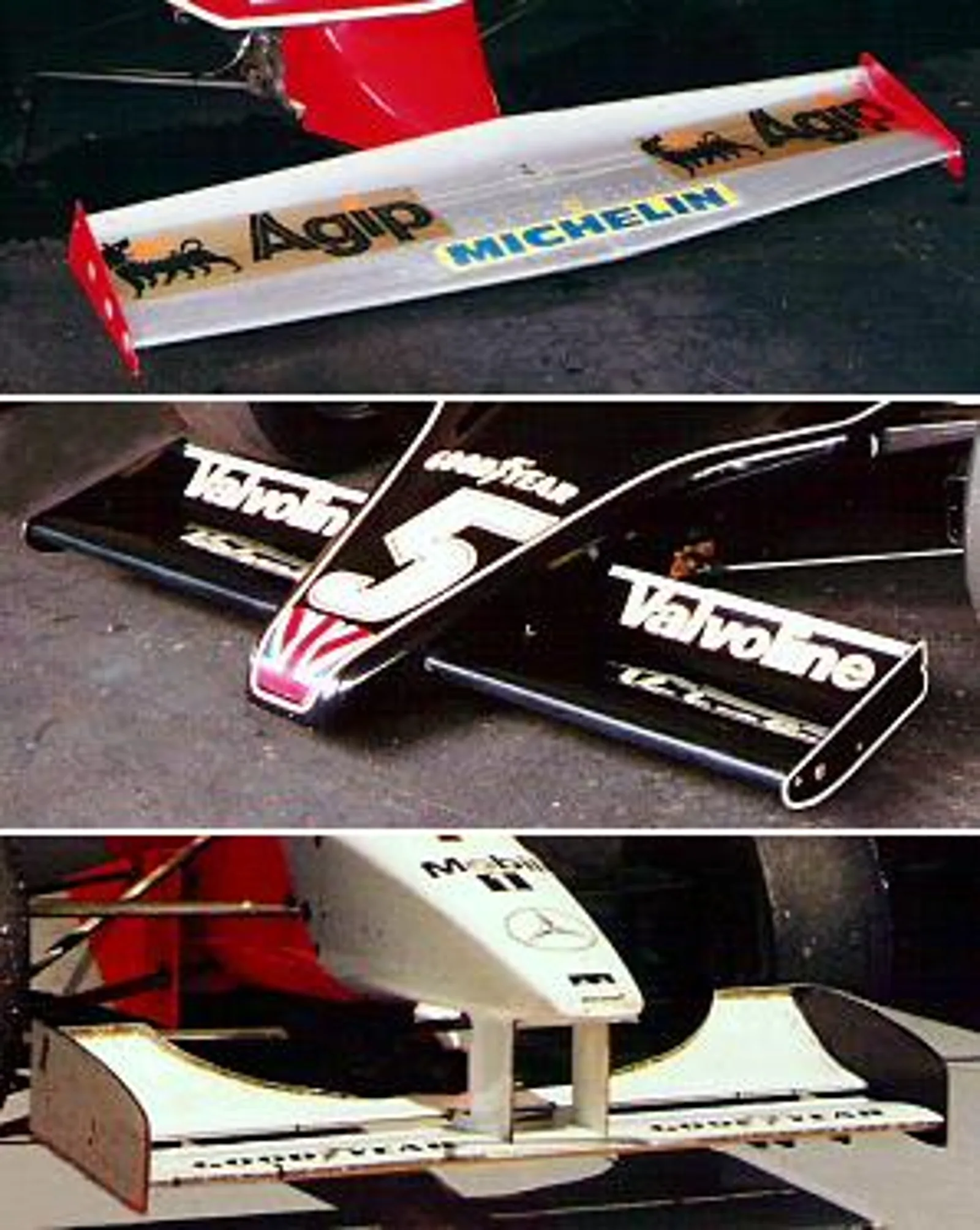
Downforce adds grip with the square of speed and costs drag at every step. From the Chaparral fan car to Formula One's 2022 return of ground effect.
Downforce is a downward aerodynamic force that presses a car onto the road, adding grip so it can corner faster. Wings, diffusers and ground effect create it, and it rises with the square of speed. Every passive device also adds drag, so setups are always a compromise.
Formula One once found the most powerful aerodynamic trick in its history, then outlawed it, and ground effect stayed out of the sport for forty years before returning under the 2022 rules. The reason it was banned is the reason it works: it presses a car into the road so hard that a single touch of the floor on the tarmac can make that grip vanish in an instant.
What is downforce?
Downforce is lift in the wrong direction, produced by the aerodynamic shape and fittings of a vehicle. On a car its job is to push the tyres harder into the road, which adds grip and lets the car go faster, especially through corners. The principle is the same one that lifts an aeroplane off the ground, used in reverse: a wing that would raise a plane presses a racing car down.
Engineers separate this aerodynamic grip from mechanical grip, which comes from the car's mass, tyres and suspension. The two work together. A car must first be stable and balanced at low speed through its chassis, suspension and tyres, and aerodynamic aids then provide balance and stability at higher speeds.
Speed is the catch. Because downforce comes from air moving over and under the car, it grows with the square of speed and only becomes significant above a certain minimum. Drag follows the same square law. Aerodynamics already plays a part below about 120 mph (190 km/h), though the emphasis shifts, and above that figure, at the speeds seen on superspeedways, small changes in aerodynamic configuration can dramatically alter handling.
For a wing, the force is usually written in terms of a lift coefficient. Downforce depends on that coefficient, the density of the air, the wing area and the square of the velocity. In ranges where the wing is not stalled the coefficient stays constant, so the force is proportional to the square of airspeed. Double the speed and the downforce quadruples.
Every passive device that makes downforce also adds drag, so the best setup is almost always a compromise.
Why does downforce cost drag?
Every passive device that creates downforce also adds aerodynamic drag, the air's friction against the car, and the ideal setup is nearly always a compromise. Where that compromise lands depends on the circuit, in particular how long the straights are and what kinds of corners it has.
On short ovals, maximum downforce is vital for grip and cornering speed, yet too much drag hurts both the exit from corners and top speed on the straights, so teams run big rear wings and front splitters and keep a close eye on the balance. Road courses mix fast straights with tight corners and changes of elevation, and teams often use adjustable elements such as wings and flaps to tune the car for different sections.
The risks are not only about speed. Some cars have had unstable aerodynamics, where a small change in the angle of attack or ride height causes large swings in downforce. At worst the car lifts, as when it passes over a bump or slipstreams over a crest. At the 1999 24 Hours of Le Mans, the Mercedes-Benz CLR driven by Mark Webber and Peter Dumbreck flipped spectacularly after closely following a competitor over a hump.
How does a rear wing or spoiler work?
The two are often confused. A spoiler is designed to spoil unfavourable air movement, usually lift, turbulence or drag. A front spoiler is generally called an air dam. A wing is a different thing: it is designed to generate downforce as air flows around it, and so, instead of cutting drag, it adds some.
Three things govern how much a wing produces. One is its form, meaning area, aspect ratio and cross-section. Another is the angle at which it meets the air. The third is how fast the car is going. A larger area means more downforce and more drag. A steeper tilt does the same, pressing harder on the rear wheels at the price of more drag.
The front wings on a racing car do two jobs. They add downforce for the front tyres, and they manage the air so it reaches the rest of the car cleanly. They are modified constantly as data arrives from race to race, and in most series they can be adjusted when the car is serviced during a race.
The rear wing has the harder job. By the time air arrives there it has been churned up by the front wings and wheels, the mirrors, the driver's helmet, the sidepods and the exhaust, so the wing works less efficiently than the one at the front. It still has to supply over twice the front wings' downforce to keep the handling in balance. Hence the far larger aspect ratio, and often two or more elements stacked together to multiply the effect.
On road cars, the story is quieter. Spoilers are added primarily for styling and have either little aerodynamic benefit or make the aerodynamics worse, and some manufacturers admit that certain spoilers are there for appearance alone. There are real exceptions. Many cars have a steep downward slope from the rear edge of the roof, which can cause airflow to separate and create a turbulent low-pressure zone, raising drag and instability. A rear spoiler makes the air see a longer, gentler slope, which delays separation and can reduce lift, improving stability at high speed.
The Porsche 911 gave the world its best-known road spoiler. The 1973 duck tail on the Carrera RS was followed in August 1974 by the large, flared whale tail on the 911 Turbo, designed to reduce rear lift and keep the car from oversteering at high speed. From 1978 it became the teatray, with raised sides to accommodate the intercooler.
What does a diffuser do?
A car body itself behaves like a wing. Almost every road car makes some aerodynamic lift because of its shape, and designers use several techniques to counter it. In profile, most road cars have the front bumper lowest, the section between the wheels higher, and the rear bumper highest. Air passing under the front bumper is squeezed into a smaller cross-section and falls in pressure. The rake of the body adds more downforce by directing the underside air upward.
Race cars amplify this with a rear diffuser. It accelerates the air under the car in front of it and raises the air pressure behind it, which lessens the wake. Splitters and vortex generators on the underside also help to add downforce or reduce drag. Some cars, such as the DeltaWing, have no wings at all and generate all their downforce through the body.
An under tray goes the other way, aiming at drag. In most racing cars the entire underside is covered with one, stopping air from being trapped beneath the car.
| Device | What it does | Cost or limit |
|---|---|---|
| Wing | Generates downforce as air passes around it | Adds drag; rear wing less efficient than front |
| Spoiler or air dam | Spoils unwanted airflow such as lift or turbulence | Often styling; little benefit on many road cars |
| Rear diffuser | Speeds up air under the car and raises pressure behind it | Needs a flat, smooth underside to work |
| Underbody tunnels and skirts | Use the ground as part of the aerodynamic system | Sudden loss if the floor touches the ground |
| Under tray | Covers the underside so air is not trapped | Mainly reduces drag |
What is ground effect?
Ground effect is the family of tricks that create downforce through underbody tunnels and floor design, treating the ground as part of the aerodynamic system. It was the successor to an earlier focus on streamlining. After wings became routine on race cars from the mid-1960s, designers turned to the air around the perimeter, the skirts and the underside of the car, looking for more downforce with less drag than a wing.
You can feel the principle with a tarpaulin on a windy day. Hold it close to the ground and it is drawn down. As it nears the ground, the gap for the air shrinks, so the air speeds up and its pressure drops, while the pressure on top is unchanged. A net downward force results. The same thing happens to a car, and because the road moves backwards relative to the car, it drags the air above it faster, which strengthens the effect.
How ground effect was found, banned and revived
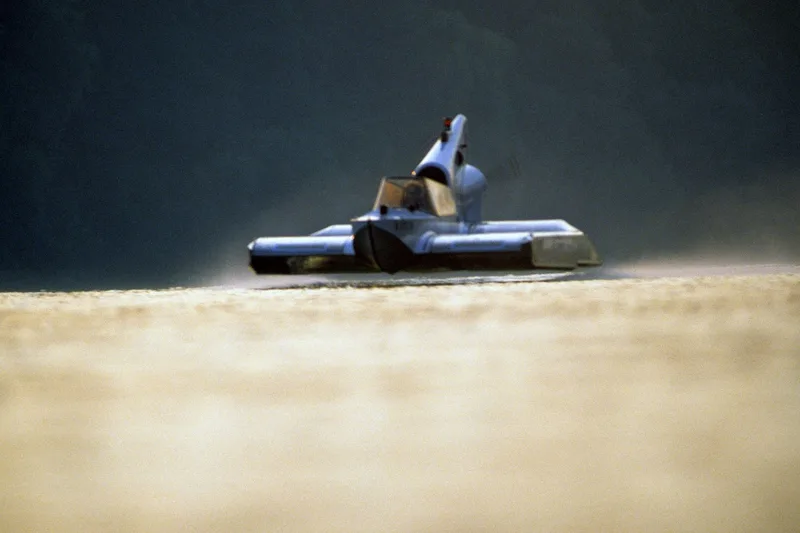
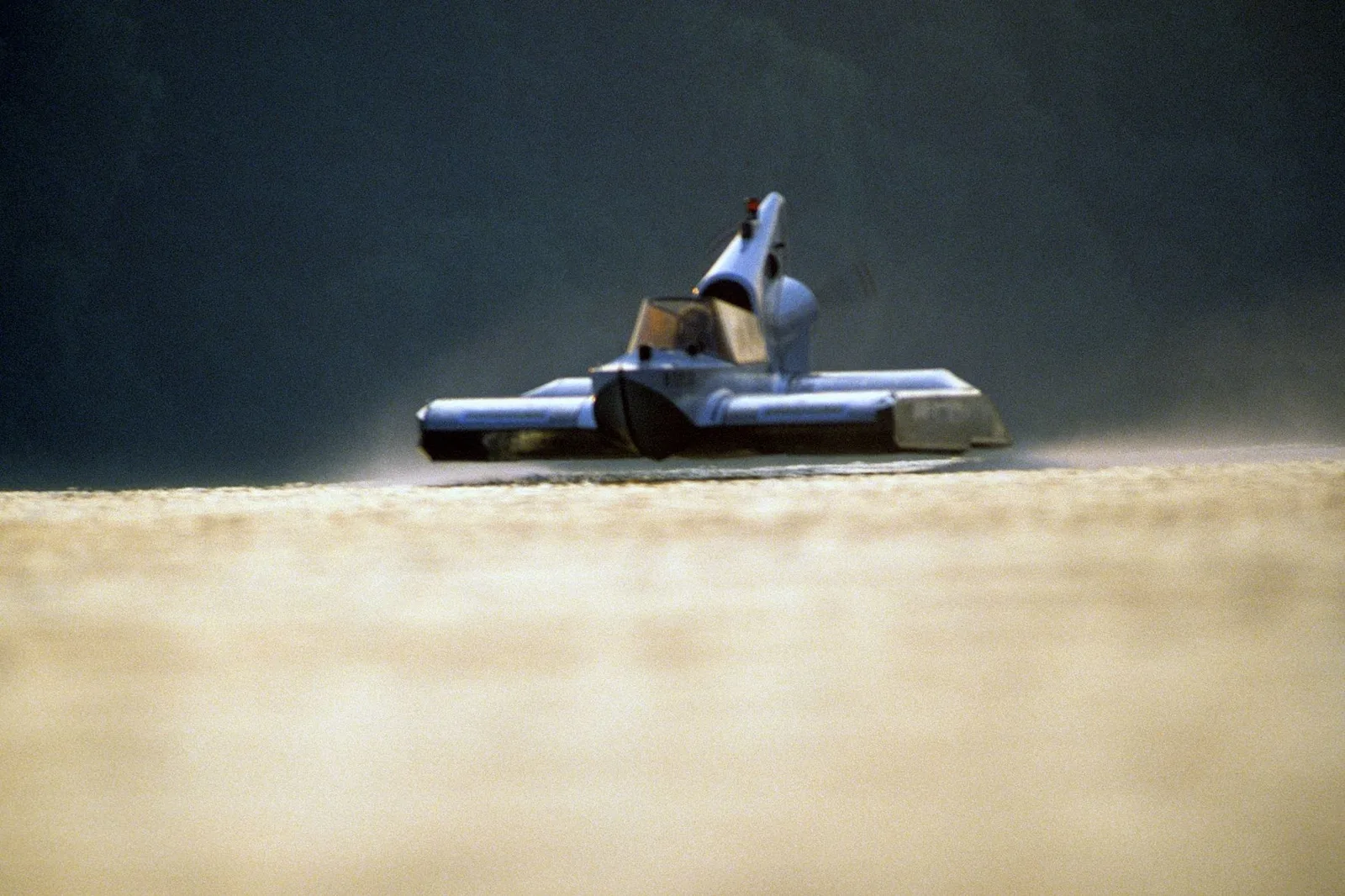
American Jim Hall pioneered it with his Chaparral cars. A 1961 car with a shaped underside was troubled by other aerodynamic problems, and in 1966 he turned to a dramatic high wing. His 1970 Chaparral 2J, the sucker car, was revolutionary. Two fans at the rear, powered by their own two-stroke engine, drew air out, while skirts closed the gap to the ground so that the cavity was sealed off from the outside air. It never won a race, but rivals lobbied for a ban, which arrived at the end of that year.
In Formula One, BRM in 1968 and 1969 and March in 1970 experimented with long side panniers, but the sidepods sat too far from the ground and nobody had yet sealed the space below to the road. Shawn Buckley began undercar work at Berkeley in 1969, sponsored by Lotus founder Colin Chapman, building test cars with a Venturi-like channel closed off by flexible side skirts. Later he helped Lotus develop the Lotus 78 from MIT.
Gordon Murray found a version by accident at Brabham. His 1974 BT44 used air dams at the front to keep air from flowing under the car, but they wore away as the car pitched, so he moved them back and discovered a small area of negative pressure beneath the car, worth around 70 kg (150 lb) of downforce. McLaren made similar underbody details for the M23.
In 1977 Tony Rudd and Peter Wright at Lotus built the Lotus 78 wing car around Colin Chapman's concept. Its sidepods were shaped like inverted aerofoils and sealed to the ground with flexible skirts. Lotus took five wins that season and two more in 1978 as it worked on the Lotus 79. Then came the Brabham-Alfa Romeo BT46B fan car, designed by Gordon Murray, whose rear fan drew power from the gearbox. The team said the fan was there for cooling, since less than 50% of its airflow was used to create the depression beneath the car. It raced once, and Niki Lauda won the 1978 Swedish Grand Prix. When the track turned oily, he accelerated over it while others slowed, because the downforce rose with engine speed. Brabham's owner Bernie Ecclestone agreed with the other teams to withdraw it after three races, but the FIA banned fan cars with almost immediate effect.
The Lotus 79 then took six victories and the title for Mario Andretti, with Ronnie Peterson second after his death. Other teams copied it until cornering speeds became dangerously high and several severe accidents followed in 1982. Flat undersides were made mandatory for 1983. The danger is built in: if the underside touches the ground, the flow is choked and almost all of the effect disappears. If that happens mid-corner, grip can drop away without warning and the car slides off. Ground effect came back to Formula One in 2022 under new regulations, after a ban lasting forty years.
IndyCar used it in its most effective form, though less substantially than Formula One. Skirts were banned in 1983, ride height was slightly higher and the cars relied on wings as well, balancing over-the-car downforce against ground effect.
What is porpoising?
Porpoising is the fault the early ground-effect cars were known for. The centre of pressure on the sidepod aerofoils shifted with speed, attitude and ground clearance, and those forces fed into the suspension, so the cars began to resonate and rock back and forth, sometimes violently, especially at low speed. Some drivers complained of sea-sickness. The poorly funded British garagista teams, with little money for wind tunnel testing, tended to copy the front-running Lotuses, and hunch counted for as much as knowledge. Group C sportscars suffered too, until better understanding let designers minimise it.
It came back with the 2022 rules. George Russell warned at the first 2022 pre-season test in Barcelona that extreme porpoising could create safety issues, and he later reported chest pain from it in Emilia Romagna. Lewis Hamilton had trouble climbing out of his car after the Azerbaijan race for the same reason.
What it means for someone buying or driving a car
For a road car, the goals of automotive aerodynamics are mainly reducing drag and wind noise and preventing undesired lift and instability at high speeds. Downforce is wanted mainly for classes of racing vehicle and for traction and cornering.
Several drag-cutting ideas are on road cars already. Side mirrors are estimated to account for 2 to 7% of total aerodynamic drag, and the Honda e swapped them for cameras, which Honda says cut the drag of the mirror by around 90%, about 3.8% across the whole vehicle. Smooth wheel covers cut drag but can make brakes heat up faster. Fender skirts on the rear wheel wells, as on the first-generation Honda Insight, do the same job. A boattail gives a teardrop profile, and a kammback, a truncated boattail, is more common in racing, efficient vehicles and trucking.
An active spoiler is the road-car compromise. The common version retracts into the rear of the car and rises when the car passes a set speed, as in the Bugatti Veyron. At low speed a fixed spoiler can add drag and does little for handling because so little air flows over it, and a hidden one keeps a cleaner appearance.