A carbon and honeycomb racer built for the new LMGTP class, three entries at Le Mans, two airborne accidents in one week and a quick exit from sports car racing.
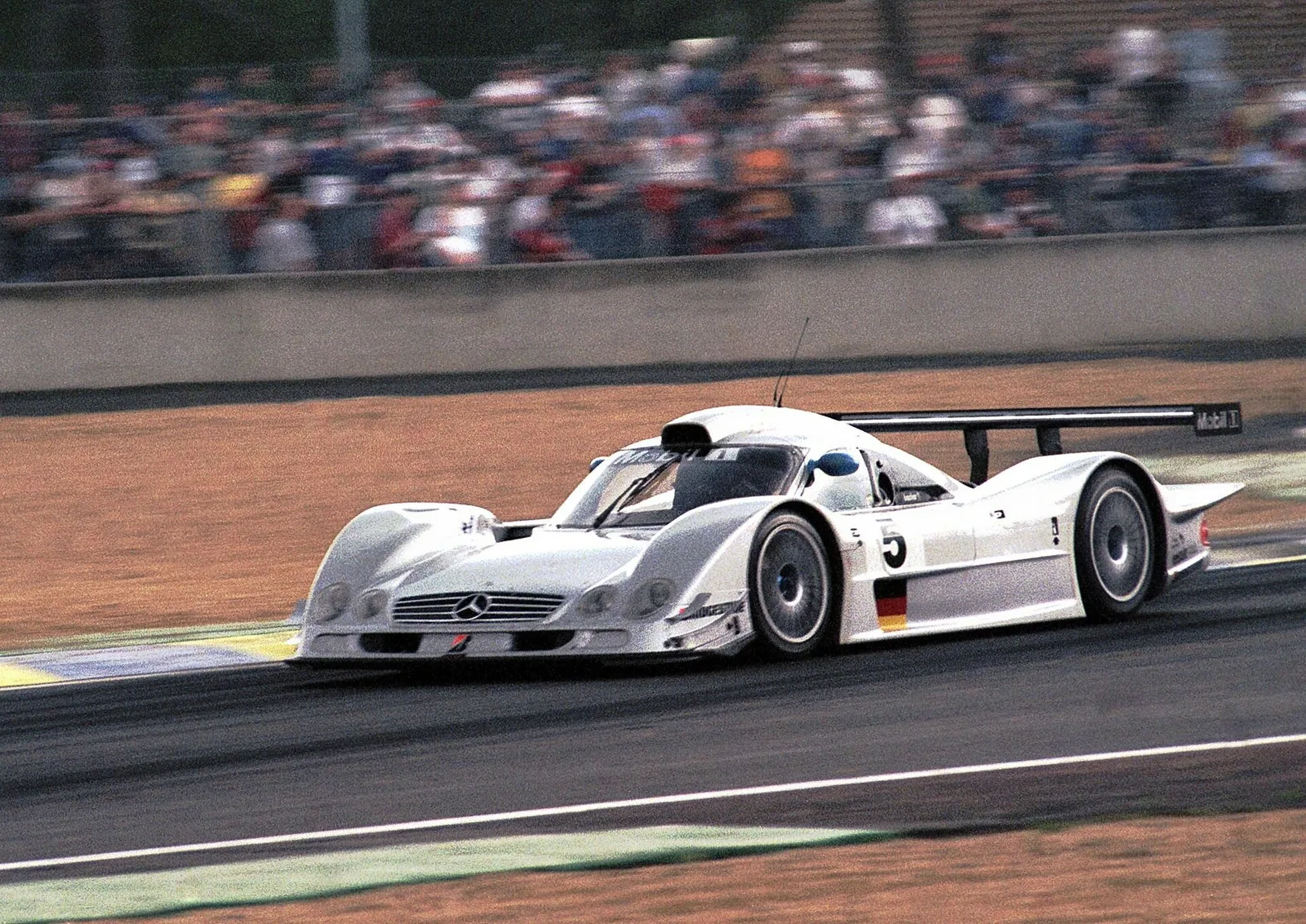
The Mercedes-Benz CLR was a 1999 LMGTP prototype with a 5.7 litre V8 and a carbon monocoque. Three were entered at Le Mans, where two were involved in airborne accidents, and none finished before Mercedes withdrew from sports car racing.
The Mercedes-Benz CLR was a prototype race car developed by Mercedes-Benz with AMG and HWA for the new Le Mans Grand Touring Prototype class. Three cars were entered at Le Mans in 1999, but two accidents before the start and a third during the race ended the car's short career, and Mercedes left sports car racing soon afterwards.
Why did Mercedes build the CLR?
Mercedes built the CLR because the rules for sports cars changed at the end of the 1990s. The FIA dropped the GT1 category for 1999, and the Automobile Club de l'Ouest, which runs Le Mans, followed suit. The ACO then created the LMGTP category, which Mercedes chose to target after its FIA GT cars could no longer compete.
Before the CLK GTR, Mercedes supported Formula One, IndyCar and the International Touring Car Championship. When the ITC collapsed at the end of that season, the company turned to the FIA GT Championship, and AMG built the CLK GTR to meet the GT1 rules. The CLK GTRs won seven of eleven races in their debut season, which earned the drivers' and teams' titles.
For 1998 AMG refined the design as the CLK LM, replacing the V12 with a smaller V8 that Mercedes thought better suited to long endurance races. The CLK LMs earned pole at Le Mans, but both retired with mechanical failure in under three hours, and Porsche won the race. Mercedes still won its second straight FIA GT title, taking all ten races that year.
Built for a new Le Mans class, the CLR never finished a race, and its airborne accidents reshaped the rules for prototypes.
How was the CLR designed?
The CLR had a carbon fibre and aluminium honeycomb monocoque, a shorter body and a naturally aspirated V8 that produced about 600 bhp (450 kW; 610 PS). Development was led by HWA GmbH, the motorsports division of AMG, and the car kept links with Mercedes road cars through its styling.
Design work began in September 1998 while Mercedes was still closing out its second FIA GT season. Because LMGTP rules did not require road versions, the chief designer Gerhard Ungar could focus purely on racing. The minimum weight fell from 950 kg (2,090 lb) under GT1 to 900 kg (2,000 lb), which made the lightweight monocoque important. Its lower half derived from the CLK LM, but the upper half had to be all carbon and aluminium to pass new load tests.
The body stood 10 cm (4 in) lower overall than the CLK LM's, and the nose sat lower and flatter because a shorter wheelbase allowed longer overhangs. Aerodynamic work was done in the University of Stuttgart's wind tunnel, with the emphasis on low drag for top speed. Tail lights were reused from the CLK-Class, while the front fascia, grille and headlamps followed the new CL-Class.
The engine was a 32-valve naturally aspirated V8 designated GT108C and loosely based on the M119 that Mercedes used in its road cars. A previous M119 variant had won Le Mans for Mercedes in 1989. Displacement rose from 5.0 L (310 cu in) to 5.7 L (350 cu in), offsetting the air restrictors the LMGTP rules required. The first engine ran in December 1998, and the Xtrac six-speed sequential gearbox came from the CLK LM.
How much testing did the CLR complete?
The CLRs covered nearly 22,000 mi (35,000 km) of testing before Le Mans. The programme was made public in February 1999, shortly before private running began at California Speedway in the US. Testing continued at Homestead-Miami Speedway in Florida, and then at Circuit de Nevers Magny-Cours in France.
There, a 30-hour run by three CLRs added 8,073 mi (12,992 km) to the total. The car was first shown to the press on 20 April at the Hockenheimring, by which point the cars had covered 21,735 mi (34,979 km) without any major failures.
Who drove the CLRs at Le Mans in 1999?
Nine drivers were named in February 1999. From the FIA GT programme came Mark Webber, Marcel Tiemann, Bernd Schneider, Jean-Marc Gounon and Christophe Bouchut. Nick Heidfeld, a test driver for the McLaren Mercedes Formula One team, joined for his first sports car experience, and Peter Dumbreck came from an open-wheel background. Franck Lagorce moved over from Nissan's Le Mans squad.
The 1998 FIA GT title earned one guaranteed Le Mans place, filled by Gounon, Tiemann and Webber in CLR No. 4. Bouchut, Dumbreck and Heidfeld drove No. 5, and Lagorce, Lamy and Schneider drove No. 6. Nos. 5 and 6 had to pre-qualify, while No. 4 could use the session for testing.
The planning went beyond Le Mans. The team intended to enter a July exhibition event at the Norisring street circuit in Nuremberg, with two 60 mi (97 km) races, and then three more American Le Mans Series rounds, including the 10-hour Petit Le Mans at Road Atlanta. More than 200 personnel from Mercedes-Benz and HWA worked on the three cars, which ran under the name AMG-Mercedes.
What went wrong in qualifying?
Pre-qualifying was the first hurdle. Of 62 applicant teams, the final Le Mans field was 48 cars, and the prototype category let in 28 of 31 entries. Toyota set the fastest pre-qualifying time, and Mercedes No. 6 was sixth, while Nos. 4 and 5 were 14th and 15th.
One CLR suffered a torn suspension linkage that pulled free from the monocoque, the first major fault the cars had suffered since testing began in February.
Two days of qualifying followed. Early on the second day Mark Webber, in CLR No. 4, pulled out of the slipstream of Frank Biela's Audi R8R to overtake. The car lifted its nose, became airborne between Mulsanne Corner and the Indianapolis complex, and flipped over. It landed on its right side, flipped back onto its wheels and skidded 300 m (980 ft) into the barriers. Webber was taken to hospital with a sore neck, chest and back.
The No. 4 car could not improve on its earlier time and dropped to tenth on the grid. Schneider's No. 6 car set a 3:31.541 lap and started fourth, while Toyota took pole at 3:29.930. The team rebuilt No. 4 with a spare monocoque taken from a test car, and Webber recovered in time to race.
Why was CLR No. 4 withdrawn before the race?
Its second accident came in the half-hour warm-up on the morning of the race. As Webber trailed his teammates towards Mulsanne Corner, the car lifted its nose again over a crest, rose more than 9 m (30 ft) and landed inverted on the tarmac. It came to rest on its roof after shedding its engine cover, rear wing and nose.
Marshals righted the car and removed Webber, who had no major injuries.
Television cameras at Mulsanne Corner broadcast pictures of the car on its roof, and the ACO later published the photographs in its 1999 yearbook. Mercedes withdrew CLR No. 4 immediately. Norbert Haug, head of Mercedes-Benz motorsport, consulted Adrian Newey, the chief aerodynamicist of the McLaren Formula One team, on how to change the remaining cars.
Bouchut felt the front of the car could go light at high speed and raised his concerns, but other drivers had not experienced that problem. Mercedes added dive planes to the front fenders of the two remaining cars to gain downforce, at the cost of some top speed, and the drivers were told not to follow other cars too closely.
How did the race unfold for the remaining CLRs?
With two CLRs left, Mercedes started from fourth and seventh. Schneider moved into third behind the two Toyotas in the opening laps, and Bouchut ran fourth. Driver changes later in the race put Lagorce in the No. 6 car and Dumbreck in the No. 5.
Schneider said it took him time to adapt to the new aerodynamics, but the car was running well by the close of his stint.
In the later part of the fourth hour, Dumbreck's Mercedes touched the Porsche 911 GT2 from Estoril Racing at the Ford Chicanes, but it seemed undamaged. On lap 76 Dumbreck was closing on Thierry Boutsen's Toyota for second, with both drivers partly blinded by the low sun. At nearly 200 mph (320 km/h) on the run towards Indianapolis, his CLR ran over the small kerbs at a right kink and lifted its front wheels. It went airborne, rotated three times and reached nearly 15 m (50 ft).
The car cleared a marshal post and the barrier, missed a billboard, and hit trees in a woodland clearing. It dug a rut and tumbled before coming to rest the right way up. A tree limb had pierced the monocoque between the seat and the fuel tank. Dumbreck was knocked unconscious, then awoke and climbed out before marshals and local gendarmes reached him. He was taken by ambulance to hospital and released.
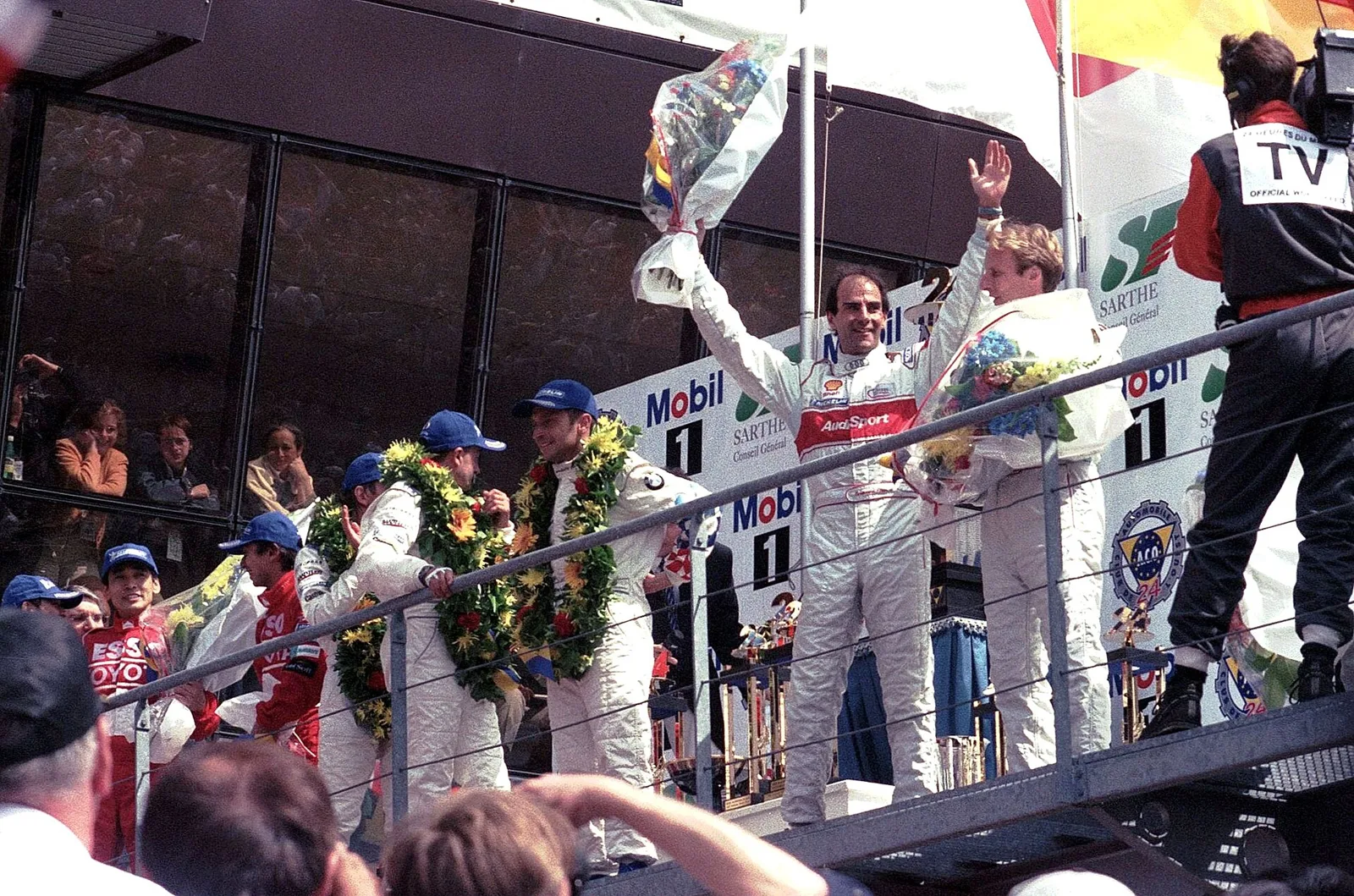
Officials slowed the race with caution flags and safety cars. At the end of lap 76, Lagorce was told to bring the last CLR straight to the garage, where the team shut the final garage door to signal its retirement. BMW won the race the following day.
What did the investigation find?
The ACO and the Federation Francaise du Sport Automobile investigated the crashes. The FFSA questioned why the ACO had let Mercedes keep racing after two accidents before the start. The ACO said no other Mercedes entry showed the same problem, and it blamed the CLR's design, which had the longest front and rear overhangs in the prototype field.
Similar accidents had happened before. In 1998 the Porsche 911 GT1-98 of Yannick Dalmas suffered a nearly identical blow over at Road Atlanta, and in 2000 the open-cockpit BMW V12 of Bill Auberlen backflipped at the same spot. The ACO cut the allowable overhang for LMGTP cars in 2000, and the FIA asked its Advisory Expert Group to write rules against airborne accidents in other racing cars.
Dumbreck first blamed the height of the kerbs, but Mercedes-Benz said the circuit was not at fault. The kerbs and the whole circuit were approved by the FIA. Once the 2000 race was over, a hill on the Mulsanne Straight was lowered by 7.9 m (26 ft) on the approach to Mulsanne Corner, where Webber had his warm-up accident.
Mercedes ran the remaining CLR on an airfield to check its wind tunnel data, and it published no conclusions. It cancelled the rest of its 1999 programme, which meant leaving the Norisring exhibition and the final three American Le Mans Series rounds. Mercedes returned to touring car racing from 2000, and it had no Le Mans entry between 1999 and 2024.
| Item | Figure | Context |
|---|---|---|
| Engine | 5.7 L (350 cu in) V8 | Raised from 5.0 L (310 cu in) for LMGTP air restrictors |
| Power | About 600 bhp (450 kW; 610 PS) | Naturally aspirated GT108C |
| Minimum weight | 900 kg (2,000 lb) | Down from 950 kg (2,090 lb) under GT1 |
| Testing | Nearly 22,000 mi (35,000 km) | Completed before Le Mans 1999 |
| Pre-qualifying | 62 applicant teams | 48 cars in the final Le Mans field |
| Warm-up flight | Over 9 m (30 ft) | CLR No. 4 near Mulsanne Corner |
| Race flight | Nearly 15 m (50 ft) | Dumbreck's car on lap 76 |
| Mulsanne hill | Lowered by 7.9 m (26 ft) | After the 2000 race |
How is the CLR remembered today?
The CLR is remembered mainly for its crashes, which have become part of Le Mans folklore. Speed Channel placed Dumbreck's accident fourth among the most memorable moments in its tenth anniversary list. Road & Track ranked Dumbreck's crash second among the ten most infamous crashes at Le Mans, and Webber's warm-up accident seventh.
Despite the programme's end, Bouchut said the CLR was one of his favourite cars in a 21-year Le Mans career, praising its handling and technology. Mercedes returned to the Le Mans grid in 2025, with Mercedes-AMG GT3 Evo customer entries in the World Endurance Championship's GT class.