A 1949 licensing scheme, a ban on sperm whale oil and the shudder problem explain why Dexron and Mercon bottles are not interchangeable.
Dexron and Mercon are the automatic transmission fluid specifications written by General Motors and Ford. Each is a family of versions that grew from Dexron (B) in 1967 and Mercon in 1987 to the ULV fluids. Newer versions are not always backward compatible, so the manufacturer's recommended fluid should be used.
Until the early 1970s, the fluid that kept American automatic gearboxes from rusting contained whale oil. When the law shut off the supply, General Motors had to rewrite its fluid recipe, the first of many revisions behind the Dexron and Mercon labels on today's bottles. Those names, and the letters and numbers after them, say which gearbox a fluid was made for.
What does automatic transmission fluid do?
Automatic transmission fluid, known as ATF, is a hydraulic fluid that an automatic gearbox cannot work without. It is usually dyed red or green so it can be told apart from motor oil. It has to let valves operate smoothly, keep friction at the brake bands to a minimum, help the torque converter do its job and lubricate the gears.
The same fluid turns up elsewhere. Power steering pumps in some cars run on it, as do certain four-wheel-drive transfer cases and modern manual gearboxes.
What is in the bottle
Modern ATF is a base oil plus an additive package, and the package is what makes one specification differ from another. The additives cover anti-wear protection, rust and corrosion inhibitors, detergents and dispersants, viscosity improvers, seal swell agents, anti-foam compounds, anti-oxidants, cold-flow improvers, high-temperature thickeners and a dye. Every ATF contains friction modifiers apart from a few Ford specifications, Type F and Type G among them, and the John Deere J-21A.
Several brands can make the same grade. Some specifications are open to competing makers, as the common Dexron is, and each brand reaches the same performance by its own chemistry, under licence from the manufacturer that wrote the specification. A few vehicle makers insist on genuine original-equipment fluid. The owner's manual usually lists the ATF specification the maker recommends.
Always use the factory-recommended fluid for your transmission.
What do Dexron and Mercon mean?
Dexron is General Motors' name for its own set of ATF specifications. Mercon is the equivalent series from Ford. Neither is one fluid: each is a family that has been rewritten many times, and the letters or names after it mark the version.
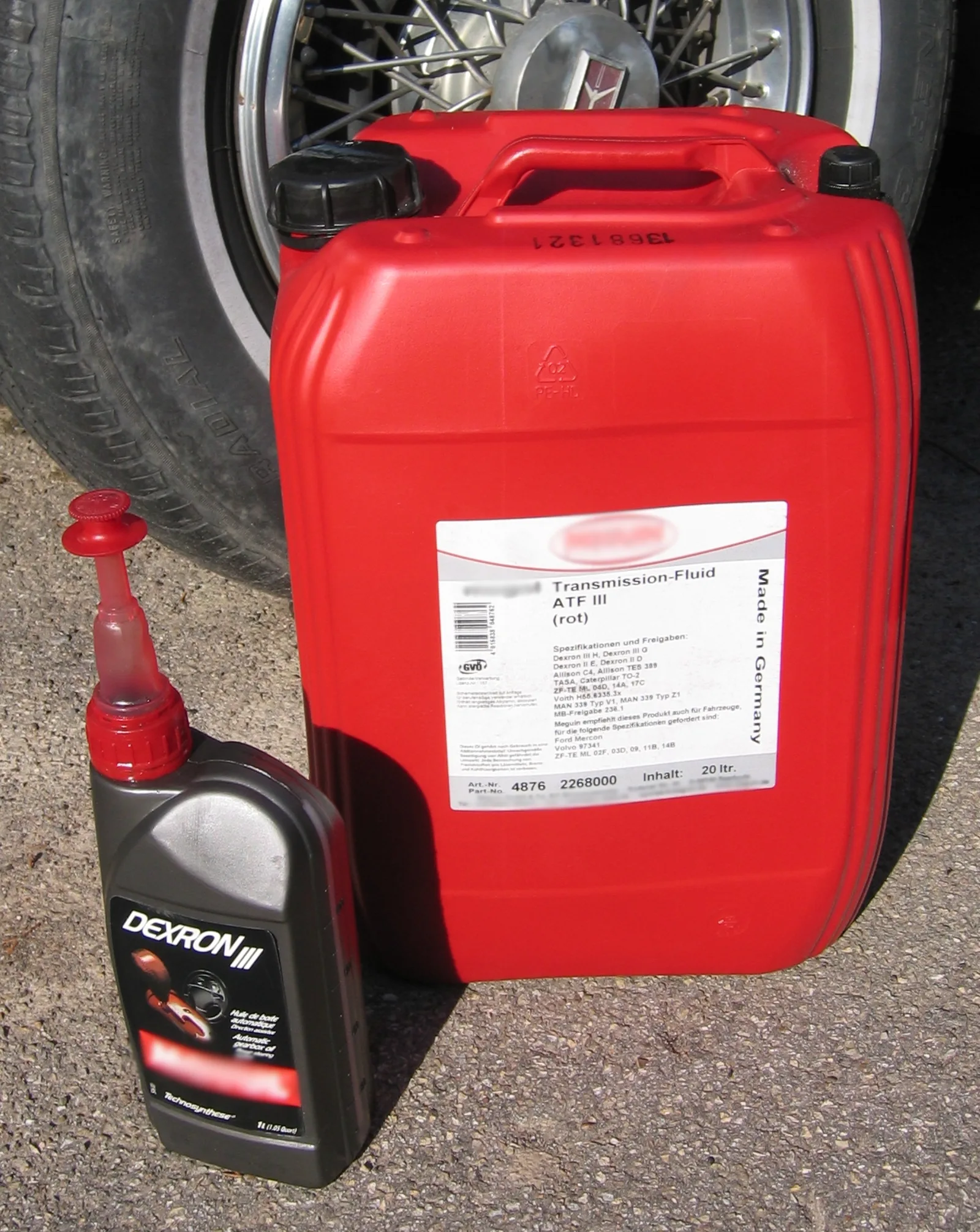
GM licenses the Dexron name and specifications to fluid makers, who market the product under labels of their own. A licensed product carries a licence number beginning with a letter from B through J, plus a "DEXRON Approved" sticker on the container. Not every Dexron fluid is licensed for resale under another brand. Ford runs a matching system. A licensed Mercon fluid must show a licence number on the container, and without one the fluid may not be approved by Ford.
Both makers also buy gearboxes from outside suppliers, and many of those use fluids of their own that neither list covers. Later each name stretched beyond ATF: GM released Dexron gear oils and other lubricants, and Ford did the same under Mercon.
How did automatic transmission fluid begin?
The first automatic gearbox used plain engine oil. Oldsmobile offered its Automatic Safety Transmission as an extra-cost option in the fall of 1937, a four-speed that needed the clutch only for starting and stopping. It shared the engine's seasonal grade of oil for lubrication and hydraulic work.
The world's first mass-produced automatic, GM's Hydra-Matic, followed for the 1940 model year with its own lubricant, GM Transmission Fluid No. 1, released in 1939. GM called it a fluid rather than an oil to discourage the habit of pouring in SAE 20 engine oil. It was only sold at Oldsmobile, Pontiac and Cadillac dealerships, so garages often used SAE 20 oil anyway, and the fluid itself struggled in cold weather.
Type A and the licence number
In 1949 GM set up an Automatic Transmission Fluid Committee, which wrote a Type "A" specification and a qualification procedure to weed out unsatisfactory fluids and give owners a way to identify good ones. Testing was done with the Armour Research Foundation, and a fluid that passed received an Armour Qualification number such as AQ-ATF-101, which had to be displayed on the container.
From 1949 to 1951 only two fluids were licensed, GM's own and Texaco's Texamatic. In 1951 GM widened the programme, and several hundred licensed brands of Type A appeared. From 1949 to 1958 every automatic transmission built by any maker used either motor oil or GM Type A, whether it came from Chevrolet, Ford, Chrysler, Packard or Studebaker.
The 1957 Type "A" Suffix "A" fluid suited hotter fluid and the higher-powered engines of the day. Ford then wrote its own specification, M2C33-A, in 1959. Chrysler followed in 1966, and Toyota ran GM fluids, among them Dexron (B) and Dexron-II (D), in the bulk of its automatics through 2003, but began issuing its own specifications in 1988.
Why did Dexron stop using whale oil?
Dexron (B) arrived on April 1, 1967. It was the first GM fluid to advertise 24,000 miles between changes and the first to need red dye, as an aid to spotting leaks. Until then GM fluid was the same colour as engine oil, though aftermarket brands were already dyed red.
Like its predecessors, Dexron (B) relied on sperm whale oil, an additive that coated internal parts to fend off rust. When the US Endangered Species Act banned imports of sperm whale oil, the additive package had to be redone. GM introduced Dexron-II(C) in 1973, with corrosion inhibitors such as jojoba oil in the mix, and it was the first to advertise 50,000 miles between changes. A small number of transmission fluid coolers with corrosion-prone solder suffered, so GM issued Dexron-II(D) in 1975. The new inhibitors made that fluid hygroscopic, which did little harm in automatics but ruled it out for other hydraulic systems where it was commonly used.
The moratorium on whale oil also ended production of the original 1967 formulation and the fluids before it. For vintage cars, GM now recommends Dexron-VI, Ford recommends Mercon V and Chrysler recommends ATF+4.
Why were the specifications rewritten so often?
Fuel rules forced new hardware. After the 1973 OPEC oil embargo the United States created Corporate Average Fuel Economy regulations in 1975, to be fully in force by the 1978 model year. Carmakers turned to three technologies that had rarely been used: an overdrive fourth gear, a torque converter clutch and front-wheel drive.
The converter clutch caused trouble. After its 1978 introduction, drivers complained of a shudder, and every maker adjusted both its fluid specification and its clutch controls. GM revised Dexron-II(D) in 1978, Chrysler issued ATF+2 in 1980 and Ford released the Type H specification (M2C166-H) in June 1981. Ford found that not every Dexron fluid cured the shudder, so servicing a Type H gearbox needed a matching service fluid. That is how Mercon was born, in January 1987.
Electronics changed the job again. GM was first with an electronically controlled transmission, in the 1987 Cadillac Allante, with Chrysler and Toyota arriving in 1988 and Ford a year after that. Shift timing, shift feel, line pressure and converter clutch apply rates all depended on how fluid behaved in the solenoids when cold, so Dexron-II(E) of 1990 improved low-temperature flow, anti-foaming and high-temperature oxidation stability. Dexron-III(F) followed in 1993.
How do the Dexron and Mercon families line up?
| Family | Fluid | Introduced | Notable change |
|---|---|---|---|
| Dexron | Dexron (B) | April 1, 1967 | First to need red dye; 24,000 miles between changes advertised |
| Dexron | Dexron-II(C) | 1973 | Whale oil replaced; 50,000 miles advertised |
| Dexron | Dexron-II(D) | 1975 | New corrosion inhibitors; revised in 1978 |
| Dexron | Dexron-II(E) | 1990 | Better low-temperature flow for electronic controls |
| Dexron | Dexron-III(F) | 1993 | Better friction stability and oxidation stability |
| Mercon | Mercon (M2C185-A) | January 1987 | Service fluid matched to Type H |
| Mercon | Mercon V | 1996 | Anti-wear and anti-shudder checks for slipping clutch converters |
| Mercon | Mercon SP | August 2001 | For the Ford 6R transmission and some 2005 to 2008 Lincoln models |
| Mercon | Mercon LV | December 2005 | Low viscosity; revised in 2007 and 2010 |
| Mercon | Mercon ULV | January 2, 2014 | Ultra-low viscosity for 10-speed gearboxes |
Can you swap Dexron for Mercon?
Not safely, in general. Ford's Type CJ of 1974 and Type H of 1981 were compatible with Dexron-II(D), and Ford was in fact a licensed Dexron-II(D) vendor. Those facts can suggest that every Ford, Mercon and Dexron fluid works with every other, but that is not correct, and the rule is to use the factory-recommended fluid for the transmission.
The original Mercon worked with Dexron-II(D), and later versions of it with Dexron-III(H). Then the families split. Mercon V, SP, LV and ULV are not compatible with Dexron-III(H) or any newer Dexron, meaning Dexron-VI, HP or ULV.
Within Dexron, the older grades were built to follow one another: Dexron (B) works with the Type A fluids, and Dexron-II(C), (D) and (E) are backward compatible with all earlier Dexron. Later fluids are not always backward compatible, and gearboxes with 6, 8, 9 or 10 speeds, like plug-in hybrid and electric drivetrains, need purpose-made fluids.
In practice the line is less rigid in some markets. Ford has said that in many countries its modern Dex3 fluid suits transmissions for which it names the older standard. Ford also modified Mercon V some time before 2007 to make it backward compatible with Mercon, and it has been ending its Mercon licence agreements in favour of Mercon V.
Which fluid goes with which transmission?
The lists vary by maker, and a few examples show the spread.
- Dexron ULV and Mercon ULV: the 10-speed GM 10L90 and Ford 10R80 from 2017 on
- Dexron HP: GM 8L90 eight-speed rear-drive gearboxes from 2013
- Dexron III or Mercon: most GM and Ford products from before 2006, Toyota products from before 2004 and many Asian vehicles, and generally cheaper than Dexron VI or Mercon V
- Dexron VI: most GM models after 2006, replacing Dexron III
- Mercon V: most Ford, Mercury and Lincoln models, plus the Mazda B-Series
- Mopar ATF+4: most Plymouth, Chrysler, Jeep and Dodge models
- Honda DW-1: every Honda and Acura except those with a continuously variable transmission
- Subaru ATF-HP: 2005 and later, apart from CVTs, with Dexron III for 2004 and earlier
Mazda's M5 fluid, used in the FN4A-EL and FS5A-EL gearboxes, is explicitly not Mercon V, and its FZ fluid for the Skyactiv-Drive is blue. Nissan's Matic D covers 3 and 4-speed gearboxes, Matic K covers 6-speed front-drive units and Matic J covered 5-speed rear-drive ones until Matic-S superseded it.
What does the colour of the fluid tell you?
Wipe the dipstick on a lint-free white rag and look. Dark brown or black fluid can point to a transmission problem, abuse or fluid that has gone far past its useful life. Overused ATF has weaker lubrication and carries abrasive friction material shed by the clutches and bands, and leaving it in speeds wear and, in time, could finish off a transmission that was otherwise sound.
Colour is only a guide. Most ATF darkens as it is used, so the maker's recommended service interval is the better yardstick, and with no service records colour is a common way to estimate how much life is left. Synthetic ATF, from original-equipment and aftermarket brands, offers better performance and service life for some uses, frequent trailer towing among them.
Can a fluid really last a lifetime?
Ford tried. Its 1967 Type F was meant to be a "lifetime" fluid that never needed changing, the first of several, and the 1974 Ford Car Shop Manual told owners the gearbox was filled at the factory for life and to use only M2C33F if fluid ever had to be added. The Type F did give a high static friction coefficient and harsh shifting, though. Many other makers later offered lifetime fluids of their own.
The principle goes back to the 1939 Chrysler Fluid Drive. Its fluid coupling held a highly refined straight mineral oil inside a case that was in effect airtight. The small amount of air inside was used up in a harmless reaction with the fluid, leaving an inert nitrogen atmosphere, so the oil barely aged. The recommended level check was stretched from 2,500 miles up to 15,500 and finally to "never", meaning the car's whole life.
Where this goes next
Mercon ULV, introduced on January 2, 2014, uses a Group 3+ base oil for the 2017 and later Ford 10R80 and GM 10L90 ten-speed rear-drive transmissions, which Ford and GM co-developed. Ford has been terminating its licence agreements for older Mercon in favour of Mercon V. Newer multi-speed gearboxes and plug-in hybrid and electric drivetrains call for specialised fluids, and a market remains for older fluids that claim to meet earlier specifications.