From banked superspeedways to 24-hour prototypes and full-contact touring cars, a guide to the main kinds of car racing and what sets each apart.
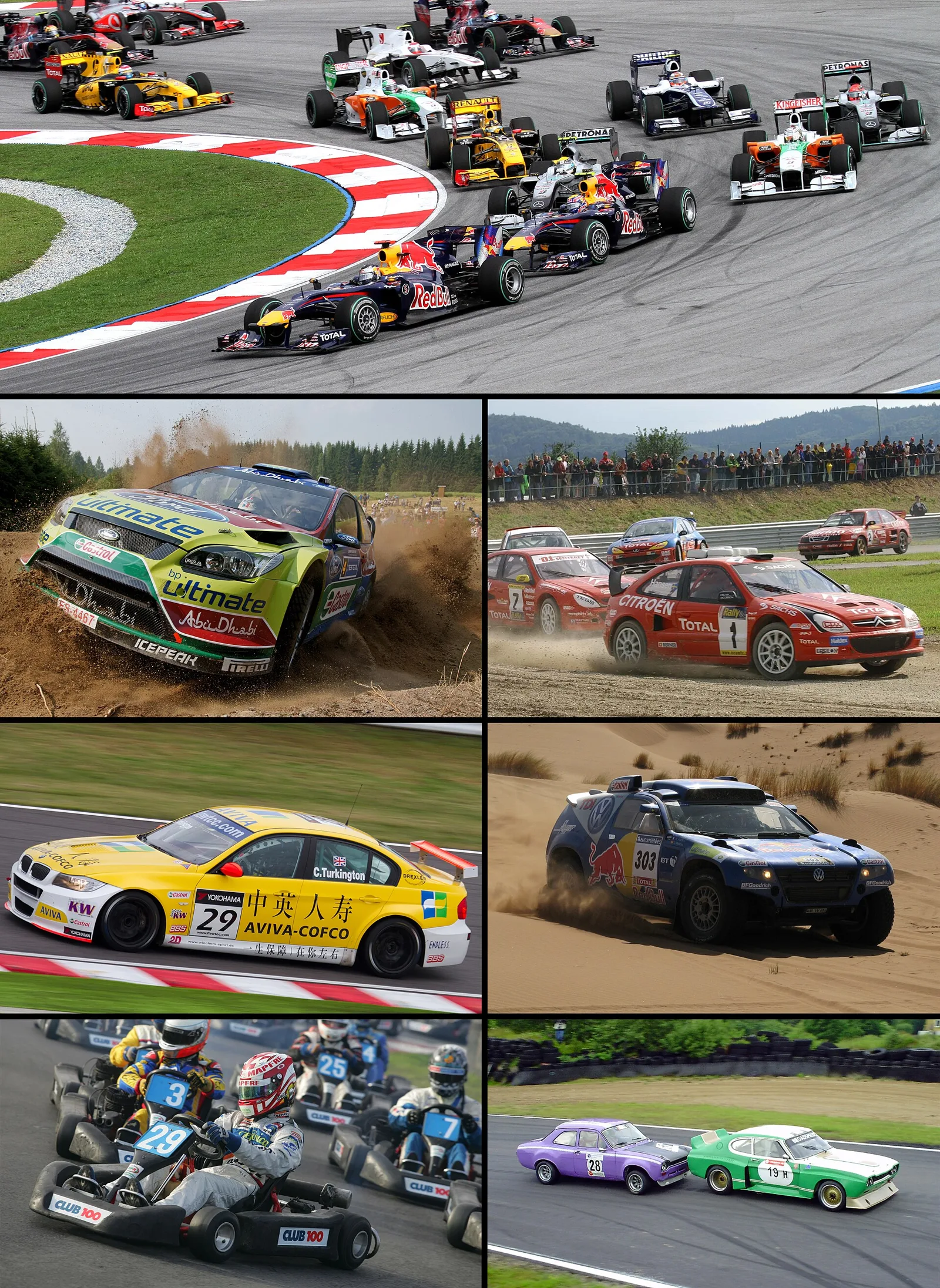
Oval racing uses one-direction banked tracks, mainly in the United States. Road racing covers paved circuits and street courses with turns both ways. Sports car racing runs prototypes and GT cars in 6 to 24-hour endurance events, and touring car racing uses production-derived four-seat cars in close, often full-contact races.
The fastest qualifying lap ever recorded at an official race meeting was not set in Formula One. It was a qualifying lap of 241.428 mph (388.541 km/h) by Gil de Ferran in a CART car on the oval at California Speedway in 2000. By comparison, the Formula One speed record is 372.5 km/h (231 mph), set by Valtteri Bottas in 2016.
That gap shows why the sport does not work as one thing. Put a car on a circuit with turns in only one direction, and the engineering, the tactics and even the crowd change. Take away the big wing and add a roof, and it changes again. Car racing has grown into several distinct traditions, each with its own rules and its own culture.
Types of car racing and how they began
The first recorded races date from as early as 1867, when a match race over about 8 miles (13 km) from Ashton-under-Lyne to Old Trafford was won by Isaac Watt Boulton's carriage. The first organised contest with a petrol-engined car came on 28 April 1887, a 2 km dash starting at Neuilly Bridge and finishing in the Bois de Boulogne. On 22 July 1894 the magazine Le Petit Journal ran Paris to Rouen, where one hundred and two entrants each handed over a 10-franc fee, and it is regarded as the first motoring competition. America's first automobile race, a Thanksgiving Day event out of Chicago, followed in late November 1895.
Many early events were really reliability trials meant to show that cars were practical transport, but they soon became a way for makers to show off. By the 1930s specialist racing cars existed. The world's first purpose-built circuit, Aspendale Racecourse in Australia, opened in January 1906, and Brooklands in England became the first purpose-built banked venue in June 1907.
From these roots, the sport divided along two lines: the shape of the track and the kind of car.
Take away the big wing and add a roof, and the whole sport changes again.
Oval racing vs road racing: how they differ
Oval racing takes place on dedicated circuits that are shaped like an ellipse or a stadium. Turns go one way, almost always counterclockwise, and banking is common. Road racing is run on a paved road surface, either a purpose-built closed circuit or a street circuit on temporarily closed public roads, and the aim is to finish a fixed number of laps fastest, or to complete the most laps in a fixed time.
The two ask different things of the driver. An oval driver shifts and brakes less and never faces a corner of a different radius. A road course usually has one preferred line, while an oval offers many. The best line depends on track condition, set-up and traffic, and in a 25-lap feature on a short track a driver might never use the same line twice. Physical demands are real on both: an IndyCar driver at Richmond may feel as much lateral g, in one direction only, as a Formula One driver at Silverstone.
Weather works differently as well. Road racing offers fast and slow corners, which suits rain tyres, whereas paved ovals generally do not run on a wet surface, although dirt ovals will sometimes tolerate light rain. A few tracks, such as Evergreen Speedway in Washington, have rain-or-shine rules.
Safety is another contrast. A road course usually has run-off areas, gravel traps and tyre barriers, while ovals tend to have a concrete wall between the track and the fans. The SAFER barrier was developed as a less dangerous alternative, either fitted over an existing wall or replacing it.
There is a US-versus-Europe split too. Ovals dominate American racing. The 2013 National Speedway Directory counted 901 ovals among the country's 1,262 ovals, drag strips and road courses, and 683 of the ovals were dirt. After the First World War American automobile racing leaned towards ovals, and dirt-track racing grew into stock car racing; drag racing branched off as well. Road racing traditions in Europe, South America, Britain and the Commonwealth grew up around public roads, at places such as the Circuit de la Sarthe, Spa-Francorchamps and Mount Panorama.
Oval track sizes
Oval tracks are classed by size, surface, banking and shape:
- Short tracks are less than a mile (1.6 km) round, and most are half a mile (0.8 km) or less. Nicknamed bullrings, they are where oval drivers serve an apprenticeship. NASCAR's top Cup Series visits six of them: Richmond, Martinsville, Bristol, Iowa, North Wilkesboro and Bowman Gray Stadium.
- Mile ovals are common but have lost importance. Only Phoenix, Loudon and Dover remain on NASCAR's calendar, and IndyCar went back to the Milwaukee Mile in 2024 after nine years away. That track, the oldest oval, began as a venue for horse racing.
- Intermediates run from 1 to 2 miles (1.6 to 3.2 km), with 1.5 miles (2.4 km) the typical size. Before 1990 only five existed, and Charlotte, Atlanta and Darlington survive from that group. A building boom in the late 1990s produced so many near-identical ones that they were nicknamed cookie-cutter tracks. Charlotte was the first with lights, in 1992.
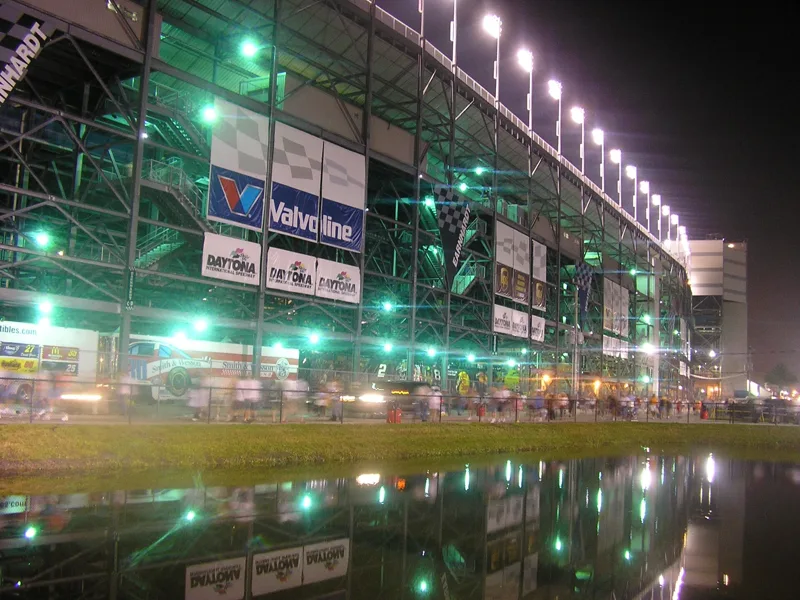
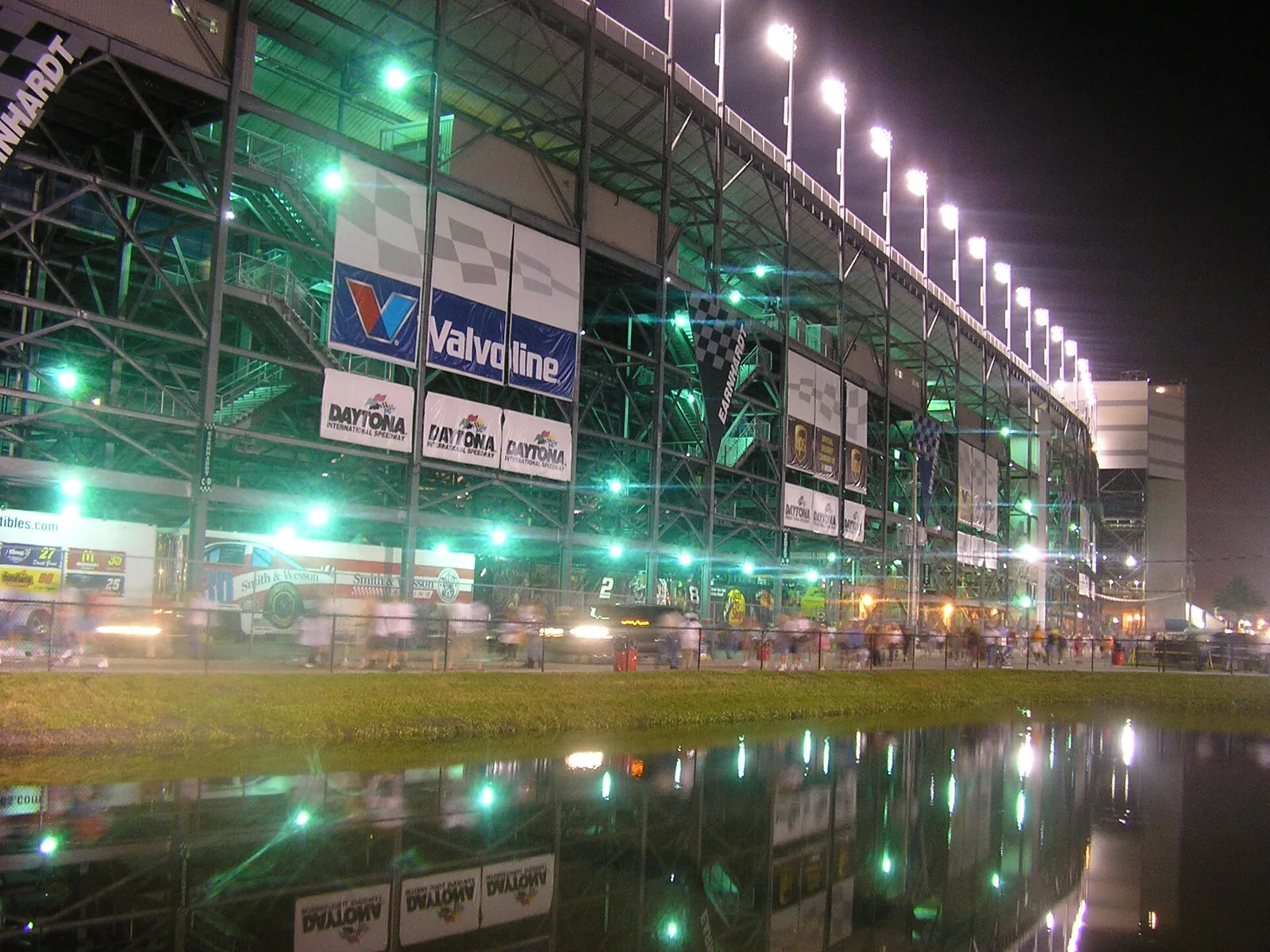
- Superspeedways are 2 miles or longer, and five are active in the United States. Indianapolis, built in 1909 as a test facility for the car industry, and Daytona, built in 1959 to replace the town's beach course, are both 2.5 miles (4.0 km) round.
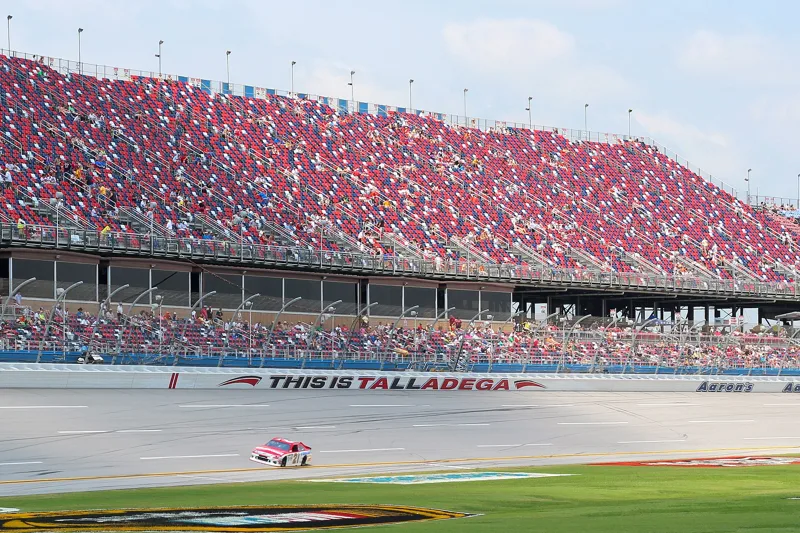
Speed is the oval's signature. Talladega, built in 1969 at 2.66 miles (4.28 km), holds the stock car record: a lap averaging 216.309 mph (348.116 km/h), set in 1987, with 228 mph (367 km/h) reached at the end of the backstretch. At Texas World Speedway in 1973, Mario Andretti set a closed-course record of 214.158 mph (344.654 km/h).
Pack racing
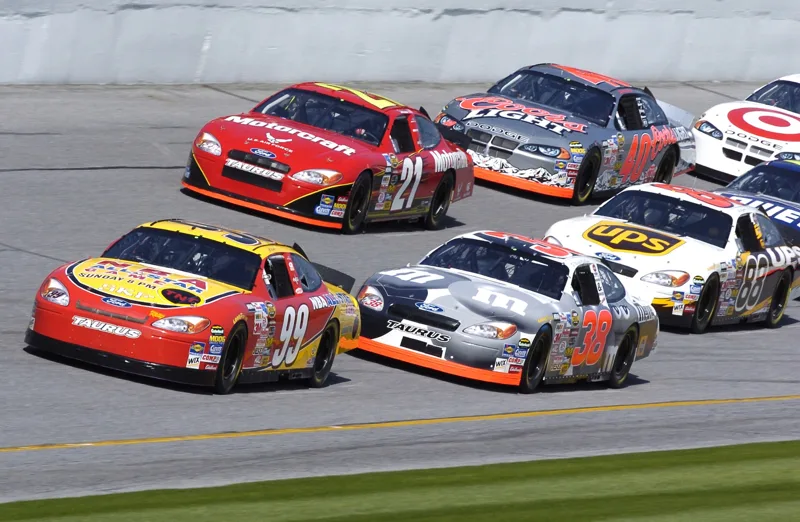
The oval's defining spectacle is pack racing, found on fast, high-banked superspeedways. Cars can take the corners flat out, since they are cornering within their limit of traction, and drafting through a turn does not hurt performance. A group running together is faster than any car alone, so everyone ends up in one big pack. In NASCAR it is often called restrictor plate racing, because cars at Talladega and Daytona must run an air restrictor to reduce power.
Passing is constant, with cars two and three abreast, and drivers need strong mental discipline. The drawback is that a crash at the front can block the track quickly and leave those behind with little time to react. Such multi-car accidents are known as the Big One.
Road racing: from public roads to purpose-built circuits
Road racing began in the early twentieth century, centred on Western Europe and Britain. The 1906 French Grand Prix at Le Mans used a long circuit of closed public roads, as did the Targa Florio. The Nurburgring in Germany, 20.8 km (12.9 mi) long with more than 300 metres (1,000 ft) of elevation change, was nicknamed the Green Hell by Jackie Stewart. In 1925 Britain outlawed racing on public roads after a spectator was hurt at the Kop Hill Climb, and Donington Park became the first permanent park circuit there. The Mille Miglia continued until 1957, and the Pau Grand Prix has run through the city streets of Pau since 1933.
Safety has driven much of the evolution. The 1955 Le Mans disaster killed 83 spectators and injured 120 after two cars touched and one crashed into the crowd, and racing was temporarily banned in several countries. By the late 1970s, sponsors and television money had brought greater professionalism. Circuits that began as public roads were widened and given chicanes and run-off areas, and deaths fell sharply. Switzerland, where circuit racing was banned for decades, allowed the Zurich ePrix in 2018 under an exemption for Formula E, and a law passed in May 2022 legalised motorsport there from 1 June 2026.
Street circuits survive and have even returned. Monaco is the old standard, and the Melbourne circuit, Las Vegas and Baku have joined the Formula One calendar. North American street racing includes Long Beach, St. Petersburg, Detroit and Toronto.
What is sports car racing? Endurance, prototypes and GT
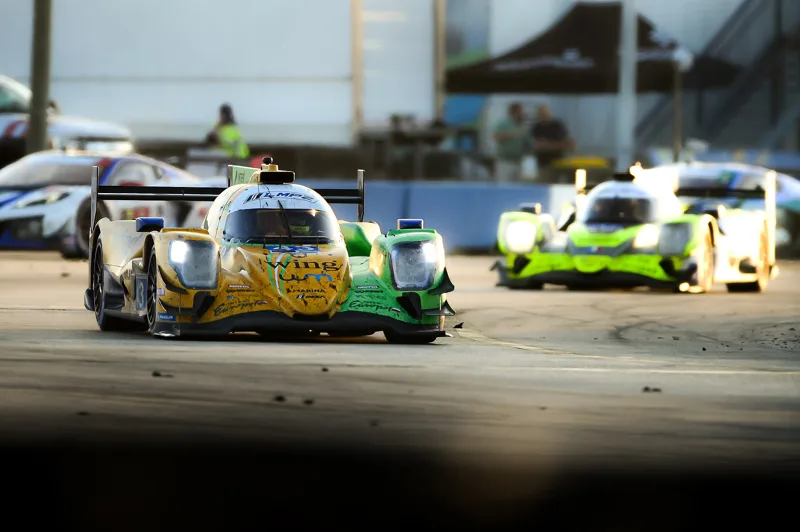
Sports car racing uses cars with two seats and enclosed wheels. At the top are purpose-built prototypes, with GT cars, based on road-going models, underneath them. These races are usually endurance events of 6 to 24 hours, so reliability, fuel economy and driver consistency count for more than outright speed. Among the best-known series are IMSA's SportsCar Championship, the GT World Challenge and the FIA World Endurance Championship.
The 24 Hours of Daytona and Le Mans, together with the 12 Hours of Sebring, form the Triple Crown of endurance racing. Petit Le Mans, the Nurburgring 24 Hours, the Spa 24 Hours, the Bathurst 12 Hour and the Suzuka 1000km are also considered crown-jewel races. Manufacturers use the sport to build their prestige. Ferrari, Porsche, Aston Martin, Jaguar, Audi, Mercedes-Benz, BMW, Bentley, Lamborghini, Maserati, Lancia, Lotus, Alfa Romeo and Chevrolet have all built reputations this way, and their road cars have often resembled the ones they raced.
The classes
The GT classes divide by power and aerodynamics:
- GT2: engines often above 600 horsepower, less downforce than GT3 and fewer driver aids.
- GT3: by far the most popular class, with more significant aero than GT2 but typically 500 to 550 horsepower. It is the top GT class in both the World Endurance Championship and IMSA.
- GT4: around 450 horsepower and very little aerodynamics, typically the last step before the premier GT classes.
Prototypes do not rely on road-legal cars. They are closed-wheel, purpose-built machines that are lighter and have more power and downforce than GT cars, which makes them much faster. Manufacturers tend to run the LMH and LMDh cars, while privateer teams field the slightly slower LMP2 machines.
How the category grew
Le Mans began in 1923, and one of its co-creators argued that sports-car racing as we know it did not exist before then. In the 1920s the cars in endurance races and Grands Prix were still basically the same, and the Bugatti Type 35 was at home in both. In the 1950s Italian cars and races shaped the genre, which came to be called Gran Turismo. From 1953 the FIA ran a World Sportscar Championship, and Ferrari, Maserati, Jaguar and Aston Martin all backed works programmes. After accidents at the 1955 Le Mans and the 1957 Mille Miglia, a 3-litre capacity limit arrived in 1958, and in 1962 GT cars took over the FIA's championship for a time.
The 1960s and 1970s brought powerful prototypes and the American Can-Am series, which ran from 1966 to 1974 and fell to rising costs and the energy crisis. The 1980s were the age of Group C in Europe and IMSA's Camel GTP in the United States. The American Le Mans Series held its first season in 1998, and Grand-Am began in 2000 with Daytona Prototypes.
Japanese success at Le Mans is recent. Mazda won in 1991, and Toyota took first and second in 2018 and again in 2019.
Production car racing: touring cars and GT
Touring car racing is road racing with four-seat cars derived from production models. Because the cars use little aerodynamics, a following car finds it much easier to stay close and pass than in open-wheel racing. Speed differences are small and grids are large, so there is often full-contact racing with bumping and nudging.
The major championships are the Supercars Championship in Australia, the British Touring Car Championship and the DTM. The FIA's World Touring Car Championship and World Touring Car Cup have both folded. Super GT in Japan descends from the older JGTC, but its cars resemble GT3 machines more than true touring cars. In North America, the SCCA's SPEED World Challenge is dominant, and Trans-Am is the longest-running road racing series in the United States. Argentina's Turismo Carretera has run since 1931; Juan Manuel Fangio won it in 1940 and 1941, and the long Chevrolet versus Ford rivalry has produced the most victories for Ford.
Production-based racing exists on the oval side as well. Bill France Sr. founded NASCAR on 21 February 1948, with help from several other drivers, and the first Strictly Stock race followed on 19 June 1949 at Daytona Beach.
Types of motorsport compared
| Type | Where it is run | Cars | Culture and typical series |
|---|---|---|---|
| Oval racing | Dedicated ovals with turns in one direction, mostly in the United States | Stock cars, IndyCars, sprint cars, modifieds, midgets | Pack racing and drafting; NASCAR Cup, IndyCar; short tracks as the apprenticeship |
| Road racing | Closed circuits and temporarily closed public roads | Open-wheel Formula cars, sports cars, touring cars | Formula One, Monaco, Le Mans; Grand Prix racing on six continents |
| Sports car racing | Closed circuits, often for 6 to 24 hours | Two-seat prototypes and GT3, GT4 and GT2 cars | FIA World Endurance Championship, IMSA, GT World Challenge; the Triple Crown |
| Production-based racing | Closed circuits and street circuits | Four-seat touring cars derived from road models; GT cars | Supercars, British Touring Car Championship, DTM; full-contact racing in big grids |
What is changing in car racing today?
Electric racing is growing, with Formula E, the Eco Grand Prix and the Electric GT Championship, and the industry has had to cope with a global pandemic and a persistent chip shortage. On the oval side, IndyCar has abandoned all intermediate tracks except the Nashville Superspeedway for its season finale as of 2025, and outside Indianapolis it no longer uses superspeedways.