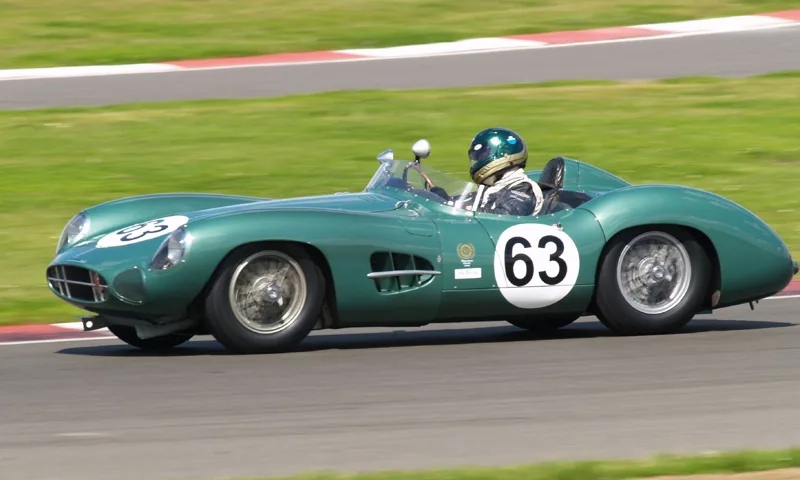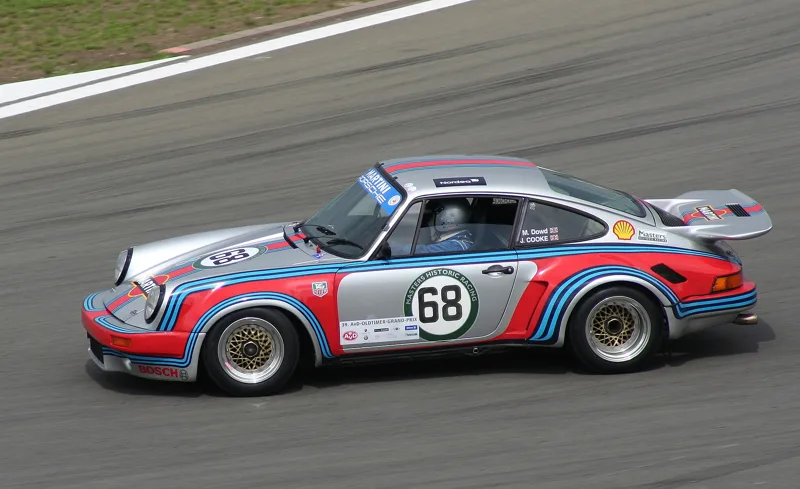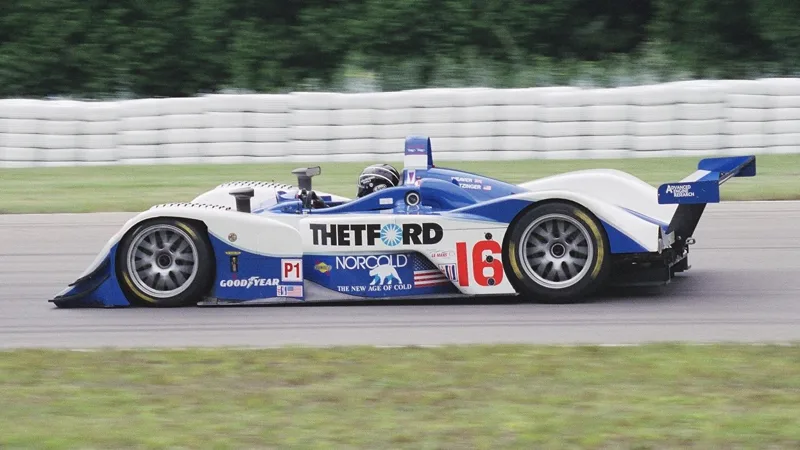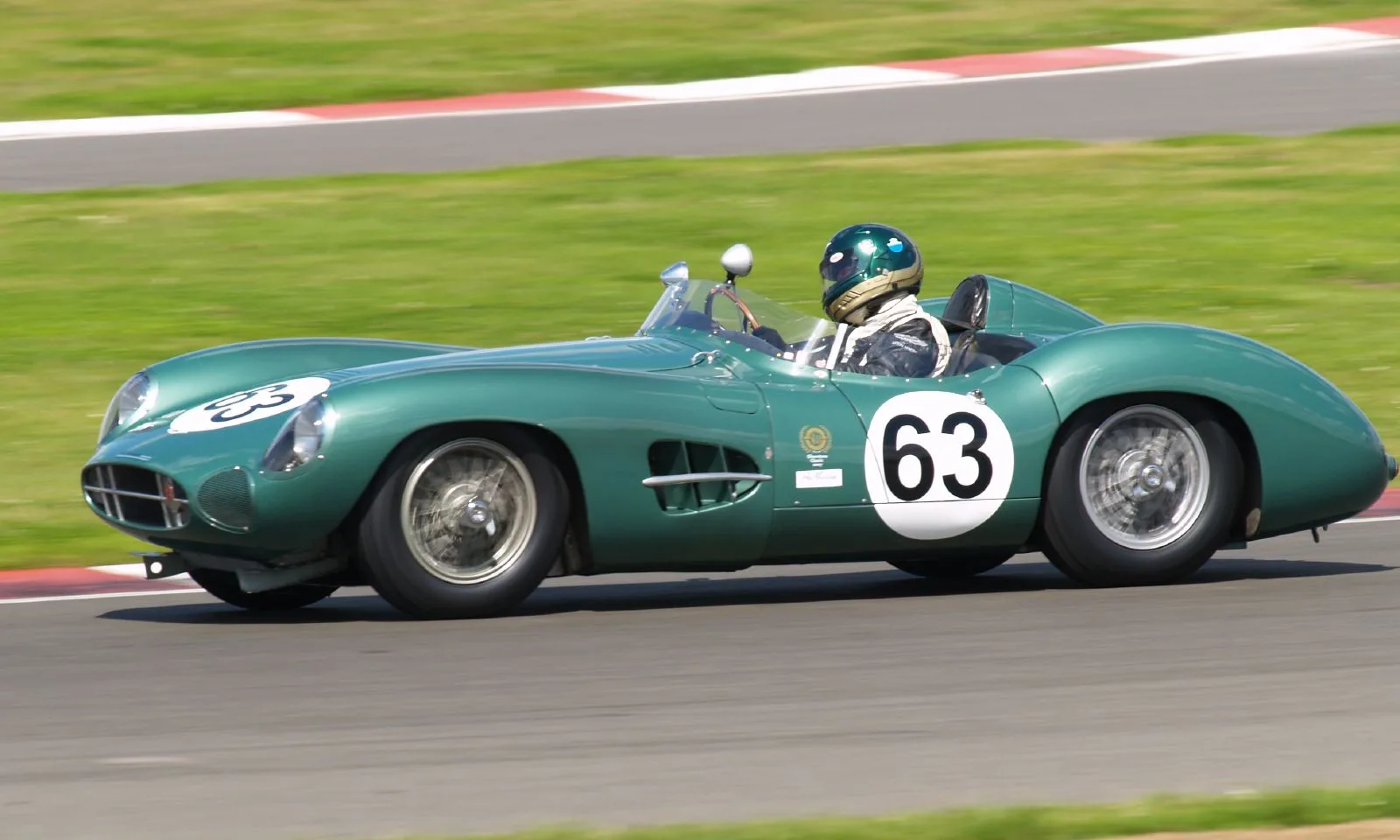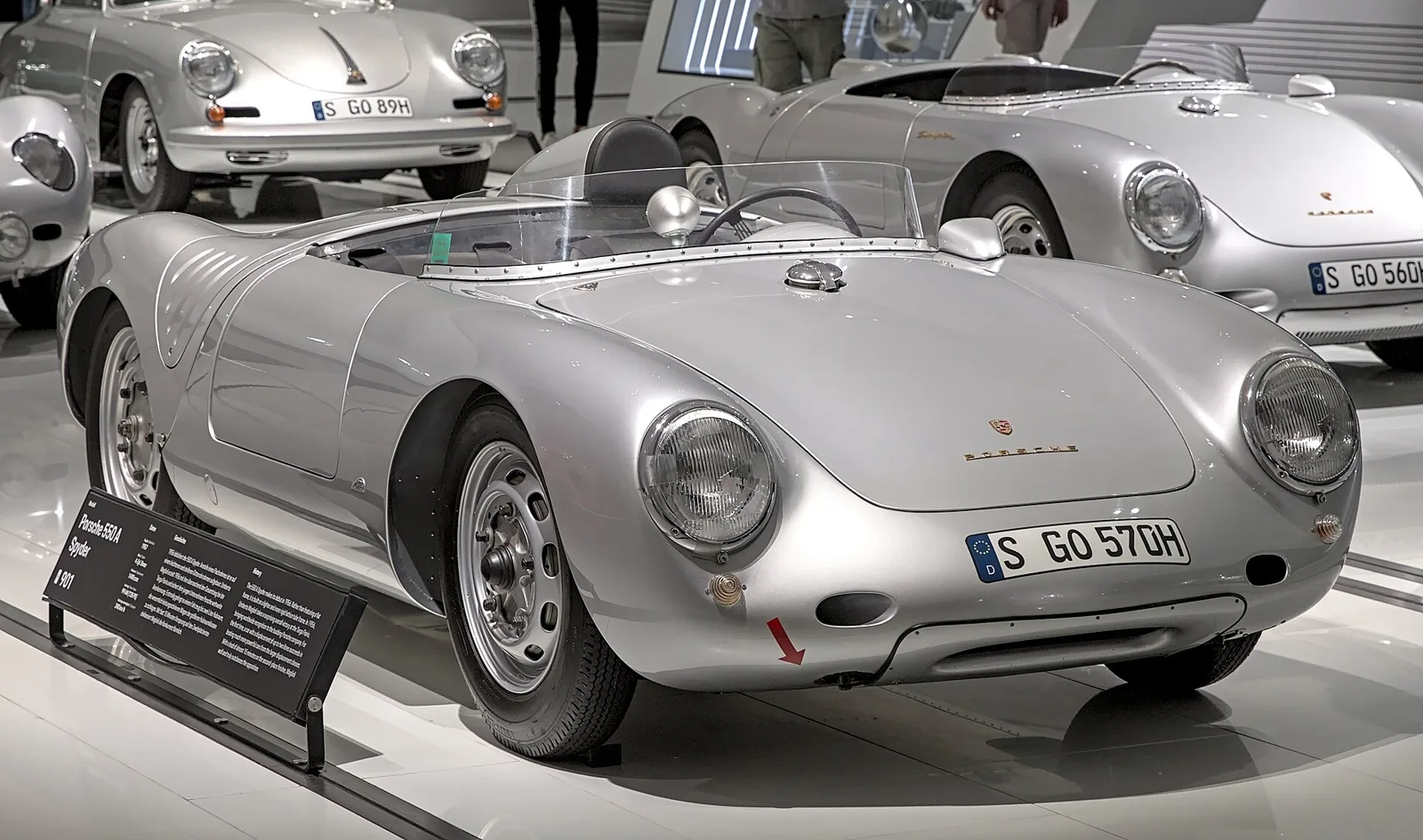
A mid-engined four-cylinder that won its first race, a Targa Florio winner, a turbocharged Group 5 monster and a Penske-run prototype that won more races than Audi's R10 in 2007.
Porsche's 550, 718, 935 and RS Spyder each won in a different era: the 550 took class wins from 1953, the 718 won the Targa Florio and Sebring, the 935 won 123 of 370 races as a customer car, and the RS Spyder won the ALMS LMP2 title in 2006, 2007 and 2008.
A Porsche 550 Spyder won the first race it ever entered, the Nurburgring Eifel Race of May 1953. Over the decades that followed, Porsche kept building racing cars that private teams could buy, from the 550 to the turbocharged 935 and the carbon-fibre RS Spyder prototype.
Each of the four cars below won in a different era, and privateers or customer teams ran every one of them alongside the factory.
What was the Porsche 550 Spyder?
The Porsche 550 was a racing sports car built from 1953 to 1956, with only 90 made. It had a mid-mounted, air-cooled four-cylinder engine, and it quickly came to dominate the 1.1- and 1.5-litre classes. It was introduced at the 1953 Paris Auto Show, and the layout later spread to top-level racing.
The idea came from the 1948 Porsche 356/1 prototype built by Ferry Porsche, together with Spyder prototypes that Walter Glockler had raced from 1951. The result sat so low that in the 1954 Mille Miglia, the German racer Hans Herrmann drove one under closed railway crossing gates.
The heart of it was the Type 547 engine, nicknamed the Fuhrmann engine after Ernst Fuhrmann. This was an all-aluminium, air-cooled boxer four of 1,498 cc, with bore and stroke of 85 mm by 66 mm. Each cylinder bank had double overhead camshafts, driven by vertical shafts, and two valves per cylinder. Two twin-barrel Solex carburettors and dual ignition fed it, and the first version made 110 PS (81 kW; 108 hp) at 6200 rpm and 121 N m (89 lb ft) of torque at 5000 rpm.
Placing the engine just ahead of the rear axle gave the 550 balanced weight distribution and largely neutral handling. The price was a low resistance to turning about the vertical axis, which could make the car rotate suddenly and be hard to catch. The layout traced back to Ferdinand Porsche, who had pioneered it on the Auto Union Grand Prix car. Early cars had a four-speed gearbox with synchromesh on every gear; from 1956 a five-speed took over, with first and reverse left unsynchronised, and a limited-slip differential kept the driven wheels from spinning in corners.
Porsche was building racing cars that customers could buy long before rival makers did.
How did the 550 race, and who else raced it?
The first car, 550-03, won its debut at the Nurburgring in May 1953, and later that year 550s took class wins at Le Mans and in the Carrera Panamericana. The Mexican win gave later performance Porsches the Carrera name. The works team raced and developed the car from 1953 to 1957.
Its record was extraordinary for such a small production run. The silver works cars carried coloured spears on the rear fenders so that pit crews could tell them apart, and Herrmann's red-tailed number 41 went from victory to victory. In the works period only two small-car rivals really troubled it at Le Mans: an OSCA that finished ahead in 1954 but was disqualified, and a 1.1-litre Lotus Eleven that trailed the winning 550 by one lap in 1957.
The 1956 version, the 550A, used a lighter and stiffer spaceframe chassis and handed Porsche its maiden outright victory at a major sports car event, the Targa Florio, although that race was not part of the world championship that year. During this era Porsche became the first European manufacturer to secure race sponsorship for North American events, through Fletcher Aviation, with which it was working on a light aircraft engine, and later through Telefunken and Castrol.
When the works team moved on to the 718 in 1957, privateers kept the 550 in competition. It was both a road car and a race car, and owners often drove it to the circuit, raced it and drove it home. One was bought by the Yugoslav leader Josip Broz Tito for Milivoje Bozic, who finished third in the 1958 Supercortemaggiore 1000 km at Monza on a single set of tyres and took his category in the 1960 European hill-climb series. Numbers were painted on in a crude hand when privateers owned them, and on the Mille Miglia a high number like 351 meant a start time of 3.51am.
The car's value today reflects that history: in 2018 Bonhams sold a 1958 550A Spyder for $5,170,000, the highest price for a 550 at auction.
How did the Porsche 718 build on the 550?
The 718 was a series of one- and two-seat sports-racing cars built from 1957 to 1962, a development of the 550A with revised bodywork and suspension. Its full name, 718 RSK, combines RS for RennSport and a K for the shape of its torsion-bar suspension. It kept the mid-engined layout and used the 1.5-litre Type 547/3 quad-cam engine, which made 142 hp (106 kW).
The RSK debuted at Le Mans in 1957 and crashed out, but by 1958 the car was third overall there with Jean Behra and Hans Herrmann, while Edgar Barth and Paul Frere took fourth and the class win. Behra also finished second at the Targa Florio. In 1959 Barth and Wolfgang Seidel gave the 718 its first overall Targa victory.
The following year was Porsche's closest brush with the title. The 1960 World Sportscar Championship had five events of which three counted. The RS 60, revised for new windscreen and cockpit rules, with an optional 1.6-litre engine developing 160 hp (120 kW) and a double-wishbone rear end, delivered a one-two at the 12 Hours of Sebring with Herrmann and Olivier Gendebien. Porsche also won the 1960 Targa Florio, with Herrmann joined on the winner podium by Jo Bonnier and Graham Hill. Porsche finished level with Ferrari on 22 points, but Ferrari won the tie-break, having two third places discarded to Porsche's one.
The family kept evolving. The RS 61 was almost identical to the RS 60 and won the European Hill Climb Championship. The W-RS of 1961 gained a 2.0-litre air-cooled flat-eight making 240 hp (180 kW); one finished eighth at Le Mans in 1963, and it was replaced by the 904 in 1964. A coupe, the 718 GTR, carried a 210 hp (160 kW) eight-cylinder engine and disc brakes, and with Bonnier and Carlo Maria Abate won the Targa Florio in 1963.
The 718 also went single-seat. For Formula Two in 1958 Porsche built the RSK Mittellenker, with the driver in the centre of the cockpit, and Behra won at Reims. In 1960 Stirling Moss, Bonnier and Hill gave Porsche a one-two-three at Aintree. When Formula One adopted 1.5 litres in 1961, Porsche entered three 718s for Dan Gurney, Herrmann and Bonnier. Gurney took three second places and fourth in the championship, but the four-cylinder engine and the chassis were out of date, and a new eight-cylinder car, the 804, followed for 1962.
| Car | Years | Engine | Defining result |
|---|---|---|---|
| 550 Spyder | 1953 to 1956 | 1,498 cc four, 110 PS (81 kW) | Won its first race, May 1953 |
| 718 RSK | 1957 to 1962 | 1.5-litre four, 142 hp (106 kW) | 1960 Sebring one-two; Targa Florio wins |
| 935 | From 1976 | 3.3L twin-turbo flat-six | 123 wins from 370 races; 1979 Le Mans |
| RS Spyder | 2005 to 2010 | 3.4-litre V8, 503 hp (375 kW) | ALMS LMP2 titles 2006, 2007, 2008 |
Why did the Porsche 935 dominate?
The 935 was a racing version of the 911 (930) Turbo, introduced in 1976 for the FIA Group 5 rules. From 1977 Porsche sold it to customers, and it won 123 of the 370 races it entered, including the 1979 24 Hours of Le Mans overall. No rival sold racing cars to customers the way Porsche did, so a field often contained five or more 935s.
It descended from the Carrera RSR 2.1 turbo prototype, which had finished second at Le Mans in 1974. The 3.3L twin-turbocharged flat-six used mechanical fuel injection and produced up to 630 kW (857 PS; 845 hp), though the big turbochargers caused plenty of lag at low revs. Customers took it into the World Championship for Makes, the IMSA series and the German DRM, and it won at Sebring, Daytona and the Nurburgring 1000 km as well as at Le Mans. Its dominance ended when the FIA replaced the six numbered groups with three, A, B and C, in 1982. A second-generation 935 followed, a limited run of just 77 cars with deliveries starting in June 2019.
The 1976 season produced the car's most dramatic fight. Under Group 5 rules, nicknamed the silhouette rules, wings, axles and bodywork could change provided the car's frontal silhouette stayed the same. Porsche shrank the 3.0-litre flat-six to 2.85 litres, and with the turbo penalty factor of 1.4 it fell into the 4.0-litre class, which had a minimum weight of only 970 kg. The empty 935 weighed 900 kg. Pre-season tests at Paul Ricard recorded 295 km/h (183 mph).
Rule makers caused trouble early. After the second race, officials demanded that the road car's whale-tail hood fit the racer, forcing Porsche to change its intercooler from an air-to-air layout to a more compact air-to-water design, which cost weeks of development time and half a million Deutsche marks. A loophole found by the engineer Norbert Singer allowed the headlights to be removed from the fenders, producing the flat nose that became the 935's trademark and later appeared on the road-going 930 as the flachbau.
BMW was the rival. Its turbocharged 3.2 and 3.5-litre CSL coupes, driven by Ronnie Peterson and Gunnar Nilsson, were fast but kept breaking their gearboxes. Porsche still needed to win the last two rounds. At Watkins Glen the test chassis of Rolf Stommelen and Manfred Schurti won, taking Porsche to 90 points against BMW's 85. At Dijon, BMW's turbo car took pole but the transmission failed in the first hour, and three 935s and two Group 5 934/5 cars won. Porsche took both of its championships, the 935 the Makes title and the 936 the sports car title, and a 936 also won Le Mans. Endurance racing's age of turbocharged engines had begun.
In 1977 thirteen 935/77A cars went to privateers in Australia, Italy, France, the United States and Germany. Georg Loos and Kremer Racing entered them in the DRM, where they met no serious competition in the big division. The factory kept developing its own 935/77 with lower drag, a second rear window and two turbochargers, yet it won only four of nine World Championship for Makes events. At Le Mans a customer 935 finished third overall, while the works car retired with engine trouble.
What was the Porsche RS Spyder?
The RS Spyder was a Le Mans Prototype 2 racing car designed by Porsche with Penske. Its name joined the 550 Spyder to Porsche's RennSport label. It was Porsche's first appearance in the top tier of sports prototypes since it dropped its LMP programme in 1999.
Porsche engineers designed it entirely in-house, with Carbotech assisting. The chassis is a carbon-fibre monocoque, with the engine and transmission acting as stressed members. The 3.4-litre, 90-degree V8 and the six-speed electro-pneumatic sequential gearbox were new from scratch. Braking came from six-piston aluminium monobloc calipers and carbon-ceramic discs. Dry weight started at 750 kg and reached 825 kg in 2010 specification. The V8 began with 478 hp (356 kW), rose to 503 hp (375 kW) in 2007 and stayed there with a new direct-injection engine in 2008, then dropped to roughly 440 hp (330 kW) in 2009 when new restrictor rules arrived.
It won on debut. Lucas Luhr and Sascha Maassen took the class win, and fifth overall, in a Penske car at the 2005 season finale at Laguna Seca. In 2006 two Penske cars won seven class victories, with an outright win at Mid-Ohio the first LMP2 outright win since 2003. In 2007 the RS Spyder Evo won eight races outright, against only four for the Audi R10 TDI from the larger P1 class, and Romain Dumas won the drivers' title.
The standout result came in 2008. Timo Bernhard, Dumas and Emmanuel Collard won the 12 Hours of Sebring overall, exactly twenty years after Porsche's previous overall win there. It was Porsche's first major endurance victory in five years, and the first time in 14 years that a car from the smaller class won Sebring outright. Porsche took the manufacturers' title by a single point from Acura. At Le Mans, where the RS Spyder debuted that year, Van Merksteijn Motorsport won the class and finished tenth overall, ahead of the Essex team in second.
Customers kept the car racing. In 2009 Team Essex won the class at Le Mans with Casper Elgaard, Kristian Poulsen and Collard, and CytoSport bought an ex-Dyson car. In 2010 CytoSport contested the full American Le Mans Series, took outright wins at Lime Rock and Mosport, and finished second in the standings. No RS Spyder ran at Le Mans that year.
What the RS Spyder left behind
Regulations for 2011 made the car obsolete because the costs exceeded the new LMP2 budget limit. The programme did not end there. The Porsche 918 Spyder uses a development of its engine, and the Porsche 919 Hybrid carried the racing programme into the LMP1 class starting in 2014.