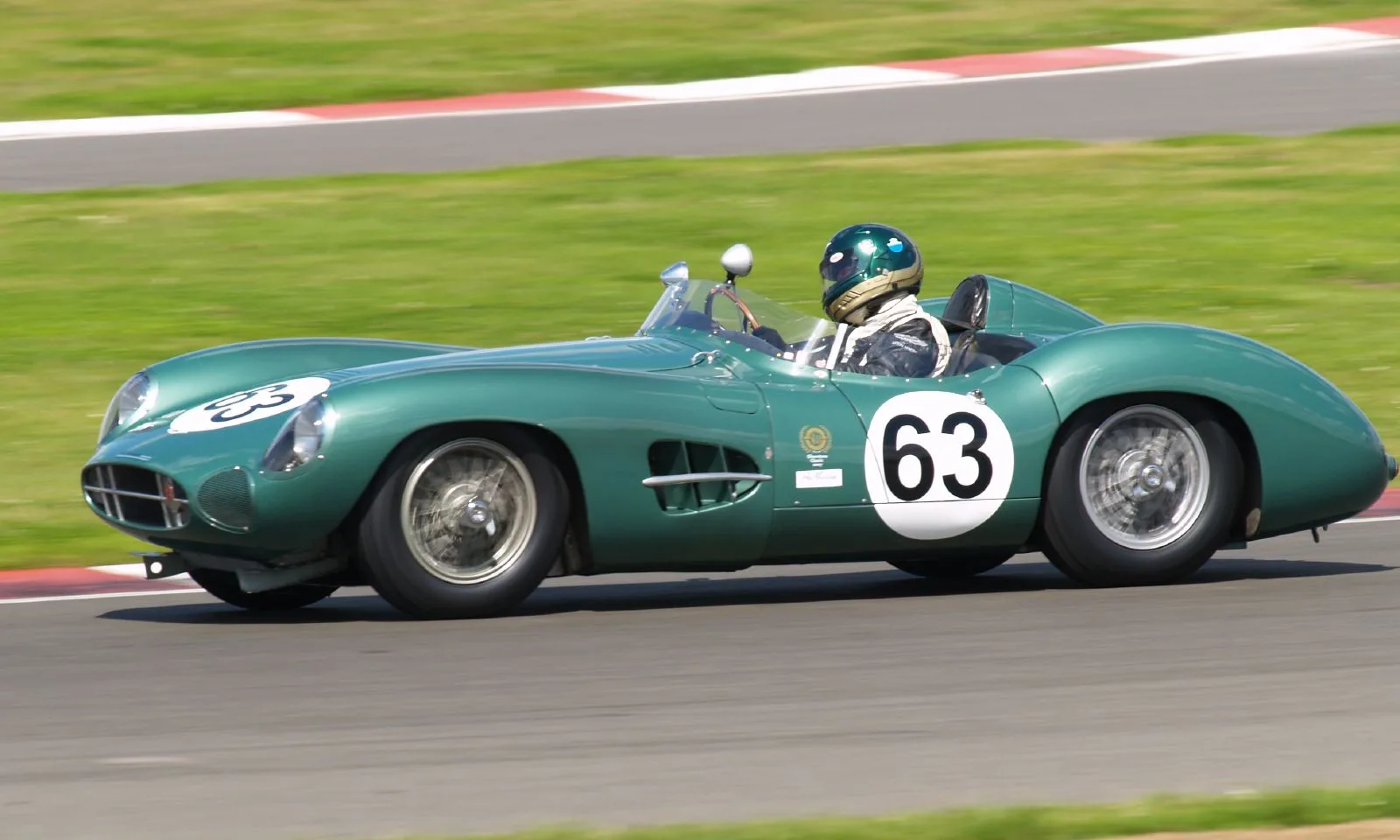
The 1959 DBR1 won Le Mans and the world title, and the DBR9, the Lola prototype and the Vantage GTE carried the story on.
Aston Martin's only outright Le Mans victory came in 1959 with the DBR1, which also won the World Sportscar Championship. The marque later took GT1 class wins in 2007 and 2008 with the DBR9, ran the Lola B09/60 prototype from 2009 and launched the Vantage GTE in 2017.
Aston Martin has won the 24 Hours of Le Mans outright exactly once, in 1959, and the same car went on to clinch the World Sportscar Championship a few months later. Every endurance racer the marque has built since has lived in the shadow of that one result, and the DBR9 carries its name.
Four machines tell the story: the DBR1 of the 1950s, the DBR9 GT1 car of the 2000s, the Lola-built prototype that borrowed the DBR9's V12, and the Vantage GTE of the late 2010s.
What was the Aston Martin DBR1?
The Aston Martin DBR1 was a sports racing car that the company began building in 1956 for the World Sportscar Championship and a calendar of non-championship races. It is best known for winning the 1959 24 Hours of Le Mans, the only time Aston Martin has finished first overall at the event.
A change in the sportscar rules made it possible. Entrants no longer had to field cars that were road legal or derived from road cars, as the DB3S had been, so Aston Martin could start with a clean sheet. Ted Cutting led the design. The body grew out of the DB3S but sat much lower, and the old open area behind the front wheel was closed up in favour of full bodywork with a large triangular vent in the side. That vent became a standard feature of later Aston Martins.
The first engine was a 2.5-litre (2493 cc) all-alloy unit, the RB6.250, loosely related to the racing Lagonda straight-six and sized to suit the 1956 Le Mans rules. For 1957 the team developed the RB6.300, a straight-six of 2992 cc rated at 250 hp (186 kW).
Aston Martin has one outright Le Mans win, and every racing car it has built since has been measured against it.
Three hard seasons before the breakthrough
The DBR1 made its debut at the 1956 Le Mans, which that year sat outside the championship. David Brown's team ran the 2.5-litre DBR1/1 alongside two older 2.9-litre DB3S cars. The Jaguar D-type that won had a 3.4-litre engine, and the Aston ran well against the bigger machinery until a gearbox failure after 246 laps ended the race for Reg Parnell and Tony Brooks while they were seventh.
The following year the car's results arrived in a rush. DBR1/1 took second place at the British Empire Trophy with Roy Salvadori, and second again at Goodwood's Sussex Trophy. Then it received the 3.0-litre engine and was joined by a sister car, DBR1/2. Together they finished first and second at the Spa Sportscar Race, Brooks ahead of Salvadori.
The 1000 km at the Nurburgring was the first round of the world championship for the new cars, and it brought a surprise. DBR1/2, driven by Brooks and Noel Cunningham-Reid, won outright against the combined strength of the Ferrari and Maserati works teams, whose drivers included Peter Collins, Mike Hawthorn, Stirling Moss and Juan Manuel Fangio. It was Aston Martin's first world championship win since the Tourist Trophy of 1953. Le Mans then undid the good work, with both cars failing to finish. Brooks did win the non-championship Spa Grand Prix.
In 1958 a third chassis, DBR1/3, arrived. The championship now capped engines at three litres, which left the 3.7-litre DBR2 ineligible, so David Brown concentrated on the DBR1 and kept the DBR2 for other events. Reliability was the enemy. Gearboxes failed at Sebring and again at the Targa Florio, although Moss was the fastest man at Sebring and, in Sicily, broke the lap record he had set in a Mercedes 300SLR by more than a minute. Moss and Jack Brabham repeated the Nurburgring win, ahead of a large field of Ferraris and Porsches, but all three cars failed to finish at Le Mans.
The season closed with the Tourist Trophy, where Aston Martin took first, second and third, Moss and Brooks winning in DBR1/2. The result came with an asterisk. Ferrari had already clinched the title and stayed away, and the four-hour race paid only half points. It was still enough to put Aston Martin second in the constructors' championship.
How did the DBR1 win Le Mans in 1959?
Carroll Shelby and Roy Salvadori drove DBR1/2 to victory at the 1959 24 Hours of Le Mans, with the sister car of Maurice Trintignant and Paul Frere second. The next closest competitor finished 25 laps behind the pair, and the result is considered the finest triumph in the marque's motorsport history.
Two more chassis had been finished that year. DBR1/4 was in fact a conversion of the DBR3, and DBR1/5 was a spare chassis sold to the privateer Graham Whitehead, the only DBR1 sold outside the works from 1956 to 1959.
The year started slowly. A lone entry at Sebring failed to finish and Ferrari's 250TR cars took a one-two. Aston skipped the Targa Florio, where Porsche filled the first four places. Then came a hat trick of victories: DBR1/1 won the Nurburgring 1000 km for the third year running in the hands of Moss and Jack Fairman, then the Le Mans triumph, and finally the Tourist Trophy at Goodwood.
That last round was a drama. Ferrari, Porsche and Aston Martin were all still in contention. The Aston entry of three DBR1s, plus Whitehead's privately owned car, looked strong until DBR1/3, which had been leading, caught fire while refuelling in the pits and was too badly damaged to continue. The blaze left the team with no space to service its other cars. Whitehead solved the problem by withdrawing his own entry and handing over his pit stall. Moss then climbed into the car that Shelby and Fairman had been sharing, DBR1/2, and won the race and the championship. Trintignant and Frere finished fourth in DBR1/4.
| 1959 championship | Points |
|---|---|
| Aston Martin | 24, from three victories |
| Ferrari | 18 net (22 gross) |
| Porsche | 18 net (21 gross) |
It remains the only World Sports Car Championship Aston Martin has won. The tally of six championship victories had set a record for a car in the 1950s, and the three straight wins at the Nurburgring, Le Mans and the Tourist Trophy equalled what the Ferrari 250TR had done at the start of 1958. Only two other cars from the decade, the Ferrari 375 Plus of 1954 and the 250TR, managed the double of world title and Le Mans in a single year.
What became of the DBR1 afterwards?
David Brown moved his attention to Formula One with the DBR4 and DBR5, a programme that proved unsuccessful, and the factory stopped racing sports cars. The four DBR1s it still owned, including a rebuilt DBR1/3, were sold to customers for use in various series.
DBR1/3 finished third at Oulton Park in 1960 and third at Le Mans with Salvadori and Jim Clark. DBR1/2 won the 1960 Rouen Grand Prix with Fairman. In 1961 DBR1/3 won at Charterhall with Jimmy Blumer, the last victory for any DBR1, and two other cars failed to finish at Le Mans. After the 1962 season every DBR1 left competition for museums and private collections. DBR1/3 is displayed at the Simeone Foundation Automotive Museum in Philadelphia.
The DBR3 gets a footnote: built on a chassis meant for the DBR1, it raced once in 1958, was judged uncompetitive and was refitted to become DBR1/4. The survivors have since become valuable. In August 2017 DBR1/1 sold for US$22,555,000, a record for any British-built car.
What was the Aston Martin DBR9?
The DBR9 was a GT1 racer from Aston Martin Racing that first appeared in 2005 and stayed in front-line use until the GT1 category ended in 2011. Based on the DB9 coupe, it kept the road car's chassis, V12 engine block and cylinder heads. Its name looks back to the DBR1.
Everything else was reworked for competition. Apart from the roof, every body panel was carbon fibre composite. The underside was flat from the nose to the rear diffuser, and a carbon wing added rear downforce. The V12 produced 634 PS (466 kW; 625 bhp) and 746 N m (550 lb ft) through two 31.2 mm air restrictors; without restriction, it was capable of over 760 PS (559 kW; 750 bhp) and over 880 N m (649 lb ft). The car could reach 60 mph (97 km/h) from rest in 3.4 seconds and 100 mph (161 km/h) in 6.4 seconds.
For the 2007 Le Mans, Prodrive reworked the design. New regulations demanded air conditioning to prevent overstressing the drivers, and Prodrive went further, fitting a heat-resistant white roof to every new car. Two redundant cooling vents in the mirrors were removed to tidy the airflow.
How did the DBR9 get on at Le Mans?
It took until 2007 for the DBR9 to win its class at Le Mans, and it won again in 2008. In 2005 and 2006 the car had been beaten by its arch-rival Corvette Racing: third in 2005, with fuel problems, and a similar story a year later.
Elsewhere those first seasons were productive. The DBR9 won the 12 Hours of Sebring in the LMGT1 class in 2005 and finished second there in 2006. In the American Le Mans Series it regularly challenged Corvette Racing, winning at Lime Rock Park, Mosport, Petit Le Mans and Laguna Seca among other rounds, and ended 2006 second in the GT1 Manufacturers' Championship. That earned the factory team an automatic place at Le Mans in 2007.
Other series were less kind. The DBR9 started the 2006 FIA GT Championship as favourite for the title but took only two victories, at Mugello and Dubai. BMS Scuderia Italia blamed the compound of its Pirelli tyres for poor results. In the Le Mans Endurance Series, Larbre Competition took the team title winning the 1000 Kilometres races at Istanbul and the Nurburgring.
The 2007 Le Mans race brought the reward. The factory's number 009 car won the GT1 class, Larbre's DBR9 was third in class, and every DBR9 that started the race reached the finish. Aston Martin marked it with the DB9 LM, a limited edition of 60 cars in Sarthe Silver. Later that year the DBS road car arrived with styling taken from the racer, tied in with the James Bond film Casino Royale. The factory DBR9s had raced in 2006 and 2007 carrying the numbers 007 and 009 as a tribute to Bond.
In 2008 Larbre and Scuderia Italia moved on, but Prodrive kept a two-car factory team at Le Mans. The number 009 car in a Gulf Oil livery, with Darren Turner, Antonio Garcia and David Brabham aboard, won the class again. In the FIA GT1 World Championship, Hexis AMR won the 2011 teams' title with DBR9/1, the first chassis ever built.
In total 16 chassis were made. Nigel Gearsley, a character in the animated film Cars 2, is based on the car.
What was the Lola-Aston Martin B09/60?
The Lola-Aston Martin B09/60 was a Le Mans Prototype constructed by Lola Cars International, with Prodrive co-developing it for Aston Martin Racing. Its internal name, DBR1-2, refers to the DBR1 chassis that won Le Mans in 1959. It was the first prototype to carry the Aston Martin name since the AMR1 of 1989.
The car evolved from the Lola B08/60 that the team used in LMP1 in 2008, and it kept the 6.0-litre (370 cu in) V12 from the DBR9. Larger air restrictors added 50 hp (37 kW) because the engine was production-based. That V12 was a little heavier, taller and longer than the custom-built engines in rival prototypes. Lola's gearbox gave way to a more compact six-speed from Xtrac, shifted by paddles, and the brakes were cooled by air fed through two fans at the rear instead of by ducts in the bodywork.
The car's competition record was strong among petrol-powered prototypes. In 2009 two factory cars contested the full Le Mans Series, with a third for Charouz Racing Systems under the AMR Eastern Europe banner. The number 007 car won the series overall and the 009 was fourth. At Le Mans, the Charouz car of Jan Charouz, Tomas Enge and Stefan Muecke came fourth behind the factory entries from Peugeot and Audi and was the highest-placed petrol car. The 008 car ran as high as third overall until Anthony Davidson collided with a GT1 Aston Martin, and the repairs and a five-minute stop-and-go penalty ended its challenge.
In 2010 the car travelled to America for the first time, finishing third at the 12 Hours of Sebring, three laps behind the two winning Peugeots. Of three cars entered at Le Mans, the 008 and 009 retired, leaving the 007 to finish sixth overall after 365 laps. Among petrol-powered cars, only the Oreca and the LMP2-winning Strakka HPD finished higher.
The B09/60 had a busy 2011 too. Muscle Milk Team Cytosport entered it in the American Le Mans Series for Klaus Graf and Lucas Luhr. After failing to finish at Sebring, the team passed the pole-sitting Dyson Racing car to win at Long Beach, won three more rounds and ended the year second in LMP1 behind Dyson.
Aston Martin Racing meanwhile built a new car, the AMR-One, for the 2011 Le Mans. A B09/60 run by Kronos Racing with Marc VDS finished seventh overall, twenty-seven laps behind the winning Audi R18 TDI, with Vanina Ickx, Bas Leinders and Maxime Martin driving. The AMR-One suffered reliability trouble and a lack of speed, so the factory team returned to the B09/60 for the closing three Intercontinental Le Mans Cup rounds and for the American Le Mans Monterey round at Laguna Seca. The lone factory car started third behind two Dyson Lolas and won by three laps. At Petit Le Mans it picked up a podium after three of the four factory Audi and Peugeot cars crashed.
| Car | Era | Category | Defining result |
|---|---|---|---|
| DBR1 | 1956 onwards | Sports racing car | 1959 Le Mans win and world title |
| DBR9 | 2005 to 2011 | GT1 | Le Mans class wins in 2007 and 2008 |
| Lola-Aston Martin B09/60 | 2009 to 2011 | Le Mans Prototype | 2009 Le Mans Series overall win; fourth at Le Mans |
| Vantage GTE | Launched 2017 | GTE endurance Grand Tourer | Convertible to GT3 specification |
What is the Aston Martin Vantage GTE?
The Vantage GTE, also called the Vantage AMR, is an endurance Grand Tourer from Aston Martin Racing, based on the Vantage road car. It replaced the Vantage GT2 and its derivatives and was launched in London in November 2017 alongside the road-going Vantage.
Aston Martin Racing and the company's Gaydon headquarters developed it together, entirely in-house, in tandem with the road car. After a shakedown at Rockingham Motor Speedway it completed two 30-hour endurance tests, first at the Circuito de Andalucia and then at the Circuito de Navarra in Spain. The team praised its durability and reliability in further tests at Sebring in Florida. By the time it appeared at the World Endurance Championship Prologue at the Circuit Paul Ricard, it had covered over 20,000 km of pre-season testing, which also took in Motorland Aragon, the Algarve International Circuit and the Yas Marina Circuit in Abu Dhabi.
The car was built so that it can switch from Group GTE trim to Group GT3 trim, and the aerodynamic work did not stop at launch. At the 2019 Le Mans Test Day the team unveiled a new low-downforce kit meant to cut the car's overall drag. The previous aerokit was an adapted WEC Sprint package with Le Mans tweaks. The new one was tested at Monza and proved highly effective compared with the kit used for the 2018 race.
The thread runs through all four cars: the DBR9 took its name from the DBR1, the B09/60 carried a DBR1 chassis designation as its internal name, and the Lola prototype used the DBR9's engine.