How Brooks Stevens and the Zimmer family built new cars that looked like the 1930s, and how both companies went bankrupt and were revived.
Neoclassic cars were built from the 1960s to the 1990s with 1920s and 1930s styling. The Excalibur used Studebaker and later Chevrolet hardware, ending in 1997. Zimmer bodied Ford Mustang, Pontiac Fiero and Lincoln Town Car bases, with its last cars made in 2020.
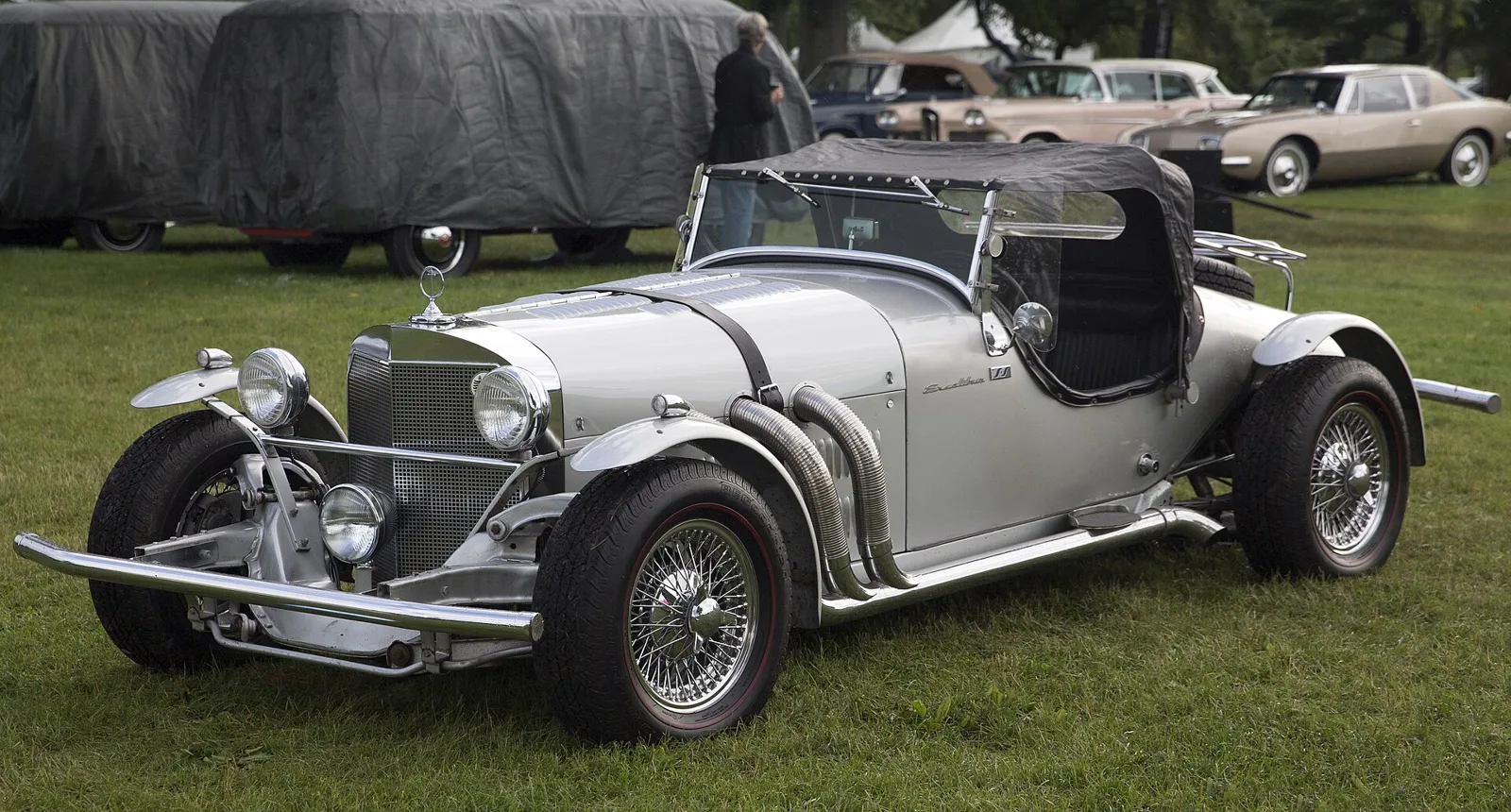
A batch of 400 Studebaker Lark chassis that the failing car maker could not use became the foundation of one of America's best-known retro cars. Brooks Stevens, the designer who had styled a Mercedes-Benz SSK lookalike for Studebaker, put his own company's bodywork on them and launched a brand called Excalibur. More than 3,500 Excaliburs were eventually built.
The Excalibur and the Zimmer are two well-known neoclassic cars, part of a category that dressed modern running gear in the proportions of the 1920s and 1930s. Both companies leaned heavily on mainstream hardware, put a flamboyant body on top and sold the result as something grander than the donor car.
What is a neoclassic car?
Neoclassic is the term for cars produced between the 1960s and the 1990s in the style of cars from the 1920s and 1930s. They are not replicas of any one model, and they are not old cars restored. They are new cars with old looks. The Excalibur, the Zimmer and the Tiffany are all examples.
The recipe is the same each time: take a current production chassis, drivetrain and safety certification, then wrap it in long bonnets, sweeping fenders, chrome and leather.
Both companies took mainstream hardware and sold it dressed as something grander.
The Excalibur car: from Studebaker prototype to 1997
The Excalibur was styled after the 1928 Mercedes-Benz SSK by Stevens for Studebaker. Stevens then formed his own company to build and sell it. The first cars sat on an off-the-shelf Studebaker chassis under special bodywork, and an upgraded engine followed soon after.
A prototype appeared at car shows in 1963 on a Studebaker Lark Convertible chassis with a 290 hp (294 PS; 216 kW) Studebaker 289 V8. That engine did not last. Studebaker ended engine production in December 1963 and moved all manufacturing to Hamilton, Ontario. Stevens turned to General Motors, and two friends who were GM executives, Ed Cole and Semon "Bunkie" Knudsen, helped him obtain engines.
Over 3,500 Excaliburs were built, all in Milwaukee, Wisconsin. The comedian Phyllis Diller was a notable fan and owned four. The firm collapsed in 1986 and was brought back more than once. Regular production lasted to 1990, new owners made some false starts after that, and the last Excalibur left the line in 1997.
Series I: 1965 to 1969
The Series I was built from 1965 to 1969 and sold into 1970 from stock. It came as the Excalibur SS or the supercharged SSK, with a Chevrolet 327 V8 in 300 hp (304 PS; 224 kW) Corvette tune. At 2,100 lb (953 kg) with a 3.31:1 rear axle, it reached 60 mph (97 km/h) in under six seconds, and Excalibur projected a top speed of 134 mph (216 km/h). It rode on those 400 surplus Lark chassis.
The first design, known as the "Step-Over", had no doors and used cycle fenders. A roadster with proper mudguards and running boards arrived for 1966, along with the four-seat Phaeton.
Series II: 1970 to 1974
The Series II grew by about 2 inches (5 cm) to a wheelbase of 111 inches (2,819 mm), and production moved to an assembly line backed by formal supplier and assembly contracts. Excalibur designed its own ladder-frame chassis, borrowed the Corvette's four-wheel disc brakes and fitted a Chevrolet 350 V8 that still made 300 hp (224 kW). Refined body moulds and better equipment justified a price nearly double the first car's. The sportier SSK, with cycle fenders and no running boards, was sold only in 1970.
Sales fell sharply: just 37 cars in 1970 and none in 1971. A thorough redesign for 1972 brought a rebound to 122 cars. The chassis was now a ladder frame with central X-bracing, matched to a Camaro front end, on a 112-inch (2,845 mm) wheelbase, and it could take the Chevrolet 454 cu in (7.4 L) Big Block V8, at first 330 hp SAE Gross (246 kW). As outputs moved from gross to net ratings the claim dropped, and the 1974 car claimed 270 hp SAE Net (201 kW). The windshield of the earliest cars folded forward, but a fixed unit arrived for 1973 to satisfy new safety standards.
A curious detail: Excalibur first adopted Volkswagen Beetle front turn signals on the Series II, at first the 1968 design and later the larger 1970 units, which stayed in use until production ended in the 1990s. The tail lights also came from the Beetle, 1968 at first, then the Super Beetle's "Elephant Foot" type from about 1973.
Series III to Series VI
The Series III appeared for the 1975 model year, and sales took off, reaching 367 cars by 1979, though quality slipped as output rose. In all, 1,141 were built (1,185 by another count), and only 76 were Roadsters. After the fuel crisis shrank Detroit's engines, Excalibur turned to the truck version of the 454, rated at 215 hp SAE (160 kW). The fenders no longer enveloped the sides as on the earlier cars, and new bumpers and other changes kept the car legal.
The Series IV came for 1980 and was the first significant redesign. It looked more angular and heavier, closer in spirit to the Mercedes 500K and 540K than to the SS and SSK. It was the first Excalibur with wind-up windows, and its longer wheelbase let even the Roadster seat four, though the Roadster only arrived for 1981. To meet emissions rules, Excalibur went back to a General Motors small-block, the 305 cu in (5.0 L) at 155 hp SAE (116 kW), with a three-speed automatic as the only gearbox. The side cowl exhausts were no longer functional. A 1984 20th anniversary edition of fifty cars was painted white over grey with grey Connolly leather.
The Series V kept up the pattern of a big revision every five years, though it was mostly a better-equipped Series IV. The company went bankrupt in 1986, reformed in 1987 and added a four-door saloon and a stretched limousine. In all, 101 sedans and 13 limousines were built, and outside coachbuilders stretched nine more sedans in 1988 and 1989. A second bankruptcy came in 1990.
The Limited Edition 100 and Series VI
In 1991 two German investors, Udo Geitlinger and Michael Timmer, took over. They planned to restart production but found the plant short of tools and construction plans, with the parts stock almost gone. Timmer left, Udo's son Jens replaced him, and the company became the Excalibur Automobile Corporation, with new facilities in West Allis, outside Milwaukee. They also built an AC Cobra replica, the Excalibur JAC Cobra.
Their revived Series III, the Limited Edition 100, was meant to run to 100 cars, but the count in the early 1990s was 23, possibly 27. It had more enveloping fenders and small rectangular tail lights. The Chevrolet small-block 350 began at 250 hp (186 kW; 253 PS) and was later swapped for the Corvette LT1 at 300 hp (224 kW; 304 PS), with a four-speed 700R4 automatic. The makers claimed 0-60 mph in 4.7 seconds and a top speed of 145 mph (233 km/h), and offered a driver's airbag and anti-lock brakes.
The Series VI followed in 1994 as a lightly updated Series V with the then-current Corvette's LT1 engine. Around two dozen were built before production stopped for good in 1997.
Zimmer Golden Spirit: the car drawn on a napkin
Zimmer Motor Cars was incorporated in Ohio in July 1980 and registered in Florida the following month, as a subsidiary of the Zimmer Corporation of Pompano Beach. The idea began at a private dinner, where chairman Paul Zimmer sketched the future Golden Spirit on a napkin and handed it to his son Bob, who was told he would run the whole operation. By 1982 Bob Zimmer was president.
At its peak in the 1980s the company had 48 dealers in 28 states, 175 employees and $25 million in annual revenue.
Golden Spirit
The Golden Spirit was the flagship from 1980 to 1988. The original used a Ford Mustang drivetrain. Each car started as a Mustang stripped of every body panel except the doors and roof; the chassis was then stretched by 38 inches and fitted with new steering and brakes. Zimmer-made fibreglass panels went on with chrome bumpers and other exterior parts. Inside, leather trim, Recaro seats and Nardi steering wheels replaced the stock fittings, though the Mustang instruments stayed.
Most were two-door hardtops, with a few convertibles and t-tops, and at least one four-door sedan and one "personal limousine" are known. The Mustang vehicle identification number was kept so that the car met US safety rules, and Zimmer sold the cars on its own manufacturer's certificate of origin. Depending on where it was first registered, a Golden Spirit could be titled as a Zimmer or as a Ford Mustang.
Quicksilver
The second product, built from 1986 to 1988, was the Quicksilver, a mid-engined two-seater based on the Pontiac Fiero and designed by Don "D.A." Johnson, a former General Motors designer. Each was made from a new Fiero, which Zimmer dismantled and modified by adding a 13-inch section behind the rear wheels and 16 inches behind the front suspension. Zimmer added power steering, which the Fiero never offered, and a new fibreglass body with a long, sloping nose and headlamps that popped up out of sight. The big chrome bumpers were made in Taiwan and plated in Florida. The leather and wood interior and new bodywork brought more luggage space. The Fiero identification number was retained, and in 1986 the car retailed at $51,950.
Both models came from one Pompano Beach factory, on lines that ran side by side from 1980 to 1988. No factory production records are known to exist, but a survey of surviving cars and their production plates suggests about 1,500 Golden Spirits and 170 Quicksilvers.
How Zimmer failed and came back
In 1987 the parent company lost $9.9 million on sales of $98.8 million. Its subsidiaries included the car company, a motor coach company and a recreational products company, and it sold its Black Fin Yacht division that year. The motor coach division, its poorest performer, had lost more than $13 million since 1985. The car company's own sales had climbed 23 per cent in 1986 compared with 1985.
In May 1988 the parent applied for Chapter 11 reorganisation. Paul Zimmer said in October that he would resign on 1 January 1989 because of poor health, remaining a director, and a group of employees under president and CEO Terry McMahan worked to steer the company out. When it emerged in July 1989 all sites had closed except the van conversion plant in Cordele, Georgia, and just over 100 employees remained.
Art Zimmer and the later cars
Art Zimmer, unrelated to the founding family, discovered in September 1996 that a car had been built with his surname. He bought the "Zimmer Motorcars" name and materials and set up the Zimmer Motor Car Club, mainly for Golden Spirit owners. It passed 500 members by 2001 and is defunct as of 2023. After buying one of the cars at a local dealership, he founded the Art Zimmer Neo-Classic Motor Car Company in 1997, and it kept producing Zimmer-badged cars until 2020, building 10 to 20 a year from Jamesville, New York.
The later Golden Spirit sold for $175,900 as a four-door convertible on a Lincoln Town Car chassis, billed as the first such car in decades. A two-door built on a Ford Mustang chassis retailed for $109,900. Owners could service the car at any Ford or Lincoln Mercury dealer, with Ford parts and warranty work, and because it sat on an existing chassis Zimmer could rely on the Town Car and Mustang legal certification instead of arranging crash and emissions tests of its own.
Art Zimmer set up production in Cambridge, Maryland, and the first Golden Spirit from the new company rolled out in December 1998. In 2000 two Syracuse firms, including the metal fabricator Rosenthal and Chadwick, won a contract for steel bumpers and badge bars, returning automotive manufacturing to Syracuse for the first time since Franklin closed in 1934. Zimmer also arranged for Sam's Auto Body in the city to build the newest model, and by 2001 a vehicle was finished every six to eight weeks. Cars were built to order and sold through an international network that reached Saudi Arabia.
Excalibur Series at a glance
| Series | Introduced | Engine | Output |
|---|---|---|---|
| Series I | 1965 | Chevrolet 327 V8 | 300 hp |
| Series II | 1970 | Chevrolet 350 V8, then 454 V8 from 1972 | 300 hp, then 330 hp gross; 270 hp net in 1974 |
| Series III | 1975 model year | Truck version of the 454 | 215 hp |
| Series IV | 1980 model year | 305 cu in small-block V8 | 155 hp |
| Limited Edition 100 | Early 1990s | Small-block 350, later Corvette LT1 | 250 hp, later 300 hp |
| Series VI | 1994 | Corvette LT1 | 300 hp |
How did the donor hardware shape each car?
Zimmer's approach had one practical advantage. Because every car carried the vehicle identification number of its donor, a Mustang, a Fiero or a Town Car, it could meet US safety rules without fresh testing, and it could be serviced where those cars were. The Excalibur began on a Studebaker chassis, moved to its own ladder frame with the Series II, and relied on General Motors engines from the first cars onwards.
Where each brand ended up
The Excalibur stopped for good in 1997 after a handful of Series VI cars. Zimmer built its last cars in 2020, and its owners' club is defunct as of 2023.