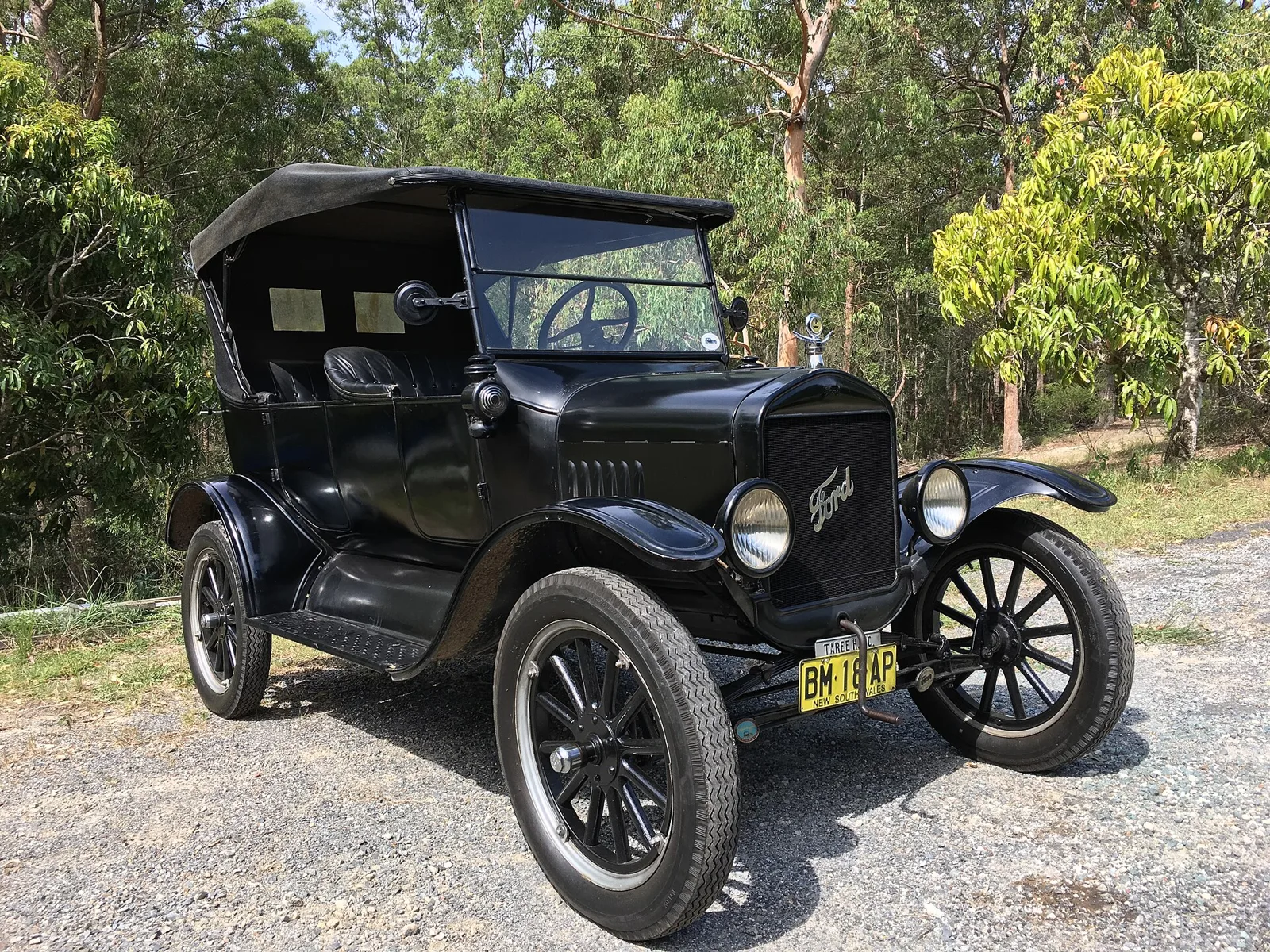
How a car with no wheel brakes and a hand crank became the first mass-affordable automobile, and why Ford finally let it go.
The Ford Model T was an American car built from 1908 to 1927 and generally regarded as the first mass-affordable automobile. Ford's moving assembly line, started in 1913, cut build time to 93 minutes. A total of 15,007,034 were made before the Model A replaced it in 1927.
A Ford worker in 1914 could buy a Model T with four months' pay. Early cars were scarce, expensive and often unreliable.
Why did the Ford Model T change the world?
It was the first reliable, easily maintained, mass-market car. Cars of the 1880s onward were scarce, costly and frequently unreliable. The Model T was none of those things, and within 2 days of its release 15,000 orders had been placed. It is generally seen as the first car that ordinary families could afford in quantity.
The car ran from 1 October 1908 to 26 May 1927. It made motoring available to middle-class Americans, and in 1999 the Car of the Century competition named it the most influential car of the 20th century, ahead of the BMC Mini, the Citroen DS and the Volkswagen Beetle. By 1918 half of all cars in the United States were Model Ts, and by the 1920s most American drivers had learned to drive in one.
Henry Ford had set out the aim in a statement quoted ever since. He would build a motor car "for the great multitude", large enough for the family but small enough for one person to run and care for, made of the best materials by the best men, and so low in price that no man on a good salary would be unable to own one.
A car for the great multitude, so low in price that no man on a good salary could fail to own one.
Who designed the Model T?
Three engineers did most of the work: Joseph A. Galamb, the main engineer, Eugene Farkas and Childe Harold Wills. Galamb and Farkas were Hungarian immigrants. Henry Love, C. J. Smith, Gus Degner and Peter E. Martin joined them, along with two more Hungarian immigrants, Gyula Hartenberger and Karoly Balogh. Henry Ford supervised the designers himself.
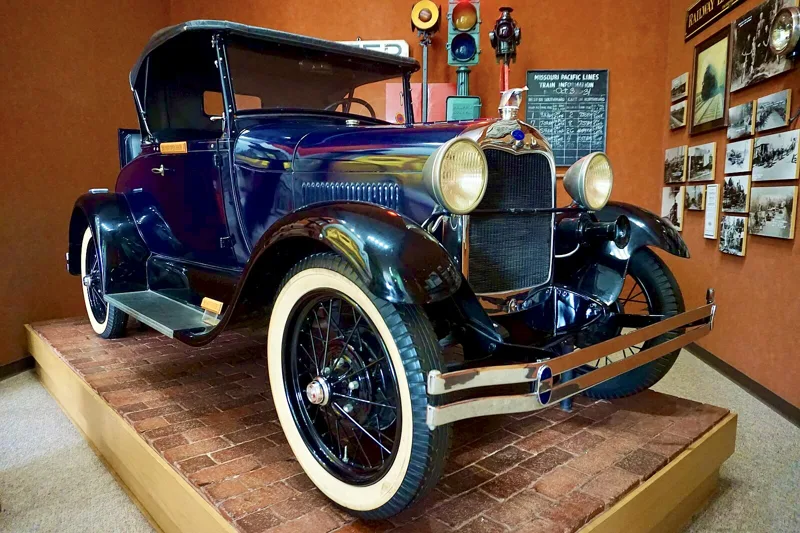
The car sat at the end of an alphabet. Ford named his first car the Model A after founding the company in 1903 and worked through the letters, twenty models in all, though not every one reached production. The Model S, an upgrade of the firm's earlier big success, the Model N, came directly before the T. Ford's successor was not a Model U but another Model A. Company publicity said the new car was such a break with the old one that Ford wanted to start over at the beginning of the alphabet.
The first production Model T was assembled on 12 August 1908 and rolled out of the Piquette Avenue Plant in Detroit on 27 September. Collectors today sort the cars into "model years", calling the first ones 1909 models, but that is a retroactive scheme. The idea of a model year as we understand it did not exist then, and the company called every revision simply "Model T".
How does a Model T work?
The Model T has a front-mounted inline four-cylinder engine of 177 cubic inches (2.9 L) that makes 20 hp (15 kW) and pushes the car to 42 mph (68 km/h). Ford quoted 13 to 21 mpg US (16 to 25 mpg imp). The engine was designed for petrol but could run on kerosene or ethanol, and cheap petrol and the later arrival of Prohibition made ethanol impractical for most owners.
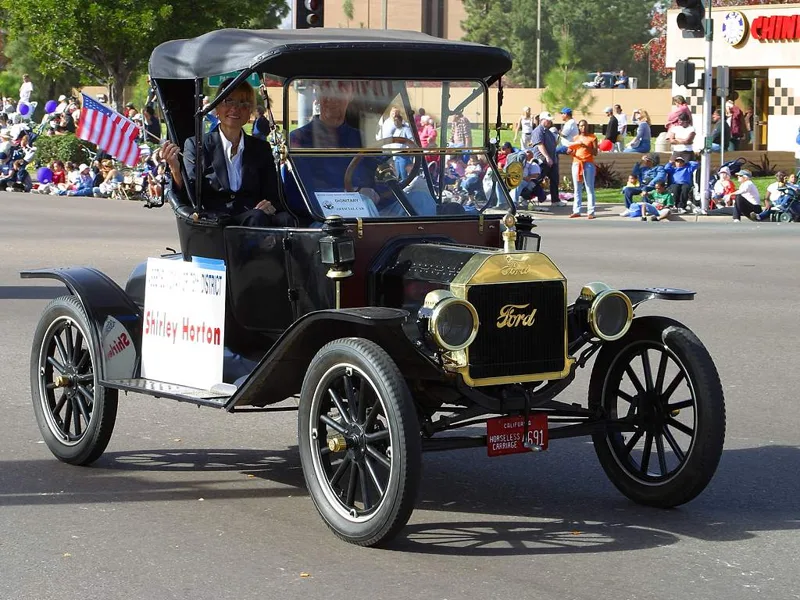
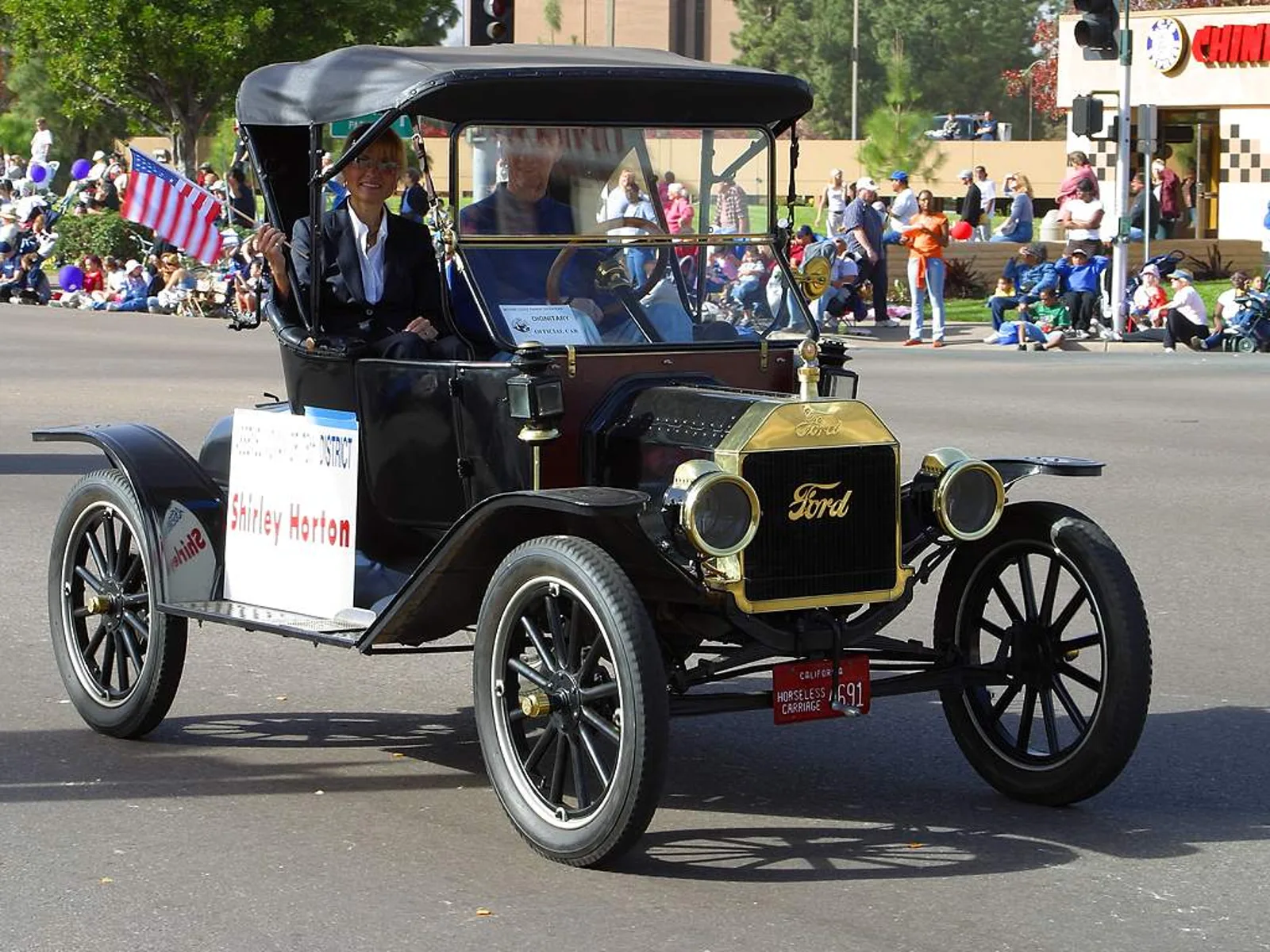
Power goes to the rear wheels through a planetary gearbox. Ford called it a "three speed", but one of the three is reverse, so today it counts as a two-speed. Modern drivers would find the controls bewildering. Three pedals sit on the floor and a lever stands beside the driver's seat, with a throttle lever on the steering wheel. The left pedal selects gears: pressed and held forward with the floor lever forward or in the middle, it gives low, held part-way it gives neutral, and released with the lever fully forward it gives high. The centre pedal engages reverse, and the right pedal works the brake on the transmission. There are no brakes on the wheels themselves. The parking brake lever acts on band brakes inside the rear drums. The first 800 cars had a lever for reverse instead of the centre pedal.
The ignition was unusual, more like those on stationary gas engines than the costly high-voltage magnetos on some other cars. A low-voltage magneto built into the flywheel fed alternating current to trembler coils that drove the spark plugs. Because proper hand-cranking generated enough current to start the engine, no starting battery was needed. That ignition also made the car tolerant of the quality or type of fuel. Electric lighting powered by the magneto arrived in 1915, replacing acetylene and oil lamps, though electric starting did not come until 1919.
Built for dirt roads
A transversely mounted semi-elliptical spring at each end let the wheels move a great deal, which suited the dirt roads of the day. The front axle was a single drop forging in vanadium steel, and Ford twisted many axles through eight full rotations (2880 degrees) before sending them to dealers as displays of their strength.
The wheels were wooden artillery wheels, with steel welded-spoke wheels offered in 1926 and 1927. Clincher tyres needed about 60 psi (410 kPa) to stay on the rim at speed, and flat tyres were common. Balloon tyres arrived in 1925 at around 35 psi (240 kPa) for a softer ride, and the steering ratio changed from 4:1 to 5:1 to suit them. The wheelbase was 100 in (254 cm), and the standard track of 56 in (142 cm) could be widened to 60 in (152 cm) to suit Southern roads. The engine outlived the car, too: Ford kept making it for replacement, stationary and marine use until 1941.
How did the moving assembly line cut Model T build time?
The line started in October 1913, and it dropped production time for a Model T to 93 minutes, split over 45 steps. Before that, the same car took 12.5 man-hours, so output rose eight times over while using less manpower. Cars came off the line at three-minute intervals, moving at six feet per minute.
The moving assembly line began operating on 7 October 1913 at the Highland Park plant and kept evolving through time and motion study. The idea itself was not Ford's alone. Ransom E. Olds had developed an assembly line for the Oldsmobile Curved Dash from 1901, and Ford and his engineers then pushed its efficiency much further during the Model T's life.
William "Pa" Klann is said to have brought the idea back from a visit to a Chicago slaughterhouse, where carcasses moved past workers on a conveyor and each person removed the same piece again and again. He reported it to Peter E. Martin, who was doubtful but told him to try. Henry Ford himself wrote in 1922 that the idea came in a general way from the overhead trolley Chicago packers use. At Ford the process evolved by trial and error under a team led by Martin, with Charles E. Sorensen, Clarence W. Avery, C. Harold Wills, Charles Ebender and Jozsef Galamb. Sorensen, in his 1956 memoir, called Henry Ford the sponsor of mass production rather than its father.
The principles Ford set down were plain. Arrange tools and men in the sequence of the operation so each part travels the least distance, have workers drop finished parts in the same convenient place, and use sliding assembly lines that deliver parts at convenient distances. Workers did no heavy lifting and little stooping, and the jobs needed no special training, which Ford noted gave work to immigrants. His complex safety procedures, especially fixing each worker at one location, dramatically reduced injuries. High wages combined with high efficiency became known as Fordism.
How many Model T were made, and what did they cost?
The final total was 15,007,034 cars, a record that stood for 45 years and was reached in 19 years from the first car. The Volkswagen Beetle finally passed it in 1972. Sales topped 250,000 in 1914, and by 1916, with the basic touring car down to $360, they reached 472,000. Several years saw sales double on the year before.
| Year | Price of a Model T |
|---|---|
| 1908 | About $825 |
| 1910 | $780 |
| 1912 | About $575 |
| 1916 | $360 (basic touring car) |
| 1924 | $290 |
Sales and marketing did as much as production. Ford built a publicity machine in Detroit so that every newspaper ran stories and advertisements. A network of independent dealers put the car in almost every North American city, and local motor clubs sprang up to help new drivers explore the countryside. Ford was keen to sell to farmers, who saw the car as a commercial tool. The franchise system he developed eventually allowed dealerships across North America and in major cities on six continents.
The effect on rivals was brutal. Rivals soon needed assembly lines of their own or faced bankruptcy, and by 1930 some 250 without one had disappeared. Vulcan of Southport, Lancashire, was the first native European maker to adopt the technique, in 1919.
Why was every Model T black?
Because of paint. Ford wrote in his autobiography that any customer could have a car painted any colour so long as it was black. Before the assembly line, Model Ts came in other colours, including red. Once cars moved along the line faster than the paint of the day could dry, only japan black dried quickly enough, and the company dropped its range of colours until fast-drying Duco lacquer was developed in 1926.
The Model T also set a convention that every other maker soon copied: the steering wheel on the left. Its engine and transmission were fully enclosed, its four cylinders were cast in a single block, and it was simple to drive and cheap to repair.
Why did Ford replace the Model T in 1927?
General Motors caught up. By the mid-1920s GM was the rising force in American motoring, and president Alfred Sloan had built a "price ladder" offering a car "for every purse and purpose". Ford, in contrast, had no interest beyond the low end of the market. Chevrolet, GM's entry-level division, mounted a bold challenge, while Harley Earl's Arts & Color Department made GM the leader in styling, an area Henry Ford did not entirely appreciate or understand.
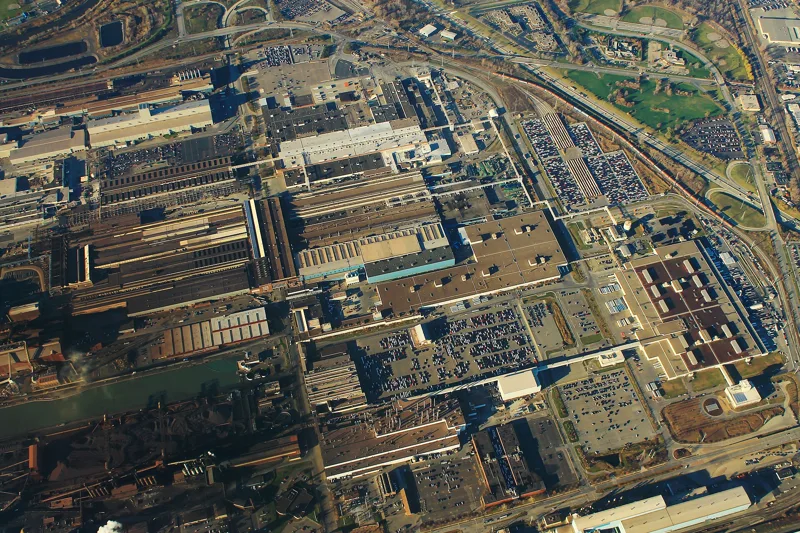
Henry Ford opposed replacing the Model T, a car in production since 1908, and he resisted the increasingly popular idea of payment plans. But Model T sales began to slide, and by 1926 flagging sales finally convinced him to approve a successor. Production was shut down for 18 months while Ford put up a huge new assembly plant at River Rouge. The new Model A launched in 1927. On 26 May 1927 Henry Ford watched the 15 millionth Model T roll off the line at Highland Park, Michigan.