From a Model T built in under two hours to GM's shrunken big sedans, rebadged imports and 297.5 million registered vehicles.
Economy car, downsizing, captive import and passenger vehicles are the terms behind the American car market. An economy car is cheap to buy and run, downsizing shrinks a model class, a captive import is a foreign-built car sold under a domestic badge, and the US has 297.5 million registered vehicles.
Ford's moving assembly line cut the time needed to build a Model T from twelve and a half hours to one hour 33 minutes, and by 1914 the company was selling half a million a year for under $500. That jump is where the economy car begins, and it frames the terms that still shape the American market: downsizing, captive imports and the sheer count of passenger vehicles.
What is an economy car?
An economy car is a vehicle designed for low-cost purchase and operation, a term used mostly in the United States. It is typically small, light and cheap to build and buy. The exact definition shifts with fuel prices, buyers' incomes and local culture, so the cheapest car on sale in one decade can look generous in the next.
Tight design limits push makers to be inventive, and many innovations began life in cheap cars, among them the Model T from Ford and the Austin Mini. Gordon Murray, who designed the McLaren F1, said that building a high-volume car to sell for six thousand pounds was a hundred times harder than drawing a McLaren F1.
The same pressure that made the Model T cheap in 1914 shrank GM's big sedans in 1977.
Why is the Model T called the first true economy car?
The Oldsmobile Curved Dash of 1901 to 1907 was the first car marketed as an economy car, and more than 19,000 were built. The Ford Model T of 1908 to 1927 gets the stronger claim because the few earlier cheap vehicles were closer to horseless carriages than practical cars, and the big makers of the time had little interest in low prices.
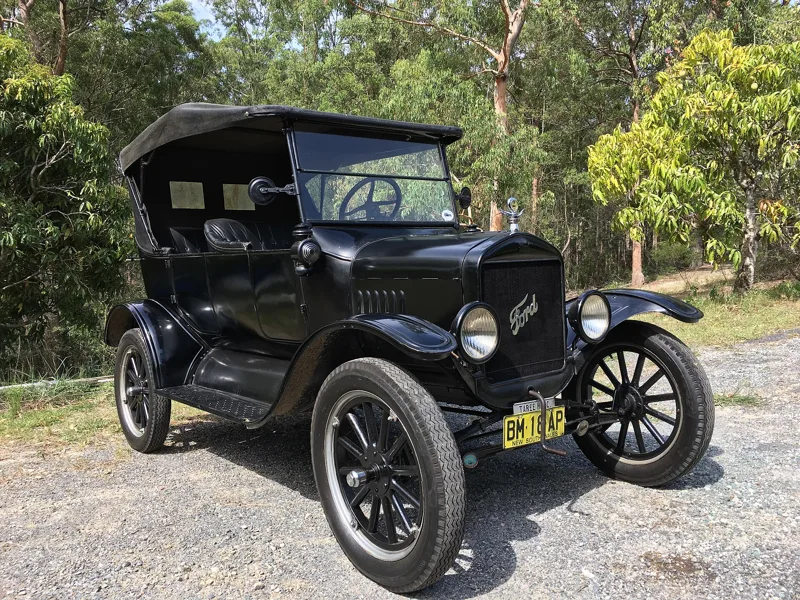
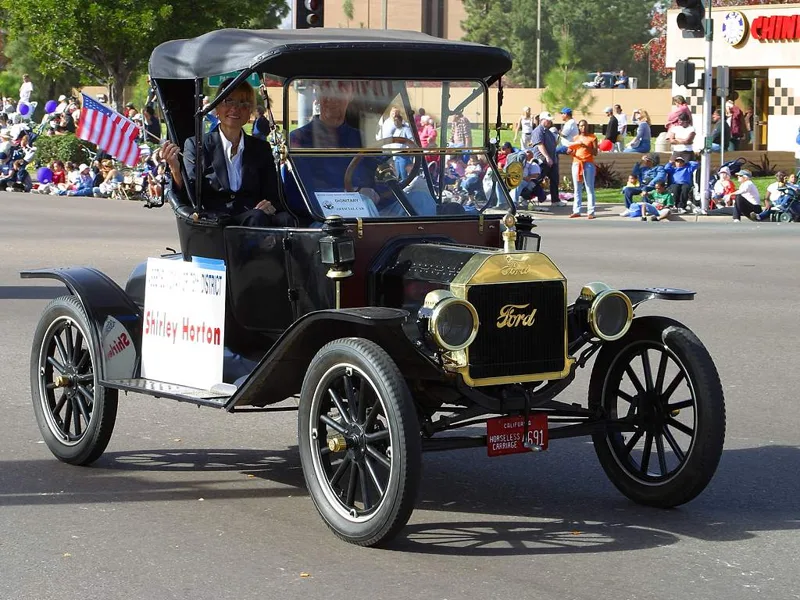
Ford promised a car for the great multitude: big enough for a family and small enough for one person to run. Its epicyclic gearbox resembled later automatics, and vanadium steel alloys made it strong without bulk. The track matched the width of ruts left by horse-drawn vehicles on unsurfaced rural roads, and ground clearance was high. An under-stressed 177 cu in (2.9 L) engine pulled it along.
Production methods did the rest. The Highland Park plant opened in 1910 and the River Rouge plant in 1919, where raw materials went in at one end and finished cars came out of the other. The moving assembly line, inspired by Chicago meat-packing disassembly, cut build time to one hour 33 minutes. Black was the only colour because no other paint dried quickly enough.
By 1914 Ford was building half a million Model Ts a year at a price below $500, more than the rest of the American industry together and ten times the nation's total output of 1908. That year he lifted the minimum daily wage from $2.83, for nine hours, to $5.00, for eight, partly to hold on to workers and partly to turn them into customers.
The Model T became the first World Car, built in Canada and Manchester from 1911 and later assembled in Japan, Mexico, Brazil, Argentina and a string of European countries including Germany, France, Spain, Denmark, Norway and Belgium. Rivals reacted quickly. In January 1915 William Durant launched the Chevrolet Four-Ninety at an introductory $550, trimmed to $490 once the electric starter and lights became a $60 option. Ford answered by dropping the Model T to $440.
How did other countries build their economy cars?
Europe and Japan relied on the Austin 7 and its rivals in the 1920s and 1930s, and from the 1940s into the 1960s the Volkswagen Beetle held both mainstream and maximum-economy roles in much of the world, notably Germany and Latin America. British, French, Italian and Japanese models, thriftier with fuel, took the cheapest-car position in their home markets.
| Car | Years | Role in its market |
|---|---|---|
| Oldsmobile Curved Dash | 1901 to 1907 | First car marketed as an economy car; over 19,000 built |
| Ford Model T | 1908 to 1927 | Considered the first true economy car |
| Morris Oxford and Cowley | From 1913 | Together 41 per cent of British private car output by 1925 |
| Volkswagen Beetle | 1940s to 1960s | Mainstream and maximum economy in Germany and Latin America |
| Zaporozhets | 1960 to 1994 | Sold by the Soviet Union on the world market |
| Zastava Koral (Yugo) | Mid-1980s | Cheapest new car on sale in the US |
Britain's 1913 Morris Oxford had a 1018 cc engine and only 1302 were made, but its larger successor the Cowley, with the Oxford, accounted for 41 per cent of British private car production by 1925. A rival, the Trojan, used a two-stroke engine whose four cylinders worked in pairs and, its makers claimed, had seven moving parts.
Body engineering changed too. The Budd Company, founded in 1912, pressed steel bodies that were replacing coachbuilt ones all over the world in the 1920s. Edward Budd and Andre Citroen went on to produce the Traction Avant by 1934, the first pressed-steel unibody car. By the 1970s the hatchback was the standard shape for new economy models, and since the 1990s every major maker has been a global company offering at least one genuinely small car.
What does downsizing mean in the car industry?
Downsizing moves a model from one size class to a smaller one, shortening the wheelbase and body to save weight and fuel. It began in the Malaise era as a reaction to the 1973 oil crisis, which led to CAFE standards in 1975 requiring each maker to average 20 mpg across its range by 1980.
General Motors was the first American maker to bring out downsized versions of its full-size line, in 1977. By the early 1980s the practice had spread to nearly every size class, and American makers lined up more closely with Europe and Japan, killing off the uniquely North American intermediate class. A cheaper route was to shift a large nameplate onto a smaller car at a model update.
A second sense of the word applies to engines. Engine downsizing means fitting a smaller displacement, though not necessarily less power, in the interest of economy. Research at the University of Bath showed capacity could be cut by 60% while keeping the torque curve of a modern, large naturally aspirated engine.
How much smaller did the cars get?
| Maker and model | Year | Length lost | Weight lost |
|---|---|---|---|
| GM full-size B/C bodies | 1977 | 12 in (300 mm) on average | 750 to 800 lb (340 to 360 kg) |
| GM intermediate A bodies | 1978 | 12 to 15 in (30 to 38 cm) | 500 to 1,000 lb |
| Chevrolet Citation and X-car relatives | 1980 | 20 in (51 cm) | 800 lb (360 kg) |
| Dodge Aries and Plymouth Reliant | 1981 | Over 28 in (71 cm) | Up to 1,200 lb (540 kg) |
GM took five years to shrink its entire range, from 1977 to 1982, in the order full-size, intermediate, compact and subcompact, and every division took part. Engineers cut the full-size cars so carefully that interior space barely shrank. The big-block V8 disappeared outside Cadillac, and after 1980 the largest engine in a B-body was a 350 cu in V8.
In 1980 the Chevrolet Citation became the first front-wheel-drive GM car outside the luxury segment, and the Cavalier followed in 1982, shorter than the Monza it replaced. A further round in 1985 turned the big Buick, Oldsmobile and Pontiac sedans into front-wheel-drive mid-sizers, leaving the Chevrolet Caprice and Cadillac Brougham as the only rear-drive sedans from 1986 to 1990.
Did Chrysler and Ford take the same route?
Not quite. Chrysler had launched bigger full-size cars for 1974, sales never recovered from the fuel crisis, and the firm came close to bankruptcy as the 1970s closed. It used its limited money on compact cars, adapting existing architecture rather than starting afresh, and in 1981 the K-cars arrived.
The Dodge Aries and Plymouth Reliant were the first front-wheel-drive Chrysler cars developed wholly in-house. They kept six-passenger seating, and the K platform spawned more than 40 vehicles between 1981 and 1995. Under Lee Iacocca, Chrysler then built the Plymouth Voyager and Dodge Caravan in 1984, the first minivans from an American maker, which could carry up to seven passengers.
Ford's first moves came earlier. The 1961 Lincoln Continental shed close to 15 inches of length and 8 of wheelbase, and Mercury moved onto a Ford-based chassis with 6 inches less wheelbase. The 1974 Mustang II, designed before the fuel crisis, was almost 14 inches shorter than its predecessor, and 6 inches shorter than the very first Mustang. GM was first to downsize a full-size line, in 1977, while Ford had already shrunk the Lincoln Continental and Mercury in 1961.
What is a captive import?
A captive import is a foreign-built vehicle sold under an importer's name or through a domestic maker's own dealer network. America's National Highway Traffic Safety Administration defines it, from the 1980 model year, as a vehicle not built domestically but imported by a firm whose main base is in the United States. The builder may be a subsidiary, a joint venture or a licensor.
The usual reason is cost: it is cheaper to import a car than to build one in the US, and it fills a gap in the line-up. Chrysler's tie-up with Mitsubishi, which began in 1971, put the Dodge Colt in showrooms to plug a hole in the compact range. Mitsubishi began selling under its own name in the US in 1982.
Cars built in a company's own plants inside a free-trade region such as the European Union, NAFTA or ASEAN do not count, and neither do European brands later bought by the Big Three, like Land Rover, Volvo and Saab.
Which captive imports did Americans actually buy?
Many. The Nash-Healey sports car of 1951 to 1954 paired a Nash drivetrain with a European chassis and body, restyled and assembled by Pinin Farina after the first year. The Nash Metropolitan, sold from 1954 to 1962, was designed by Nash but built by Austin in Britain, the first American-designed car only ever built in Europe. It was among the few small cars to sell well in a period obsessed with size.
Mercedes-Benz entered America in the 1950s through Studebaker-Packard showrooms, and Pontiac dealers sold British-built Vauxhalls from 1958 to 1962. Ford's Anglia and Prefect of 1948 began the modern captive-import system, and the company later sold the Cortina until 1970, the Capri through Mercury in the 1970s, and from 1978 the Mk1 Fiesta.
GM sold German Opels through Buick dealers, rebadged Isuzus under the Buick and Chevrolet names, and from the late 1980s gathered Isuzu and Suzuki imports under the Geo brand in Chevrolet showrooms. Later examples included a Cadillac sold as the Catera that was really an Opel Omega, the Chevrolet Aveo from South Korea, the Pontiac GTO and G8 from Holden in Australia, the Saturn Astra from Belgium, and the Chrysler Crossfire, an American design that Karmann built in Germany. The Chevrolet SS of 2014 to 2017 was a Holden Commodore.
How have captive imports fared outside America?
Poorly in Europe, where most have failed. Europe received the Chevrolet Venture minivan as the Opel or Vauxhall Sintra and the Chevrolet Trans Sport, but it fitted European tastes badly and scored poorly in safety tests. The Peugeot 4007 and 4008 and Citroen C-Crosser and C4 Aircross were rebadged Mitsubishis. The Ford Mustang, introduced to Europe in 2015, has done well thanks to its image.
Elsewhere, Holden Commodores were sold as the Chevrolet Lumina in the Middle East and South Africa from 1998 to 2013, and in Brazil Holden's Calais and Berlina became the Chevrolet Omega from 1998 to 2012. Press and public liked them, but the price held sales down. In Japan, even rebadging a Chevrolet Cavalier as a Toyota failed to help.
Why do they fail? Exchange-rate swings can push prices out of reach, quality can be marginal, as with some Daewoo models sold under GM names in the 2000s, and dealers may be reluctant to promote a car that cuts into more profitable ones. Others stumble for reasons beyond their control: the Sunbeam Tiger sold well until Sunbeam became a Chrysler captive import.
How many passenger vehicles are there in the United States?
Registrations of motor vehicles in the United States reached about 297.5 million in 2024, according to the Federal Highway Administration, up from 8,000 in 1900. The country has been the second-largest passenger vehicle market since China overtook it in 2009, and General Motors, Ford and Chrysler have long been known as the Big Three.
Passenger vehicles have outnumbered licensed drivers since 1972, and in 2001 some 70% of Americans drove to work. New York City is the only place in the country where over half of households have no car, the figure exceeding 75% in Manhattan against 8% nationally. Car occupancy runs at roughly 1.7 people.
How old is the American fleet, and what do buyers pay?
Older every decade. The mean age of cars was 5.1 years in 1969, the median 6.5 years in 1990 and 9.4 years in 2007, and by 2011 the median across all vehicles had reached 10.8 years. The 2009 Cash for Clunkers programme bought and scrapped about 850,000 vehicles.
Sales swing with the economy. A record just over 11 million cars were sold in 1985, but in 2009 fewer than 6 million passenger cars found buyers, and combined car and light truck sales fell to a little over 13 million against a typical pre-crisis 20 million. In 2006 vehicles built in NAFTA countries made up 5.5 million sales, imports 2.2 million, with Japan sending 923,000 and Germany 534,000.
Few Americans pay sticker price. In July 2004 the average sticker was $29,746, the average discount $4,982 (16.8%), and buyers paid an average $24,764. In 2003 domestic models carried the biggest discount at 20.6%, against 10% for Japanese, 12.8% for Korean and 7.7% for European makes.
Pickups, not sedans, topped sales for years. In 2006 the Ford F-Series sold 796,039 and the Chevrolet Silverado 636,069. Rising oil prices ended the pickup's reign as top vehicle type in mid-2008, and the Toyota Corolla took the title. By September 2017 crossovers were outselling traditional cars, including sedans, hatchbacks and sports cars, put together.