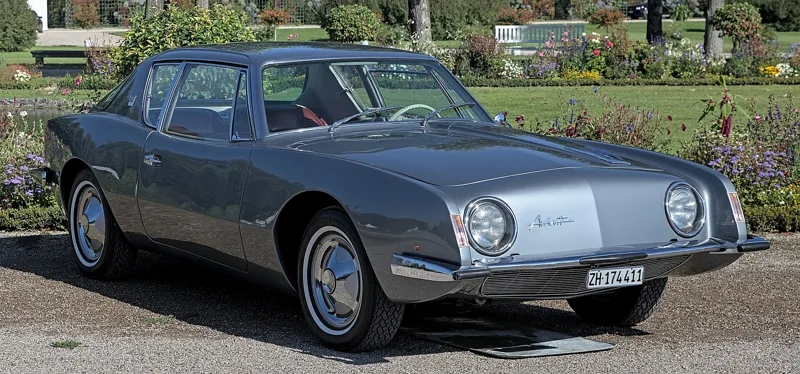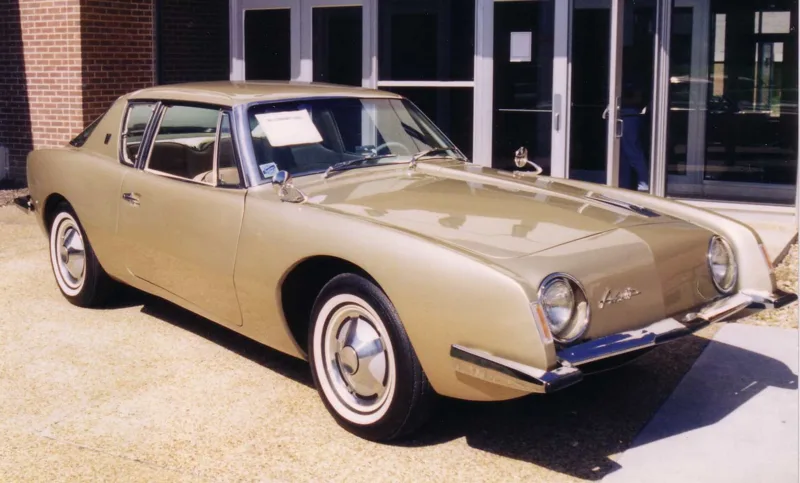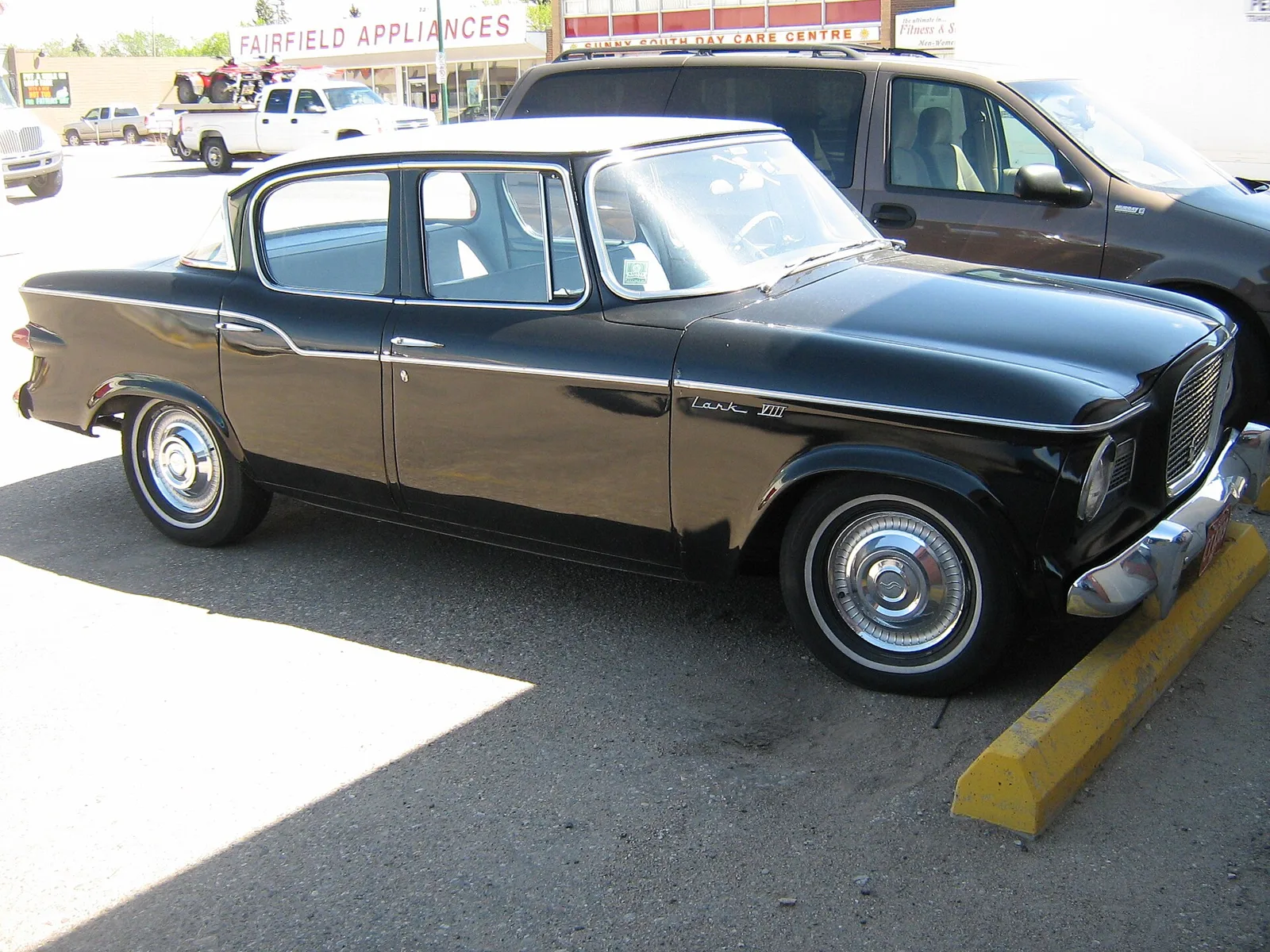
A 1959 compact built on a full-size bodyshell, with a V8 option, a Brooks Stevens restyle and a Canadian finish after South Bend closed.
The Studebaker Lark was a compact car built from 1959 to 1966 on a shortened full-size bodyshell. Built first at South Bend and then at Hamilton, it offered six-cylinder and V8 engines and became the bulk of Studebaker's range.
Studebaker's compact Lark was built from 1959 to 1966 and became the bulk of the company's output in its final years. It started as a rescue idea for Studebaker-Packard and ended when the South Bend plant closed and the car was built only in Canada.
What was the Studebaker Lark?
The Lark was a compact car that Studebaker built from 1959 to 1966, first as a Studebaker-Packard product and then, from mid-1962, as a Studebaker Corporation car. It was built at South Bend, Indiana and at Hamilton, Ontario, and it was also shipped abroad as kits for local assembly.
Lark-based models made up most of the range after 1958, and they sold in far greater numbers than the Hawk and Avanti. The name was gradually dropped from the catalogue from 1963, and by early 1964 the cars were sold under Commander, Daytona and Cruiser names only.
The company was one of America's oldest vehicle makers, and its 100th anniversary had fallen in 1952. Automobile production ended in 1966, closing a long run for one of the oldest American marques.
A compact cut from a full-size bodyshell, it sold well at first, then carried Studebaker to the end of its car making.
Why did Studebaker build a compact?
Studebaker-Packard was operating managed under contract by Curtiss-Wright Aircraft while losses had persisted for several years. The company president, Harold E. Churchill, proposed leaving the full-size car market and building a smaller car that might rescue the business.
The Lark took its basic bodyshell from the full-size Studebakers of 1953 to 1958. By shortening the front and rear overhangs and trimming the wheelbase ahead of the firewall, engineers kept room for six adults and a useful amount of luggage.
The car reached showrooms in autumn 1958 as a 1959 model. The 1939 Studebaker Champion, which had pulled the company through the years before the Second World War, was the model Churchill had in mind, along with the plain Studebaker Scotsman of 1957 to 1958.
How was the first Lark styled?
The Lark came in two series, the Lark VI for six-cylinder cars and the Lark VIII for V8s. Both were offered in Deluxe and Regal trims, and the simple grille echoed the 1956 to 1959 Hawk.
Its restrained use of chrome and clean lines set it apart from the bigger, lower and wider cars that Detroit's three largest makers were selling at the time. Only the Rambler American came close to that purer look among the cars sold for 1959.
Early Larks came as sedans with two or four doors, along with a hardtop coupe and a station wagon with two doors. Outside the Rambler range, the Lark offered the widest choice of compacts on the American market.
How well did the first Larks sell?
Sales were good in 1959 and 1960, partly because Studebaker had secured dual dealerships with Big Three dealers that did not yet have their own compacts. That arrangement gave the Lark showroom space that a smaller independent would otherwise struggle to find.
It stood out as the first car of its size with a V8. The Rambler Rebel had carried a V8 of similar size since 1957, but the smaller Rambler American was limited to an inline six, so the Lark stood out in its class.
A convertible arrived for 1960. It was Studebaker's first since 1952. A four-door station wagon joined the range. It was Studebaker's first since 1952. A four-door station wagon joined the range. The four-door wagon soon proved the more popular of the two wagons, as two-door wagons fell out of favour across the industry.
A taxicab version, first called the Econ-O-Miler, used the wagon's longer wheelbase. Its 4.5 in (110 mm) of extra length went into rear seat legroom, which mattered to taxi operators.
For 1959 and 1960 buyers could pick a 170 cu in (2.8 L) flathead six or a 259 cu in (4.2 L) V8. Reviewers were impressed by the V8, which could reach 60 mph from a standstill in around 10 seconds, a figure close to much larger cars.
Among the early Big Three compacts, only the Valiant managed to break the 20-second mark for 0-60 mph. Detroit's other compacts had no V8 until the so-called senior compacts appeared for 1961.
What changed for 1961?
For 1961 Studebaker introduced the Cruiser, a four-door sedan built on the taxicab body with a more luxurious interior. Its 1959 to 1960 style roofline and operating vent windows in the rear doors separated it from the other sedans.
The 1961 cars added a canvas folding sunroof called the Skytop, a squared-off roofline on the non-Cruiser sedans and the hardtop, and a broader grille with quad headlamps. Quads were standard on Regal and Cruiser models and optional on Deluxes.
The bigger news was under the bonnet. The Hawk sports car supplied a 289 cu in (4.7 L) V8 as an option, mostly for police pursuit packages, while the six-cylinder was reworked. Engineers converted the 170 flathead to overhead valves, lifting output to 112 hp (84 kW) from 90 hp (67 kW) without losing fuel economy.
The overhead-valve six was marketed as the Skybolt Six, and testers found it easier on fuel than the old flathead. Cars with it could shave nearly four seconds from the 0-60 mph time. Cowl ventilation, suspended pedals and revised steering also arrived that year.
Sales nonetheless fell sharply in 1961. Dodge had launched the Lancer, and General Motors had added the Buick Special, the Oldsmobile F-85 and the Pontiac Tempest. Several Big Three dealers that had taken on the Lark dropped Studebaker under pressure from Detroit.
The Italian Studebaker importer commissioned redesigns from Francis Lombardi for the two-door and from Pietro Frua for the four-door. Both were shown at the Turin Auto Show in November 1960, and their front ends drew criticism, although the designs were otherwise well received.
How did Brooks Stevens restyle the Lark for 1962?
To reverse falling sales, the new president Sherwood Egbert asked the industrial designer Brooks Stevens for a striking but inexpensive update for 1962. Stevens lengthened the body, especially at the rear, and modernised the interior, and the board was pleased with how much he achieved for the money.
The Daytona joined the range as the top-trim convertible and hardtop, while the Regal remained available. Four-door sedans for 1962 were moved onto the 113 in (2,900 mm) wheelbase used by the Cruiser. The two-door wheelbase grew from 108.5 in to 109 in.
A strike by the United Auto Workers at South Bend halted production for 38 days early in 1962. Despite that, the company sold more than 90,000 cars, well above the 1961 total, and writers have argued that the strike cost it a much larger total.
What was new for 1963?
For 1963 Stevens again restyled the car. The wrap-around windshield was removed, the greenhouse was lightened with thinner pillars, and a new instrument panel with full gauges replaced the older dashboard. A vanity mirror and makeup tray sat in the glove box on most models.
The biggest novelty was the Wagonaire, a station wagon with a sliding roof that Stevens also designed. Buyers were curious but cautious, and reports of water leaks led management to add a fixed-roof version at mid-year.
Mid-1963 brought the Standard series, a stripped line of Larks that bore no Lark nameplates and carried plain Studebaker script. Sold mainly to fleets, the two-door sedan had a base price of US$1,935, which was very competitive for the period.
Bendix disc brakes, first offered on the Avanti, became available at US$97.95 and greatly improved stopping power. The Avanti's R1 naturally aspirated and R2 supercharged 289 V8s also arrived, and the Super Performance Package turned some cars into Super Larks.
Even with those changes, sales slipped to around 77,000 cars in 1963. Buyers wanted more than a mild update, and the lineup needed a larger change.
How did the 1964 restyle change the Lark?
Stevens carried the modernisation further for 1964, producing the most mainstream looking Studebaker since 1946. A full-width stamped aluminium grille and squared-off headlamp surrounds replaced the Hawk-like front of 1962 and 1963.
The Lark name was phased out. The lowest-priced cars became the Challenger, replacing the Standard, and the Commander name returned in place of the Regal trim. The Daytona gained a four-door sedan, and the Cruiser stayed at the top of the range.
Studebaker also dropped Lark badges in favour of the circle-S logo. Early advertising still called the Challenger and Commander Larks, but the Lark emblem survived only on the roof sail panels of some Challengers.
The Marshal, a purpose-built police car in three body styles, was marketed to departments. Its brochures claimed that 130 mph was merely incidental, and it came in Pursuit, Patrol and City variants.
Why did the South Bend plant close?
Studebaker tried hard to build a high-performance image for 1964, sending cars to the Bonneville Salt Flats for production-car records. Advertising played up the R-series engines, the disc brakes and the claim that Studebakers were different by design.
The R-series engines and Super Performance Packages were developed with the help of Andy Granatelli, who ran Paxton Products and the STP business. Even so, sales did not climb, and by early autumn 1963 the board had slowed the South Bend line.
The board believed the time had come to leave the car business. Its subsidiaries were profitable, while the automotive division was losing heavily. Egbert wanted to keep building cars, but the directors moved to wind up automotive production.
After talks with UAW Local 5 leaders, the directors decided to close South Bend and continue production at the Canadian plant in Hamilton, Ontario, which they believed could be run at a profit. The closure was announced on December 9, 1963.
The final South Bend Lark-type, a Bordeaux Red 1964 Daytona hardtop, rolled off the line on December 20. It was originally meant for a dealer in Pennsylvania, but it is now in the Studebaker Museum in South Bend.
What happened to the Lark in Canada?
Production carried on at Hamilton under Gordon Grundy, who led Studebaker of Canada, who wanted Studebaker to remain a car builder. The second-series Canadian 1964 cars were little different from the South Bend models.
The Challenger series was dropped from the Canadian line, and six-cylinder Daytona models, which had until then been sold just in Canada and abroad, were added to the US range. The Commander Special paired a Commander two-door with Daytona interior trim.
The R-series engines were discontinued, though Paxton continued to sell them until 1967. Once the South Bend foundry closed, the Canadian plant needed a new engine source, and the company turned to General Motors' Canadian subsidiary, McKinnon Industries.
For 1965 the Studebaker six became a 3.2-litre unit making 120 hp from 194 cu in, and a V8 of 4.6 litres (283 cu in) rated at 195 hp took the place of both the 259 and 289 engines. Fewer than 20,000 Studebakers were built that year, and loyalists coined the term Chevybaker for the GM-powered cars.
How did the 1966 Studebaker differ?
The 1966 cars were slightly restyled after the company reversed its decision to skip annual changes. They gained a new grille, single headlamps and revised side trim, and the Hawk logo was revived on wheelcovers and grilles.
Studebaker's last engineering innovation was Refreshaire ventilation, with flow-through air and extractor vents built into the taillamps. The Cruiser lost its opening rear-door vent windows as a result.
A bigger six, 230 cu in (3.8 L) and rated at 140 hp, became an option, at first only with an automatic. The Wagonaire returned to a fixed roof after a one-year gap, and the Commander received standard heater and washer equipment in January 1966.
Gordon Grundy sought less than $300,000 in tooling money in early 1966 for a facelifted 1967 model, but the board refused and ordered the Hamilton plant closed. The last Studebaker, a Timberline Turquoise Cruiser four-door, was built on March 16, 1966.
That car was one of 8,935 Studebakers built in 1966, although some sources give 8,947. The car marked the close of a transport heritage reaching back some 114 years.
Which special and overseas Larks were built?
Pietro Frua rebodied a small number of Larks in 1960, with straight lines and generous glass, and two four-door examples survive. Brooks Stevens also built concept cars on the Lark chassis, including the Skyview wagon and the Sceptre sports coupe.
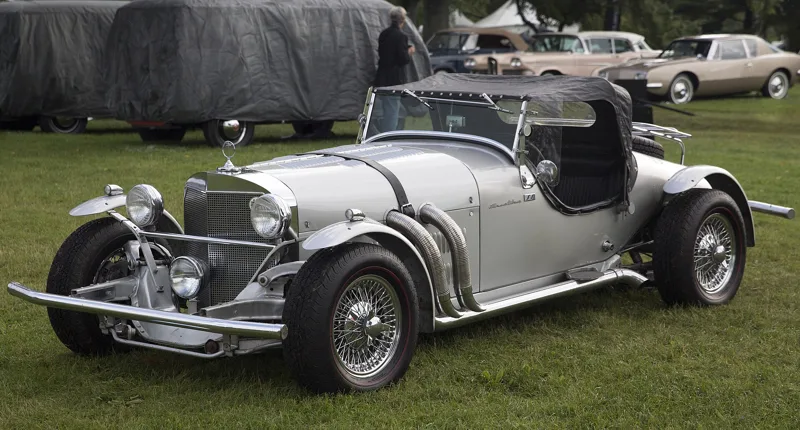
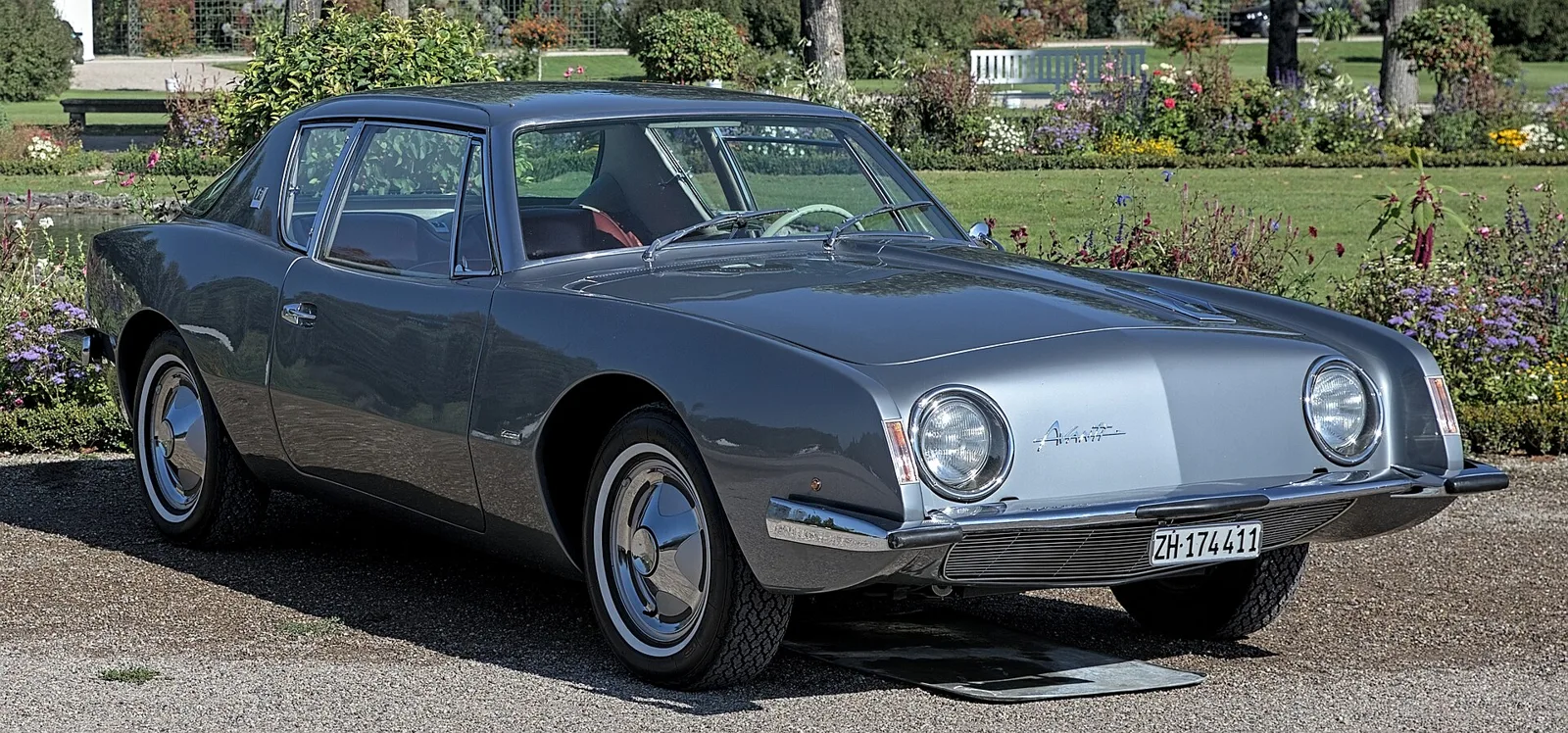
The Lark convertible's reinforced X-frame went into the Avanti and into Stevens' Excalibur. Excalibur later switched to its own chassis when the Studebaker frames ran out, and Avanti Motors kept the basic chassis into the early eighties.
Australia built Larks under licence from late 1960, with Canada Cycle and Motor assembling them until 1966. Haifa's Ilin plant in Israel kept building the car into 1967, and a long-wheelbase Lark convertible served as the Israeli presidential car in 1964.
Studebaker Lark specifications at a glance
| Specification | Detail |
|---|---|
| Class | Compact car |
| Production | 1959 to 1966 |
| Early engines | 170 cu in (2.8 L) six; 259 cu in (4.2 L) V8 |
| 1961 six | Overhead valves; 90 hp (67 kW) rising to 112 hp (84 kW) |
| 1965 engines | 120 hp six of 194 cu in (3.2 L); 195 hp V8 of 283 cu in (4.6 L) |
| 1966 six | Optional 230 cu in (3.8 L), rated at 140 hp |
| 1963 Standard base price | US$1,935 for the two-door sedan |
| Last car built | March 16, 1966 |
| 1966 output | 8,935 cars (some sources say 8,947) |