From the 1949 Rocket 88 to the Pontiac GTO, the Mustang and the 1973 oil crisis: what a muscle car is, who started the craze and why it faded.
Muscle cars are US-built two-door coupes that pair a maker's most powerful V8 with a lighter, cheaper body, mostly from the 1960s and early 1970s. The 1964 Pontiac GTO popularised the idea; emissions rules, insurance costs and the 1973 oil crisis brought the era to an end.
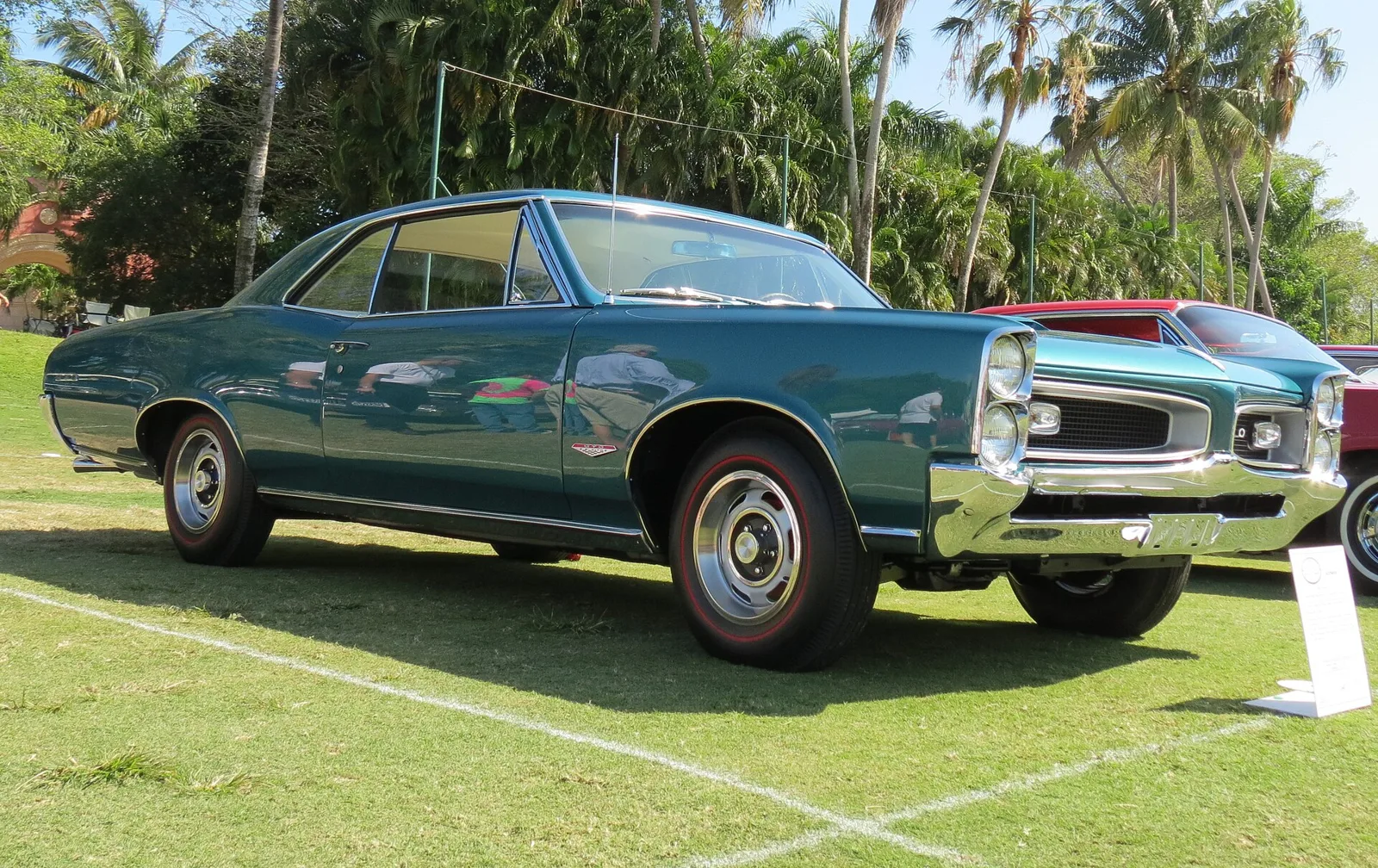
When Pontiac launched the GTO in 1964, its sales manager expected to sell 5,000 of them. The package actually found 32,450 buyers in its first year, 75,342 in its second and 96,946 in 1966, the best year the GTO ever had. A trick of marketing, a loophole in a corporate rule and a bigger engine in an ordinary family coupe had created a new class of car.
What is a muscle car?
In plain terms, a muscle car is a two-door coupe from an American maker, fitted with a strong engine and sold on speed. The recipe is simple: take the biggest, most powerful engine in the catalogue and drop it into a smaller, lighter and cheaper car. The idea is older than the name, which appeared only in the mid-1960s and spread through car magazines, marketing and advertising.
Ask for a precise definition and the arguments begin. The usual ingredients are a large high-performance V8, often in the most powerful form a model offered, rear-wheel drive, a relatively light two-door body and US manufacture in the 1960s or early 1970s, with 1964 to 1973 sometimes used as the window. Beyond that, opinions split. Some feel only mid-size cars qualify, a view that Motor Trend, Road & Track and Car and Driver do not share. Those magazines, along with CNBC, accept high-powered pony cars as muscle cars when they carry suitable equipment, and the AMC AMX, a two-seater, counts for some people while the two-seat Chevrolet Corvette does not.
The term also moved around. At first such cars were more often called "supercars" in America, as in the 1957 Rambler Rebel and, in a May 1965 Car Life road test, the Pontiac GTO. By 1966 supercars were an industry trend. Over time the word drifted to far more expensive and exotic machinery, and "muscle car" took over the earlier meaning.
Pontiac planned 5,000 GTOs and found 32,450 buyers in the first year.
Where did the first muscle cars come from?
Opinions differ, though many point to the 1949 Oldsmobile Rocket 88 as the first full-sized muscle car. It put the 303 cu in (5.0 L) V8 from the larger Oldsmobile 98 into the lighter body of the six-cylinder Oldsmobile 76. The V8 made 135 hp (101 kW), and the car won eight of ten races in the 1950 NASCAR season. Together with Cadillac's 331 cu in engine, also new in 1949, the two are credited with opening the modern age of the performance V8.
The 1955 Chrysler C-300 advertised 300 hp (224 kW) from a 331 cu in (5.4 L) V8 as "America's Most Powerful Car", with 0-60 mph in 9.8 seconds and could reach 130 mph (209 km/h). The 1956 Studebaker Golden Hawk used a 275 hp (205 kW) Packard V8. And the 1957 Rambler Rebel, the first mid-sized car offered with a big-block V8, did 0-60 mph in 7.5 seconds with its 327 cu in (5.4 L) engine and 255 hp (190 kW), making it the fastest stock American sedan of its day. Only the fuel-injected Corvette beat it, by half a second. Some people therefore call the Rebel the first muscle car.
How did drag racing shape muscle cars?
Early in the 1960s, Mopar (Dodge, Plymouth and Chrysler) and Ford fought for supremacy at the drag strip, and the road cars absorbed the lessons. The 1961 Impala from Chevrolet could be had with an SS package at $53.80 that added a 409 cu in (6.7 L) V8 making 425 hp (317 kW) plus better brakes, tyres and suspension. Dodge's 1962 Dart 413, known as the Max Wedge, made 420 hp (313 kW) and covered the quarter mile in under 13 seconds.
Then came cars that barely belonged on the road. In 1963 Ford built two hundred Galaxie "R-code" cars specifically for drag racing, with fibreglass panels, aluminium bumpers and a 427 cu in (7.0 L) engine rated at 425 hp (317 kW). The next year it put the 427 in the lighter Fairlane body to create the Thunderbolt, with acrylic windows and fibreglass and aluminium panels, good for the quarter mile in 11.76 seconds. It was technically road legal, yet it was judged unsuitable even for the drive to and from the strip. Ford built 111.
General Motors answered with the Z-11 Impala, 57 of them in 1963 only, using a 427 cu in (7.0 L) engine officially rated at 430 bhp (321 kW) and a 13.5:1 compression ratio that demanded high-octane fuel. Dodge's 1964 330 Lightweight carried a 426 cu in (7.0 L) Hemi rated at 425 hp (317 kW), though rumour put its real output higher, and it came with a factory disclaimer that it was designed for supervised acceleration trials and not for everyday driving.
How did the Pontiac GTO start the muscle car era?
With a policy designed to stop it. In early 1963 General Motors banned its divisions from motor racing, and Pontiac, whose advertising already leaned on performance, shifted its emphasis to the street. According to Pontiac marketing manager Jim Wangers, John DeLorean, Bill Collins and Russ Gee turned the coming Tempest into a sporty car by swapping its standard 326 cu in (5.3 L) V8 for the 389 cu in (6.4 L) V8 from the full-sized Grand Prix. Promoting the big engine as a special high-performance model would speak to the youth market, which Ford's Lee Iacocca had also noticed as he prepared the Mustang.
The plan broke a General Motors rule capping engines in the intermediate A-body line at 330 cu in (5.4 L). The team found that the rule did not restrict large engines sold as an option. General manager Elliot "Pete" Estes approved the model, and sales manager Frank Bridge capped the first run at 5,000 cars.
The name came from the Ferrari 250 GTO, short for Gran Turismo Omologato, a grand tourer certified by the FIA for racing. A Pontiac employee unusually did arrange for the FIA to homologate the car in 1964, so it could in principle compete in European sports car racing.
Production began on 3 September 1963. The GTO was a $295 option package on the Tempest-based LeMans, and the standard engine made 242 kW (325 hp) at 4,800 rpm with a four-barrel carburettor and dual exhausts, backed by a floor-shifted three-speed manual gearbox with a Hurst shifter, stiffer springs, a bigger front anti-roll bar, wider wheels and hood scoops. Buyers could add a four-speed manual, a two-speed automatic and a "Tri-Power" engine with three two-barrel carburettors rated at 348 bhp (260 kW). Fully optioned, the car cost about $4,500 and weighed around 3,500 lb (1,600 kg).
The first GTO is credited with popularising the muscle car segment, and some consider it the car that started the trend among all four domestic makers. For 1965 power rose to 335 hp (250 kW) for the base engine and 360 hp (270 kW) for Tri-Power. Car Life tested a Tri-Power car with a close-ratio four-speed, power steering, metallic brakes and a 4.11 limited-slip differential, and recorded 0-60 mph in 5.8 seconds and covered the quarter mile in 14.5 seconds, crossing the line at 100 mph (160 km/h). Its observed top speed was 114 mph (182.4 km/h). The car's sticker price came to $3,643.79.
The reviews also carried warnings. Testers criticised the slow steering, a ratio of 17.5:1 or four turns lock-to-lock, and the drum brakes, which Motor Trend and Road Test judged alarmingly inadequate in high-speed driving. Car Life, whose car had metallic brakes, had no complaint about stopping. In 1966 the GTO became a separate Pontiac model rather than a package, and although Pontiac pushed the "GTO Tiger", the youth market nicknamed it the "goat".
What is the difference between a muscle car and a pony car?
| Feature | Muscle car | Pony car |
|---|---|---|
| Defining example | Pontiac GTO, 1964 | Ford Mustang, April 1964 |
| Typical size | Intermediate, with a lightweight two-door body | Compact, smaller and more uniform in form |
| Engine idea | Largest V8 a model offered | Economy six or small V8, with big V8s as options |
| Seating | Two-door body; the GTO seats four | Room for four |
| Price example | GTO package from $295 over a LeMans | Mustang base price $2,368 |
| Look | Marketed for its performance | Long hood, short deck, bucket seats |
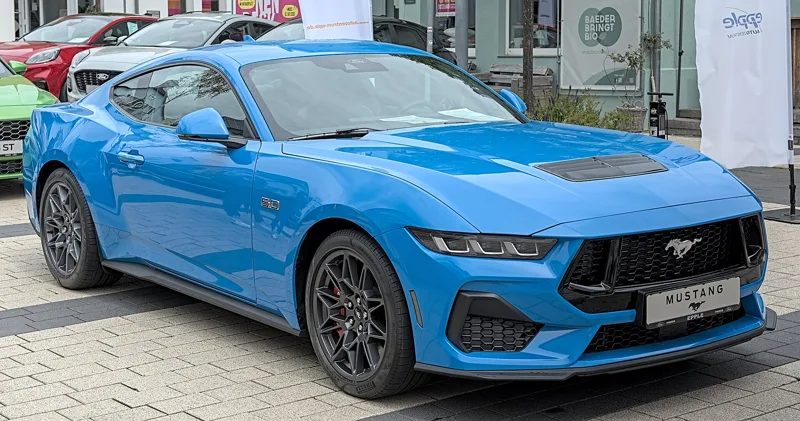
The overlap is where the confusion lives. A pony car is an affordable, compact, highly styled coupe or convertible with a sporty image, and the Ford Mustang created the niche and the term. Typical features include rear-wheel drive, a long hood and short deck, bucket seats, space for four, a wide menu of options and parts shared with other models. The general view is that pony cars run smaller and more alike in form than muscle cars, though a few intermediates, such as the Dodge Challenger, may sit in both camps. Car Life editor Dennis Shattuck coined the phrase "pony car".
The Plymouth Barracuda, a fastback based on the Valiant, reached showrooms on 1 April 1964, a fortnight ahead of the Mustang. Chrysler's limited budget compromised the design, and sales were a fraction of the Mustang's. Ford's Mustang launched on 17 April 1964 on the Falcon platform with a 170 cu in (2.8 L) six-cylinder engine, a three-speed manual gearbox and a base price of $2,368. Extras like a V8, a four-speed gearbox, air conditioning and power steering could raise the price by as much as 60%, which made those cars very profitable. Dealers took orders for 22,000 cars on the first day, and the extended model year ended with 618,812 Mustangs sold, far beyond Ford's forecast of 100,000.
Ford's brief to its design studios set five targets: four seats, bucket seats with a floor shifter, a weight ceiling of 2,500 lb (1,100 kg), a length limit of 180 inches (5 m) and a price under $2,500. The result is a useful measure of how different a pony car's purpose was from a GTO's.
How big did the horsepower war get?
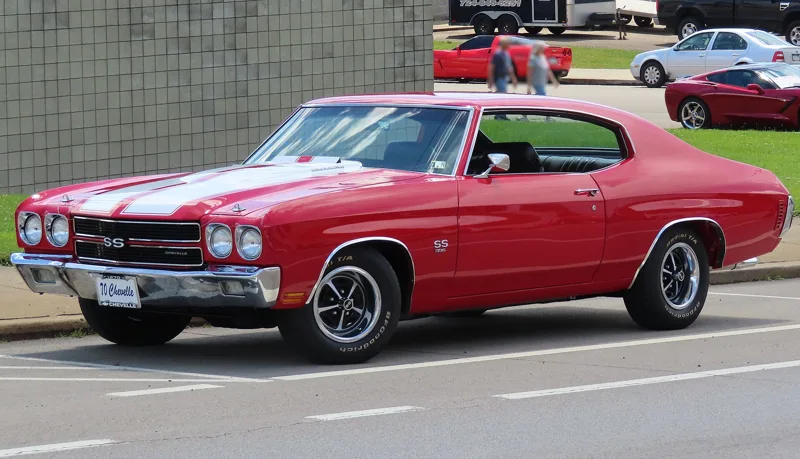
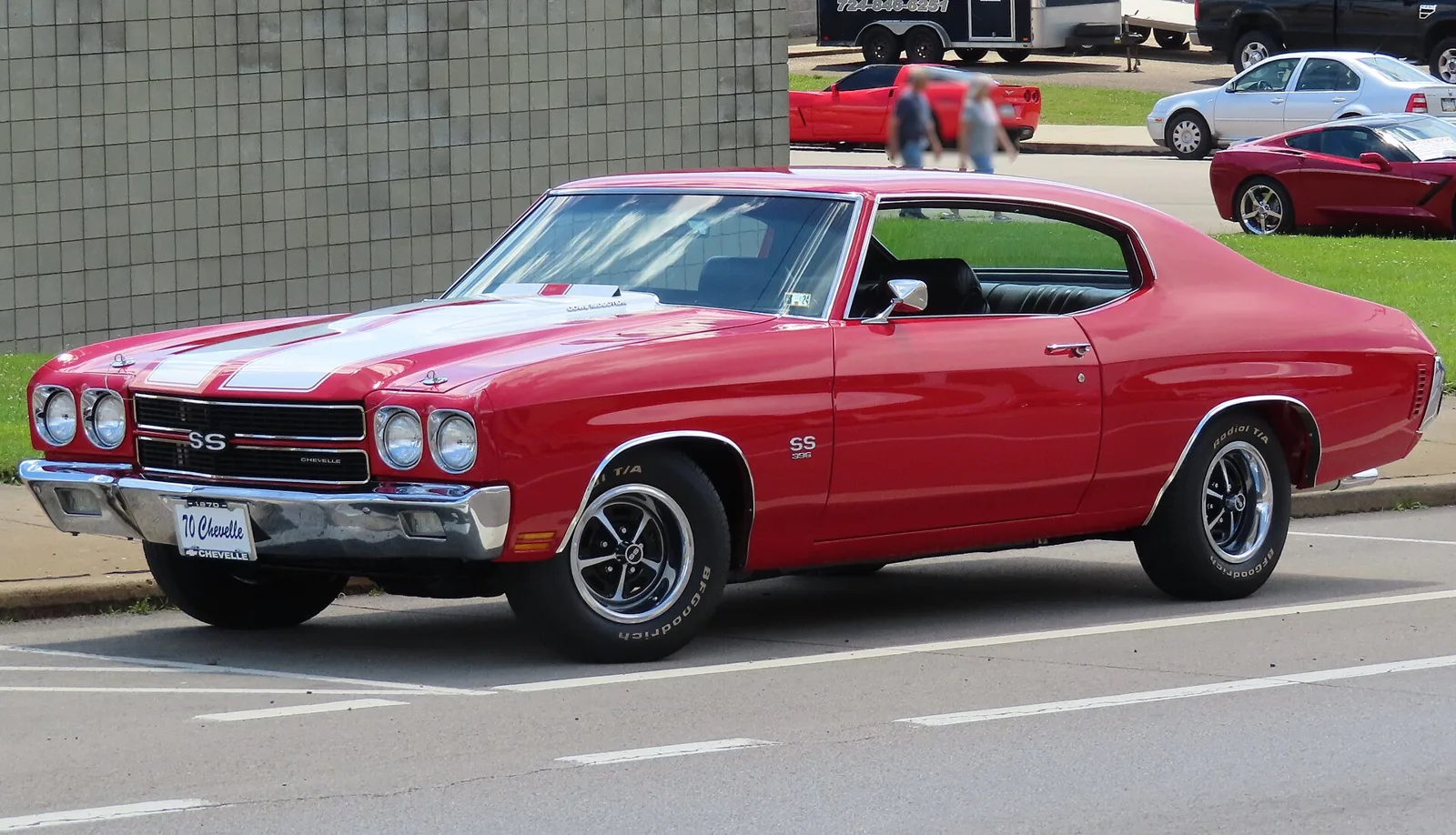
The competition produced a horsepower race that peaked in 1970, when the LS-6 Chevelle was advertised at up to 450 hp (336 kW). Pure muscle cars often sold in small numbers, but makers valued the publicity halo they gave the rest of the range. GTO sales encouraged other General Motors divisions to follow with the 1964 Oldsmobile 442, the 1964 Chevrolet Chevelle SS and the 1965 Buick Gran Sport.
As luxury and options piled on weight, engines had to grow and cars grew more expensive, so budget muscle cars appeared in response: the Plymouth GTX of 1967, then the Plymouth Road Runner and Dodge Super Bee of 1968. The Road Runner won Motor Trend's Car of the Year in 1969, and with optional performance parts it ran 14.7 seconds over the quarter mile, trapping 100.6 mph (162 km/h), for US$3,893. These were basic-trimmed intermediates meant to undercut the more expensive and stylish models from General Motors and Ford. The Barracuda could become a muscle car with Chrysler's 426 Hemi, available as an option from 1968, or with a 383 cu in (6.3 L) V8 with 300 hp (224 kW) that managed 13.33 seconds for the quarter mile with a trap speed of 106.50 mph (171 km/h). From 1969, the Chevelle offered the 427 cu in (7.0 L) L72 big-block as the COPO 427 option, and the car ran 13.3 seconds. AMC's 390 cu in (6.4 L) engine gave 315 hp (235 kW) in 1968 trim for the Rebel SST, Javelin and AMX.
The extreme end was the 1969 ZL-1 Corvette, with an aluminium 7.00-litre V8 whose official rating was 430 hp (321 kW) while reports put its output at 560 hp (418 kW), enough for a 10.89-second quarter mile.
Which are the best muscle cars?
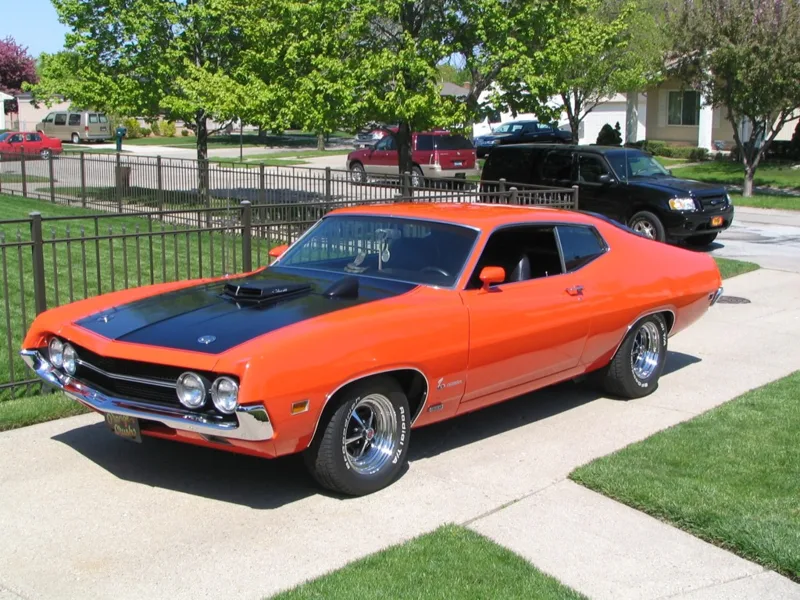
Magazines publish their own top lists, and the same cars keep turning up. The GM and Ford models that came to define the class include the Pontiac GTO (1964), the 396 Chevrolet Chevelle (1965), the 400 Buick Gran Sport (1965), the 400 Oldsmobile 442 (1965), the 427 Mercury Comet Cyclone (1964) and the 390 Mercury Cyclone (1966). At the budget end, the Road Runner and Super Bee showed that high performance could come cheap.
There is no agreed best, because the definition is subjective and endlessly debated. What the cars do show is a ladder: drag-strip specials like the Thunderbolt for those who wanted speed above all, fully equipped intermediates like the GTO for those who wanted performance and style, and cheap, bare-bones machines for those who wanted straight-line speed at under US$3,000.
Why did the muscle car era end?
Several pressures hit at once. Power outputs of performance models had been eroding since 1968 as stricter emissions controls arrived. High insurance rates and tighter restrictions on performance cars hurt demand. By 1970 buyers were moving toward smaller compacts or more luxurious personal luxury cars, and by 1972 small imported sports cars were gaining popularity while domestic pony cars sold poorly. Observers believed the Camaro and Firebird might be discontinued after 1973.
Pony car share of the total market slid from a peak of 13% in 1967 to 9% by 1969. Each new generation had grown larger, heavier and costlier: compared with the original 1965 Mustang, the 1973 car had gained 8.5 inches (216 mm) in length and 5.9 inches (150 mm) in width, and weighed over 600 lb (272 kg) more. Then the 1973 oil crisis left large, heavy cars out of step with the market. Ford was ready with the smaller Mustang II for 1974, promoted as a fuel-efficient model. Chrysler dropped the Challenger and Barracuda after 1974, and AMC cancelled the Javelin the same year.
The GTO showed the slide clearly. In 1972 and 1973 it went back to being an option package on the intermediate LeMans, and in 1974 it was a trim package on the compact Ventura. That was the last year of the original run.
Where this goes next
The story did not stop in 1974. The Pontiac Firebird Trans Am appeared in Smokey and the Bandit, and as pony cars regained popularity in the late 1970s, Chevrolet resurrected the Camaro's Z28 option for 1977. In the mid-1980s fuel injection on V8s, such as Ford's 5.0 in the 1986 Mustang and General Motors' LB9 in the 1985 Camaro IROC-Z and Firebird Trans Am, brought more power and better fuel economy.
The Firebird and Camaro were discontinued after 2002, which left the Mustang alone among American-built pony cars until Dodge brought back the Challenger for 2008. The GTO name returned for the 2004 model year as a Holden Monaro converted to left-hand drive, a coupe based on the Commodore, and stayed on sale as a captive import through 2006.
What does it mean for someone buying or driving one?
The class rewards knowing which version you are looking at: a Mustang with the base six-cylinder is a very different car from the same model with a V8 and options, and the GTO's headline 325 hp needed Tri-Power to reach 348 bhp. Factory warnings on the drag specials make plain that the most extreme cars were never meant for daily use, and the GTO's own press tests flagged slow steering and drum brakes that were no better than the standard Tempest's.